
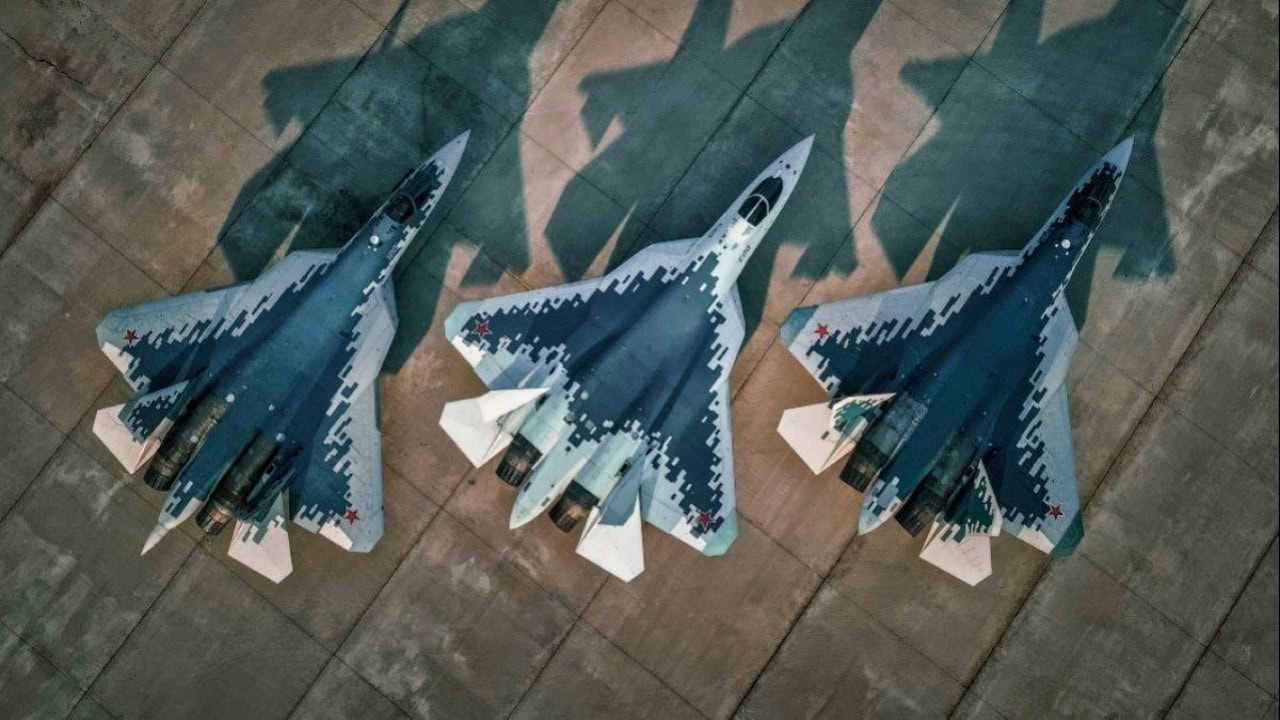
Russian Su-57 Crashes During Training Flight In Moscow Oblast: A Russian Sukhoi Su-57 stealth fighter jet reportedly crashed in the Odintsovo district near Zvenigorod, Moscow Oblast. The incident occurred during a training flight, with the pilot reportedly ejecting safely before the aircraft went down in a field.
The Su-57 (NATO reporting name Felon) is Russia’s most advanced fifth-generation multirole fighter, with an estimated cost of $100–120 million per unit. Recent reports have the aircraft operating in a counter-drone role.
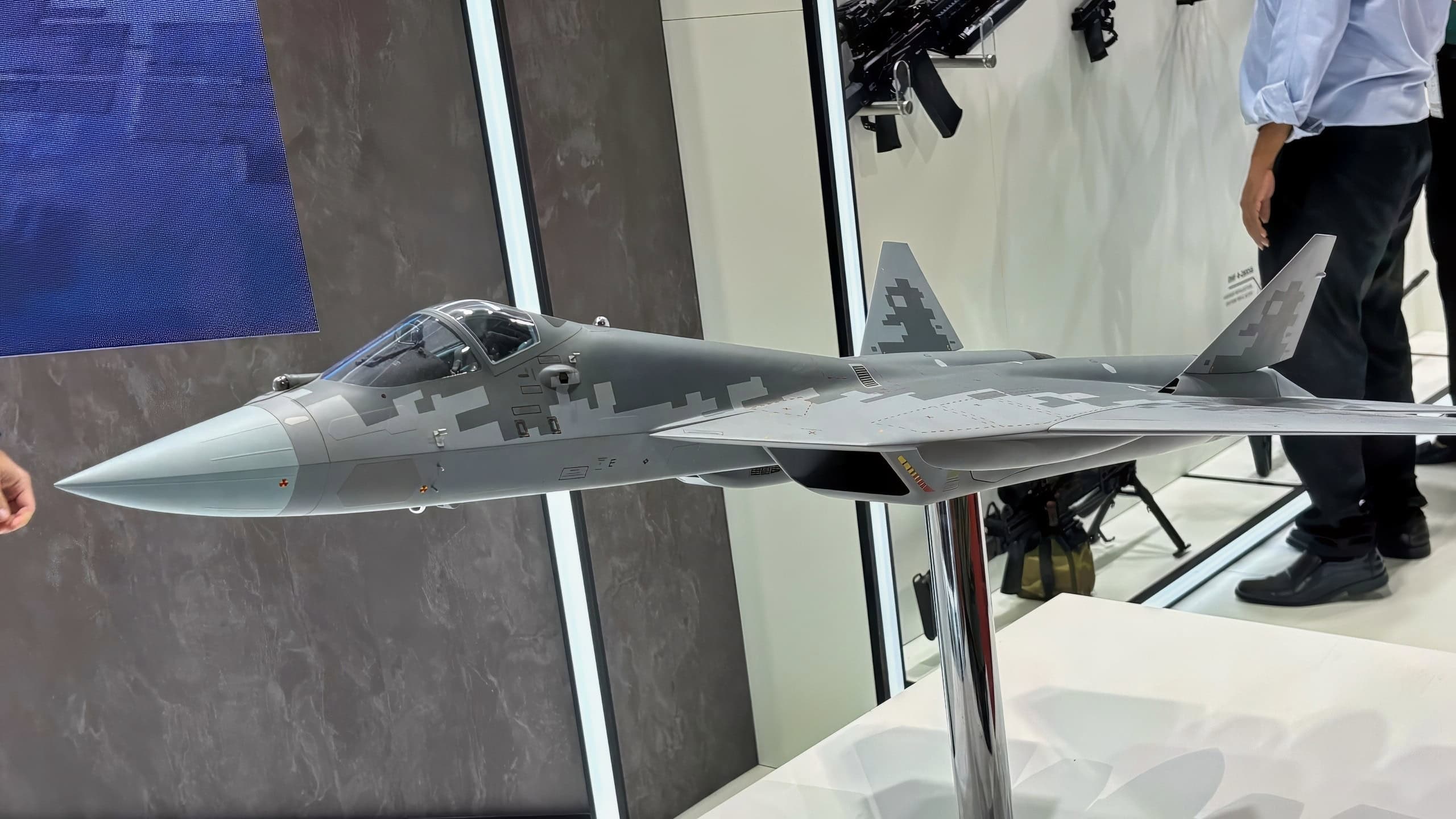
Su-57 Model 19FortyFive Original Photo
The Kyiv Post noted that there are photos online that show the aircraft carrying R-73 air-to-air missiles on external wing pylons rather than inside its internal weapons bay, a configuration that negates its stealth characteristics. If reports are accurate at this early stage, the photos only strongly suggest the rare Su-57 has been destroyed.
While the Russian Defense Ministry hasn’t provided any details, the crash appears to have been an accident. Ukraine has previously reported targeting Su-57 aircraft during deep drone strikes on Russian airbases, such as the attack on the Chelyabinsk Air Base.
Pilot Tried To Avoid Residential Area
Witnesses from the local area told Russian officials that the pilot tried to avoid residential development and steered the aircraft toward a field, after which he ejected.
This suggests the pilot was experiencing issues with the aircraft but still had some degree of control and was able to prevent the accident from becoming a catastrophe.
Eyewitnesses also told the Russian news service Astra that the aircraft exploded after the pilot ejected.
Vadim Badekha, CEO of the United Aircraft Corporation (part of Rostec), had stated that “the Su-57 is the only fifth-generation aircraft taking part in real combat operations,” referring to the war in Ukraine. (The F-35 would like a word)
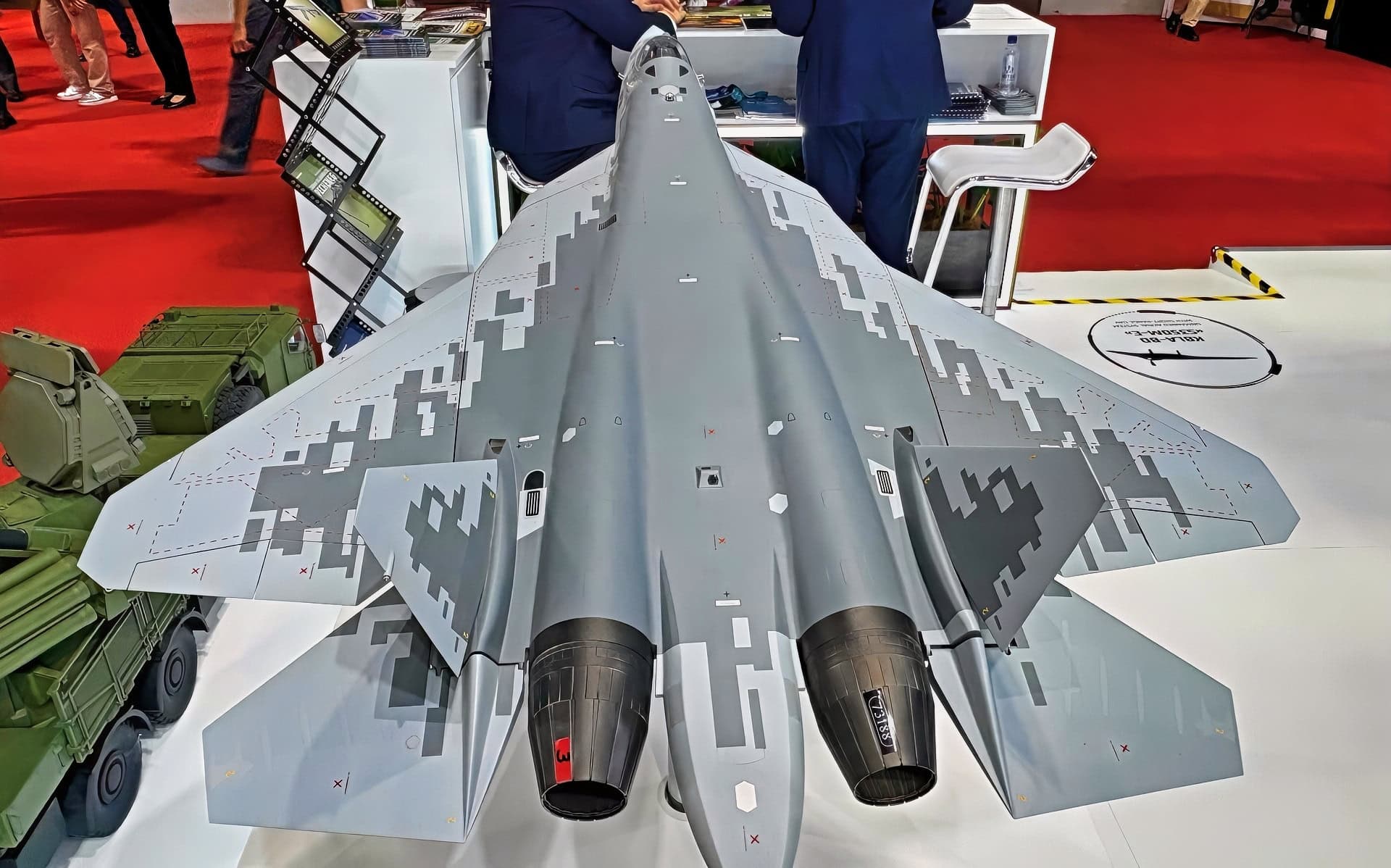
Su-57 Felon Model Aircraft. Image taken on 4/20/2026 by Reuben F. Johnson.
Rare Fighter: Su-57 Felon Is Still Operating In Small Numbers
Despite being Russia’s most advanced aircraft that made its maiden flight in 2010, production has been slowed by numerous delays.
Russia has produced only 30-35 Su-57s, with between 20 and 25 of these being active, combat-capable aircraft.
The Russian Sukhoi Su-57 is widely considered by many experts to be the worst-performing stealth fighter, particularly compared to its American and Chinese counterparts like the F-22 Raptor and J-20, due to significantly inferior stealth capabilities, limited production, and issues with technology and workmanship.
A recent compelling article by the aviationgeekclub.com explains that the Su-57 may not be a stealth aircraft at all, despite being marketed as such by the Russians.
The Felon Has the RCS 1,000 Times That Of An F-35
Dario Leone, a respected aviation analyst, cites evidence of the Felon’s enormous radar cross-section, according to Abhirup Sengupta, an aviation expert, on Quora.
“Sukhoi’s own patent describes Su-57 having a frontal RCS between 0.1 to 1 m^2 (-10 to 1 dBsm), which is comparable to that of a clean F-18E Super Hornet or Tomahawk cruise missile. Do you see anyone referring to either as Stealth,” Sengupta asked?
“Imagine if Boeing were to market F/A-18 Super Hornets or F-15 Silent Eagles with an Enclosed Weapons pod and weapon bays as a ‘Stealth aircraft’ along the lines of 5th gen. aircraft, how do you think they would compare to F-35?,” he added.
The Su-57 has a 1,000 times greater RCS than an F-35, he said, adding that the F-35 will be able to detect the Felon at six times the range of the Su-57.
Su-57 Felon’s History
The Felon is capable of aerial combat, ground attack, and maritime strikes. The Su-57 incorporates stealthy characteristics, supermaneuverability, supercruise, integrated avionics, and large payload capacity.

Su-57 and Su-75 Checkmate Russian Air Force.
Russia and India signed a contract in 2010 for Sukhoi and Hindustan Aeronautics Limited (HAL) to develop a derivative of the PAK FA jointly called the Fifth Generation Fighter Aircraft (FGFA). Each country was to pay $6 billion, and the development was expected to take 8-10 years.
However, by 2014, the partnership fell apart. The Indian Air Force started voicing concerns over performance, especially the stealth feature, cost, and workshare. India found that the aircraft did not meet its requirements and left the partnership in 2018.
Russia has been seeking buyers for a two-seat variant that could serve as an airborne command platform, coordinating both manned and unmanned aircraft.
The Su-57 is powered by two Saturn AL-41F1 afterburning turbofan engines that power the aircraft to Mach 2.45. A new engine has been in the works for a decade but has not materialized.
The armament for the aircraft includes a 30 mm autocannon under the nose, various anti-ship, anti-aircraft, and anti-armor missile configurations with eight hard points in the storage bays.
According to Air Force Technology, the Russian aircraft is also equipped with 3D thrust vector jets, enabling higher maneuverability and the capability to develop a supersonic cruising speed.
Russia Claims The Su-57 Will Soon Be A 6th-Generation Fighter
Tass, the government-controlled news service, reported that an upgraded and even more advanced model of the Su-57 could be in development, and that it would be the world’s first in-service “sixth-generation” aircraft.
Tass quoted Russian Aerospace Force ex-commander and Chairman of the Federation Council Defense and Security Committee Viktor Bondarev, who made an outlandish claim.
“This is actually a splendid plane, and it can embrace both fifth-and sixth-generation features. It has huge modernization potential. Importantly, it is the best among the existing versions of its stealth characteristics. It incorporates all the best that is available in modern aviation science both in Russia and in the world.”
Russia’s Debacle In China
Russia sent a Su-57 to China in November 2024 for the 15th China International Aviation and Aerospace Exhibition, which was a disaster from a public relations standpoint.
Chinese social media, which is very pro-China and anti-West, was quick to point out the flaws of the Russian design, despite the fact that the two countries have a publicly stated “no limits partnership.”
Russia made the mistake of sending a prototype Felon instead of a production model. Several aviation enthusiasts were quick to point out numerous design issues and other perceived flaws. That included the numerous exposed bolts and rivets on the fuselage and poorly aligned sections and tolerances.
Regardless, the crash shows the dangers of flying high-performance aircraft and is a factor for all nations’ air forces.
About the Author: Steve Balestrieri
Steve Balestrieri is a National Security Columnist. He served as a US Army Special Forces NCO and Warrant Officer. In addition to writing on defense, he covers the NFL for PatsFans.com and is a member of the Pro Football Writers of America (PFWA). His work was regularly featured in many military publications.