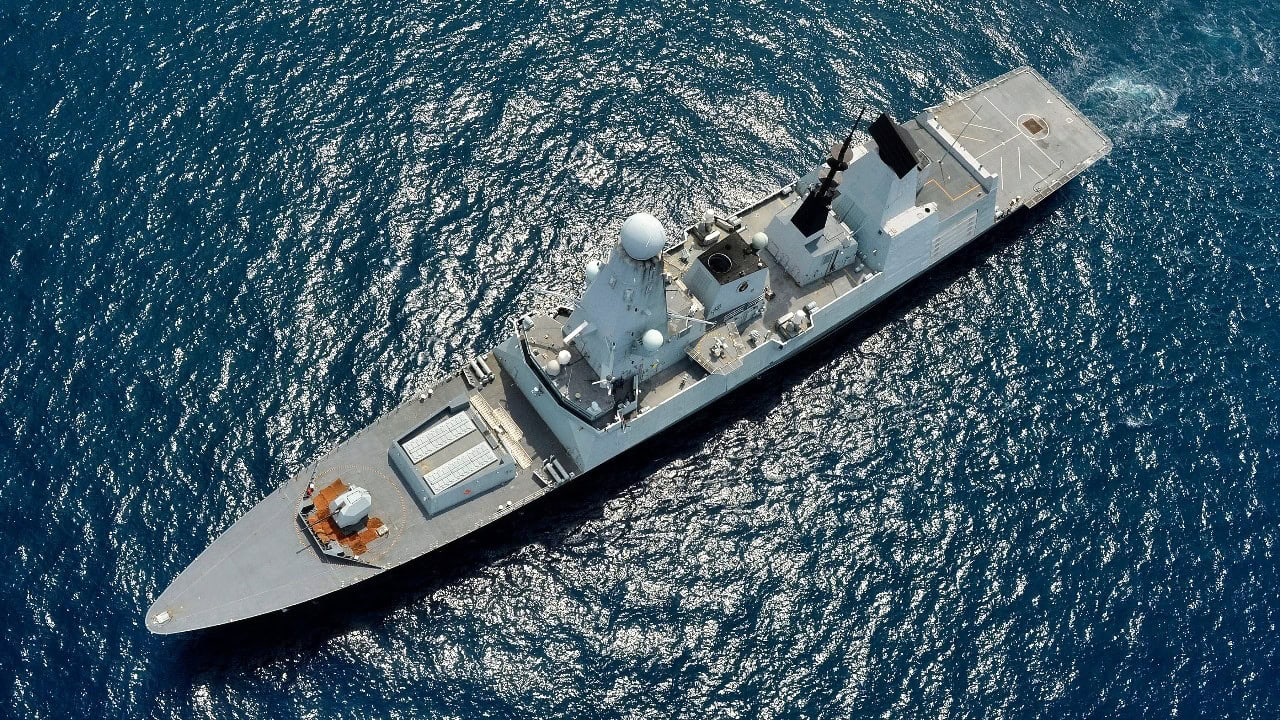
Summary and Key Points: Britain is canceling the Type 83 destroyer, the planned successor to the Royal Navy’s Type 45 air-defense fleet, and replacing it with a Hybrid Navy concept built around at least six Common Combat Vessels, crewed command ships that direct uncrewed systems above, on, and below the sea. The British government pitches the shift as a boost for UK shipyards and a more affordable path than a small class of expensive bespoke destroyers. Critics counter that the architecture is untested and that if the Type 45s retire before a proven replacement arrives, the Royal Navy could field no destroyers at all by 2040, making this the service’s biggest surface-fleet gamble in decades.
The Royal Navy’s New Problem
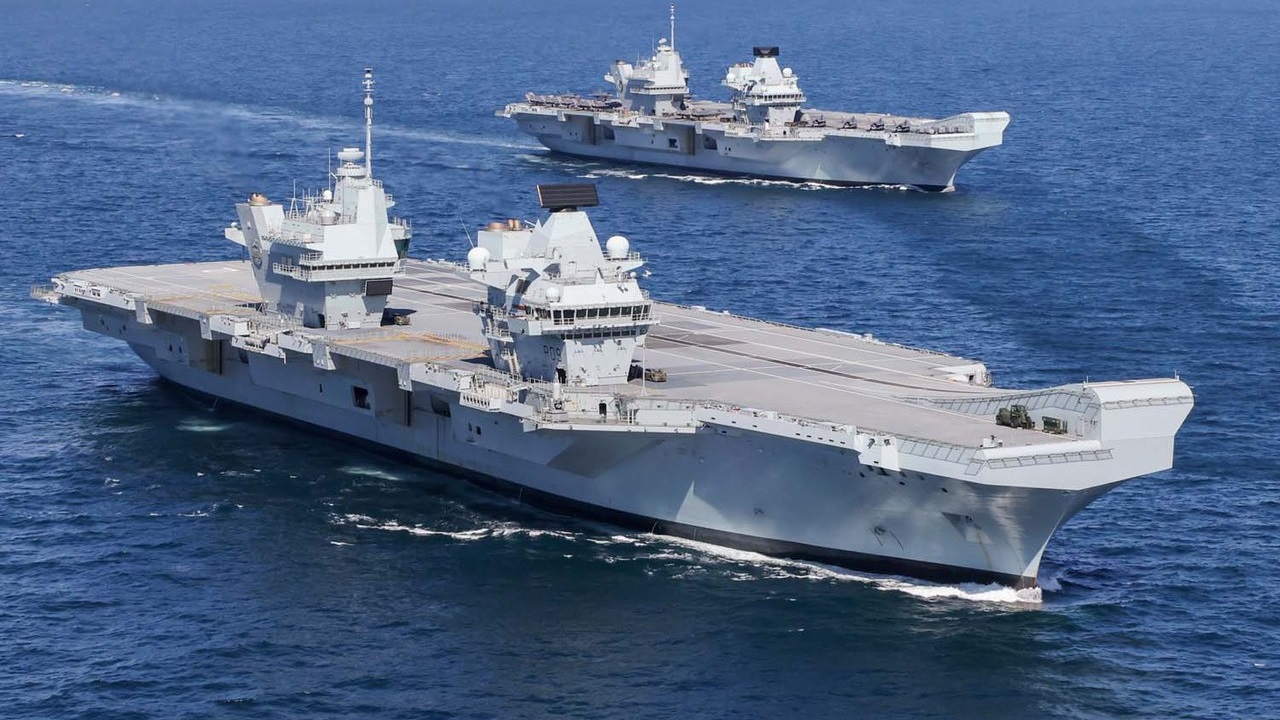
HMS Prince of Wales and HMS Queen Elizabeth pictured at sea for the first time…Wednesday 19 May 2021 saw a historic moment in Britain’s carrier renaissance as HMS Queen Elizabeth and HMS Prince of Wales met at sea for the first time. With two 65,000 tonne carriers in operational service, Britain has a continuous carrier strike capability, with one vessel always ready to respond to global events at short notice. Image: Creative Commons.
Britain is making a huge gamble. London is abandoning their planned Type 83 destroyer as a traditional successor to the Type 45 and replacing it with a “Hybrid Navy” built around at least six Common Combat Vessels that control sea drones above, on, and below the sea. The British government says these ships will replace the Type 45 destroyers as part of a broader distributed air-defense system.
Why Britain Is Making the Shift: The Type 83 Challenge
The theory behind this move by London is that modern naval warfare has changed.
Instead of building a few exquisite, massively expensive destroyers, Britain wants to construct cheaper, crewed command ships linked to missile barges, sensor drones, underwater systems, and autonomous platforms. Navy Lookout, a popular online trade publication, frames this as the Royal Navy’s biggest surface-fleet shift in decades: a move away from classic large air-defense destroyers toward an integrated crewed/uncrewed combat system.
The British are canceling the Type 83 destroyer and exploring unconventional solutions to maintain their capabilities. Already, the Royal Navy has struggled to maintain its combat capacity. Dwindling numbers of warships and submarines, declining output from naval shipyards, and reductions in naval recruitment are causing major problems for the Royal Navy.
London must maintain some semblance of a naval capability.
They are struggling to maintain that capability using conventional methods. A shift toward autonomous or partially autonomous naval forces might be what’s needed to address the seemingly inexorable decline in the Royal Navy’s capabilities and numbers.
The Lessons of Modern Warfare
Plus, the Ukraine War and, to a lesser extent, the on-again-off-again Mideast war have shown the world the centrality of unmanned systems for modern warfare. One of the lessons from these recent conflicts is that conventional warfighting platforms, such as destroyers, are no longer always the best suited to fighting in a modern conflict where drones and advanced anti-ship ballistic missile (ASBM) swarms dominate.
The Royal Navy might be deftly turning a real failure of their naval capabilities into a potential success. If that proves true, Britain may lose many of its conventional manned systems in favor of unmanned systems. It’s a gamble. Given the changing face of modern war, though, it might give Britain an advantage over its peers.
Why the Type 45 Destroyer Matters
Britain’s Type 45 destroyers are getting old. Britain built the Type 83 as its replacement.
The Type 45 destroyer provides high-end air defense for carriers, task groups, and national missions. A drone-linked “system of systems” approach might eventually work. That system depends on networks, autonomy, sensors, datalinks, survivability, and command integration all functioning properly under wartime conditions.
The Times notes that critics of this plan are especially worried about losing traditional air-defense destroyer capability and relying on untested architecture. And that is a real fear.
In that way, the critics are justified in being worried. After all, using maritime drones as a replacement for the Type 83 is not a proven destroyer. These systems may never work as advertised. Even if they do work, they might not work as well as traditional destroyers.
Britain’s Shipbuilding Reality
Now that the British are moving away from the Type 83, given their sclerotic naval shipyard capacity, it could very well mean that by 2040, the Royal Navy could field no destroyers if the Type 45 retires and no traditional Type 83s enter service. That is technically plausible if the proposed Common Combat Vessel doesn’t get classified as a destroyer.
At the same time, readers must understand just how utterly hopeless Britain’s naval shipyards have become. The idea that these yards could produce any Type 83 at the scale Britain needs for such an unstable geopolitical moment is ridiculous. The Type 83 will soak up limited funds, and only a few–over the course of decades–will ever be produced. At the same time, British defense firms can produce drones in far greater volumes and at lower cost. And they’re easier to mass-produce than conventional destroyers.
Britain’s High-Stakes Naval Gamble
Drone warships and common vessels could sustain British shipbuilding by creating exportable designs and avoiding the crippling cost spiral of bespoke major warships. The British government explicitly pitches the CCV concept as a boost for UK shipyards and industry.
With their proposed CCV concept, London is admitting that it can no longer afford the old model of naval power. The Hybrid Navy concept could be visionary. It could also be technological wishcasting brought on by painful industrial and financial realities. Either way, the Royal Navy is betting that drones and distributed systems can replace conventional (and costly), exquisite platforms before Britain’s remaining surface fleet ages out.
About the Author: Brandon J. Weichert
Brandon J. Weichert is the Senior National Security Editor at 19FortyFive.com. He also manages The Weichert Brief on Substack. Weichert also hosts “National Security Talk” on Rumble. He is the author of four bestselling national security books, the most recent of which is A Disaster of Our Own Making: How the West Lost Ukraine (Encounter Books). Follow him via Twitter/X @WeTheBrandon.