
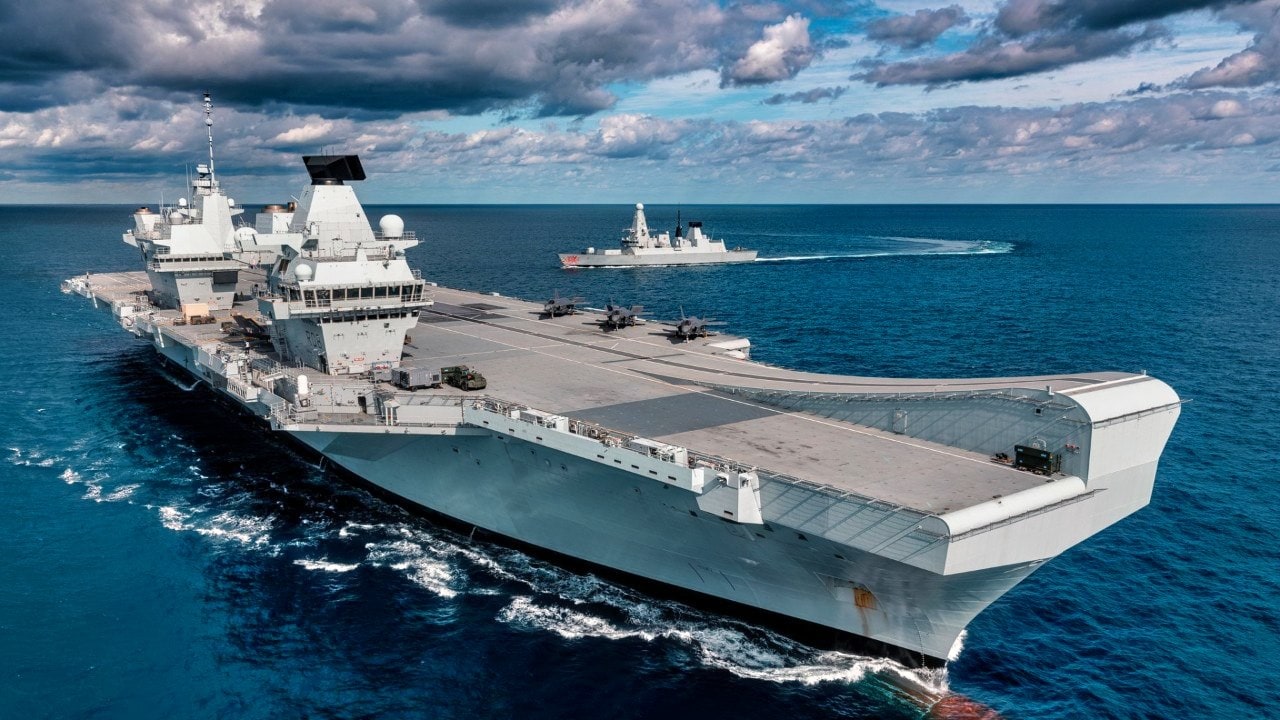
Summary and Key Points: Britain’s shipbuilding industry — BAE Systems, Babcock, Thales, and a network of yards from the Clyde to Devon — spent the better part of a decade tied to a single question of industrial survival, not naval strategy. A fifteen-year contract signed with BAE in 2009 to keep British warship-building alive had become so binding that when the government went looking for savings in 2010, its own accountants concluded that canceling the work would cost more than finishing it. This is the story of how a contract, not a strategy, built the largest warships in Royal Navy history. This is the Queen Elizabeth-class aircraft carrier saga.
The Queen Elizabeth-class Aircraft Carrier Story
In 2010, a new British government went hunting for savings and turned to the two aircraft carriers it had inherited, the most expensive warships the country had ever ordered. When the accountants finished, they concluded that canceling the ships would cost more than building them. Britain finished the largest warships in Royal Navy history not because the strategy demanded it, but because the contracts made stopping the more expensive option.
When David Cameron stood in the House of Commons on 19 October 2010 to present his government’s defense review, he had already looked hard at killing at least one of the two aircraft carriers then taking shape in yards around Britain. He did not kill them. Explaining why, he told Parliament that the country had been left in a position where “even canceling the second carrier would actually cost more than building it.” The arithmetic, not the strategy, had made the decision.
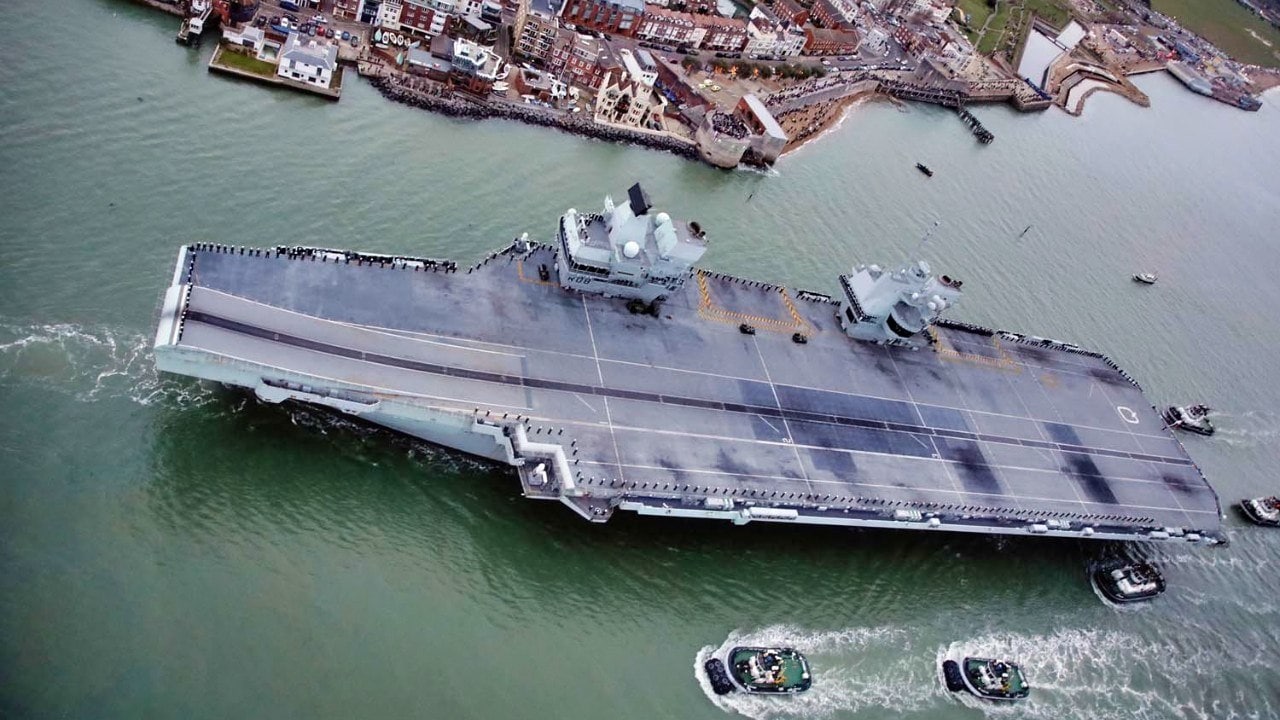
HMS Queen Elizabeth Aircraft Carrier. Image Credit: Royal Navy.
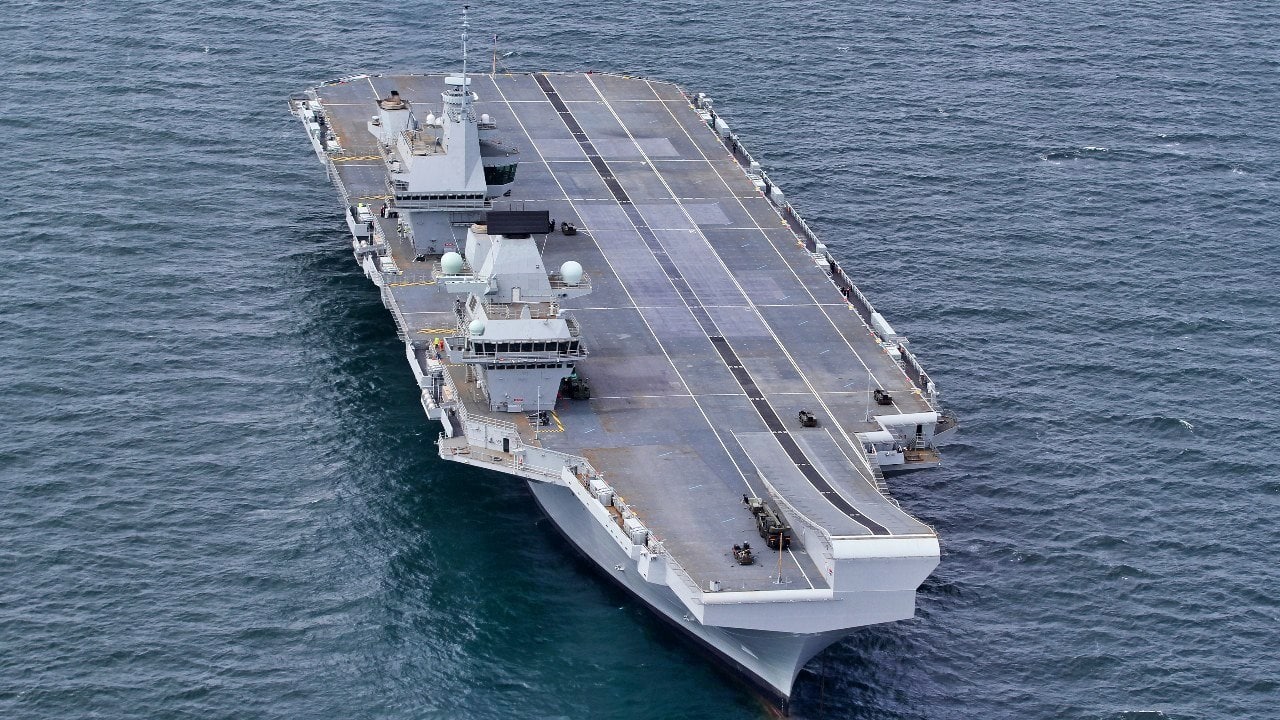
Queen Elizabeth-Class Aircraft Carrier Royal Navy. Image Credit: Creative Commons.
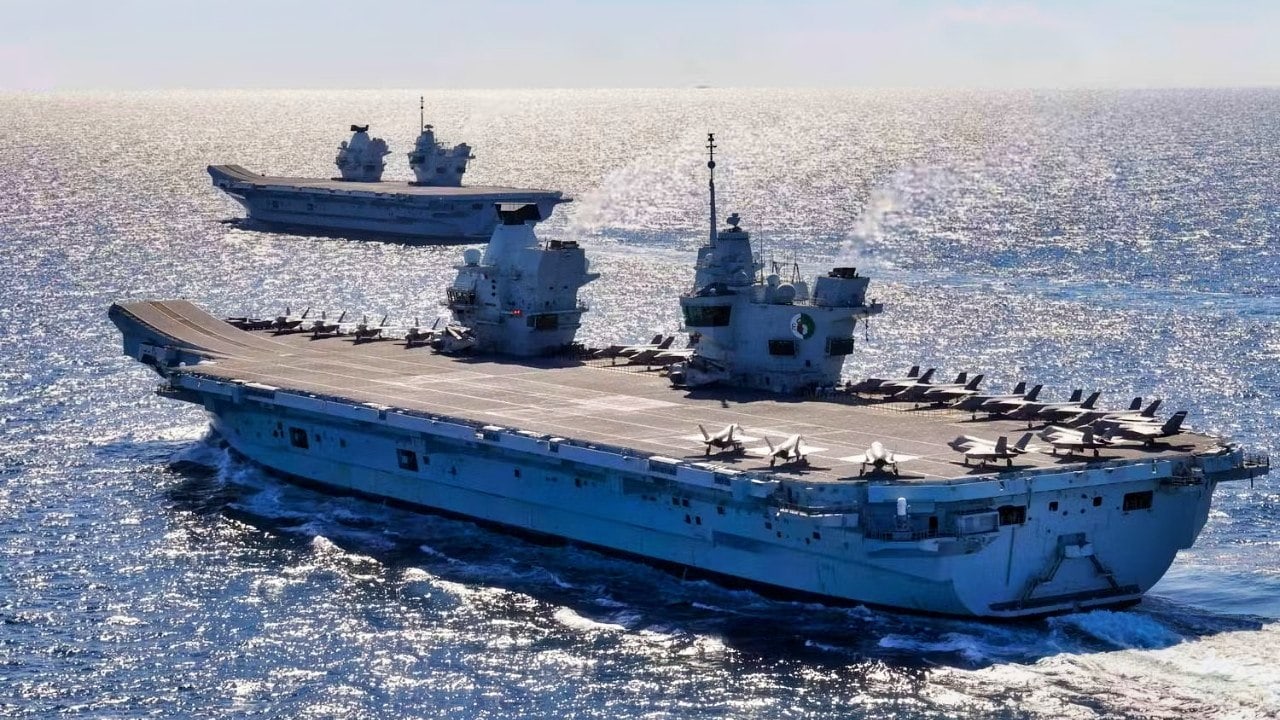
Queen Elizabeth-Class. Image Credit: Royal Navy.
That claim became the defining line of the whole program, and it was not quite the whole truth. When the National Audit Office examined the numbers the following year, its auditors complicated the picture: once the loss of VAT exemptions and other effects were counted, canceling one carrier would still have saved around £200 million, and canceling both would have saved about £1.2 billion, though the short-term penalty of walking away would have run close to an extra £1 billion first. The machinery behind Cameron’s claim was a fifteen-year Terms of Business Agreement that the previous government had signed with BAE Systems in 2009, guaranteeing the company’s work to keep British warship-building alive.
That contract, more than any strategic judgment, is why two 65,000-tonne ships exist today.
How Do You Build an Aircraft Carrier With No Dock Big Enough?
Britain no longer had a single shipyard large enough to build a ship this size, so it built the carriers everywhere at once.
The work was carried out through the Aircraft Carrier Alliance, an unusual arrangement in which BAE Systems, Babcock, and Thales constructed the ships alongside the Ministry of Defense itself, which sat within the alliance as both customer and partner. The hulls were divided into giant blocks and parcelled out to six shipyards the length of the country: BAE on the Clyde at Govan and Scotstoun and at Portsmouth, Babcock at Appledore in Devon and at Rosyth, A&P Tyne at Hebburn, and Cammell Laird on Merseyside, which built the flight decks.
Rosyth, on the Firth of Forth, was chosen for final assembly because its dock was the only one in Britain big enough to take the finished ships. The blocks, some weighing more than 11,000 tonnes, were floated onto sea-going barges and shipped around the coast to Fife, where they were welded together like a vast three-dimensional jigsaw. In August 2011, the 8,000-tonne Lower Block 03 left Govan and traveled 600 miles around the north of Scotland to reach Rosyth.
Lifting the pieces into place required a crane bigger than anything Britain owned, so one was bought abroad. Goliath, a 1,000-tonne gantry crane, was built in Shanghai by Zhenhua Heavy Industries, shipped partly assembled to Rosyth, and installed as part of an £80 million upgrade to the yard. The crane itself cost £12.2 million, and the government planned to sell it afterward to prevent Rosyth from gaining an unfair advantage over other British yards. The largest warships ever built for the Royal Navy were assembled under a crane made in China.
The Money: From £3.9 Billion to More Than £6 Billion
The price followed the familiar path of large defense projects. The program was approved in 2007 at roughly £3.9 billion for the pair and finished above £6 billion, an increase driven by design changes, the long argument over whether to build the second ship at all, and above all by a decision taken early in the build for reasons that had nothing to do with shipbuilding.
In December 2008, with the financial crisis breaking, the government chose to slow construction to push spending into later years and ease the immediate pressure on the budget. Stretching the schedule did not save money; it added about £1.5 billion to the eventual bill, by the National Audit Office’s reckoning, a textbook example of how deferring cost tends to increase it.
By the time the contract was formally re-baselined, the Committee of Public Accounts recorded that ministers and the Treasury had approved a build cost of £6.212 billion for the two ships. The department then held the line against further growth, working with the alliance to apply the lessons of the first hull to the second.
The Catapult U-Turn That Cost About £100 Million
The most expensive change of mind came over how aircraft would get off the deck. The 2010 review had directed that one carrier be converted to a catapult-and-arrestor configuration so it could fly the longer-ranged F-35C rather than the vertical-landing F-35B. On paper, it looked sensible. In practice, an 18-month study found the cost of the conversion climbing from around £886 million per ship in late 2010 to £2 billion and rising by early 2012, and the work would have added roughly three more years to the build, leaving Britain without a usable carrier until well into the 2020s.
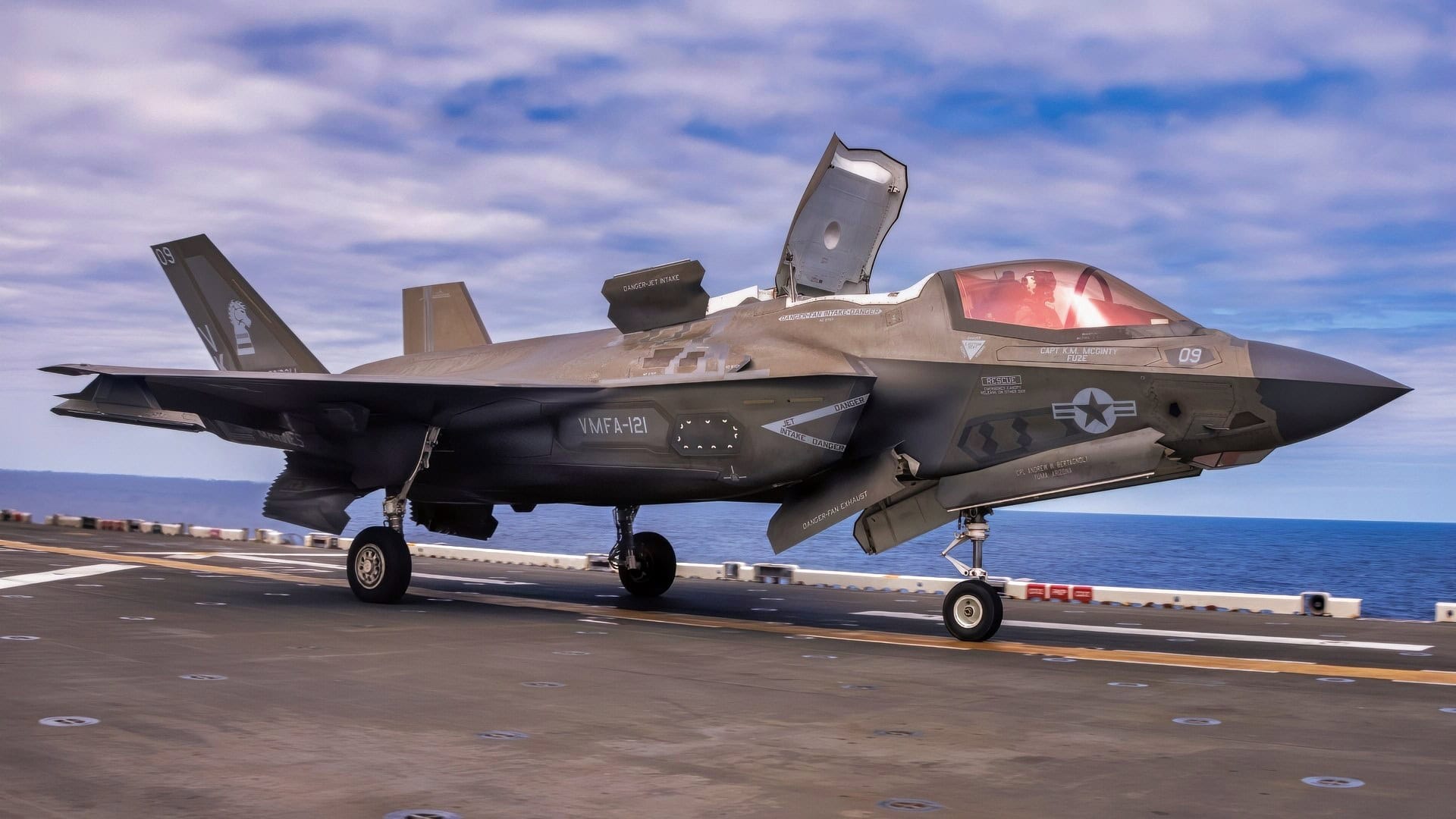
A U.S. Marine Corps F-35B Lightning II assigned to Marine Fighter Attack Squadron (VMFA) 121, 31st Marine Expeditionary Unit, takes off during a joint service flyover in the Philippine Sea, Feb. 26, 2026. Aircraft participated in a coordinated event to demonstrate joint service readiness and maritime capabilities. The 31st MEU is a persistent, combat credible force operating aboard the ships of the Tripoli Amphibious Ready Group in the U.S. 7th fleet area of operations, routinely interacting and operating with our allies and partners to contribute to deterrence, security, crisis response, and combat operations in the Indo-Pacific region. (U.S. Marine Corps photo by Lance Cpl. Victor Gurrola)
In May 2012, the Defense Secretary, Philip Hammond, reversed the decision and reverted both ships to the original ski-jump design and the F-35B. He later told Parliament that the abortive conversion study and the reversal had together cost something in the order of £100 million, money spent studying a change that was never made. It was the clearest single illustration of a program in which indecision carried its own price tag.
Queen Elizabeth-Class: What Britain Was Really Buying
The carriers were only ever partly about the two ships. At its peak, the program employed around 10,000 people and drew on hundreds of firms across the supply chain, and much of the political weight behind it came from that industrial base rather than from any assessment of naval need. The money spent sustained skilled manufacturing jobs across the country and kept sovereign shipbuilding capability alive, which was the explicit purpose of the 2009 contract that later trapped Cameron.
The honest part of the story is what happened as the work ran out. As carrier construction wound down, BAE consolidated warship-building on the Clyde and ended shipbuilding at Portsmouth in 2014, resulting in the loss of about 940 jobs and closing centuries of naval construction in a city that had built warships since the age of sail. Appledore in Devon, which had built the carriers’ bow sections, closed in 2019 once its work was done and no follow-on orders appeared. It was later bought and reopened by Harland & Wolff, and after that firm collapsed into administration in 2024, the yard passed to Spain’s state shipbuilder Navantia in January 2025. First steel for a new Royal Fleet Auxiliary support ship was cut at Appledore late last year, though most of that vessel will be built in Cádiz. A British yard that helped build Britain’s biggest warships now cuts steel, under Spanish ownership, for a ship largely assembled in Spain. This feast-and-famine cycle, a surge of work followed by closures once it ends, is exactly the problem the government’s National Shipbuilding Strategy was created to solve.
The Same Questions Now Facing Type 26, Type 31, and AUKUS
The two ships are now in service. The military role can be stated in a sentence and then set aside: each displaces about 65,000 tonnes and is designed to operate the F-35B, and both have had well-publicized propeller-shaft troubles since. As of mid-2026, HMS Queen Elizabeth has just completed a long docking period at Rosyth, the assembly yard now converted into the yard that keeps the carriers running under a long-term Babcock maintenance contract, while HMS Prince of Wales has returned from an eight-month deployment to the Indo-Pacific. The dockyard that built them has become the dockyard that sustains them, which is one answer to the feast-and-famine problem.
The larger questions the carrier program raised have not gone away; they have simply moved to the next generation of warships. BAE is building the Type 26 frigates on the Clyde, and in 2025, Norway selected the design in a deal that RUSI put at around £10 billion, pointing toward a combined Anglo-Norwegian fleet of thirteen anti-submarine ships. To meet Norway’s timetable, build slots allocated to the Royal Navy are being handed to Oslo, with the make-up orders for Britain’s own eight ships not yet placed. At Rosyth, Babcock is building five Type 31 frigates under a fixed-price contract, an arrangement that has already resulted in a reported £90 million loss and a formal warning that the program needs to be rescoped. And at Barrow-in-Furness, the workforce building Britain’s next nuclear submarines under the AUKUS agreement is projected to reach 16,500 by 2027, a concentration of skilled labor that will have to be fed orders for decades or risk being lost.
The Queen Elizabeth-Class Saga Continues
Every one of those programs turns on the same tension that the Queen Elizabeth-class carriers exposed. A country that wants to build complex warships must keep yards, cranes, and skilled workers busy between projects, or watch them close and pay to rebuild them later. Britain canceled its largest warships because a contract designed to preserve that capability made cancellation too expensive. The open question, fifteen years on, is whether the industrial base those ships were partly built to preserve can be kept working through the programs that follow, or whether the country is once again building up a workforce it will not be able to sustain.
About the Author: Harry J. Kazianis
Harry J. Kazianis (@Grecianformula) was the former Senior Director of National Security Affairs at the Center for the National Interest (CFTNI), a foreign policy think tank founded by Richard Nixon based in Washington, DC. Harry has over a decade of experience in think tanks and national security publishing. His ideas have been published in the NY Times, The Washington Post, The Wall Street Journal, CNN, and many other outlets worldwide. He has held positions at CSIS, the Heritage Foundation, the University of Nottingham, and several other institutions focused on national security research and analysis. He is the former Executive Editor of The National Interest and the Diplomat. He holds a Master’s degree focusing on international affairs from Harvard University.

