
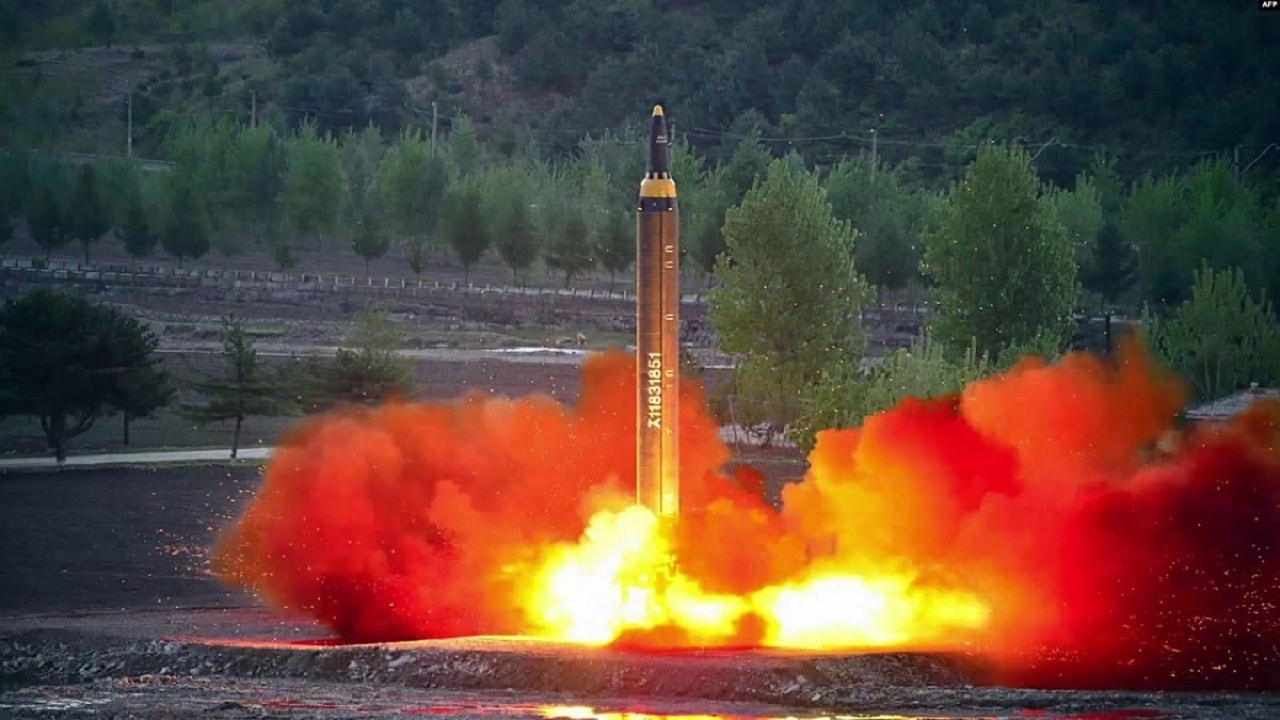
Ukraine Gave North Korea Something Its Test Ranges Never Could: Combat Data – North Korea can test a missile over the Sea of Japan and film the splash. It cannot test that missile against a modern air-defense network, night after night, with someone shooting back. The war in Ukraine gave it that laboratory. And that means in the months and years to come, North Korea has all the tools to develop a modern missile arsenal; otherwise, it would never have had the chance to build.
North Korea’s Ukraine War Missile ‘Tests’

North Korea Hwasong-17 ICBM. Image Credit: Creative Commons.
Russia has been firing North Korean short-range ballistic missiles at Ukrainian cities and military sites since late 2023. The first batches were crude. Later batches were not. The difference is the part Seoul and U.S. forces in Asia have to live with now.
On August 5, Reuters reported that a North Korean missile unit of about 90 people had begun deploying to Russia’s Voronezh region, with plans for as many as 120 ballistic missiles and six launchers. Andrii Cherniak of Ukrainian military intelligence said Pyongyang had already sent another 40 KN-23 and KN-24 missiles, and that Russia had used 150 of those types between late 2023 and August 2025.
The same weapons, Ukrainian officials told Reuters in February 2025, had gone from missing by one to three kilometers to landing about 50 to 100 meters from their presumed targets. Reuters could not independently verify that assessment. Forensic teams did not find an obvious new design in the wreckage. Something still changed.
A careful August 2026 study by 38 North is the best public attempt to say what that something was. Early KN-23s also failed in flight. Ukraine’s prosecutor said that about half of the missiles launched from Russia between December 2023 and late February 2024 exploded in the air or went off course.
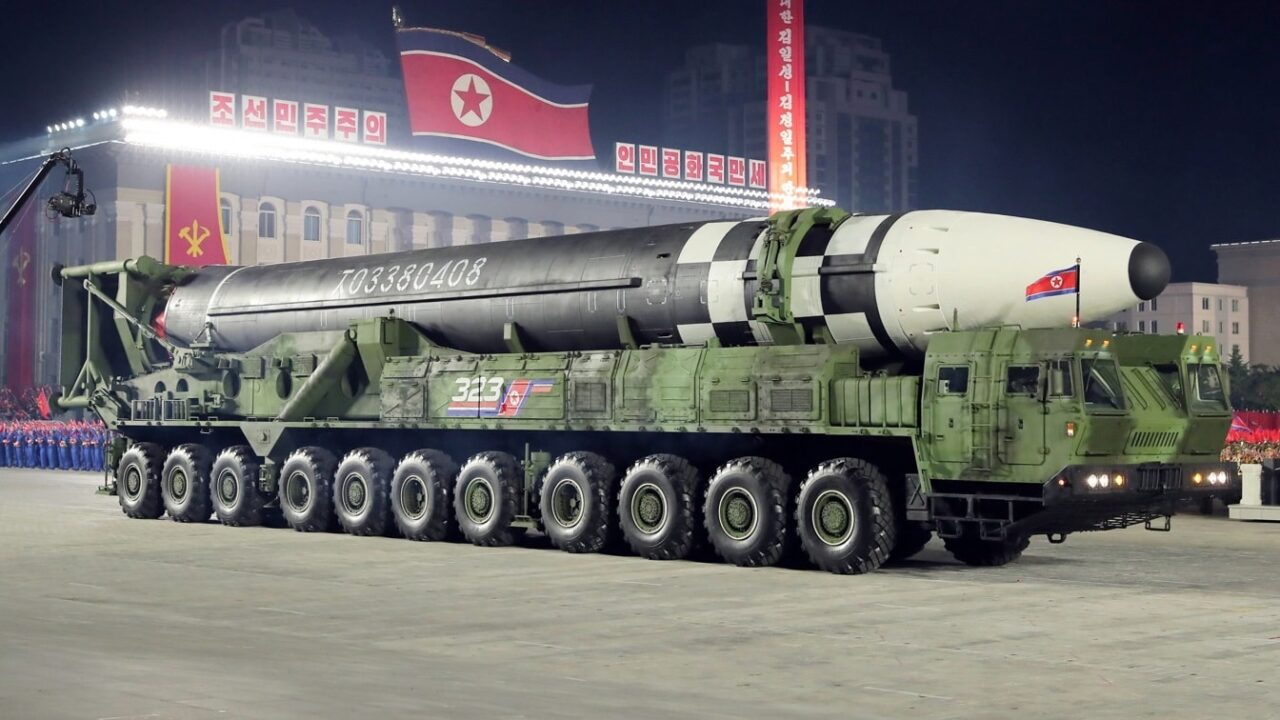
North Korean Hwasong-16 ICBM. Image Credit: KCNA/North Korean State Media.
Those complaints largely stopped. Ukrainian officials later said Russian specialists had made technical modifications, and that Russian and North Korean crews had worked on the problem together. 38 North’s judgment is narrower than the most dramatic headlines: the likely fix is not a Hollywood seeker that hits a doorway.
It helps beat electronic jamming so the missile can use satellite navigation again. A French study cited there put satellite-aided accuracy in the 35-to-90-meter band.
That is still a different weapon from a missile that misses by a mile.
Do not confuse that with unsourced claims that the KN-23 now lands inside a few meters, or that Russia ran a full telemetry lab on every combat shot.
Combat missiles are not test articles. They are not stuffed with the extra instruments a range shot carries. What Ukraine did give North Korea is still rare: hundreds of live launches, wreckage to study, a look at how Patriot and other Western defenses behave, and Russian engineers sitting on the problem.
National Security Journal has already tracked the new unit and the July strikes. The point for Asia is simpler. Those lessons do not stay in Voronezh.
North Korea’s Missiles: What Went to Russia, and What Came Back
The KN-23 is known in North Korea as the Hwasong-11A. The KN-24 is the Hwasong-11B. Both are solid-fuel, road-mobile, short-range ballistic missiles, shown in 2019. They look like Russia’s Iskander. Ukrainian forensic work, summarized by Radio Free Europe/Radio Liberty, says they are not straight copies.
The KN-23 is longer, carries a warhead on the order of 500 kilograms, and is generally credited with a range around 600 kilometers. Fins let it swerve in flight, which is a headache for interceptors. It can fly a depressed path — lower and flatter than a classic high arc — so radar sees it later. This site has already walked through how those missiles got deadlier once they were in Russian hands. The new fact in August is not the first shipment. It is a North Korean unit going with them.
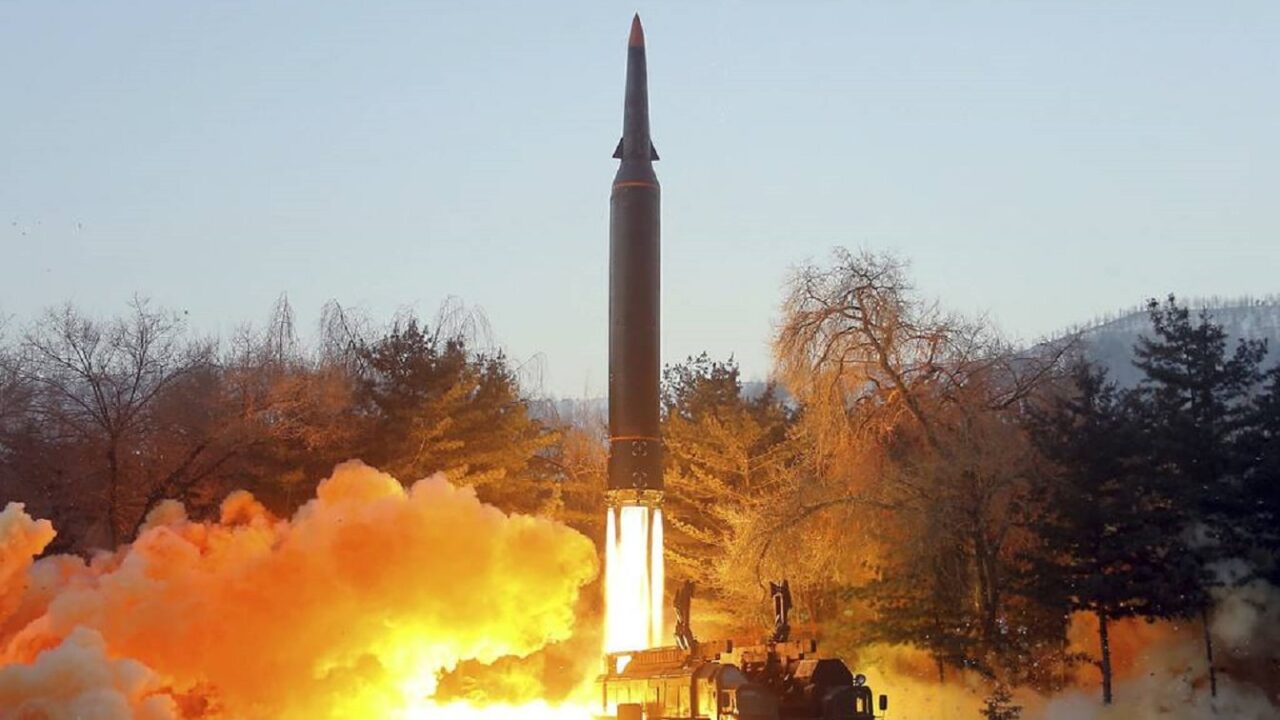
North Korean Missile Launch. Image Credit: Creative Commons.
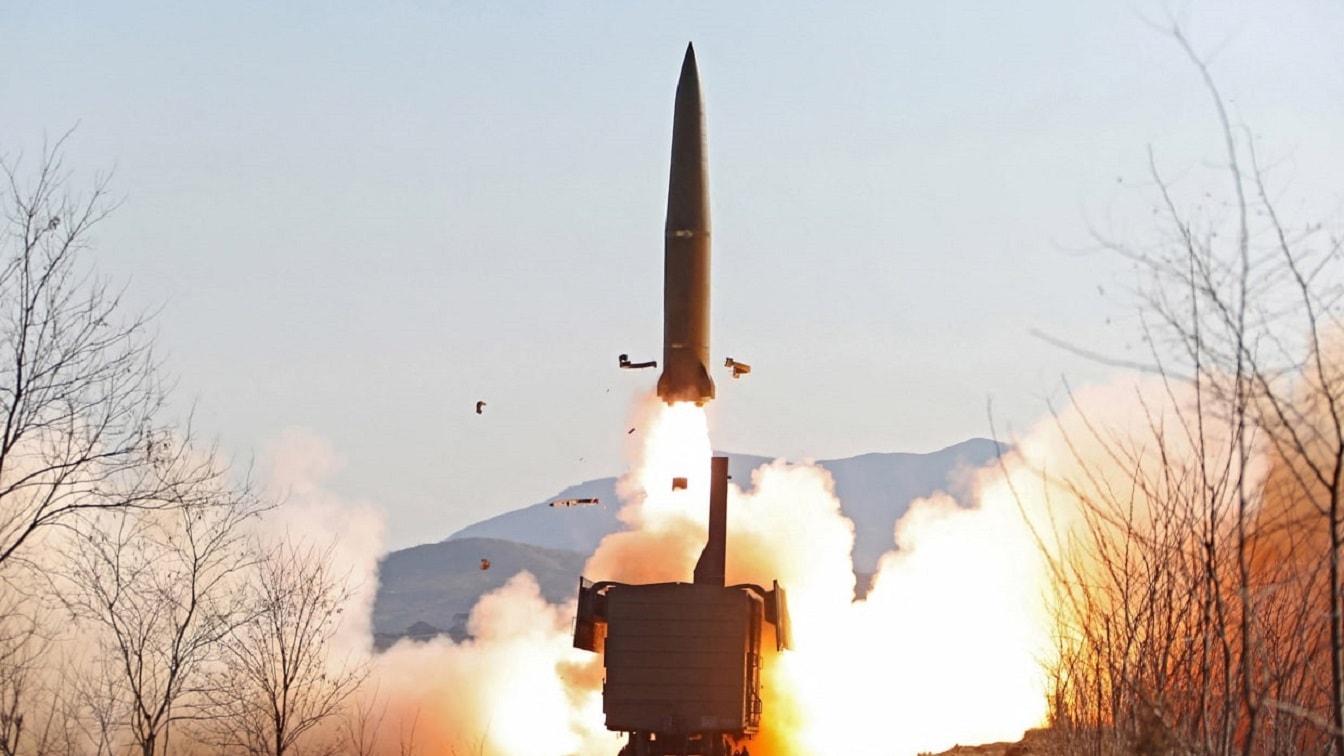
North Korean missile test. Image Credit: KCNA.
A short-range missile that can reach 600 kilometers from North Korean soil already covers Seoul, Osan Air Base, Camp Humphreys, and most of the American and South Korean airfields that would have to fight the opening hours of a war. Accuracy is what turns that map from a terror problem into a targeting problem. A miss of two kilometers in a dense city is still a massacre. A miss of 50 to 100 meters against a hardened hangar, a Patriot battery, or a fuel farm is a military result. Ukrainian sources told Reuters the early KN-23s were linked to high civilian death tolls precisely because they were inaccurate. Tighter accuracy does not make them kinder. It makes them useful against the things U.S. Forces Korea actually needs.
What Russia has handed back besides the guidance fix is harder to prove.
The two countries signed a comprehensive partnership in 2024. North Korean troops — estimates of the first wave run around 12,000 to 15,000 — have fought and died in the Kursk fighting. Cash, fuel, and spare parts have moved. Help with satellites and air defense is widely assumed and only partly documented. 38 North has noted that Moscow is more comfortable assisting a “civilian” space program than a nuclear one. The Diplomat has argued Russia may share satellite intelligence rather than give Pyongyang a whole constellation.
Production matters as much as the seeker. North Korea has shown it can build these missiles in volume. Russia has shown it will keep asking for more. A factory that has to replace 150 exported rounds, then another 40, then a 120-missile unit is learning to build at wartime speed. That is a lesson sanctions were supposed to prevent.
Why South Korea and U.S. Forces Should Care
U.S. and South Korean planners have spent years buying defenses against exactly this class of shot: Patriot batteries, the Terminal High Altitude Area Defense system in Seongju, Aegis ships, and a growing South Korean missile shield.
Those systems work. They are also finite. Ukraine has spent expensive interceptors on cheap and medium missiles until the magazine became the story. A North Korea that can fire more accurate KN-23s, in larger numbers, on depressed paths, forces the same math onto a smaller peninsula. The first hours of a Korean war are already a race to keep airfields open. Better short-range missiles shrink the time that can be lost in a race.
The troops who went to Russia matter here too. Combined Forces Command spokesman Col. Ryan Donald told reporters this month that North Korea had taken the lessons from that war and brought them home. Al Jazeera carried the line as U.S. and South Korean forces opened Ulchi Freedom Shield, the annual drill running August 17 to 27. Those exercises now include drones, GPS jamming, and cyberattacks — the same menu Ukraine has lived with. This site has already argued that Korea is no longer a standalone theater, the place where a European war and an Asian one can collide. A missile that was tuned against Ukrainian Patriots is a missile that will be aimed at the same family of radars around Seoul.
The larger arsenal is moving at the same time. North Korea has solid-fuel intercontinental ballistic missiles, including the Hwasong-18, that can be rolled out and fired faster than the old liquid monsters. It is building toward a bigger nuclear stockpile; the arithmetic of that build, and why Kim wants hundreds of warheads rather than a handful, is a separate force-sizing problem. The Ukraine pipeline does not have to put a new seeker on an ICBM to change the peninsula. If the short-range force that would open a war is more accurate, more reliable, and more numerous, the ICBM only has to stay in the background as the reason Washington thinks twice. North Korea has sold missile DNA before.
What the Next Tests Will Show
North Korea fired ballistic missiles from the Wonsan area this month, South Korea’s Joint Chiefs said, including a shot on August 12, six days after another from the same coast. Reuters reported Pyongyang denouncing the U.S.–South Korea drills as more provocative than last year’s. Tests over water do not prove the Ukraine fix is in the home inventory. They are how Kim shows the force is not a museum. Watch for more KN-23-class shots with tighter impact patterns, for more talk of satellite updates, and for whether the Voronezh unit actually fires under North Korean crews. That last item would mean Pyongyang is no longer just a supplier. It is a combat missile operator.
About the Author: Harry J. Kazianis
Harry J. Kazianis (@Grecianformula) is the former Senior Director of National Security Affairs at the Center for the National Interest (CFTNI), a foreign policy think tank founded by Richard Nixon based in Washington, DC. Harry has over a decade of experience in think tanks and national security publishing. His ideas have been published in the NY Times, The Washington Post, The Wall Street Journal, CNN, and many other outlets worldwide. He has held positions at CSIS, the Heritage Foundation, the University of Nottingham, and several other institutions related to national security research and studies. He is the former Executive Editor of the National Interest and the Diplomat. He holds a Master’s degree focusing on international affairs from Harvard University.

