
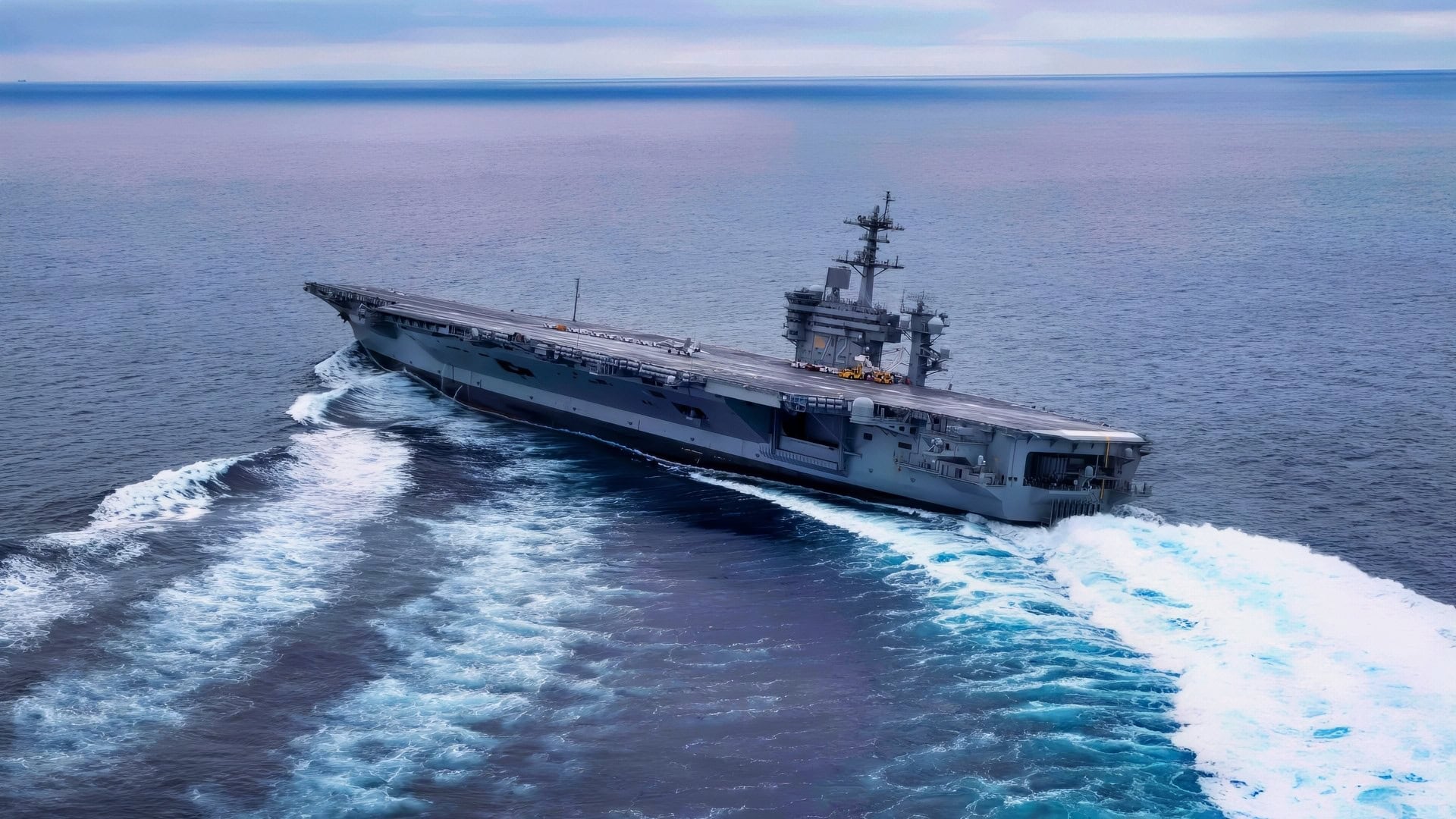
Iran Does Not Have to Sink a U.S. Carrier. It Has to Stop the Flight Deck – A U.S. Navy aircraft carrier is a floating airfield of about 100,000 tons, longer than three football fields, with a crew of roughly 5,000. And we do a lot of work on these warships – as you can see from our recent visit to the USS Intrepid below.
But these big warships don’t sail alone. Destroyers and cruisers steam with it, radars up, missiles in the launchers. That package is a carrier strike group. Iran has spent years promising to sink one. In 2026, it has been in an actual shooting war with the United States — Operation Epic Fury, which began on February 28 — and it has not come close.
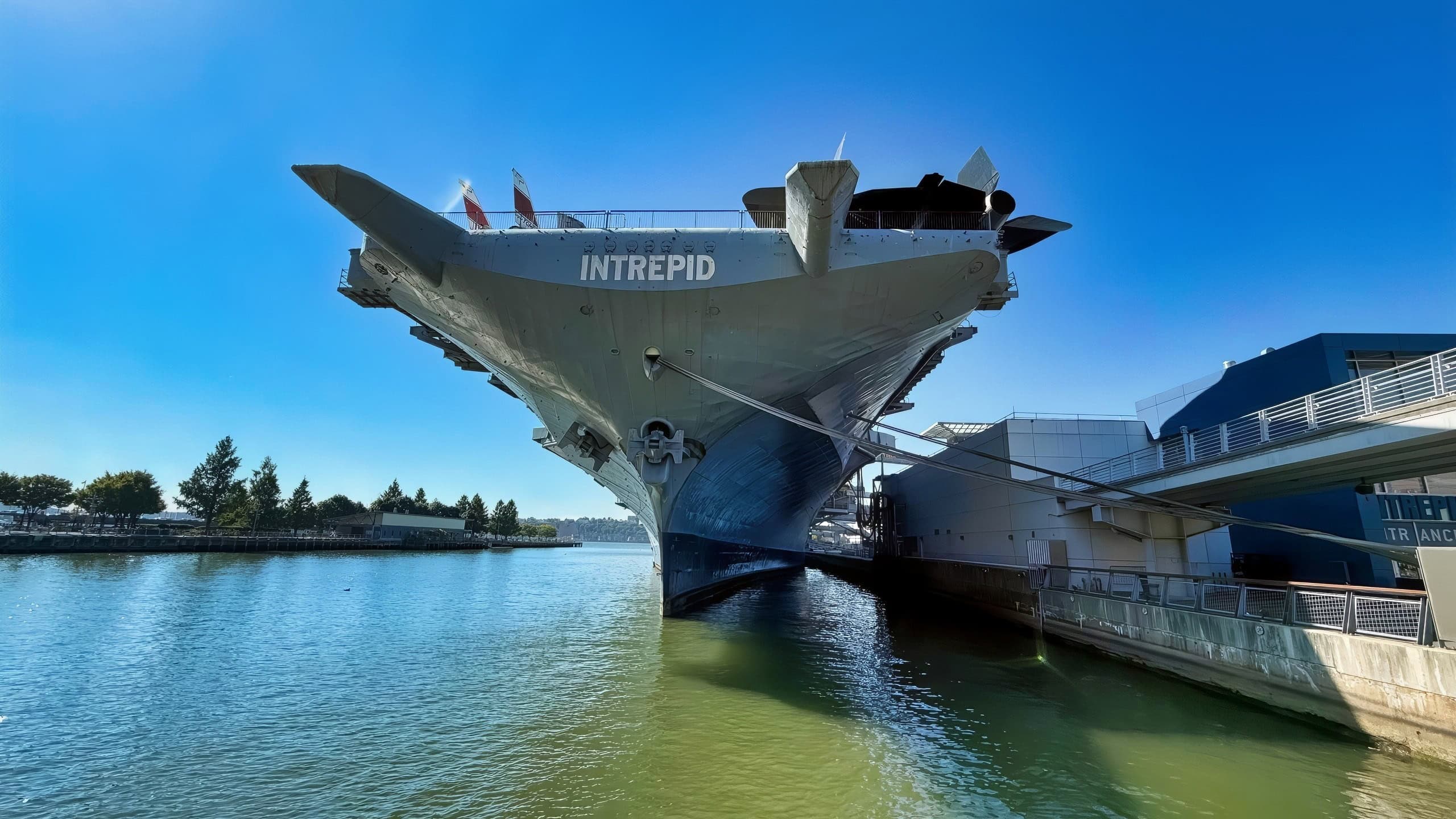
USS Intrepid Essex-Class Aircraft Carrier 19FortyFive.com Photo.
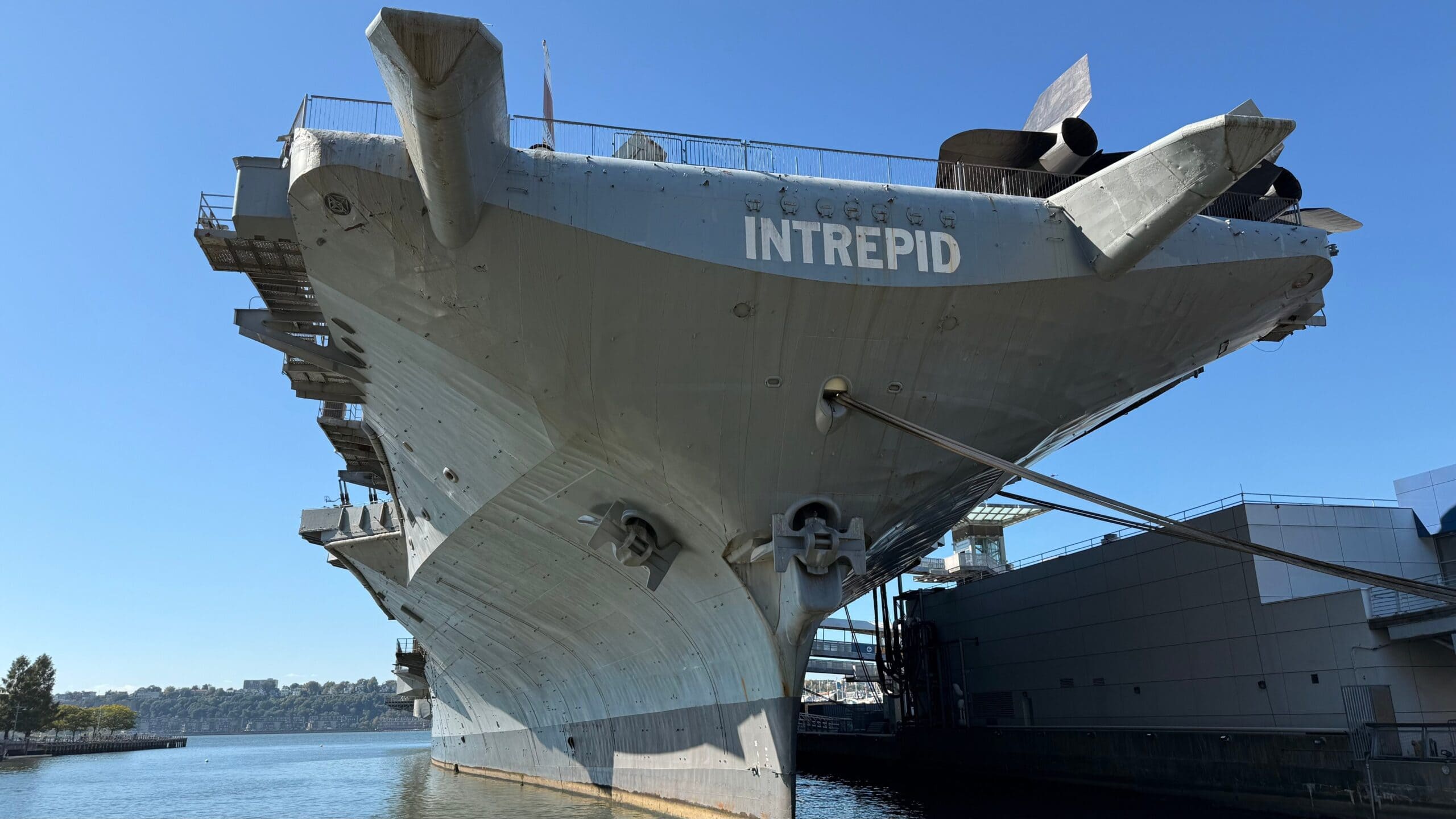
Exterior of Essex-Class USS Intrepid. Image Credit: 19FortyFive.com
After the opening strikes, Iranian media said ballistic missiles had hit the USS Abraham Lincoln. U.S. Central Command called the claim a lie. The missiles, CENTCOM said, “didn’t even come close.” That is the public record as of mid-August. No American carrier has been confirmed hit. The war is still on, or at least not over, as of right now. Shipping through the Strait of Hormuz, the narrow waterway that carries a large share of the world’s seaborne oil, has been attacked for months. Reuters reported on August 14 that traffic there had nearly stopped after two more ships were hit, and that Defense Secretary Pete Hegseth said the U.S. Navy could keep a blockade of Iranian ports going indefinitely.
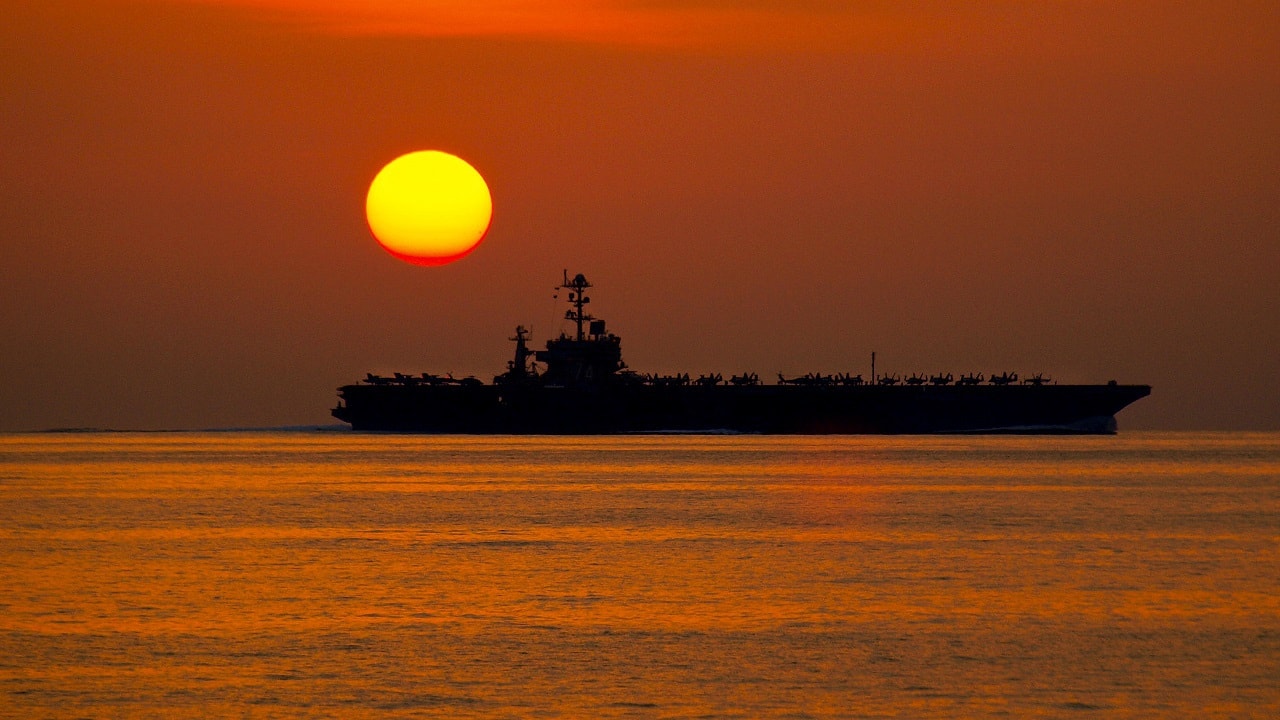
U.S. 5TH FLEET AREA OF RESPONSIBILITY (Jan. 5, 2012) The Nimitz-class aircraft carrier USS John C. Stennis (CVN 74) operates in the Arabian Sea during sunset. John C. Stennis is deployed to the U.S. 5th Fleet area of responsibility conducting maritime security operations, theater security cooperation efforts and support missions for Operation Enduring Freedom. (U.S. Navy photo by Yeoman 3rd Class James Stahl/Released)
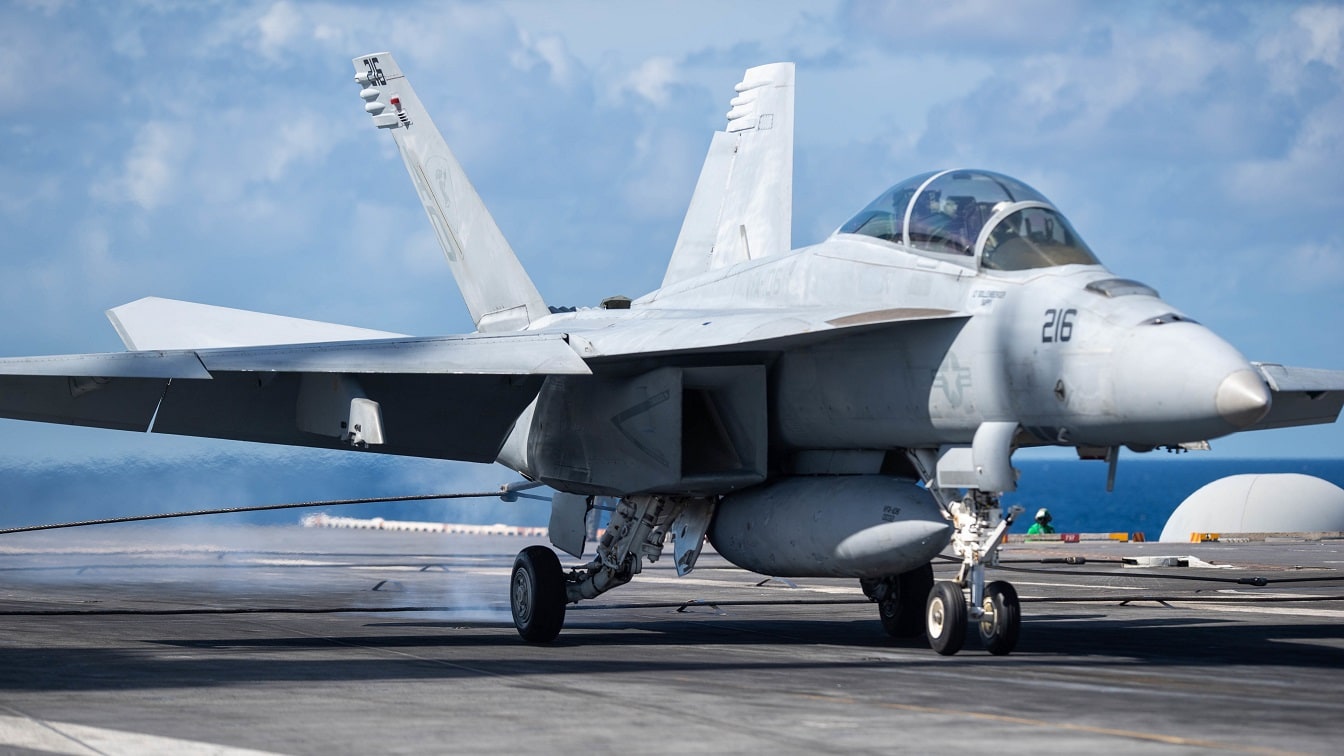
An F/A-18F Super Hornet, assigned to Strike Fighter Squadron (VFA) 106, catches an arresting gear wire while landing on the flight deck of the aircraft carrier USS John C. Stennis (CVN 74) in the Atlantic Ocean, Nov. 4, 2019. The John C. Stennis is underway conducting routine operations in support of Commander, Naval Air Force Atlantic. (U.S. Navy photo by Mass Communication Specialist 2nd Class Grant G. Grady)
The question that will not go away is not whether Iranian television can announce a carrier kill. It is whether Tehran has the weapons to put steel on a moving aircraft carrier, and what “success” would look like if it did. Sinking a nuclear supercarrier is the poster. Stopping it from launching airplanes is the job. A fire on a crowded flight deck can do that without putting the hull on the bottom.
That is a narrower, uglier problem than the one in the speeches. It is also the one worth taking apart.
What Iran Actually Has to Attack a US Navy Aircraft Carrier
Iran’s navy is a two-service navy. The regular navy owns a few conventional submarines, including Russian-built Kilo-class boats, and some larger surface ships. The Islamic Revolutionary Guard Corps Navy is the force built for the Gulf: fast boats, mines, coastal missiles, and small submarines that hide in shallow water. The Guard force does not try to win a gunfight with a destroyer. It tries to throw more cheap threats at a ship than the ship can shoot down at once.
The missiles come in two families, and they are not the same problem. Cruise missiles fly low, like small airplanes, and try to hide in the radar clutter near the water. Iran’s Noor and Qader are in that class, cousins of a Chinese design the country has built and improved for years.
The Abu Mahdi, named for an Iraqi commander killed with Qassem Soleimani, is the long-range claim — more than 1,000 kilometers, or about 620 miles, in Iranian statements. That figure is a claim, not a U.S. test report. If it is even roughly true, it means a carrier sitting well outside the Strait of Hormuz is not automatically safe.
Ballistic missiles go high and come down fast. The Khalij Fars, built from the Fateh family of road-mobile rockets, is Iran’s anti-ship ballistic missile. The idea is the same one China uses with the DF-21D: a warhead falling from a high arc is a different intercept problem than a sea-skimming cruise missile. War on the Rocks noted this year that the terminal phase of that shot was not what older ship defenses were drawn to defeat.
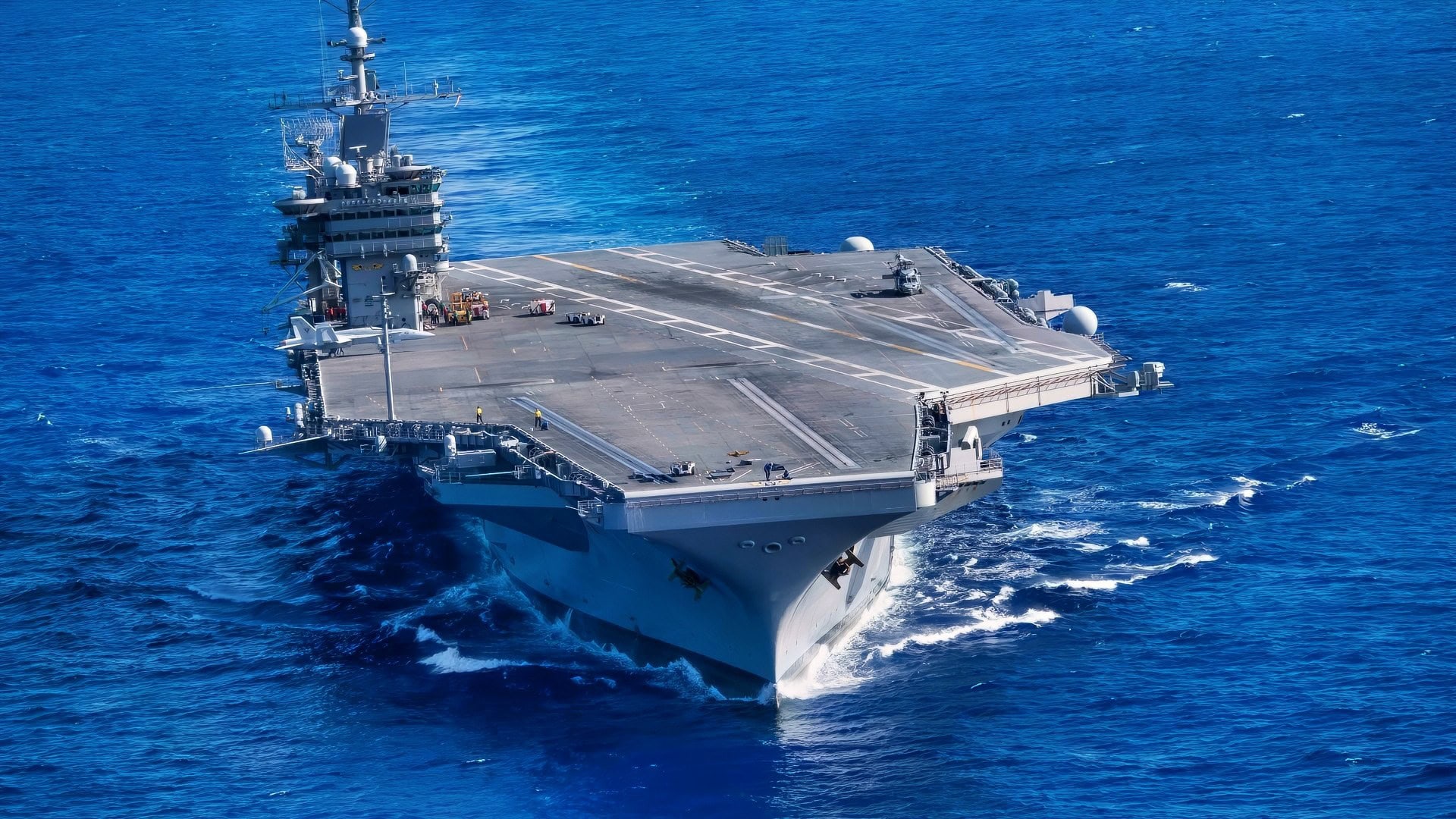
The aircraft carrier USS John C. Stennis (CVN 74) steams through the Atlantic Ocean, Sept. 6, 2019. The John C. Stennis is underway as part of a Commander, U.S. 2nd Fleet ordered sortie ahead of Hurricane Dorian, which is forecasted to bring high winds and heavy rain to the East Coast. Ships are being directed to areas in the Atlantic Ocean where they are best postured for storm avoidance. (U.S. Navy photo by Mass Communication Specialist 3rd Class Grant G. Grady)
Hormuz-series missiles are sold as anti-radar weapons: they home in on the emissions a warship uses to see. Iranian officials also talk about hypersonic systems such as Fattah. Treat those as announcements until someone other than Tehran measures them.
Drones fill the cheap end. One-way attack drones derived from the Shahed-136 are slow, loud, and numerous. They are not carrier-killers by themselves. They force escorts to spend expensive interceptors — Standard missiles that cost a million dollars or more — on airframes that cost a fraction of that. Fast boats and naval mines are older tools, and they still work in a strait that, at its narrowest, is about 21 miles across. Mines do not have to sink a carrier. They have to make a captain refuse the water.
The live data set is not a U.S. carrier. It is commercial shipping, and it is the Houthis in the Red Sea who have used Iranian-related anti-ship ballistic missiles and drones against merchant ships since late 2023. They have hit cargo vessels. They have not sunk a U.S. carrier. That gap is the whole argument.
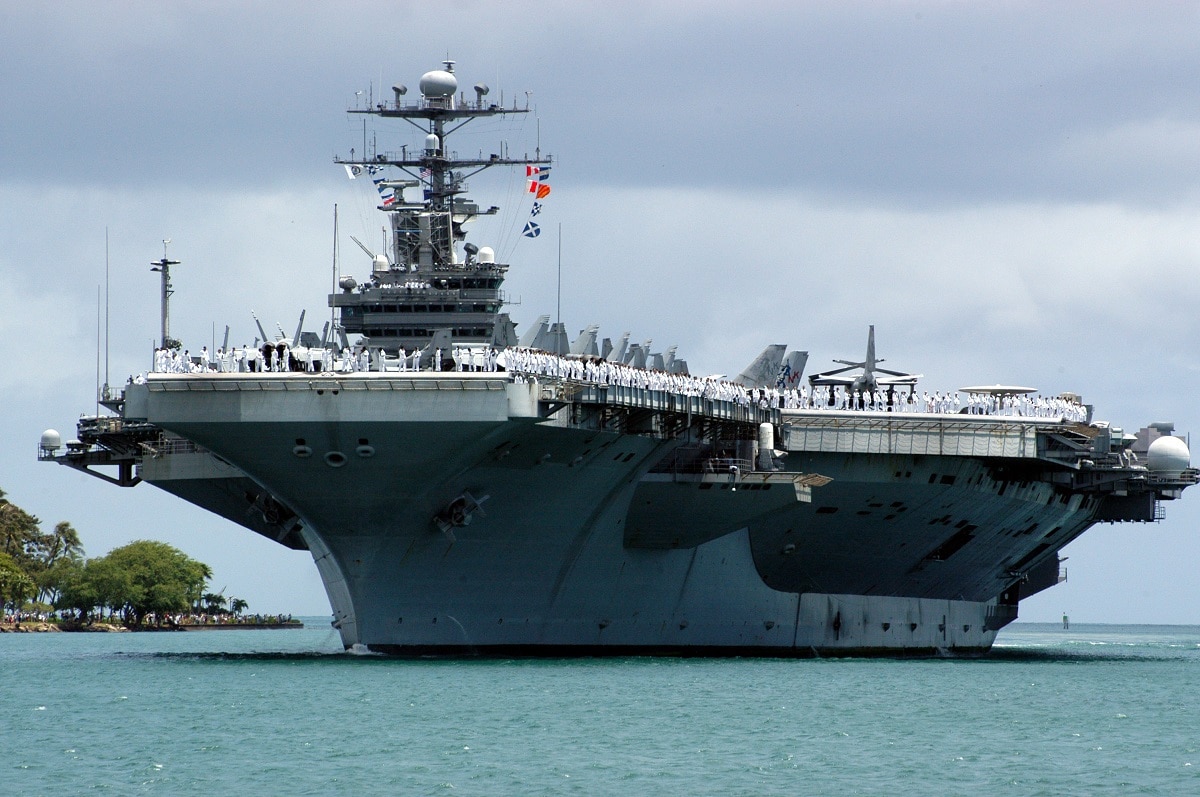
PEARL HARBOR, Hawaii (June 29, 2004) Sailors aboard the Nimitz-class aircraft carrier USS John C. Stennis (CVN 74) Òman the railsÓ as she pulls through the mouth of Pearl Harbor. Stennis arrived as part of RIMPAC (Rim of the Pacific Maritime Exercises), which includes the participation of seven countries. The objectives of the exercises are enhancing combat readiness and exploiting opportunities for cooperation with multinational unties. U.S. Navy photo by Journalist Seaman Ryan C. McGinley. (RELEASED)
Finding the Ship Is Half the Problem
A carrier in a fight does not park in the Strait of Hormuz. It usually stays out in the Arabian Sea or the Gulf of Oman, moving at more than 30 knots, changing course, with airborne radar and fighters looking outward. The strike group’s job is to keep the big deck outside the cheap inner layer of boats and mines and make Iran take a long-range shot at a moving target it may not be able to see clearly.
To hit that target, Iran needs more than a missile. It needs a location, an update, and a way to tell the warhead where the ship will be when the weapon arrives. Satellites, drones, small boats, and shore radar all help. Weather, jamming, decoys, and the simple size of the ocean all hurt. A ballistic missile that cannot find the deck is just an expensive splash. That is the most likely reason the Lincoln shots, if they were aimed at the carrier at all, did not come close. This site has already covered Iran’s long fixation on the carrier as a trophy. Fixation is not a fire-control solution.
If the weapons do arrive, they meet a layered defense. Early-warning aircraft and fighters try to kill the shooters and the incoming missiles far out. The escort ships fire long-range Standard missiles, then shorter-range
Evolved Sea Sparrow missiles, then rolling-airframe missiles, then last-ditch guns. Electronic decoys try to draw seekers away from the hull. None of that is magic. Magazines are finite. A big, mixed raid — ballistic, cruise, and drones at once — is designed to empty those magazines. A denial force does not have to sink ships. It has to keep the defenses working and the launchers running dry.
Sinking Versus Stopping
Sinking a Nimitz-class or Ford-class carrier is a different engineering problem than hitting it. The ship is compartmented. It has a lot of reserve buoyancy. The nuclear plant is deep in the hull. Putting it on the bottom would take repeated, well-placed hits below the waterline, or a magazine explosion the crew could not contain. No navy has done that to an American supercarrier.
Iran has not done it to a U.S. destroyer in this war either. The United States, for its part, struck and sank Iran’s own converted drone carrier, Shahid Bagheri, in the opening hours of Epic Fury — a 42,000-ton ship that had been in service barely a year. That is the exchange so far.
A mission kill is easier, and it is enough. The flight deck is a parking lot of fueled, armed jets. A warhead that opens that deck, starts a fuel fire, or cooks off a bomb does not have to flood the engineering spaces. On July 29, 1967, USS Forrestal was launching strikes off Vietnam when a rocket fired by accident on the deck ruptured a fuel tank and set off a chain of explosions.
The Navy’s own history records 134 dead, 161 injured, and 21 aircraft destroyed. The ship did not sink. It left the line. Similar deck disasters on USS Oriskany in 1966 and USS Enterprise in 1969 made the same point: the carrier’s vulnerability is the air wing sitting in the open, not the reactor.
What if Iran Hit a Navy Aircraft Carrier?
A single Iranian hit that starts that kind of fire would be a strategic event even if the hull stayed dry. Flight operations would stop. Aircraft that survived would have nowhere to land except another deck or a shore base.
The strike group would turn into an escort problem. Land-based bombers and other carriers would have to pick up the sorties, the scenario this site has already walked through in a disabled-deck analysis. In March, Ford had a fire in the laundry spaces. CENTCOM said it was not combat-related, that the plant was unharmed, and that the ship remained fully operational. That incident is useful only as a contrast. A laundry fire is a maintenance story. A missile on a packed deck is a different century of damage control.
Iran does not need a perfect shot to change the war. It needs a lucky one in the right spot at the right time, after a raid large enough to leak through. That is a hard military problem. It is not an impossible one. Carriers in this war have already been pulled farther from the Iranian coast at times to stay outside the densest threat rings. Distance is, in itself, an admission that the missiles are real.
About the Author: Harry J. Kazianis
Harry J. Kazianis (@Grecianformula) was the former Senior Director of National Security Affairs at the Center for the National Interest (CFTNI), a foreign policy think tank founded by Richard Nixon based in Washington, DC. Harry has over a decade of experience in think tanks and national security publishing. His ideas have been published in the NY Times, The Washington Post, The Wall Street Journal, CNN, and many other outlets worldwide. He has held positions at CSIS, the Heritage Foundation, the University of Nottingham, and several other institutions related to national security research and studies. He is the former Executive Editor of the National Interest and the Diplomat. He holds a Master’s degree focusing on international affairs from Harvard University.

