

Summary and Key Points: For most of the past decade, the story of Canada’s military was simple: it would not pay. In the span of a few months, that story collapsed. Prime Minister Mark Carney’s government hit NATO’s 2% spending target five years ahead of schedule, poured tens of billions into defense, and pledged to roughly triple the budget to $900 billion over the next decade. And yet the Canadian Army can still field only about half its vehicles, because the hardest problem in defense is not writing a cheque. It is turning money into a brigade that can actually fight, and readiness is a lagging indicator that Canada is only beginning to measure.
Canada’s Military Is Being Tested: An Introduction
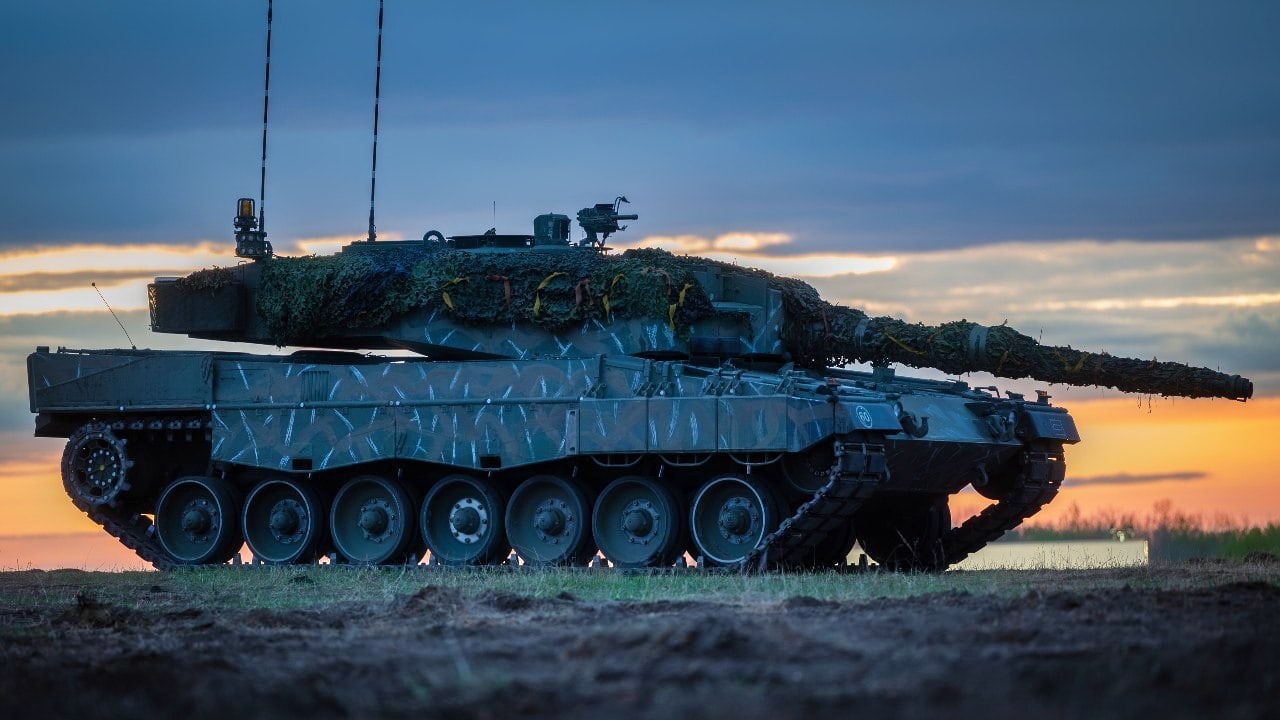
Troops depart their main base of operations for the training area on May 9, 2023, as Ex MAPLE RESOLVE kicks off. Combat arms and support vehicles left in convoys as defined by the order of battle.
For most of the past decade, Canada occupied a familiar and uncomfortable place in the NATO alliance: the wealthy member that would not pay its share. Its defense spending hovered near 1.4% of GDP against the alliance’s 2% target, its equipment aged, its ranks thinned, and its allies grumbled. Then, almost overnight, the premise of that entire critique disappeared. What replaced it is a harder problem, one that money alone cannot solve on any timeline that matters.
The Money Finally Came
On March 26, 2026, Prime Minister Mark Carney stood at a naval dockyard in Halifax and announced that Canada had reached NATO’s 2% of GDP defense-spending target. It was not a marginal achievement. Carney said his government had invested more than $60 billion in defense and security over the preceding ten months, the largest year-on-year increase in defense investment in generations, and had reached the 2% mark at least five years ahead of the timeline set by the previous government, which had privately told NATO officials Canada would never meet the target at all. Ottawa put the figure in historical terms: the highest level of defense spending relative to the economy since the fall of the Berlin Wall.
And 2% is only the floor of the new ambition. Canada has signed on to NATO’s updated goal of 3.5% of GDP on core defense plus 1.5% on related infrastructure by 2035, and the Carney government has laid out a plan to roughly triple total defense spending over the next decade to $900 billion. To move money faster, it stood up a Defense Investment Agency in October 2025 to accelerate procurement of any contract worth more than $100 million, released a new defense industrial strategy built around a “Build, Partner, Buy” framework meant to reduce dependence on the United States, and joined the European Union’s defense-readiness initiative at the Munich Security Conference.
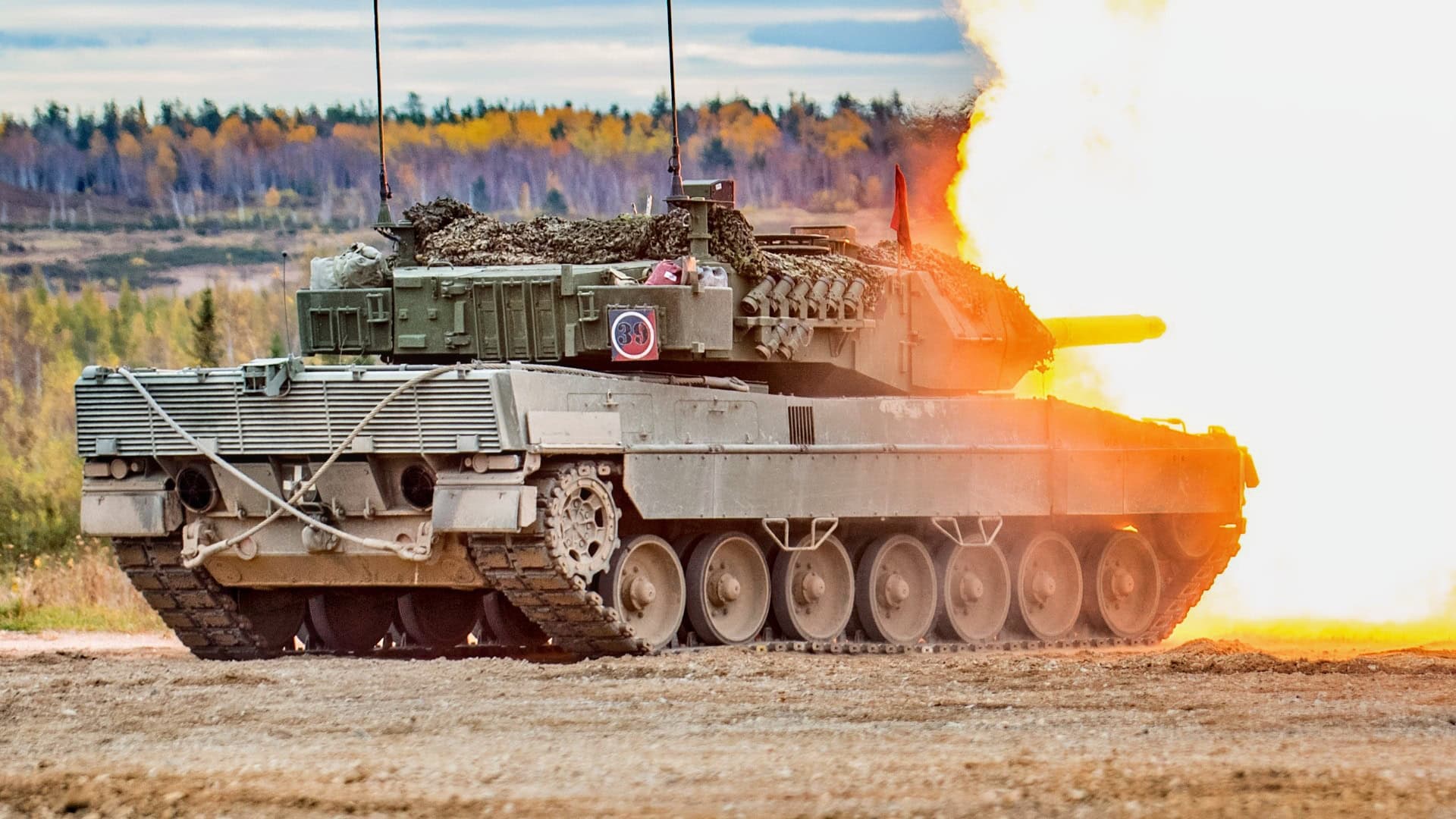
The Royal Canadian Dragoons, C Squadron, conducts a Leopard 2A4 tank shoot during an exercise at 5 Canadian Forces Support Base (5 CDSB) Gagetown, New Brunswick, October 23, 2020.
The driver behind the sudden urgency is not subtle. President Trump’s trade war, his repeated musings about annexing Canada as a “51st state,” and what Carney has called a rupture rather than a transition in the relationship with Washington shocked Ottawa out of a long complacency. For years, Canada had under-invested on the assumption that the United States would always be its protector. That assumption no longer holds, and the budget reflects it. Whatever one thinks of the politics, the old criticism that Canada simply refuses to fund its military is now out of date.
The Problem Money Can’t Fix Fast
Here is the catch. A defense budget buys capability only slowly, and Canada is starting from deep in a hole. A recent internal assessment of the force found operational readiness across all elements sitting at 61.3%, well below the 90% the military expects of itself, and the equipment picture underneath was worse: land key-fleet serviceability stood at just 51%. Defense analyst David Perry put the reality in plain terms. Across airplanes, army vehicles, and ships, only about one piece of equipment in two is actually deployable.
The reason a spending surge does not immediately move those numbers is structural. Money cannot instantly manufacture a trained soldier, restore a fleet of worn-out vehicles to service, conjure the spare parts an obsolete system needs, or repair a procurement bureaucracy that takes years to buy anything. As one analysis of Canada’s defense transformation put it, spending cannot equate to capability when outdated equipment demands burdensome maintenance and personnel shortages slow the conversion of funds into forces. The cheque clears in a quarter; the capability arrives, if the money is spent well and sustained, in years. That gap between a budget and a brigade is where Canada now lives, and nowhere is it wider than in the Army, whose readiness shortfalls have been documented for years.
The Hollow Brigade
The Canadian Army is the branch where the distance between reputation and readiness is starkest. This is a force with a genuinely storied past, from Vimy Ridge to the beaches of Dieppe to a decade of hard fighting in Kandahar. What it lacks today is modern equipment and the capacity to deploy what it has. Its inventory is widely described as obsolescent, with gaps in exactly the capabilities that define contemporary land warfare: modern ground-based air defense, armed and reconnaissance drones at scale, and long-range precision artillery. These are not exotic wish-list items. They are the systems that the wars of the past several years have shown to be decisive, and the Canadian Army is thin in all three.
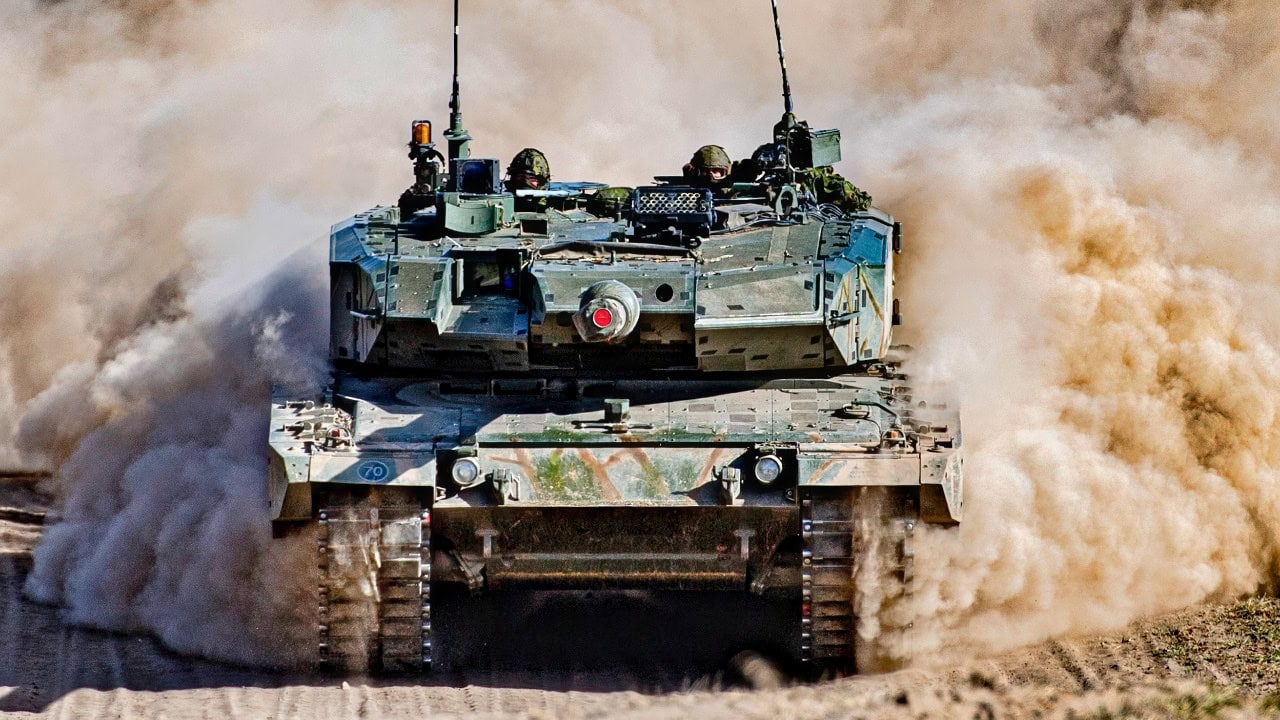
A Leopard 2A4 tank from Lord Strathcona’s Horse (Royal Canadians) drives on the Black Route of the 3rd Canadian Division Support Base Garrison Wainwright Training Area in preparation for Exercise MAPLE RESOLVE 21 on April 28, 2021.
The contrast with allies is unflattering. Poland, a former Warsaw Pact state on NATO’s exposed eastern flank, has bought HIMARS rocket artillery, hundreds of tanks, and self-propelled howitzers at speed, assembling a heavy land force in a handful of years, while the Canadian Army remains, in the words of one assessment, stuck in “hurry up and wait.” Canadian training has also been slow to absorb the multi-domain concepts that now govern how armies fight. And the human texture of the problem is mundane but corrosive: at bases such as Garrison Petawawa, soldiers describe rising local rents that force long commutes or substandard housing, the kind of daily friction that quietly pushes people out of uniform. Layered on top is geography. Canada’s vast, sparsely defended Arctic archipelago is precisely the region allies now expect it to secure, and it is the hardest and most expensive place on earth to project and sustain a land force.
Recruits and Rust
The Army’s deepest shortage is people, and here the news is genuinely mixed, with one real bright spot. The Canadian Armed Forces have been short roughly 15,000 to 16,000 members, around 15% of their authorized strength, and for years, recruitment fell further and further behind. That trend has finally turned. In 2025–26, the force enrolled 7,310 regular members, beating its own target and posting the highest intake in more than 30 years. It is the clearest evidence yet that the renewed political attention and money are producing something real.
But even this good news underscores the lag. A recruit signed today is not a trained, deployable soldier for years, and the retention side of the ledger remains stubborn, with members continuing to leave over pay, housing, aging equipment, and burnout. The retention problem has proven remarkably durable. The bureaucracy compounds it. When Ottawa opened enlistment to permanent residents to help fill the ranks, more than 21,000 applied, yet in the first year of eligibility, fewer than 100 were actually enrolled, most applications frozen in security vetting. Solving the manpower crisis requires not just interest, which has returned, but a system fast enough to convert interest into soldiers, which has not yet materialized.
The Procurement Trap
If any single file captures why money and capability are not the same thing, it is Canada’s fighter purchase, and it bears directly on the Army’s future air cover as well as the Air Force’s own. The F-35 program has been a running saga of delay. Canada committed to 88 F-35 stealth fighters but has so far confirmed only 16, with the government reviewing whether to buy the remaining 72 amid the trade rupture with Washington. The first Canadian jet entered final assembly in early 2026, yet aircraft are not expected to arrive until 2028, and the F-35’s Block 4 upgrade is running roughly five years late and billions over budget by the U.S. government’s own accounting. Canada’s other marquee project, a plan for up to twelve new submarines, remains in its early stages, with German and South Korean bidders competing.
The through-line is a procurement system that has been synonymous with delay and cost overrun for a generation. Tellingly, the new industrial strategy exempts the fighter and submarine competitions, Canada’s largest capability decisions of the decade, from its own reforms, meaning the biggest buys will be made under the old rules. Meanwhile, the Parliamentary Budget Officer has warned that chasing the 3.5% target could add tens of billions annually to the federal deficit by 2035, meaning the money now flowing must withstand years of fiscal and political pressure before it delivers. An announced budget is not a submarine underwater.
Canada’s Military Is a Giant Question Mark in 2026
It would be easy, and wrong, to file all of this under the familiar “Canada won’t defend itself” story. That story is genuinely over, and the reversal deserves to be taken seriously. Reaching 2% five years early, tripling the long-term budget, creating an agency to speed up procurement, and posting the best recruiting year in three decades are not empty gestures; together, they mark the most significant shift in Canada’s defense posture since the Cold War ended. Readiness lagging a spending surge is not a scandal but the ordinary physics of rebuilding a military, and with sustained investment, the serviceability and manpower numbers should climb over time.
The real risks are different ones. The first is durability: a ten-year, $900 billion rearmament has to outlast changes of government, fiscal crises, and the eventual fading of the Trump-era shock that triggered it, and Canadian defense pledges have a long history of evaporating once the external pressure eases. The second is execution: unless the procurement system is genuinely fixed, the money will convert into delay and overrun rather than deployable capability, and the Army will remain half-serviceable no matter how large the budget grows. What Canada has bought itself so far is not a ready army but the chance to build one.
For a decade, the question about Canada’s military was whether it would ever pay. That question has been answered faster and more decisively than almost anyone predicted.
The question now is slower and harder to capture in a headline: whether a country can turn a historic pile of money into an Army that can deploy, sustain, and fight, and how many years of patience and reform that will demand. The taps are finally open. The Army is still mostly dry.
About the Author: Harry J. Kazianis
Harry J. Kazianis (@Grecianformula) was the former Senior Director of National Security Affairs at the Center for the National Interest (CFTNI), a foreign policy think tank founded by Richard Nixon based in Washington, DC. Harry has over a decade of experience in think tanks and national security publishing. His ideas have been published in the NY Times, The Washington Post, The Wall Street Journal, CNN, and many other outlets worldwide. He has held positions at CSIS, the Heritage Foundation, the University of Nottingham, and several other institutions related to national security research and studies. He is the former Executive Editor of the National Interest and the Diplomat. He holds a Master’s degree focusing on international affairs from Harvard University. Kazianis is Editor-In-Chief of 19FortyFive.

