
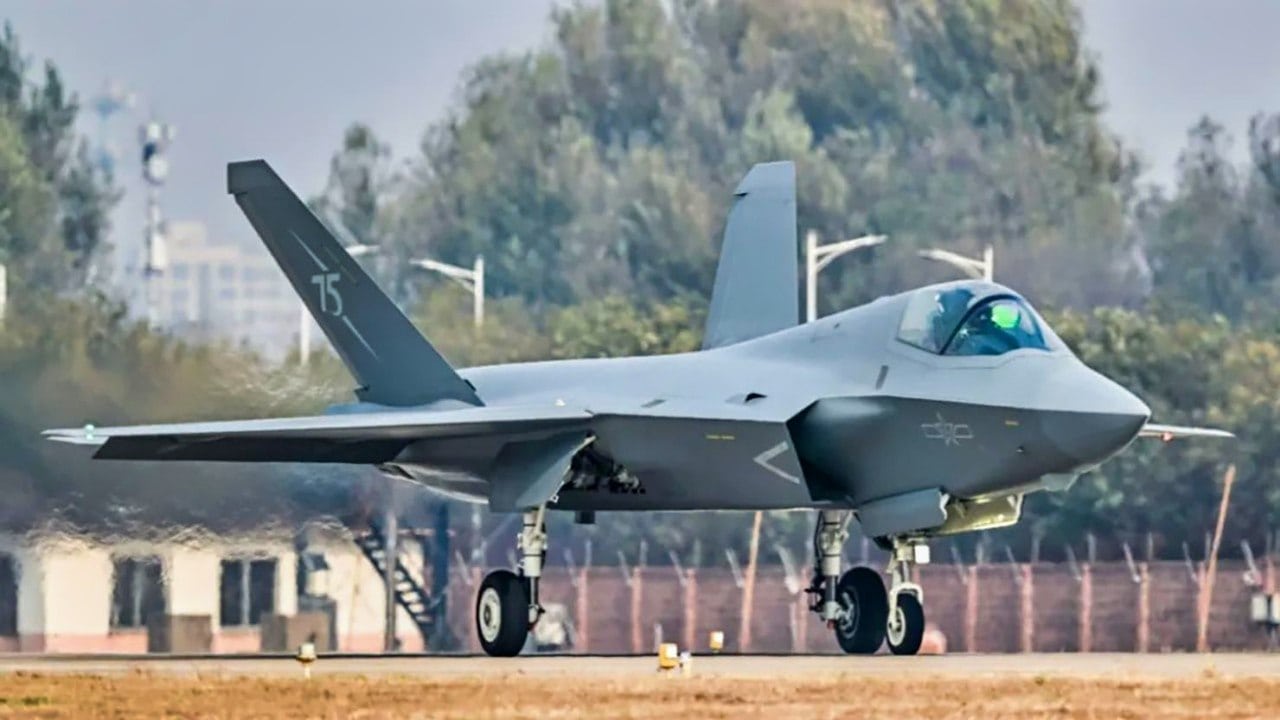
China’s J-35A May Trail the F-22 and F-35. Numbers and Geography Still Make It 1 Thing: Dangerous – The J-35A began as a company-funded demonstrator. Shenyang Aircraft Corporation flew the first FC-31 in October 2012 without a confirmed order from the Chinese military. Fourteen years later, its descendant wears PLAAF markings, appears on production lines, and anchors a new factory complex built for expansion.
China keeps details secret. It has not published the J-35A’s radar cross-section, engine life, combat radius, radar performance, electronic warfare suite, unit cost, or operational fleet size. Reuters called the aircraft a “black box” when it made its official public debut in November 2024.
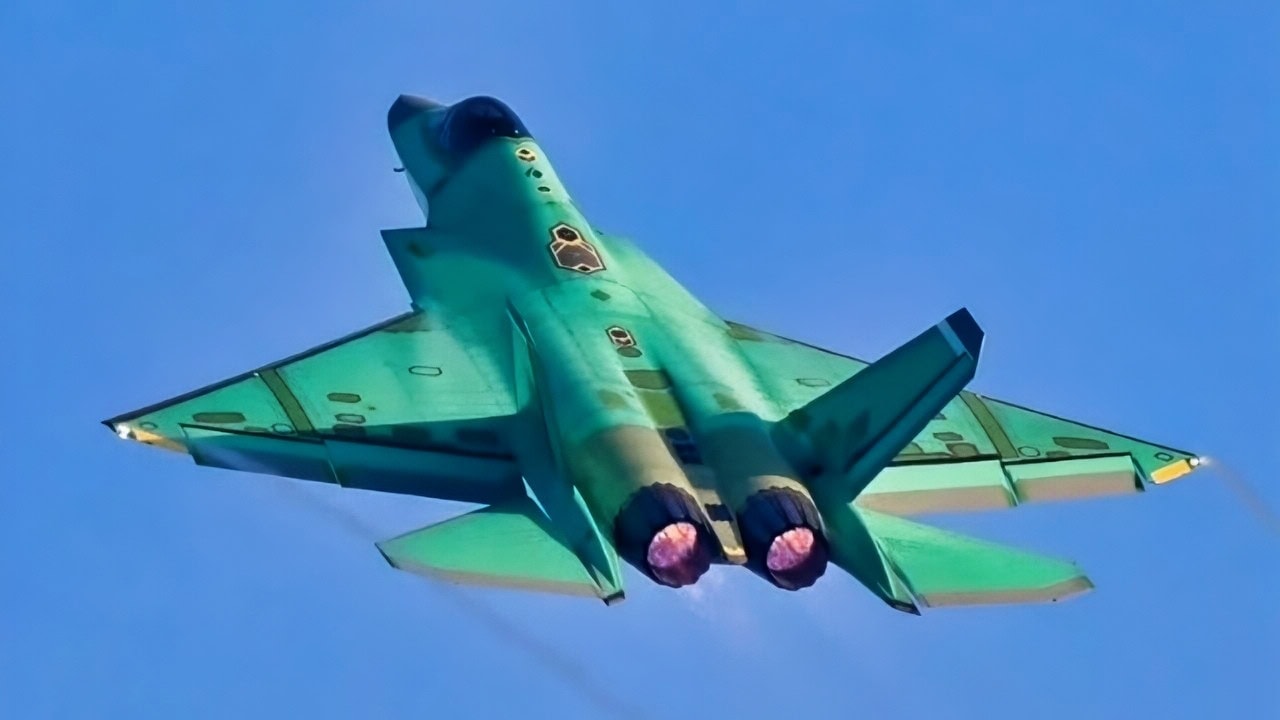
J-35A Stealth Fighter. Image Credit: Social Media Screenshot.
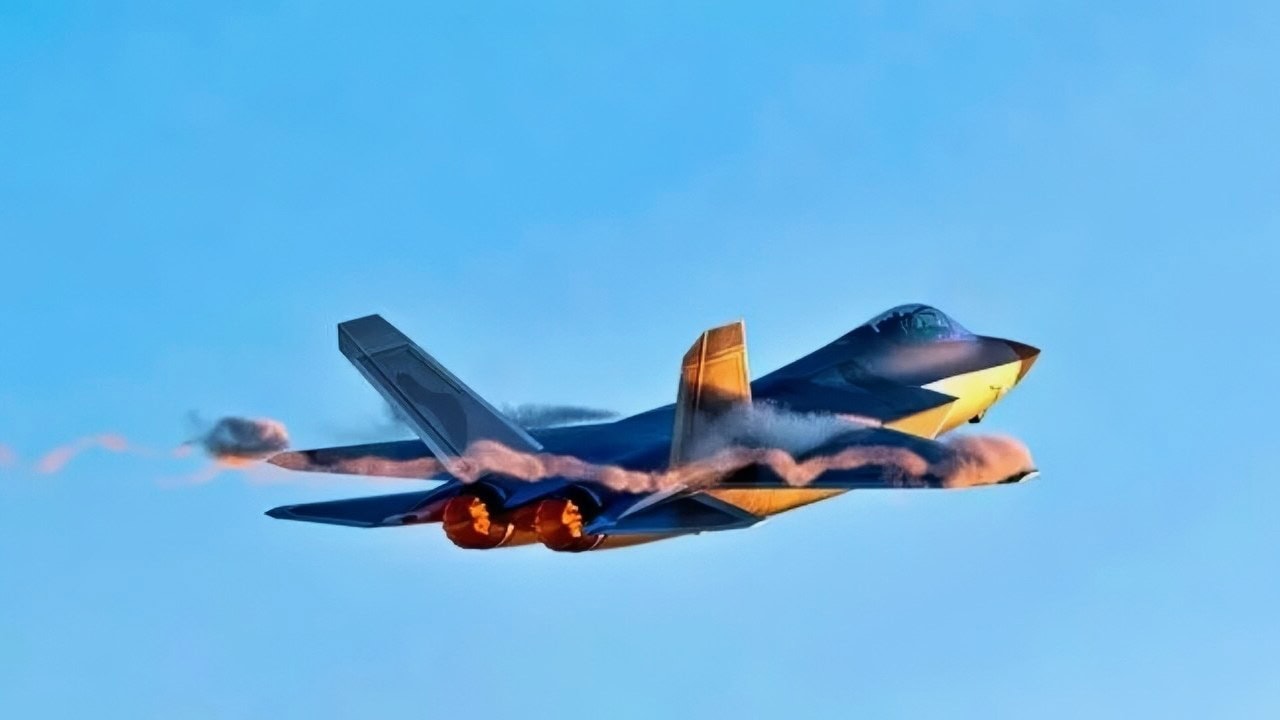
J-35A Fighter from China PLAAF. Image Credit: Creative Commons.
Public evidence does not show the J-35A matching the F-22’s supercruise and thrust-vectoring performance or the F-35’s mature sensor-fusion architecture. It also does not support dismissing China’s second stealth-fighter family as an imitation with no military value.
Employment and scale matter more. The medium-weight, twin-engine J-35A is designed to complement the J-20, operate inside China’s sensor and missile network, and enter service in quantities the small F-22 fleet cannot match. A one-for-one comparison misses the force around it.
The FC-31 Began as an Export Demonstrator Without a PLA Order
The first FC-31 looked like an export project searching for a customer. Its prototype, which used Russian-derived RD-93 engines, flew in Zhuhai in 2014, where its demonstration reinforced doubts about its thrust and maturity. The aircraft had stealth shaping and internal weapons space, but no announced PLA requirement.
Shenyang kept working. The second FC-31 prototype flew in December 2016 with a cleaner fuselage, reshaped wings, smaller clipped tails, and Chinese WS-13E engines. The redesign improved low-observable shaping and moved the aircraft beyond the technology demonstrator seen four years earlier.
The Chinese Navy Turned the FC-31 Into the J-35
The program gained a military purpose when China’s navy needed a stealth fighter for its catapult-equipped carrier. A revised aircraft flew in October 2021 with folding wings, a catapult launch bar, reinforced landing gear, and a sensor turret beneath the nose. Another naval prototype appeared in 2022.
Carrier operations require lower approach speeds, stronger structure, corrosion protection, and flight-control software. The naval J-35 received a larger wing and twin-wheel nose gear, while the land-based aircraft discarded weight and equipment it did not need.
In September 2025, the military released footage of the J-35 completing catapult-assisted takeoffs and arrested landings aboard Fujian alongside the J-15T and KJ-600 airborne early-warning aircraft. Fujian entered service in November 2025, though its air wing still required operational workups.
The naval requirement turned an export gamble into a national program. The J-35 supplies a stealth aircraft for carrier aviation, while the land-based J-35A offers the air force a related design without the penalties imposed by sea service.
The Land-Based J-35A Entered Public View in 2024
The aircraft that became the J-35A appears to have flown by September 2023. It carries a smaller wing, a single-wheel nose landing gear, and no folding mechanism or catapult bar. China officially presented it in November 2024 as a medium multirole stealth fighter intended to seize and maintain air superiority.
Chinese officials said the aircraft uses a domestic engine and improved human-machine interaction, though they withheld measurable performance. The family approach lets the J-35 and J-35A share sensors, avionics, weapons and manufacturing knowledge while retaining different structures and software.
The September 2025 parade supplied strong evidence of operational status. Janes identified three J-35As and at least one naval J-35 carrying PLA colors and service serials, assessing that both variants had entered service. Chinese television later showed both types under construction at Shenyang.
The program kept moving in 2026. AVIC publicized a newly manufactured naval J-35 conducting a factory flight in January. In May, Chinese television showed an aircraft with AVIC markings and the number 001, assessed as the J-35AE export version. No foreign delivery had occurred by July 31.
The F-22 and F-35 Still Hold Important Advantages
The F-22 retains advantages rooted in its air-dominance mission. The Air Force credits the Raptor with stealth, avionics, maneuverability and supercruise. Its thrust-vectoring nozzles and high-altitude performance were designed around killing advanced fighters.
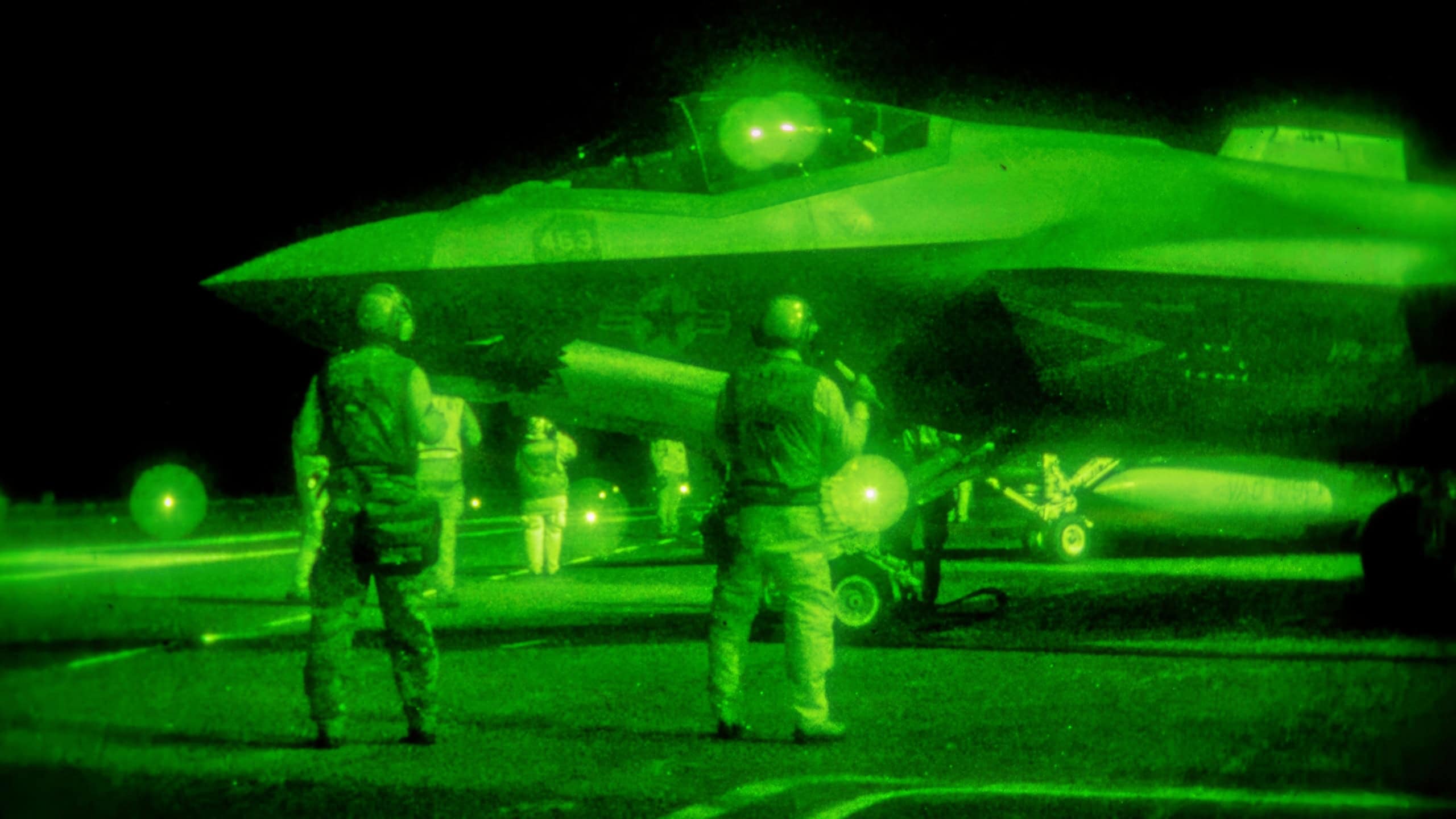
PACIFIC OCEAN (Jan. 23, 2026) –U.S. Navy Sailors conduct routine flight operations on the flight deck of the Nimitz-class aircraft carrier USS Theodore Roosevelt (CVN 71) Jan. 23, 2026. Theodore Roosevelt, flagship of Carrier Strike Group (CSG) 9, is underway conducting exercises to bolster strike group readiness and capability in the U.S. 3rd Fleet area of operations. (U.S. Navy photo by Mass Communication Specialist 2nd Class Ryan Holloway)
China has not demonstrated comparable J-35A supercruise, thrust vectoring or engine durability. The fighter’s internal bays and low-observable shaping show its intended role, but Beijing has released no data establishing detection range against stealth targets, resistance to jamming or sustained high-power performance.
The F-35 presents another benchmark. Its strongest advantage lies in sensor fusion, collecting and distributing information from radar, electro-optical sensors and electronic-support systems. It has years of operational use, a multinational training base and a software-and-weapons system spanning three U.S. variants and allied fleets.
The J-35A’s exterior shows attention to frontal stealth, internal weapons and distributed sensors. Resemblance does not reveal software quality, emissions control, electronic warfare or the ability to combine data into a trustworthy picture. Those areas require years of testing and unit experience.
American superiority on paper also has limits. The F-22 inventory contains 184 aircraft, and its latest mission-capable rate fell to 40.19 percent in fiscal 2024. GAO reported that the F-35 fleet’s mission-capable rate fell to 44 percent in fiscal 2025. A fighter in maintenance does not add to the day’s sortie count.
China’s Home-Field Advantage Changes the Air Battle
A conflict around Taiwan would place the J-35A close to Chinese bases, depots, air defenses and command networks. It could fly shorter missions from mainland runways, return to domestic repair facilities and operate beneath coverage from ground radars, surface-to-air missiles and KJ-500 airborne-warning aircraft. That geography creates a home-field advantage for Chinese stealth fighters.
U.S. F-22s and F-35s would arrive from fewer regional bases or depend on tankers. The Pentagon’s 2025 China report assessed that PLA strikes reaching 1,500 to 2,000 nautical miles could disrupt American involvement across the Asia-Pacific in sufficient volume. Runways, fuel storage, command nodes and tankers would compete for protection.
Chinese designers describe the J-35A as a “point guard” in systematic combat. The phrase points toward an aircraft that finds targets, shares tracks and coordinates shooters instead of chasing isolated dogfights. A J-35A supported by ground sensors, a KJ-500 and long-range missiles presents a different problem from one meeting an F-22 over neutral territory.
Shenyang Is Building the Capacity for a Large J-35 Fleet
Production changes the calculation. Satellite analysis published in 2026 identified a new aviation complex north of Shenyang with about 4 million square feet of manufacturing space and a 12,000-foot runway. The site gives AVIC room to add J-35 production at scale without ending J-15 and J-16 work at the older plant.
The same analysis estimated that expansions at Shenyang and Chengdu added more than 8 million square feet of manufacturing space and might support as many as 300 fourth- and fifth-generation fighters per year across all types. That is not a forecast of 300 J-35As. It shows China building capacity for a larger combat aircraft force.
J-35 chief designer Wang Yongqing said in 2025 that the common air-and-sea family was intended for a substantial fleet, with shared equipment reducing development and maintenance costs. Large orders spread training, spare-parts, and tooling expenses while giving the PLAAF room to absorb maintenance and losses.
The F-22 production line is closed, and every Raptor sidelined reduces a fixed inventory. The F-35 remains in large production, but U.S. aircraft are divided among services, training units, allies, and global commitments. China would concentrate the J-35A inside the theater its military has spent decades preparing to defend.
As of publication, Beijing had not published an official J-35A inventory or annual production target for the land-based fighter. The new Shenyang production complex was still in the final stages of construction.
About the Author: Harry J. Kazianis
Harry J. Kazianis (@Grecianformula) was the former Senior Director of National Security Affairs at the Center for the National Interest (CFTNI), a foreign policy think tank founded by Richard Nixon based in Washington, DC. Harry has over a decade of experience in think tanks and national security publishing. His ideas have been published in the NY Times, The Washington Post, The Wall Street Journal, CNN, and many other outlets worldwide. He has held positions at CSIS, the Heritage Foundation, the University of Nottingham, and several other institutions related to national security research and studies. He is the former Executive Editor of the National Interest and the Diplomat. He holds a Master’s degree focusing on international affairs from Harvard University.

