
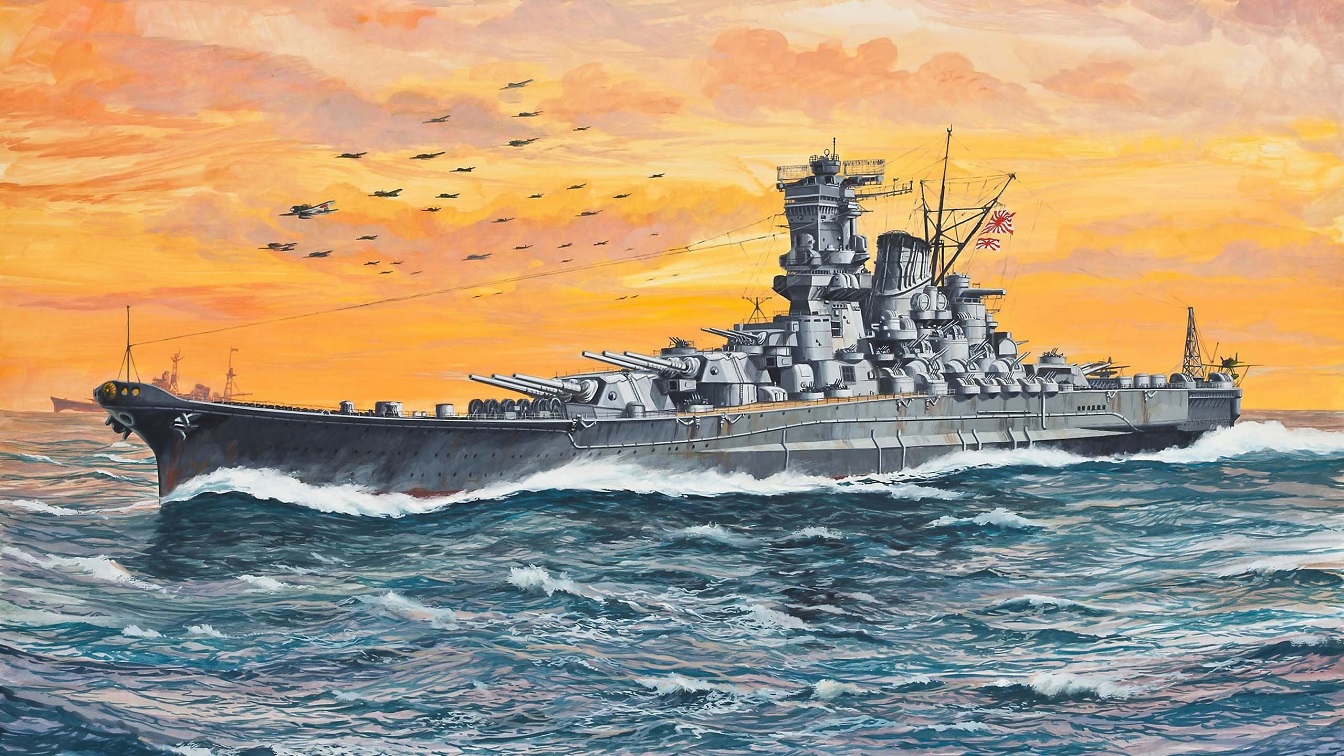
Summary and Key Points: To build the Yamato and Musashi, the largest battleships ever constructed, Japan first had to rebuild the shipyards themselves. Beginning in 1937, the Kure Naval Arsenal and Mitsubishi’s Nagasaki yard widened dry docks, strengthened slipways, and built new heavy cranes to handle hulls of nearly 70,000 tons armed with nine 46-centimeter guns, 18.1 inches in bore and the largest ever mounted on a warship. Because each turret weighed more than a destroyer, Japan built a dedicated vessel solely to transport them. The entire program was concealed behind oaths of secrecy, camouflage screens, and censorship so thorough that the U.S. Office of Naval Intelligence still listed the ships with 16-inch guns in July 1945, four months after Yamato was sunk.
The Yamato-Class Battleship Origin Stories History Forgets
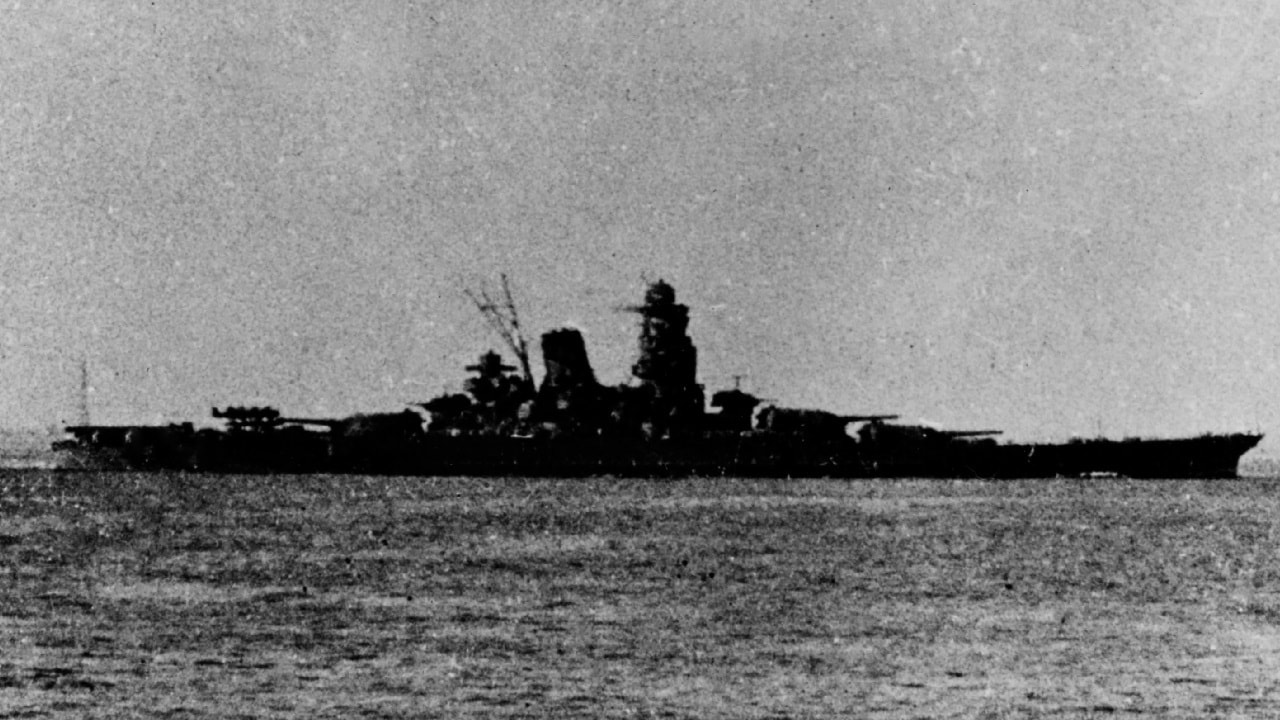
Yamato-class battleship Yamato. Image Credit: Creative Commons
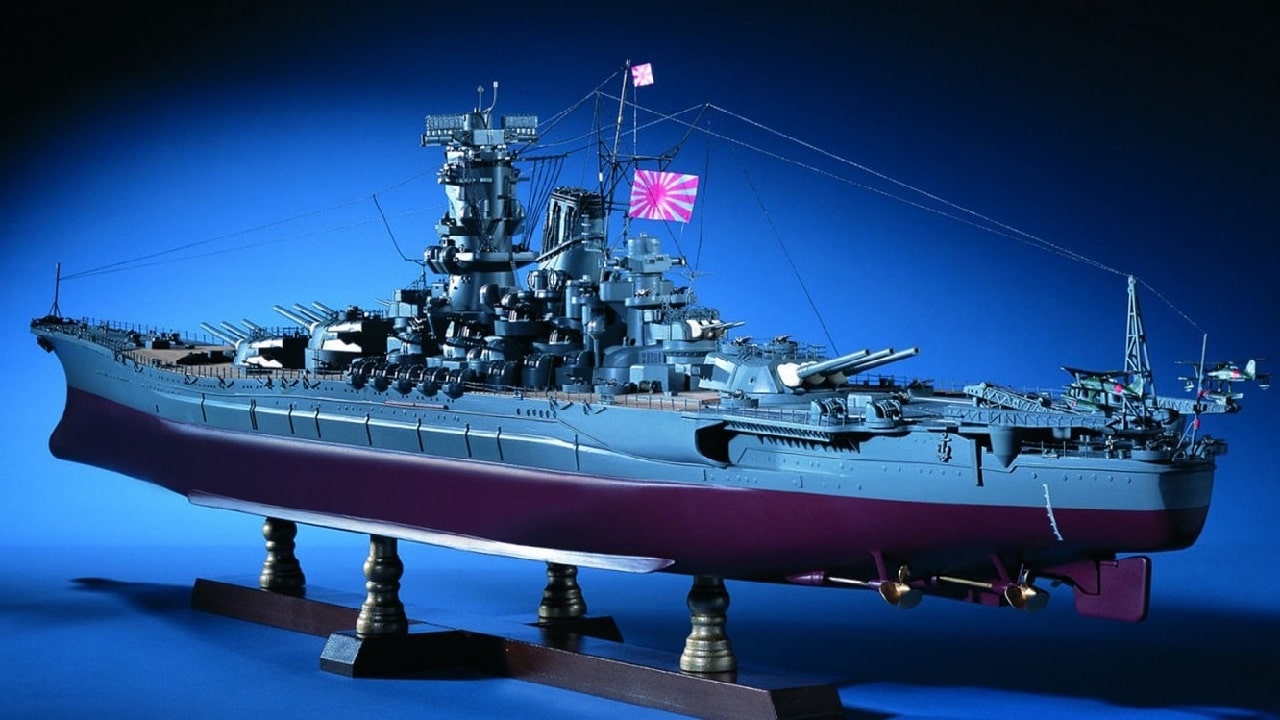
Yamato-class battleship model. Image Credit: Creative Commons.
The Yamato and Musashi are remembered for how they died, overwhelmed by American carrier aircraft in 1944 and 1945. The more remarkable story is how they were built. To construct the largest battleships ever made, Japan had to rebuild the shipyards themselves, invent a vessel whose only job was to carry the guns, and wrap the entire program in a secrecy operation so complete that the U.S. Office of Naval Intelligence still listed the ships with 16-inch guns in July 1945, four months after Yamato went to the bottom. The construction of these ships was a feat of industrial engineering and concealment that the story of their sinking has almost entirely erased.
The Kure Naval Arsenal and Mitsubishi’s Nagasaki shipyard set out in 1937 to build warships larger than anything that had ever floated, and the first problem they faced was that the yards themselves were not big enough to hold them. Before a single frame of the Yamato class could be laid, Japanese industry had to be physically expanded to accommodate a ship of nearly 70,000 tons, and every stage of that expansion had to happen behind a wall of secrecy designed to keep the United States from learning what Japan was doing. The result was two battleships that the Western world would not accurately measure until after the war that destroyed them was over, and an industrial achievement that has been overshadowed for eighty years by the airpower that sank the ships in an afternoon.
Yamato-Class: The Ship Japan Designed Around Its Guns
The Yamato class was a deliberate answer to an arithmetic problem. When Japan withdrew from the Washington Naval Treaty in the mid-1930s, its planners understood that Japanese shipyards could never match the sheer output of American industry in a naval arms race. If Japan could not build more battleships than the United States, the reasoning went, it would build battleships so powerful that each one could defeat several American ships at once, offsetting quantity with individual superiority. That single strategic premise drove every subsequent design decision and pointed toward the largest naval guns ever conceived.
The final design emerged from a competition between rival Japanese naval architects, whose proposals differed over how to balance hull weight against armor protection, before the navy settled in 1937 on a battleship built around a main battery of nine 46-centimeter guns, with a bore of 18.1 inches.
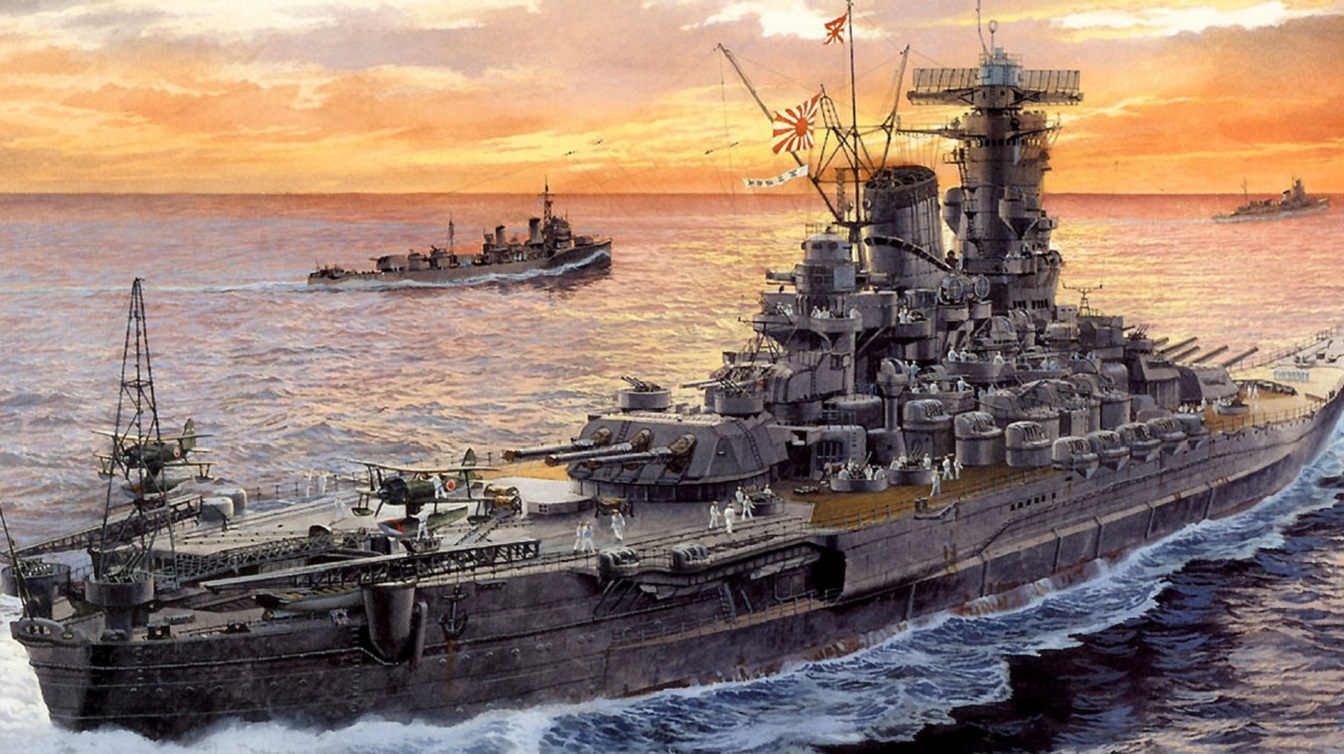
Battleship Yamato. Image Credit: Creative Commons.
These were the largest naval guns ever mounted on a warship, before or since, each capable of firing a 1,460-kilogram armor-piercing shell more than 42 kilometers. The choice of caliber was itself a form of protection, because 18-inch guns were so far beyond the era’s treaty norms, which capped battleship guns at 16 inches, that foreign analysts would refuse to believe Japan had actually built them. The gun that made the ship formidable also made the ship unbelievable, and Japan intended to keep it that way.
Rebuilding the Shipyards to Build the Ship
A ship of this size could not be built with existing methods or existing facilities.
The naval architects who designed the Yamato worked through more than two years of studies before the final plans were fixed in March 1937, drafting 23 separate blueprints and testing roughly 50 experimental hull models in the test basin to find the most effective shape, because the ships could not be created by simply scaling up data from earlier battleships. Building 18-inch guns and armor thick enough to resist 18-inch shells was unprecedented and demanded fundamental experimentation at every stage.
The physical plant had to be transformed to match. At Kure, where Yamato’s keel was laid down on 4 November 1937, the existing dry dock had to be widened and deepened to accommodate a hull of unprecedented beam. Mitsubishi’s Nagasaki yard, the only other facility in Japan capable of the work even after expansion, required strengthened slipways, expanded workshops covering hundreds of thousands of square meters, and new floating cranes of 350 and 150 tons to lift the massive armor plates and gun fittings into place.
Japanese industry adopted electric welding in place of riveting and block-construction techniques to assemble the enormous structures. The turrets posed a problem all their own, because each gun mount weighed 2,774 tons, more than a contemporary destroyer, and was simply too large and heavy to move by rail or by ordinary ship. Japan’s solution was to build a dedicated vessel whose sole purpose was to carry the turrets and barbette components to the shipyards, a specialized transport without which the battleships could not have received their main armament at all. The guns were so large that moving them required inventing a ship to move them.
The two battleships did not progress at the same pace. Yamato, built by the navy at Kure with top priority, was launched on 8 August 1940 and commissioned on 16 December 1941, months ahead of schedule as war loomed. Musashi, built by Mitsubishi at the less suitable dockyard in Nagasaki by a contractor less experienced with warships of this scale and at lower priority, took longer, launching on 1 November 1940 and commissioning on 5 August 1942. A third hull was laid down and later converted into the aircraft carrier Shinano during construction, and two further ships planned in the original program were never built.
The Curtain Over Kure
Every part of this industrial effort took place under a concealment program of extraordinary thoroughness. Because the ships’ entire strategic value depended on the United States not knowing their true size and armament, Japan treated their construction as a state secret to be defended by every available means. Workers at the yards were required to sign oaths of secrecy and pass stringent background checks, and they were forbidden from discussing any aspect of the project with anyone. Japan’s censors scrubbed references to the ships from every publication in the country.
The physical concealment was equally deliberate. The Japanese erected enormous screens and camouflage over the construction docks, planted palm trees and built long walls around the shipyards to block sightlines, and had the windows of nearby houses and buildings planked over with wood so that no one could observe the slipways. The secrecy extended even to the moments that were normally public spectacles. When Musashi was launched at Nagasaki, the event was hidden behind a citywide air-raid drill staged to keep residents indoors and away from the harbor, and the launch of the 73,000-ton hull threw up a wave more than a meter high that swept through the harbor, flooded nearby homes, and capsized small fishing boats. Yamato’s commissioning at Kure was likewise kept deliberately austere, a ceremony stripped of the usual fanfare precisely because the navy remained intent on concealing the ship’s characteristics, and it passed without a single headline in the news.
What American Intelligence Thought It Was Facing
The measure of how well the secrecy worked is written into the record of American intelligence, which spent years guessing wrong. The U.S. Office of Naval Intelligence did not even become aware of Yamato and Musashi by name until late 1942, after Yamato had already served as flagship at Midway, and its estimates of their characteristics were far from the mark for years afterward.
As early as January 1938, the American naval attaché in Tokyo, Captain Harold Bemis, had correctly reported that Japan was building two 16-inch battleships of considerably greater tonnage than the 35,000-ton treaty limit, and the informal club of foreign naval attachés in Tokyo generally agreed the new ships would exceed the treaty, with the British, German, and French attachés all guessing around 45,000 tons. The Soviet attaché went further in the wrong direction, concluding that Japan could not even manufacture guns that large without importing the necessary equipment. Almost every one of those estimates understated the ships, and none identified the true 18.1-inch armament.
The errors persisted deep into the war, aided by active Japanese disinformation. In October 1942, ONI still estimated the ships at 35,000 tons armed with nine 16-inch guns. Japanese officers seeded jokes and references to the “special type” 16-inch guns of the Yamato that reached American intelligence, and an intercepted message referring to “special type” 40-centimeter ammunition reinforced the mistaken belief that the ships carried 16-inch weapons.
By the spring of 1943, Pacific Fleet intelligence had crept upward to an estimate of nine 17.7-inch guns, and only by early 1944 did American officers, piecing together fragments and confirming them through a talkative prisoner that September, arrive at a reasonably accurate appreciation of the ships’ true size. The correction came almost impossibly late. As official U.S. listings gave the Yamato class nine 16-inch guns as late as July 1945, four months after Yamato had been sunk, and both Jane’s Fighting Ships and the Western press carried wrong figures throughout the war. Japan had built the two largest battleships in history and kept their true dimensions secret from its enemy until after that enemy had already destroyed them.
The Engineering Everyone Remembers Wrong
The single fact most often cited to prove the Yamato class was obsolete is that Musashi absorbed an estimated 19 torpedoes and 17 bombs before sinking at Leyte Gulf, and that Yamato took ten torpedoes and numerous bombs before capsizing. That endurance is usually offered as evidence that even the greatest battleship was helpless against airpower. It is better understood as evidence of how well the ships were engineered to survive, because the punishment they absorbed was the direct result of deliberate design choices that the sinking narrative tends to skip.
The Yamato was designed to survive damage to a degree unusual among battleships of the era. Her reserve buoyancy reached roughly 57,450 tons, against about 21,300 tons for the older Japanese battleship Fuso, and the design aimed to keep the ship stable until she listed to 20 degrees, even with her unarmored ends flooded. Her armor scheme concentrated protection where it mattered most, an all-or-nothing arrangement with a main belt over 400 millimeters thick sloped outward to improve its resistance, and turret faces protected by up to 650 millimeters of armor, built specifically to withstand the same 18-inch shells the ship itself fired.
The naval architects took genuine pride in this survivability, and the ships vindicated that pride, staying afloat under a barrage of hits that would have sunk any carrier or cruiser of the period many times over. The tragedy their builders recognized was not that the ships were poorly made. It was that naval warfare had changed so completely by the time they entered service that the quality of their construction could not save them from being expended.
The Ships That Barely Fought
For all the industrial effort poured into them, the Yamato-class battleships spent most of their careers in harbor, held at anchor at Truk, Brunei, and Kure because they were too valuable and too fuel-hungry to risk, waiting for a decisive surface battle against the American fleet that Japanese doctrine had promised and that never came in the form envisioned.
Yamato fired her main guns at an enemy surface ship on only one occasion, during the Battle of Leyte Gulf in October 1944, helping to sink an American escort carrier and a destroyer before torpedoes drove her off.
Musashi was overwhelmed by American carrier aircraft in the same battle and sank in the Sibuyan Sea, and Yamato was expended in a one-way mission toward Okinawa in April 1945, sunk by hundreds of carrier planes before she could reach the American landings. Shinano, the converted carrier sister, was torpedoed by a submarine days after commissioning.
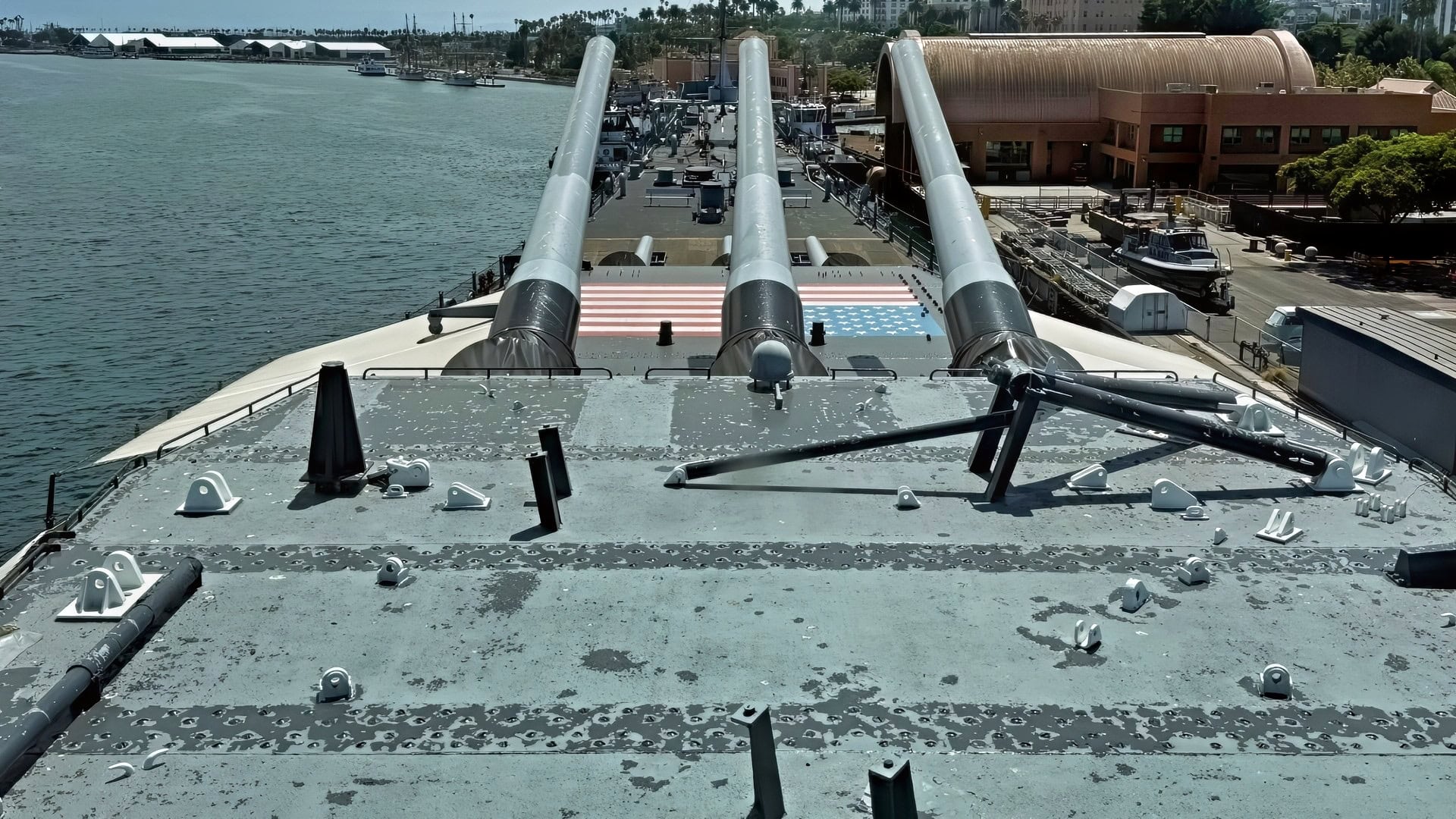
16-Inch Iowa-Class Guns USS Iowa. 19FortyFive.com Image.
The ships that Japan had rebuilt its shipyards to construct, invented new machinery to arm, and hidden behind years of elaborate secrecy accomplished almost nothing of what they were designed to do.
What endures is the construction itself, a program that pushed a nation’s entire heavy industry to its limit to build the largest battleships the world would ever see, and concealed them so effectively that the country fighting them learned their real size only after they were gone.
The Yamato Museum in Kure, built near the yard where the lead ship took shape, now draws visitors to a 26-meter scale model of a battleship whose true dimensions were, for most of its existence, one of the best-kept secrets of the Second World War.
About the Author: Harry J. Kazianis
Harry J. Kazianis (@Grecianformula), Editor-In-Chief of 19FortyFive, was the Senior Director of National Security Affairs at the Center for the National Interest (CFTNI), a foreign policy think tank founded by Richard Nixon based in Washington, DC. Harry has over a decade of experience in think tanks and national security publishing. His ideas have been published in the NY Times, The Washington Post, The Wall Street Journal, CNN, and many other outlets worldwide. He has held positions at CSIS, the Heritage Foundation, the University of Nottingham, and several other institutions related to national security research and studies. He is the former Executive Editor of the National Interest and the Diplomat. He holds a Master’s degree focusing on international affairs from Harvard University.