
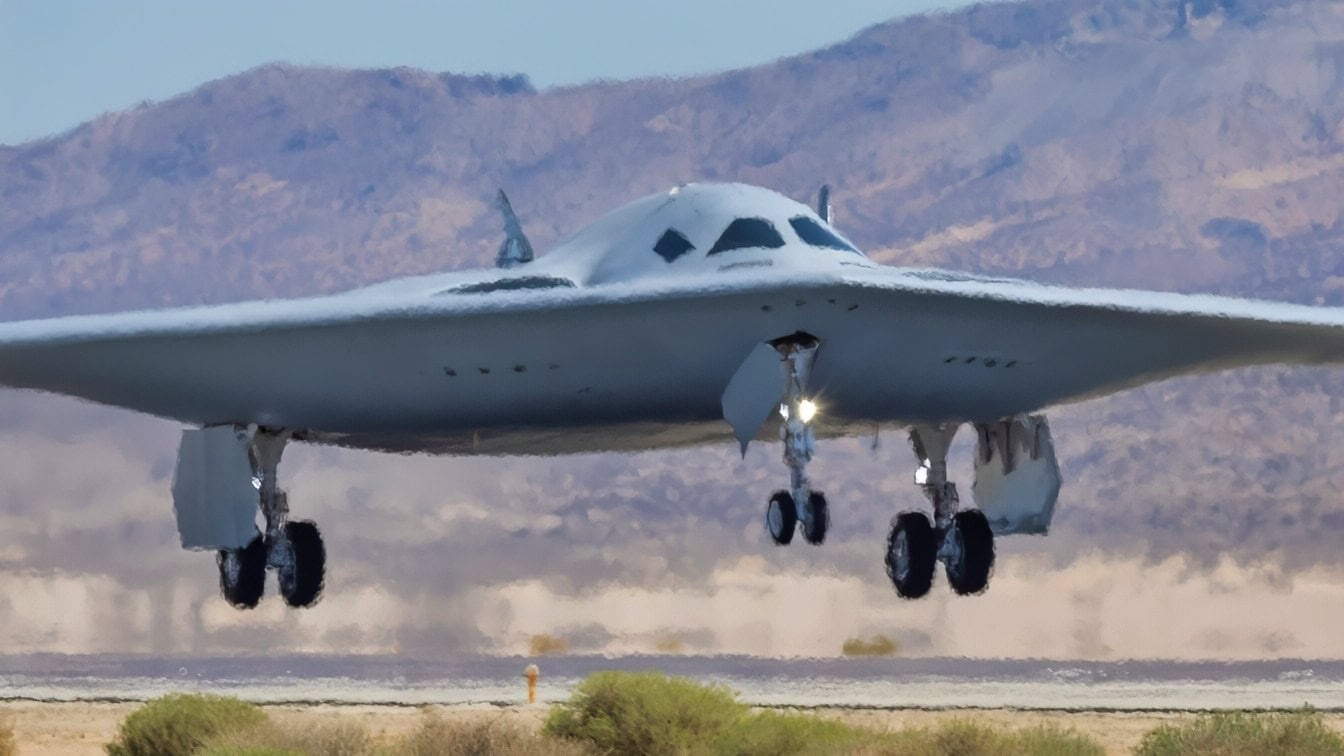
China Says PADJ-X Found B-21 Flaws Without the Bomber’s Classified Data: Chinese aerospace researchers say a new design tool exposed aerodynamic and stability weaknesses in the B-21 Raider. The January 7 report by Interesting Engineering described PADJ-X, a multidisciplinary optimization platform developed by a team led by Huang Jiangtao at the China Aerodynamics Research and Development Center.
The researchers applied 288 design variables to what they called a “B-21 type” configuration. They reported a 15 percent increase in lift-to-drag ratio, smaller shock-wave effects, and a change in pitching-moment coefficient from 0.07 to minus 0.001, according to the South China Morning Post’s account of the study.
Those numbers describe a mathematical model, not the aircraft flying at Edwards Air Force Base. The researchers did not disclose the data used to construct their baseline. The B-21’s exact geometry, mass distribution, center-of-gravity limits, control laws, propulsion installation, radar-absorbing materials, and operating conditions remain classified.
The real program passed its critical design review in 2018. A second test aircraft arrived at Edwards in September 2025, moving the campaign beyond initial flight-performance work and into mission-systems and weapons-integration testing. As of July 29, no public Air Force response to the PADJ-X study was available.
PADJ-X Optimized an Assumption Set, Not the US Air Force B-21 Raider Bomber
Optimization software improves the objective function as defined by its designers, subject to specified constraints. A 15 percent lift-to-drag gain means the revised model moved through the modeled airflow more efficiently under the specified conditions. It does not establish that the baseline was defective or that the revision met the Raider’s full mission.
A penetrating bomber must balance range, payload, structural strength, internal volume, engine airflow, infrared signature, radar signature from several directions, maintainability, and handling. The B-21’s smaller airframe reflects several of those tradeoffs. Changing a wing contour to reduce drag also changes volume, loads, control authority, and electromagnetic behavior.
This is the central weakness in the broader claim that PADJ-X uncovered a B-21 design flaw. Public photographs reveal the bomber’s general planform. They do not provide the engineering definition needed to reproduce the aircraft or the classified requirements Northrop Grumman was ordered to meet.
Near-Zero Pitching Moment Is Trim, Not Proof of Stability
The pitching-moment result also requires care. A coefficient close to zero at one modeled operating point indicates that the aircraft is near aerodynamic trim at that point. It does not establish longitudinal stability over the course of a mission.
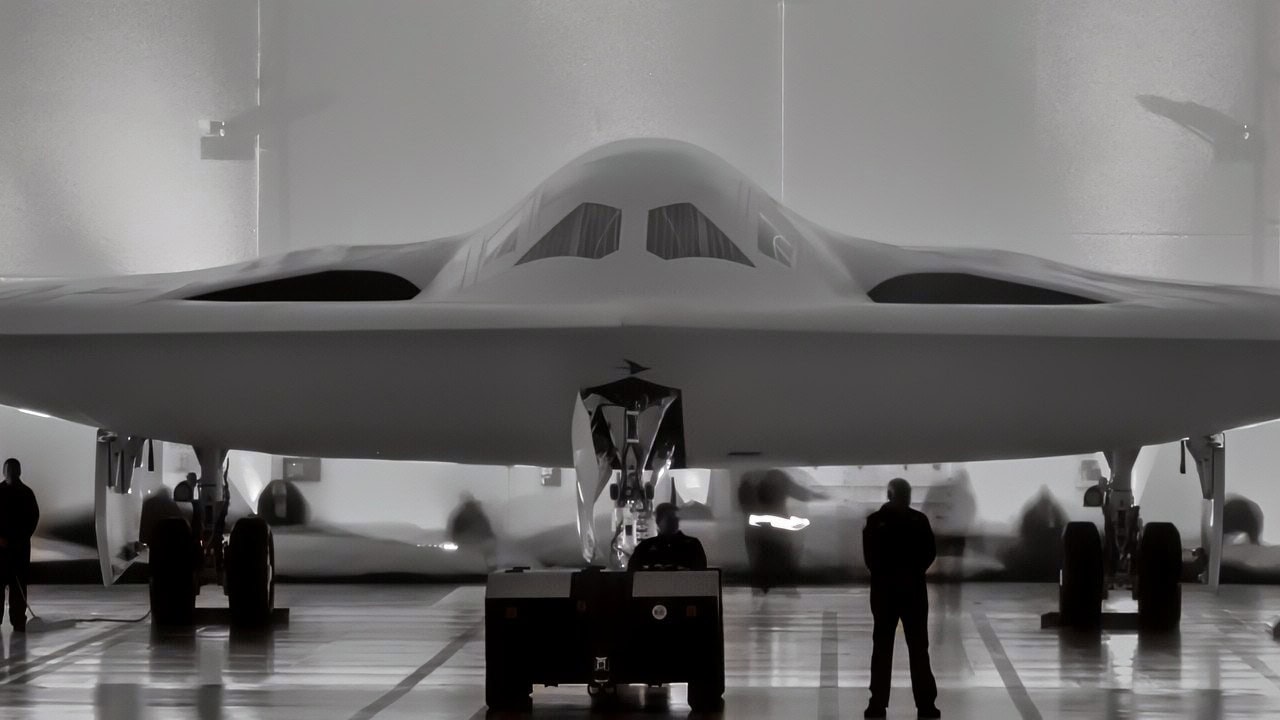
A B-21 Raider is unveiled at Northrop Grumman’s manufacturing facility on Air Force Plant 42 in Palmdale, California, Dec. 2, 2022. The B-21 will be a long-range, highly survivable, penetrating strike stealth bomber capable of delivering both conventional and nuclear munitions. (U.S. Air Force photo by Airman 1st Class Joshua M. Carroll)

U.S. Air Force Airmen with the 912th Aircraft Maintenance Squadron prepare to recover the second B-21 Raider to arrive for test and evaluation at Edwards AFB, Calif., Sept. 11, 2025. The arrival of a second test aircraft provides maintainers valuable hands-on experience with tools, data and processes that will support future operational squadrons. (U.S Air Force photo by Kyle Brasier)
Static stability depends on how the pitching moment changes with angle of attack and on the relationship between the aerodynamic center and the center of gravity. An aircraft is trimmed when its net pitching moment is zero. A destabilizing moment slope drives it farther from the trimmed condition after a disturbance, as an Embry-Riddle aerodynamics text explains.
A serious assessment therefore needs the modeled speed, altitude, angle of attack, fuel state, weapons load, center-of-gravity position, and control response across the relevant envelope. The published summary does not provide those inputs. PADJ-X found a geometry with a lower calculated pitching moment under selected conditions; it did not demonstrate that the B-21 is unstable.
China’s Design Tool Is the More Important Development
Adjoint optimization itself is not new. NASA’s FUN3D software dates to the late 1980s and supports adjoint-based analysis, mesh adaptation, and design optimization. The Chinese team’s broader claim is that PADJ-X integrates aerodynamics, propulsion, electromagnetics, infrared signature, and sonic-boom effects into a single framework.
If the platform performs as described, its value lies in reducing the time and computing expense needed to compare complex designs. Chinese engineers would gain a faster way to narrow options for future bombers, fighters, and uncrewed aircraft before committing to wind-tunnel models or prototypes. The B-21 exercise demonstrates China’s digital-engineering ambitions, not the successful reconstruction of the Raider.
The distinction also matters when reading Chinese simulations involving the B-21. A model’s output depends on the performance values, sensor assumptions, and rules it contains. Classified aircraft leave outside researchers estimating the inputs that control the result.
The Real B-21 Is Being Judged in Flight
The Air Force is mixing developmental and operational testing earlier than usual. An operational test pilot flew the Raider with a developmental test pilot in 2026, allowing the service to assess combat suitability alongside technical performance. An Air Force test plan scheduled for 180 days was completed in 73, while operational pilots began flying the aircraft.
Production is moving at the same time. In February, the Air Force and Northrop Grumman agreed to use $4.5 billion in appropriated funds to increase annual production capacity by 25 percent. Aircraft are expected at Ellsworth Air Force Base in 2027. U.S. Strategic Command chief Adm. Richard Correll told senators on March 26 that his command requires 145 Raiders, a demand tied to Northrop Grumman’s faster production plan.
On July 9, the Air Force announced that the B-21 will operate with a two-pilot crew after analyzing the aircraft’s capabilities and long-range mission profile. The decision ended speculation that automation would reduce the cockpit to one pilot, an issue examined in recent coverage of the crew requirement.
The Air Force has not released the geometry, mass properties, control laws, or flight-test data needed to reproduce the B-21. Those records remain inside the classified test program at Edwards.
About the Author: Harry J. Kazianis
Harry J. Kazianis (@Grecianformula) was the former Senior Director of National Security Affairs at the Center for the National Interest (CFTNI), a foreign policy think tank founded by Richard Nixon based in Washington, DC. Harry has over a decade of experience in think tanks and national security publishing. His ideas have been published in the NY Times, The Washington Post, The Wall Street Journal, CNN, and many other outlets worldwide. He has held positions at CSIS, the Heritage Foundation, the University of Nottingham, and several other institutions related to national security research and studies. He is the former Executive Editor of the National Interest and the Diplomat. He holds a Master’s degree focusing on international affairs from Harvard University.