
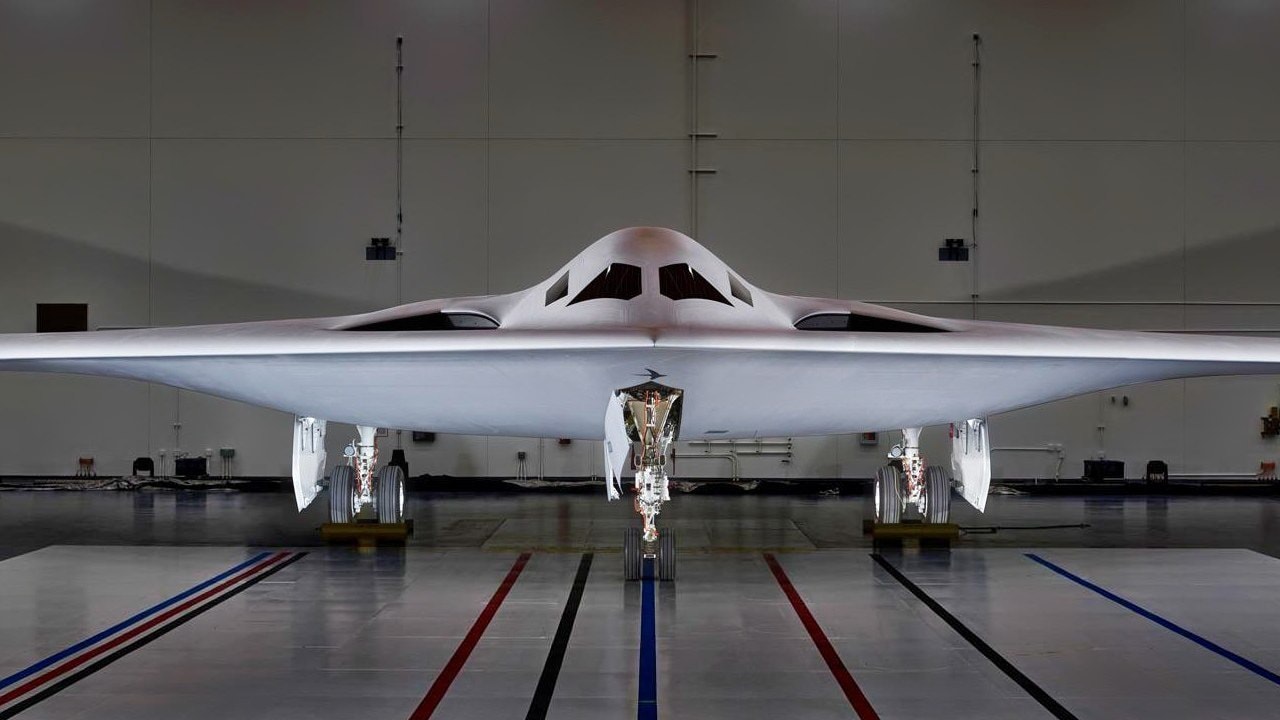
Summary and Key Points: A Chinese research team published a computer simulation in which China’s new stealth aircraft, advanced sensors, and hypersonic missiles hunt down and destroy America’s next stealth bomber, the B-21 Raider. The result made headlines. But strip away the framing, and the study shows something close to the opposite of what it claims: not that China can kill the B-21, but that doing so would require solving a long chain of hard problems all at once, and the simulation simply assumes they are. Detecting a stealth bomber is difficult. Killing one is much harder, and China’s own math quietly admits it.
China’s B-21 Raider Problem Not Exactly Solved
The claim is striking and worth stating plainly. As the South China Morning Post reported back in late 2023, a team led by associate professor Chen Jun of Northwestern Polytechnical University ran a computer simulation, published in the peer-reviewed journal Acta Aeronautica et Astronautica Sinica, in which Chinese forces detect and shoot down a B-21-like stealth bomber using a combination of stealth aircraft, hypersonic missiles fired from near space, and advanced tactics. It is one entry in a steady stream of Chinese studies claiming to defeat American stealth, and the natural instinct is to read it as a warning that the B-21 is already obsolete. That reading is wrong, but the reasons it is wrong are more interesting than the headline.
This Won’t Be Easy
Start with what is genuinely true, because the study is not fantasy. Detecting stealth aircraft is a real and advancing science, and China has invested heavily in it: infrared search-and-track systems that hunt the heat of an engine rather than bouncing radar off the airframe, passive radars that read the disturbance a stealth jet makes in ambient signals, low-frequency radars that see what fire-control sets cannot, and most recently, space-based radar satellites claimed to spot low-signature targets from orbit.
The numbers Chinese teams publish are eye-catching: an infrared system said to track aircraft from 285 kilometers away, land-based radars claimed in one 2024 simulation to detect an F-22 or F-35 from 180 kilometers away, and an F-35 in its weapons-laden “beast mode” from a startling 450 kilometers away. The underlying physics is sound. Stealth reduces a signature; it does not erase one.
A hot exhaust plume radiates, a large aircraft still reflects some energy, and low-frequency radar has always seen stealth shapes better than the high-frequency sets used to guide missiles. No serious Western planner believes stealth is permanent invisibility, which is precisely why the B-21 was designed with far more than a low radar cross-section in mind. On the narrow question of whether China can sometimes detect a stealth bomber, the answer is plausibly yes, and increasingly so.
Here is where the simulation quietly changes the subject. Detecting an aircraft and killing it are separated by an enormous, unglamorous gap, and that gap is the whole game. A kill requires a chain: detect the target, then maintain a continuous track precise enough to guide a weapon, then get that weapon to the target, then have it complete the intercept against a moving, emitting almost nothing, jamming, and actively maneuvering bomber that is trying to break the chain. Each link is harder than the one before.
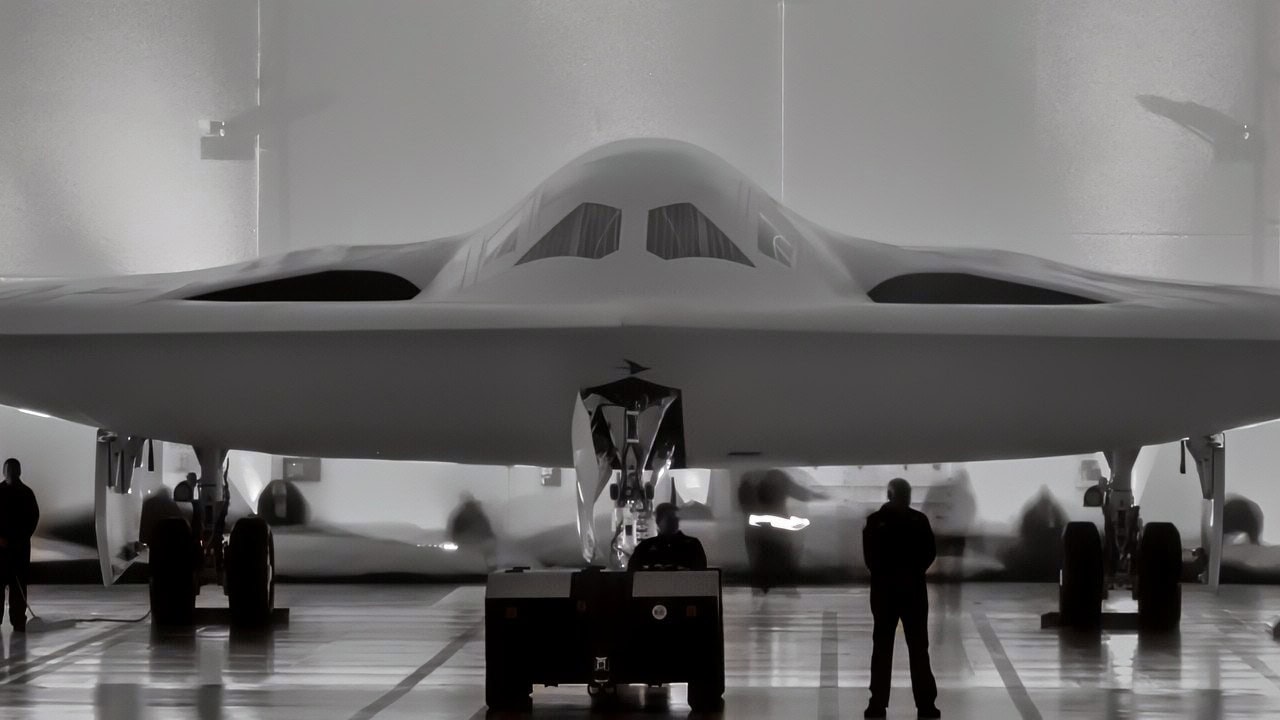
A B-21 Raider is unveiled at Northrop Grumman’s manufacturing facility on Air Force Plant 42 in Palmdale, California, Dec. 2, 2022. The B-21 will be a long-range, highly survivable, penetrating strike stealth bomber capable of delivering both conventional and nuclear munitions. (U.S. Air Force photo by Airman 1st Class Joshua M. Carroll)

U.S. Air Force Airmen with the 912th Aircraft Maintenance Squadron prepare to recover the second B-21 Raider to arrive for test and evaluation at Edwards AFB, Calif., Sept. 11, 2025. The arrival of a second test aircraft provides maintainers valuable hands-on experience with tools, data and processes that will support future operational squadrons. (U.S Air Force photo by Kyle Brasier)
The low-frequency and space-based radars that can detect a stealth aircraft are notoriously poor at producing a weapons-quality track; they can tell you something is out there without providing enough precision to hit it. And a detection range is not an engagement range: knowing a bomber crossed a line 400 kilometers away is worlds apart from holding it tightly enough, long enough, to walk a missile onto it.
Cueing a hypersonic weapon onto a maneuvering aircraft, rather than a fixed target, is itself unproven at the required precision. A simulation can wave all of this away with favorable assumptions, and this one does. Built by its own authors, tuned with their own parameters, and run against a bomber whose true signature China can only estimate, it assumes the hard links hold. That is not evidence. It is a hypothesis dressed as a result.
Which raises the question of why the B-21 in particular keeps drawing this attention, and the answer explains the messaging. The Raider is not just another stealth aircraft; it is the centerpiece of America’s future ability to strike deep inside a defended country. Designed explicitly to penetrate the dense air defenses and missile networks China has built across the Western Pacific, the same networks that dominate wargames of a fight over Taiwan, it is the backbone of the U.S. bomber force for the next half-century, with a minimum of 100 planned and the first aircraft on track to reach Ellsworth Air Force Base in 2027. Two are already flying test missions, and the program recently put an operational pilot in the cockpit to begin combat-focused evaluation. A weapon that threatens to make China’s expensive defensive bubble permeable is exactly the weapon Beijing has the strongest incentive to convince the world it can defeat.
That incentive is the real story. A simulation showing a Chinese victory over the B-21 serves two audiences at once: it signals to Washington that American stealth will not guarantee access, and it reassures a domestic audience that the country is not defenseless against a bomber it cannot yet match. And it cannot yet match it: China’s own would-be equivalent, the H-20, has produced no confirmed flight and is slipping toward the 2030s, which means Beijing is working on the counter-stealth problem partly because it has no penetrating bomber of its own. None of the detection claims that fuel these studies have been independently verified, and a war game is not a shootdown. The same skepticism Western audiences rightly bring to Pentagon threat briefings belongs here in equal measure.
China’s B-21 Raider Problem Won’t Be Easy to Solve
So what does the study actually prove?
Not that the B-21 can be killed, but that killing it is a chain of unsolved problems China is signaling it wants to solve. Detecting the bomber is becoming genuinely more plausible, and that alone is worth American attention, because the Raider’s survivability was never meant to rest on invisibility.
But the leap from seeing a stealth bomber to destroying one remains exactly where the difficulty has always lived, and no simulation authored by the side that wants the answer can close that gap on paper.
China ran a war game and won it. The war game was the easy part.
About the Author: Harry J. Kazianis
Harry J. Kazianis (@Grecianformula) was the former Senior Director of National Security Affairs at the Center for the National Interest (CFTNI), a foreign policy think tank founded by Richard Nixon based in Washington, DC. Harry has over a decade of experience in think tanks and national security publishing. His ideas have been published in the NY Times, The Washington Post, The Wall Street Journal, CNN, and many other outlets worldwide. He has held positions at CSIS, the Heritage Foundation, the University of Nottingham, and several other institutions related to national security research and studies. He is the former Executive Editor of the National Interest and the Diplomat. He holds a Master’s degree focusing on international affairs from Harvard University.