
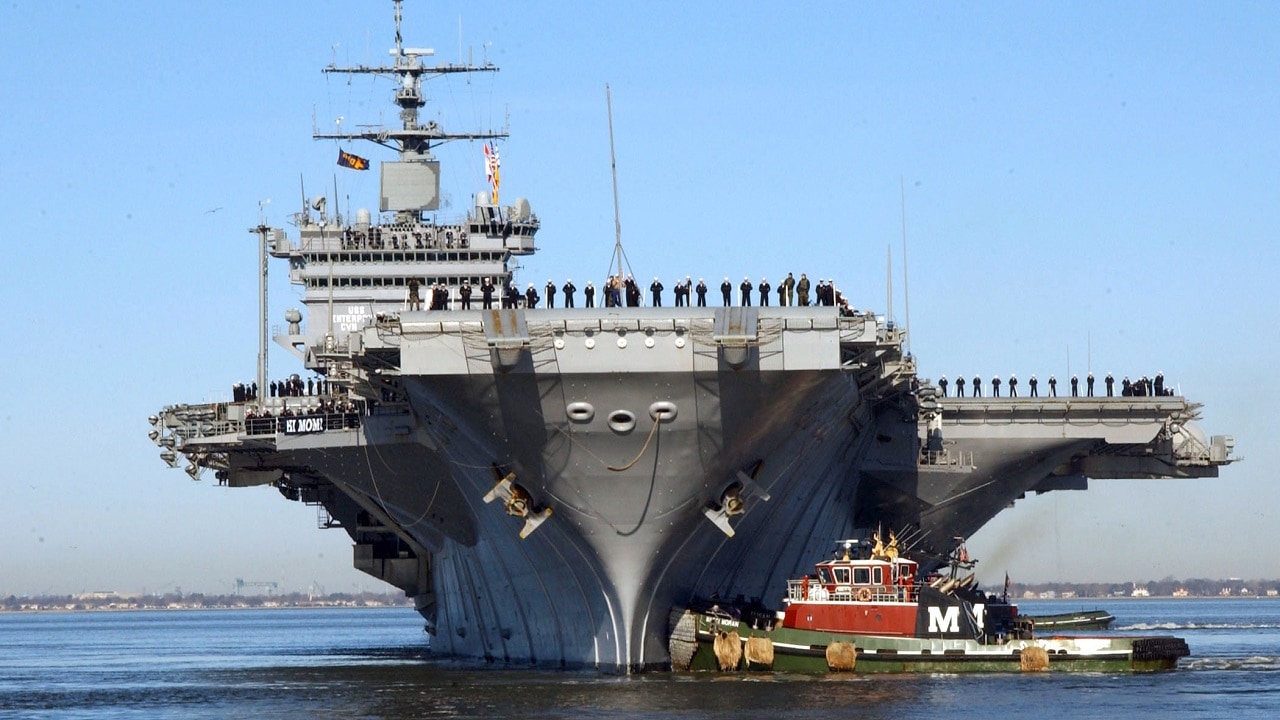
The U.S. Navy took USS Enterprise out of active service in December 2012. If the current disposal schedule holds, the last major section of the world’s first nuclear-powered aircraft carrier will not be processed until September 2030. The retirement of CVN-65 will have taken nearly 18 years.
The Navy awarded NorthStar Maritime Dismantlement Services a $418,497,668 firm-fixed-price contract on July 15, 2026. NorthStar will dismantle the entire carrier in Mobile, Alabama, recycle usable material and send hazardous and low-level radioactive waste to authorized disposal facilities.
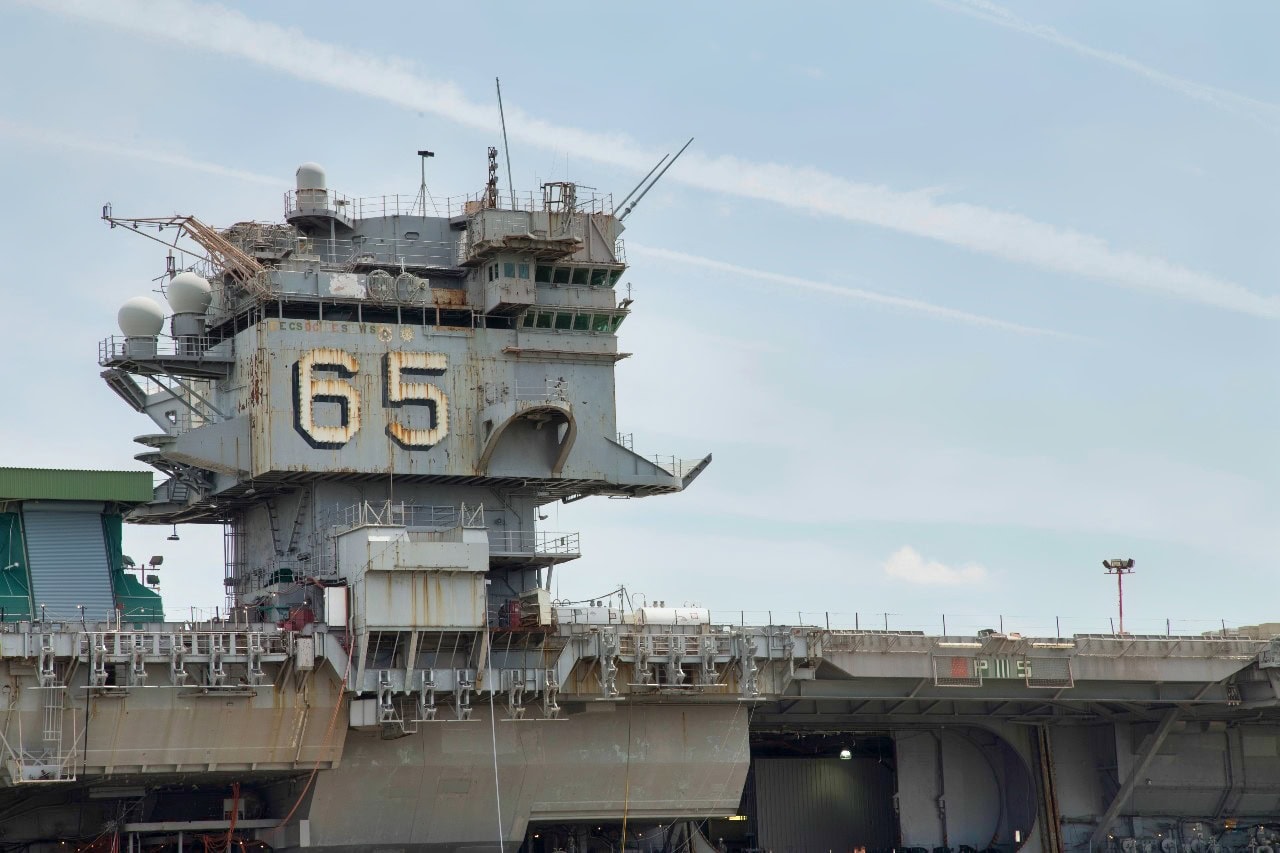
NEWPORT NEWS, Va. (July 15, 2018) — USS Enterprise (CVN 65) sits pierside at Newport News Shipbuilding following its decommissioning in February 2017. (U.S. Navy photo by Mass Communication Specialist 2nd Class Cat Campbell/RELEASED)
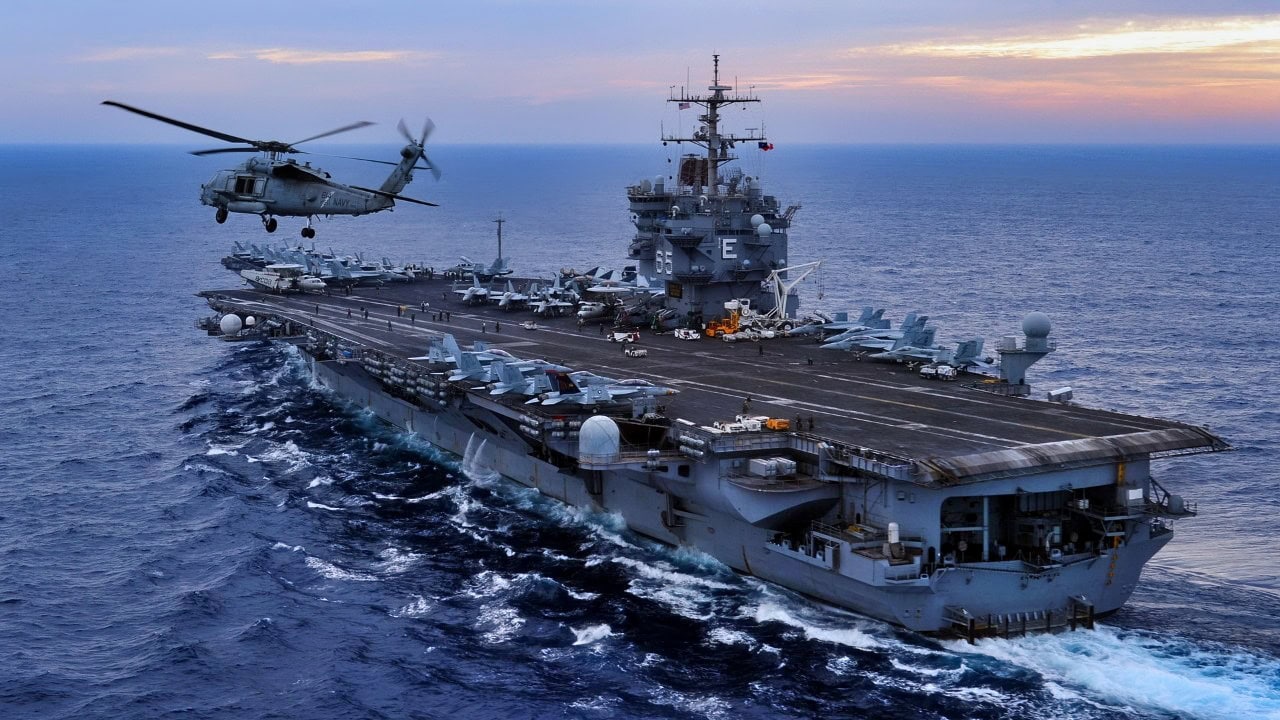
USS Enterprise from 2012. Image Credit: Creative Commons.
That contract covers the final physical destruction of the ship. It does not include the $863 million the Navy previously spent removing Enterprise’s nuclear fuel, stripping equipment and placing the carrier into an inactive condition. The Government Accountability Office documented that earlier cost after reviewing the program in 2018.
Adding the two publicly identified phases produces a bill of about $1.28 billion. The actual government cost is higher because that calculation does not capture every year of pier-side maintenance, environmental planning, engineering work, contract preparation and litigation surrounding the disposal program.
USS Enterprise Was Retired Years Before Her Decommissioning Work Ended
Enterprise completed 51 years of service before the Navy began her inactivation in 2012. She was formally decommissioned in February 2017, but GAO reported that the inactivation program continued through December of that year. The long gap between her final deployment and disposal shows why taking a nuclear carrier out of service is a separate industrial program, not a single ceremony.
Workers removed weapons, reusable equipment, classified systems, fluids and other material before defueling the propulsion plants. The spent nuclear fuel left the ship and entered the Naval Reactors fuel-management system. Enterprise no longer contains operating reactor cores, but reactor structures, piping, shielding and surrounding compartments still contain residual radioactive material that requires controlled handling.
Enterprise’s Eight Nuclear Reactors Made CVN-65 Unique
Enterprise used eight A2W reactors, a design choice inherited from the early nuclear era. The Nimitz-class carriers that followed use two much larger reactors. That eight-reactor propulsion arrangement made CVN-65 a one-of-a-kind disposal problem.
The Navy has decades of experience recycling nuclear submarines and cruisers. It had never dismantled a 1,100-foot nuclear aircraft carrier weighing more than 70,000 tons. Enterprise also carries asbestos, lead, oils, polychlorinated biphenyls and other regulated material spread through a ship designed and built during the 1950s.
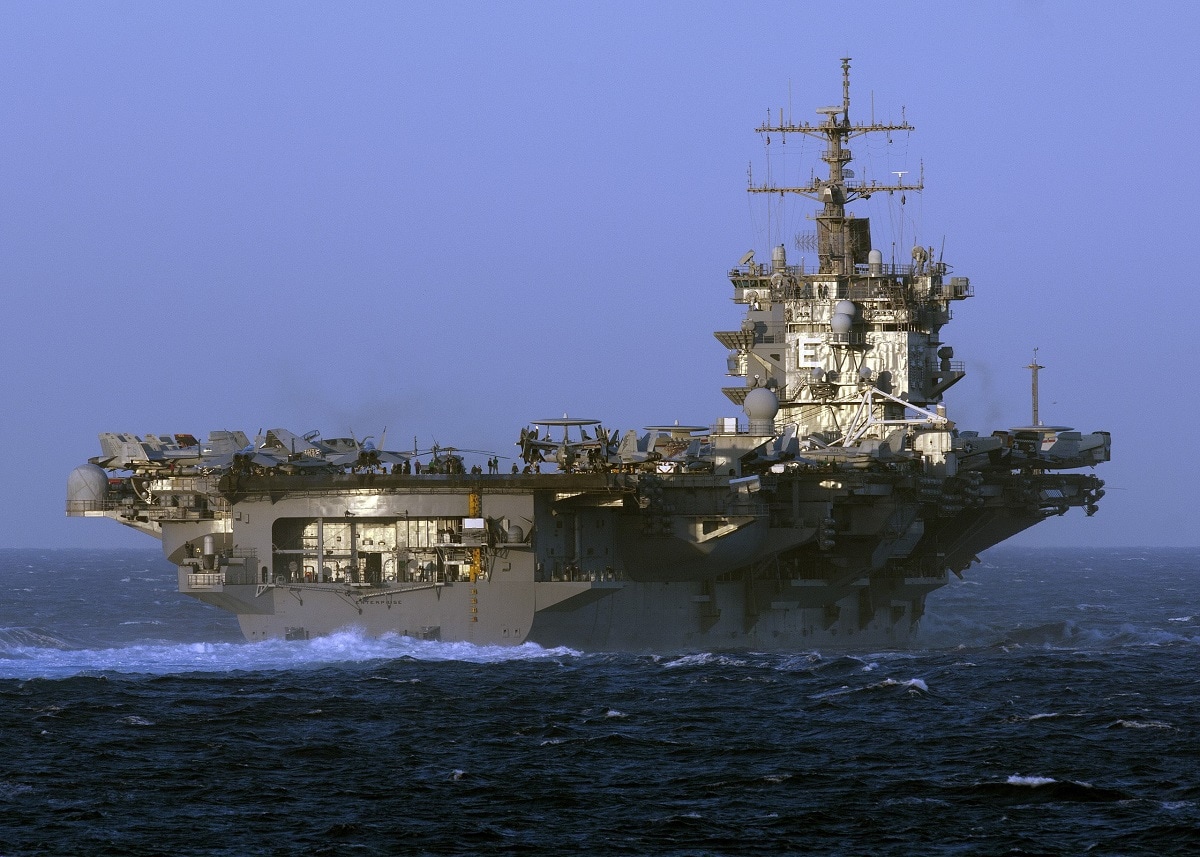
Image Credit: US Navy
Conventionally powered carriers follow a simpler path. The Navy transferred Kitty Hawk and John F. Kennedy to a shipbreaker for one cent each because the contractor expected to recover value from their steel and other metals. Those symbolic carrier sales transferred the cost and responsibility for ordinary dismantlement. Enterprise’s radiological material prevented that kind of arrangement.
The Navy also rejected preservation and sinking as realistic disposal methods. Removing the reactor plants and processing the surrounding material requires cutting deeply into the hull, while leaving radiological waste aboard would be unacceptable. The same difficulty has long complicated the retirement of America’s earlier nuclear-powered surface warships.
The Navy Spent Years Choosing How to Dismantle USS Enterprise
The Navy initially considered sending Enterprise to Puget Sound Naval Shipyard, where retired nuclear submarines and cruisers enter the Ship-Submarine Recycling Program. That option relied on a proven government process but would have consumed dry-dock space and nuclear-qualified labor needed to maintain active submarines and aircraft carriers.
GAO found that the public-yard approach might require about a decade of work once it began and cost more than $1 billion. Earlier planning placed the start deep into the 2030s because Puget Sound already faced a heavy submarine-maintenance and recycling workload.
The Navy eventually chose full commercial dismantlement. Its 2023 disposal decision and new carrier-disposal program office concluded that private industry could finish the job in about five years, at roughly half the projected public-yard cost, while preserving naval shipyard capacity for fleet maintenance.
Reaching that decision required years of environmental review and negotiations over regulatory responsibility. The Navy had to define how a commercial contractor would process a defueled naval reactor plant, control radiation exposure and move waste into licensed disposal channels. The debate over options, including why Enterprise could not simply become a museum or target ship, became part of the Navy’s search for a legally and technically workable disposal method.
The Navy Had to Award the Enterprise Contract Twice
The Navy first selected NorthStar in May 2025 under a $536.7 million contract with a planned November 2029 completion date. HII ShipCycle challenged the procurement after technical problems prevented it from submitting a proposal before the deadline. A federal judge ordered the Navy to reopen the competition.
The replacement award announced in July 2026 again selected NorthStar, this time for $418.5 million. The new contract is about $118 million lower than the original award, although scheduled completion moved from November 2029 to September 2030.
Because the agreement is firm-fixed-price, NorthStar assumes more of the financial risk if the work proves harder than expected.
That gives the Navy greater cost certainty, but Enterprise remains a first-of-its-kind project involving an old ship, incomplete historical records, and systems no commercial yard has previously dismantled at this scale.
Workers in Mobile Will Separate USS Enterprise Into Different Waste Streams
Enterprise must first be transferred from Newport News to the Mobile dismantlement facility. Workers will then remove the island, flight-deck structures, internal systems and large hull sections while continually identifying which materials can be recycled and which require controlled disposal.
Ordinary steel and nonferrous metals will enter commercial recycling channels after survey and release.
Asbestos, contaminated oils, lead and other hazardous substances will be packaged under environmental rules.
Low-level radioactive material from the reactor plants will be segregated, placed in approved containers and transported to authorized licensed sites.
The Navy’s final environmental impact statement examined transportation risks, worker exposure, air and water monitoring, accident response and waste disposal. The contractor must use controlled radiological work areas, personnel monitoring, contamination surveys and documented release criteria before material leaves the site.
The most dangerous material, the spent reactor fuel, is already gone. The Mobile project concerns the defueled propulsion plants and the residual radioactivity fixed inside components and structures. That distinction lowers the risk without turning the ship into conventional scrap.
USS Enterprise Will Set the Rules for Retiring the Nimitz Class
Enterprise is the Navy’s pilot project for every nuclear carrier that follows. Nimitz is scheduled to leave service in 2027, and the Navy has budgeted $562 million for its initial inactivation. The first Nimitz-class retirement will begin while Enterprise is still being dismantled.
Nimitz has two reactors rather than eight, but it is a roughly 100,000-ton ship and the first member of a 10-carrier class that will retire over several decades.
The Navy expects lessons from Mobile to shape contracts, waste packaging, regulatory oversight and cost estimates for each one.
The Enterprise name is already moving forward. The future USS Enterprise, CVN-80, is under construction at Newport News, and the Navy has used repurposed plate from CVN-65 in the new carrier.
If NorthStar meets its schedule, the final sections of the first nuclear Enterprise will leave the disposal process in September 2030 while her successor is being prepared for service.
MORE – China’s J-20 Stealth Fighter Is Ready to Challenge the F-22
About the Author: Harry J. Kazianis
Harry J. Kazianis (@Grecianformula) was the former Senior Director of National Security Affairs at the Center for the National Interest (CFTNI), a foreign policy think tank founded by Richard Nixon based in Washington, DC. Harry has over a decade of experience in think tanks and national security publishing. His ideas have been published in the New York Times, The Washington Post, The Wall Street Journal, CNN, and many other outlets worldwide. He has held positions at CSIS, the Heritage Foundation, the University of Nottingham, and several other institutions related to national security research and studies. He is the former Executive Editor of the National Interest and The Diplomat. He holds a master’s degree focusing on international affairs from Harvard University.

