

George Patton Hit Bottom More Than Once and Kept Returning to Command – “I don’t measure a man’s success by how high he climbs, but by how high he bounces when he hits bottom.” The sentence is widely attributed to General George S. Patton and has appeared in official U.S. military commentary, although a secure dated record of when he first said it is difficult to find.
As a description of Patton’s life, the line fits. His career was not a steady ascent from West Point to victory in Europe. He struggled in school, suffered a serious combat wound, spent years advocating armored warfare before the Army embraced it, inherited a corps damaged by defeat and nearly destroyed his own career by abusing two hospitalized soldiers.
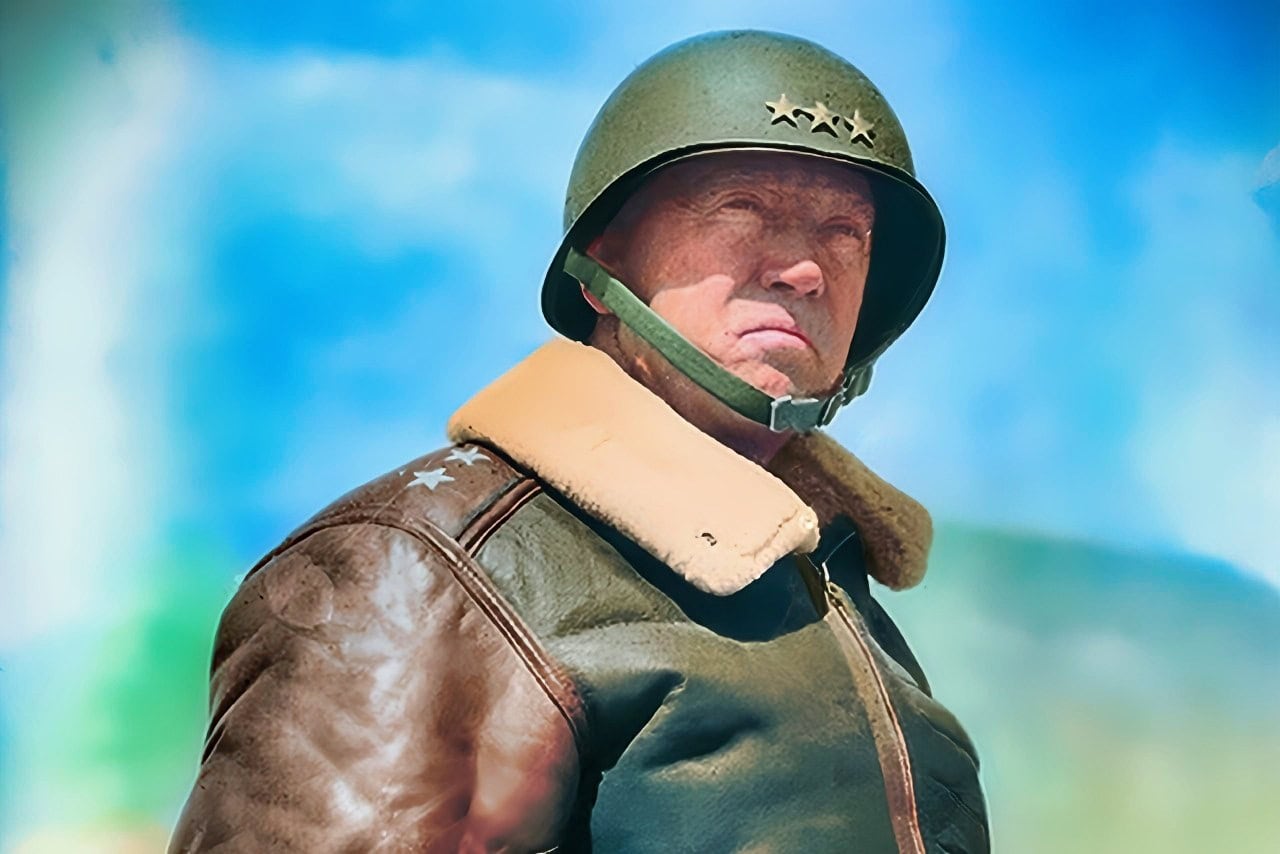
George Patton U.S. Army Photo

General Patton Portrait. Image Credit: Creative Commons.
Patton’s resilience should not be confused with innocence. Several of his worst problems were self-inflicted and deserved consequences. He recovered because he kept preparing, accepted assignments beneath the command he wanted, and retained an operational skill senior officers believed the Army would need again.
That combination made him unusually hard to discard. Patton was impulsive, vain, and reckless with words, yet he was also a relentless student of war. When his personality pushed him out of favor, his preparation often created another route back.
West Point Forced Patton to Learn Persistence
Patton entered the Virginia Military Institute in 1903 before transferring to West Point. He struggled academically and repeated his first year after failing to complete the required work. He stayed, graduated in 1909, and finished fifth among 42 competitors in the modern pentathlon at the 1912 Stockholm Olympics. The pattern behind Patton’s famous maxim was already visible.
His early service included the 1916 expedition into Mexico. During World War I, Patton organized the Army’s tank school in France, commanded the 304th Tank Brigade and was wounded at Cheppy in September 1918. He recovered and spent the interwar years studying mechanized warfare. The Army eventually fielded a huge M4 Sherman force, but Patton had worked through years when armor remained institutionally marginal.
Kasserine Gave Patton a Defeated Corps
The U.S. Army suffered a damaging setback at Kasserine Pass in February 1943. Eisenhower removed Major General Lloyd Fredendall and placed Patton in command of II Corps on March 6. Patton inherited troops whose confidence, discipline, and reputation had suffered under German attack.
He imposed stricter standards, restored order, and approved an offensive scheduled for later that month. The fighting at El Guettar gave American units an important success against a German armored counterattack. Omar Bradley replaced Patton in April, but the short assignment showed why Eisenhower turned to him when a formation needed urgency.
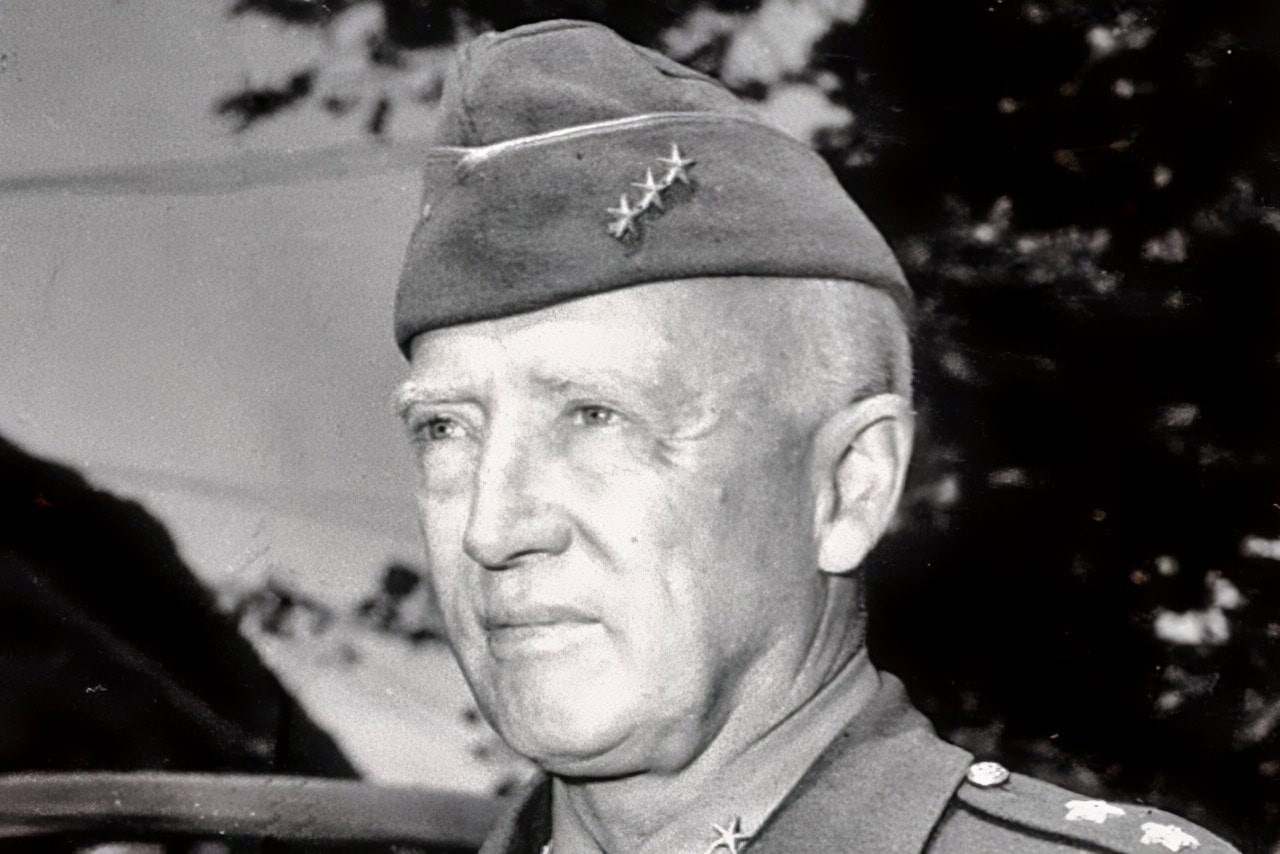
George S. Patton Quote of the Day. Creative Commons Image.
Sicily Was the Disaster Patton Created
Patton’s Seventh Army landed in Sicily in July 1943, captured Palermo, and reached Messina in August. The campaign strengthened his standing as a field commander. It also produced the scandal that nearly ended his career.
Patton slapped two soldiers receiving treatment for combat exhaustion, a condition now associated with post-traumatic stress. He accused them of cowardice and treated psychological injury as a moral failure. The Army ordered him to apologize, removed him from Mediterranean command and denied him the prominent role he expected in the invasion of France.
This was not bad luck or political persecution. Patton had abused wounded soldiers and damaged the Army publicly. Eisenhower retained him because battlefield skill remained scarce, not because the conduct was excusable. Their relationship depended on planning around Patton’s strengths while limiting the harm caused by his judgment.
A Phantom Army Became Patton’s Route Back
Patton’s public role before D-Day was command of the fictional First U.S. Army Group, part of Operation Fortitude. German leaders regarded him as one of the Allies’ most dangerous offensive commanders, so his presence made a supposed invasion near Pas-de-Calais credible. Army University Press describes his reputation as a central element of the deception.
Behind the deception, Patton prepared the real Third Army. It became operational in France on August 1, 1944, broke through German defenses and drove across the country. The commander sidelined before D-Day soon led one of the fastest Allied advances of the war, giving substance to another maxim about refusing defeat.
His largest recovery came during the Battle of the Bulge. Patton’s staff had studied a possible turn north before Eisenhower requested options. Third Army reoriented its attack and moved divisions almost 100 miles through winter weather in two days, according to the Army Center of Military History. Elements of the 4th Armored Division reached Bastogne on December 26.
Peace Exposed the Limits of Patton’s Judgment
After Germany surrendered, Patton wanted a combat command in the Pacific. Instead, he became military governor of Bavaria. His resistance to aggressive denazification and public comparison of former Nazis to American political party members created another controversy. Eisenhower removed him from Third Army in October 1945 and assigned him to the smaller Fifteenth Army.
There was no battlefield left on which Patton could restore his position. On December 9, his car collided with an Army truck near Mannheim. The crash broke his neck and left him paralyzed. Doctors prepared him for a flight home after signs of improvement, but a blood clot reached his heart at 5:55 p.m. on December 21.
MORE – The US Navy’s Toilet Problem
About the Author: Harry J. Kazianis
Harry J. Kazianis (@Grecianformula) was the former Senior Director of National Security Affairs at the Center for the National Interest (CFTNI), a foreign policy think tank founded by Richard Nixon based in Washington, DC. Harry has over a decade of experience in think tanks and national security publishing. His ideas have been published in the NY Times, The Washington Post, The Wall Street Journal, CNN, and many other outlets worldwide. He has held positions at CSIS, the Heritage Foundation, the University of Nottingham, and several other institutions related to national security research and studies. He is the former Executive Editor of the National Interest and the Diplomat. He holds a Master’s degree focusing on international affairs from Harvard University.

