
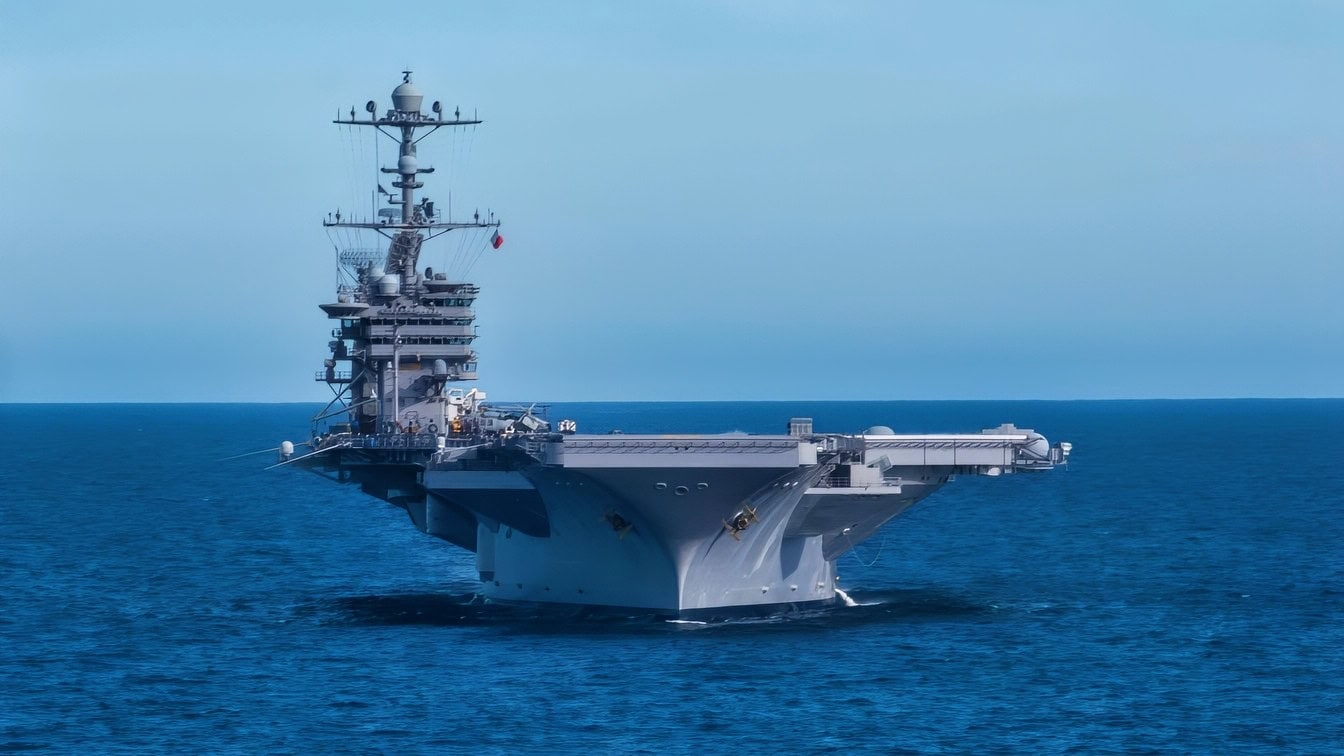
The U.S. Navy Needs a Bigger Fleet. But it Can’t be More of the Same: On September 12, if nothing changes, USS Abraham Lincoln will still be deployed. By then, the carrier and its strike group will have logged 295 days on deployment, the second-longest carrier run since the end of the Cold War, trailing only USS Gerald R. Ford’s 326-day marathon, which wrapped up in May.
Lincoln spent nearly seven months in the Arabian Sea with no announced port calls. Sustaining that two-carrier presence eventually meant pulling USS George Washington, the Navy’s only forward-deployed Pacific carrier, out of its home theater to relieve Lincoln, rather than surging in a fresh third ship.
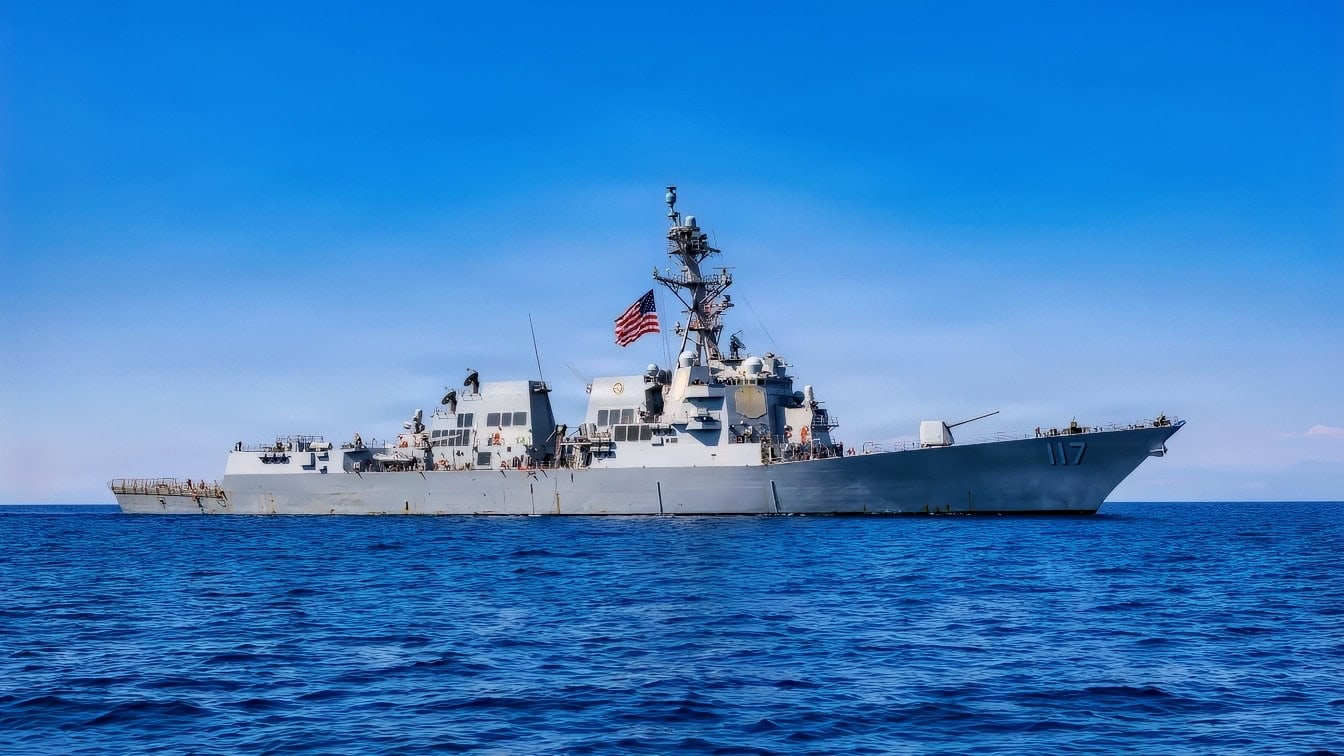
Arleigh Burke-class guided-missile destroyer USS Paul Ignatius (DDG 117) conducts boat operations while underway in the Mediterranean Sea, Aug 1, 2026. Paul Ignatius is on a scheduled deployment in the U.S. 6th Fleet area of operations to support the warfighting effectiveness, lethality and readiness of U.S. Naval Forces Europe-Africa, and defend U.S., Allied and partner interests in the region. (U.S. Navy photo by Mass Communication Specialist 2nd Class Deven Fernandez)
That’s not an unusual year anymore. Strike group deployments have averaged eight and a half months since Hamas attacked Israel on October 7, 2023. Right now George Washington is still in the Arabian Sea, supporting U.S. operations against Iran under Operation Epic Fury, away from the Western Pacific, where the Pentagon says it must concentrate against China.
Two hundred eighty-nine battle-force ships, ninety-nine deployed. On paper, that looks respectable. In practice, it’s a Navy meeting today’s demand by borrowing readiness it hasn’t banked yet.
The obvious response is that America needs a bigger Navy. That’s not wrong, exactly.
But if the plan is simply more of what’s already in the fleet, more carriers, more Virginia-class submarines, more Burke destroyers, at the prices those ships now command, the country will still be short a decade from now, with a much larger bill attached.
The real question isn’t how many ships the Navy needs. It’s how many missions still require the single most expensive ship in the yard.
None of this is an argument against carriers or submarines. A frigate cannot relieve a carrier in the Arabian Sea. But every mission that can be pushed down the cost ladder preserves scarce high-end capacity for the ones that cannot. A Ford- or Nimitz-class carrier generates a scale of sustained airpower and command capability that nothing unmanned comes close to matching. A Virginia-class attack submarine is about as close to irreplaceable as anything in the fleet for covert surveillance or high-end undersea warfare.
The country should keep building both. The trouble starts when that kind of capability becomes the default answer for jobs that don’t call for it.
The Burke Is Not a Beat Cop
That’s where the Arleigh Burke destroyer comes in. Burkes are superb warships, arguably the best surface combatants afloat. The Navy needs plenty of them for the missions that demand a Burke’s capabilities: high-end air and missile defense, escorting a carrier through contested waters, offensive surface action against a peer navy.
But a destroyer built for that fight also gets sent on presence patrols, maritime security missions, escort duty for routine convoys, and routine engagement and exercises with partner navies. Many of those lower-threat missions require presence and endurance more than the Burke’s full combat suite.
This isn’t a new complaint. In the 1970s, Chief of Naval Operations Elmo Zumwalt pushed what he called the high-low mix: expensive multimission ships paired with cheaper vessels built for narrower jobs, on the theory that an all-exquisite fleet would always be too small for its budget. The Oliver Hazard Perry-class frigates that came out of it served for decades, proof the idea could work.
The Navy Has Tried This Fix Before
The Navy’s current answer to the Burke problem is FF(X), a new frigate built off Huntington Ingalls’ Legend-class National Security Cutter, the hull the Coast Guard has run for years. The Navy says it will absorb routine work and free destroyers for harder missions, and the service has made it part of the “Golden Fleet.”
Sound plan. It’s close to a plan the Navy already tried twice and got wrong both times.
The Littoral Combat Ship was supposed to do exactly this. It became the textbook case of a program that never worked as sold. Constellation was meant to avoid that by adapting an existing European design with minimal changes. The Navy ended up truncating the program to two hulls, terminating four of the six frigates it had ordered, after the design drifted so far from its French-Italian parent that it retained less than fifteen percent commonality with the original.
Neither failure dooms FF(X). It means nobody should take the pitch on faith. The test was never the hull. It’s whether the Navy can leave a decent design alone long enough to build it at the price promised.
Below the Frigate, an Even Cheaper Answer
The same question the Navy is finally asking about destroyers applies one level down. Why does a mission need a crewed hull, with berths and life support for the people aboard, when what it actually calls for is persistence, or just eyes on the water?
In July, an Orca extra-large unmanned undersea vehicle completed a 1,000-nautical-mile transit across the Pacific. In May, the Navy picked seven companies, several outside the traditional shipbuilding club, to build and test Medium Unmanned Surface Vessels through this fall.
None of that hardware is meant to replace a submarine or a destroyer, and it shouldn’t be sold that way. Its value is in jobs that never needed a warship: persistent surveillance of a strait, mine clearance, distributed sensing that feeds a targeting picture without putting sailors in a minefield. The Navy already runs mine warfare this way, keeping people out of the water where the mines are.
Push that logic further, and a fair amount of the fleet’s workload starts to look like it belongs to a machine, not a warship.
The thing worth watching is whether the Navy keeps its discipline here too. An unmanned system only stays cheap enough to buy in numbers and risk more freely than a crewed warship as long as the Navy resists loading it with exquisite sensors until it costs nearly as much as what it replaced, and nobody will risk losing it. That’s the same failure mode as the frigate story, one rung down.
Two Navies, One Name
Put the pieces together, and the fleet the Navy needs looks less like a bigger version of today’s Navy and more like a differently shaped one: carriers and submarines reserved for missions that genuinely require them, frigates absorbing mid-tier work if FF(X) can hold its design discipline, and a growing layer of unmanned systems doing jobs that never needed a crew at all.
What makes this moment strange is that the Navy is building toward both futures under the same brand name. The frigate program is part of what the Navy calls the Golden Fleet. So is the Trump-class battleship, USS Defiant, a single capital ship promoted as more powerful than any battleship in history.
One instinct is to distribute naval power across dozens of cheaper, crewed ships and expendable unmanned systems. The other concentrates enormous money and firepower in one large, visible ship. The administration is pursuing both under the same name, and nothing yet forces a choice between them. Which instinct wins out will depend on what happens when budgets, shipyards, and procurement priorities eventually do.
About the Author: Dr. Andrew Latham
Andrew Latham is a professor of international relations and political theory at Macalester College in Saint Paul, MN. You can follow him on X: @aakatham.