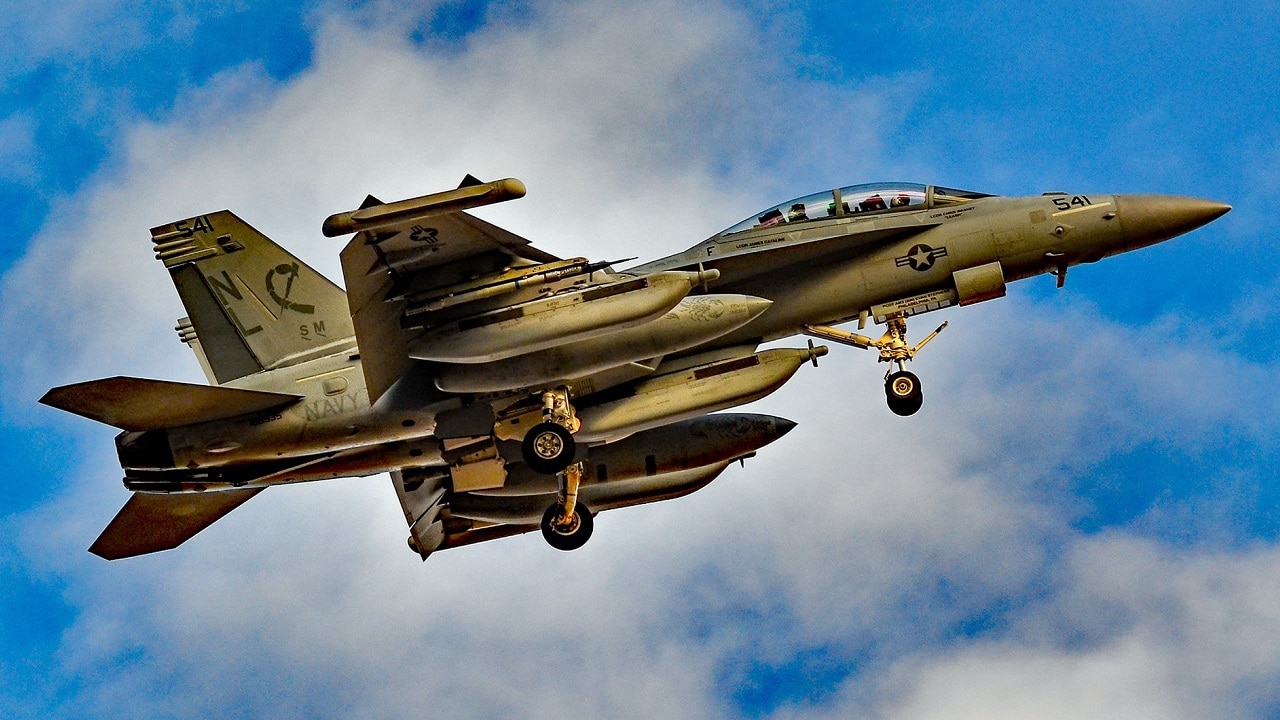
The EA-18G Growler is the United States Navy’s carrier-based electronic attack jet — in essence, a Super Hornet airframe turned into a jammer, sensor, and suppression platform for opening safe corridors through dense enemy air defense umbrellas.
Although a new crop of fifth- and sixth-generation aircraft is either increasingly coming online or just over the horizon, the Growler is likely to remain relevant to a future contingency in the Pacific with China, as that contest would likely hinge on long-range missiles, integrated air defenses, and electronic warfare as much as fighter-on-fighter aerial fights.
What the Growler was Built for
The Growler was designed to replace the EA-6B Prowler and perform the indispensable work of jamming radars and communications, locating hostile emissions, and suppressing enemy air defenses.
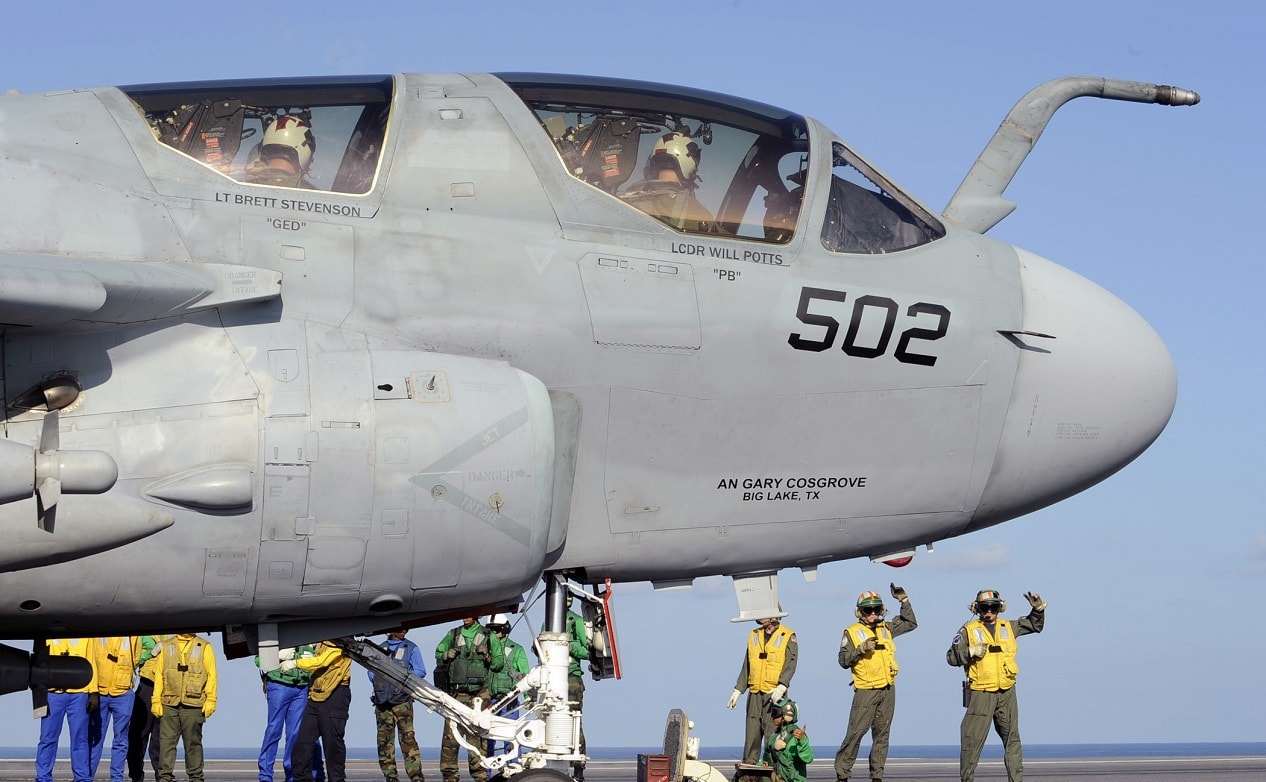
An EA-6B Prowler, assigned to the “Shadowhawks” of Electronic Attack Squadron 141 prepares to launch from a catapult during flight operations aboard the Nimitz-class aircraft carrier USS Theodore Roosevelt during carrier qualifications.
In practice, the Growler escorts strike packages, sits off, blankets part of the radio spectrum, and can fire anti-radiation missiles when jamming alone isn’t enough.
It is less a fighter than a battlefield enabler, and its ultimate purpose is to degrade the enemy’s ability to see, track, and coordinate, thereby allowing other aircraft to survive long enough to deliver weapons.
The Growler first entered production in 2004 and made its first flight in 2006.
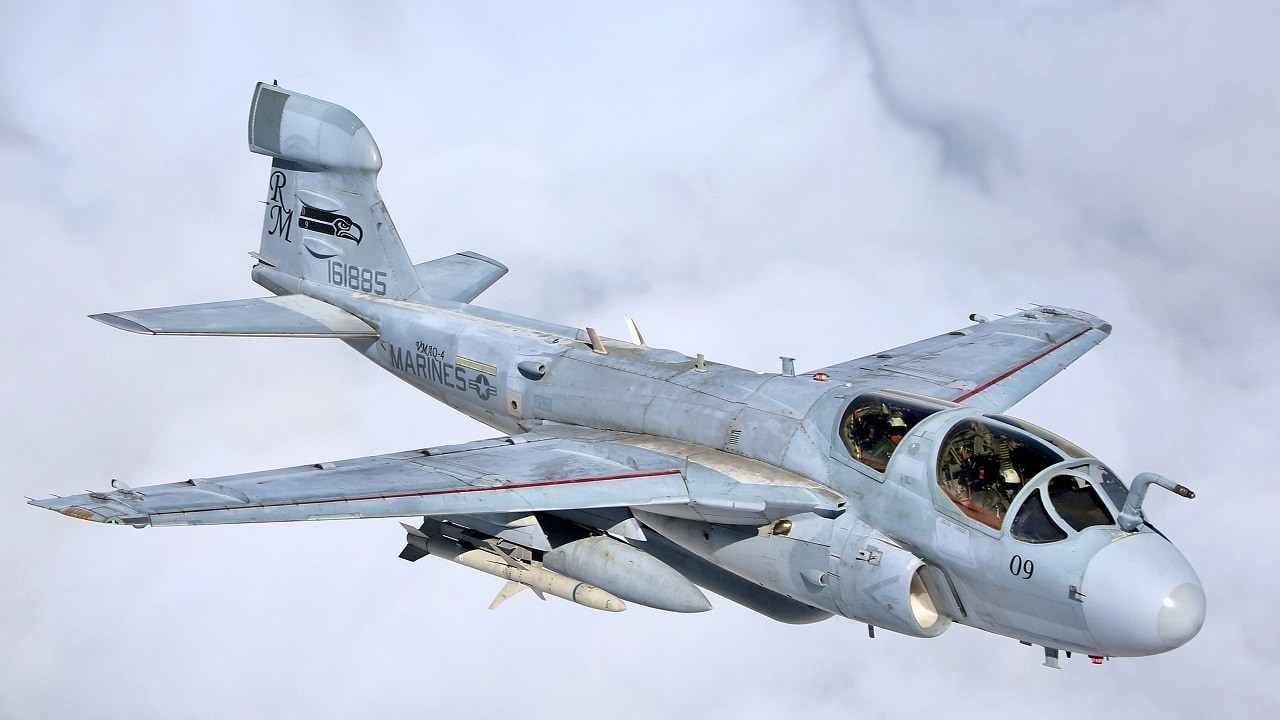
A total of 170 EA-6B Prowlers were constructed by Grumman, and not a single one was ever shot down in combat.
How the Growler is Different
Compared to the F/A-18F Super Hornet, the Growler is not a clean-sheet aircraft, but a missionized derivative of it.
It retains its parent’s carrier suitability, twin engines, speed, and basic combat resilience, while also integrating a specialized electronic warfare suite, with the second cockpit position dedicated to jamming.
As a result, the Growler is a dedicated electronic warfare machine that can still defend itself and carry weapons, but one whose real value lies in making the rest of a carrier air wing more lethal.
In terms of cost, the Growler is less expensive to build than the F-35B and F-35C, and about the same as the Super Hornet.
The Navy lists the EA-18G at about $67 million per unit, while the F-35B and F-35C cost about $102 million each.
A significant part of the Growler’s cost savings, compared to the fifth-generation F-35 family of aircraft, can be attributed to the Growler’s dearth of stealth characteristics and coatings, as well as its close similarities to its Super Hornet parent aircraft.
Relevance to the Pacific
In a hypothetical conflict in the Pacific with China, the Growler would play an essential role. A Western Pacific fight would likely be saturated with sensors, interceptors, surface-to-air missiles, and networking-heavy command systems, all of which are vulnerable to electronic attacks and make access expensive.
That said, the Growler is not a magic silver bullet.
Chinese air defenses are resilient, distributed, and adaptive, so jamming would be just one layer in a broader campaign involving stealth aircraft, stand-off weapons, decoys, cyber effects, and unmanned systems.
But in a theater where the first strike could be decisive, taking away the adversary’s eyes and ears is highly valuable from a strategic standpoint.
A New Crop of Aircraft: the U.S. Navy’s F/A-XX
While the United States Navy is awaiting the sixth-generation F/A-XX to be selected for service, that aircraft would likely complement the Growler in the nearer term, supplanting its fourth-generation predecessor in the future, depending on how the U.S. Navy chooses to build its future air wings.
The U.S. Navy has suggested that the future NGAD family of systems is expected to include a replacement for the Growler, but also that this could be accomplished through a broader manned-unmanned package rather than simply swapping out the Growler for another aircraft.
But electronic attack is evolving. If the F/A-XX incorporates built-in electronic warfare capabilities, longer reach, and better integration with unmanned aerial vehicles, some of the Growler’s current tasks could migrate to that new platform and its unmanned loyal wingmen-type subordinates. Even so, a dedicated jamming platform like the Growler could remain useful.

F/A-XX Boeing Image.
Perhaps the most likely outcome is a phased transition in which the Growler continues to play an important role through the 2030s, then gradually gives way to the F/A-XX or other platforms if that sixth-generation fighter, along with drones, can take up the burden of electronic warfare at a comparable scale.
In sum, the Growler’s future is unlikely to be an abrupt retirement but rather a gradual drawdown and replacement by newer, more powerful — and potentially unmanned — platforms.
About the Author: Caleb Larson
Caleb Larson is an American multiformat journalist based in Berlin, Germany. His work covers the intersection of conflict and society, focusing on American foreign policy and European security. He has reported from Germany, Russia, and the United States. Most recently, he covered the war in Ukraine, reporting extensively on the war’s shifting battle lines from Donbas and writing on the war’s civilian and humanitarian toll. Previously, he worked as a Defense Reporter for POLITICO Europe. You can follow his latest work on X.