
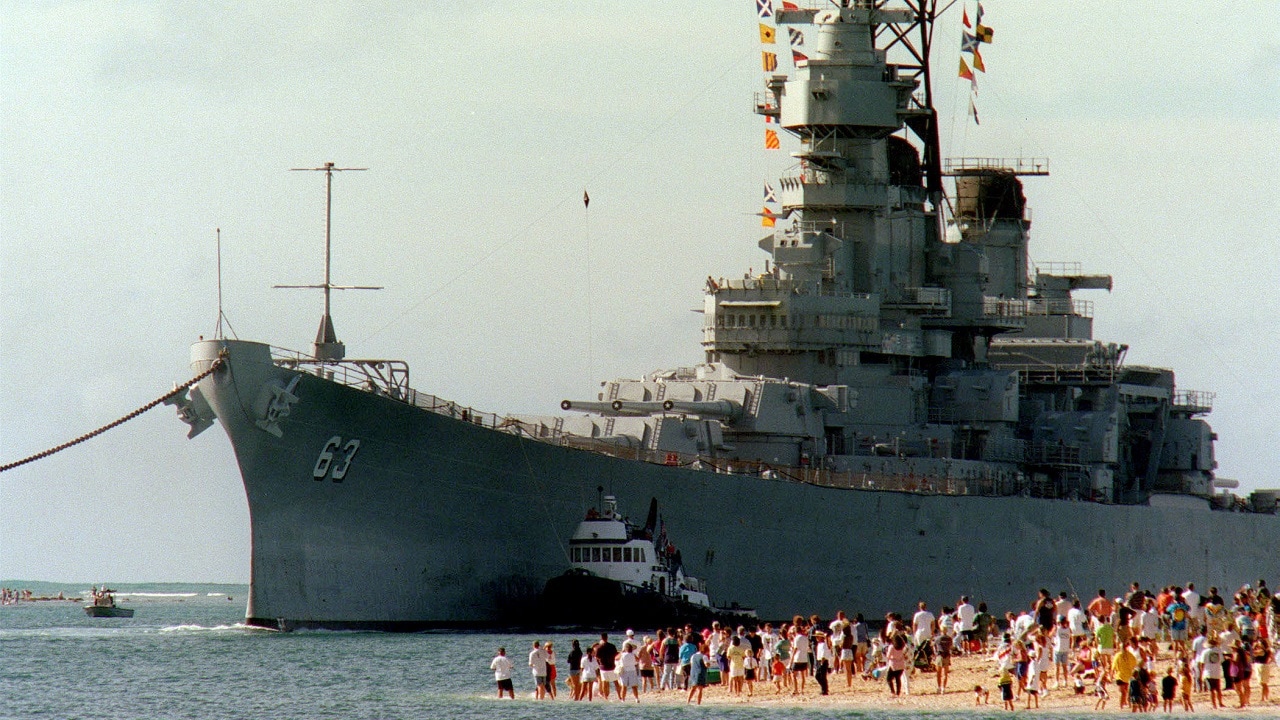
Trump-Class Battleship by the Numbers: $17.47 Billion, 128 VLS Cells, and 15 Planned Ships – The Trump-class battleship remains a design and budget proposal, not a contracted warship. As of August 4, 2026, the Navy planned to buy the future USS Defiant in fiscal 2028 at a gross weapon-system cost of $17.47 billion. April budget documents listed the ship as 840-888 feet long and 35,000-41,000 tons. Those preliminary dimensions may change as the nuclear propulsion plant selected in May is integrated.
The proposed battery centers on 128 Mk 41 vertical-launch cells and 12 positions for Conventional Prompt Strike hypersonic weapons. That is smaller than Russia’s recently rebooted Kirov-class battlecruiser, the Admiral Nakhimov. The Navy also wants nuclear-capable cruise missiles, high-output lasers, advanced naval guns, and larger payload modules for weapons too large for the Mk 41. No final combat-system baseline, armor standard, or operational missile load has been published.
The formal shipbuilding plan schedules 15 battleships through fiscal 2055, replacing the original political goal of 20 to 25. The first three account for $43.526 billion in planned shipbuilding funds through fiscal 2031, plus $3.9 billion in research and development.
Congress has not committed to the class. A bipartisan Senate stopgap funding proposal released on August 3 excluded the administration’s request for $1 billion in fiscal 2027 advance procurement. The White House said the money was needed to order nuclear-propulsion components before the lead ship’s planned purchase.
USS Defiant Is Smaller Than Iowa by Weight, Not Length
The Trump class is smaller than an Iowa-class battleship by displacement, but not necessarily by length. USS Wisconsin measures 887 feet 3 inches and displaces 57,271 tons at full load. Defiant’s preliminary range reaches 888 feet, while its upper displacement figure is 41,000 tons. It would be almost Iowa-length while weighing at least 16,000 tons less.
The Iowas were built around nine 16-inch guns, heavy armor, and large magazines for shells and powder. Defiant is being shaped as a missile magazine, sensor platform, and fleet headquarters. The Navy has released no armor-belt thickness, underwater-protection standard or damage-resistance specification that supports a direct survivability comparison with a World War II battleship.
Early design material placed the crew between 650 and 850 sailors, far below the roughly 2,700 carried by an Iowa during World War II. Automation and the absence of large gun crews reduce manpower, although a nuclear propulsion plant requires specially trained watchstanders and maintainers.
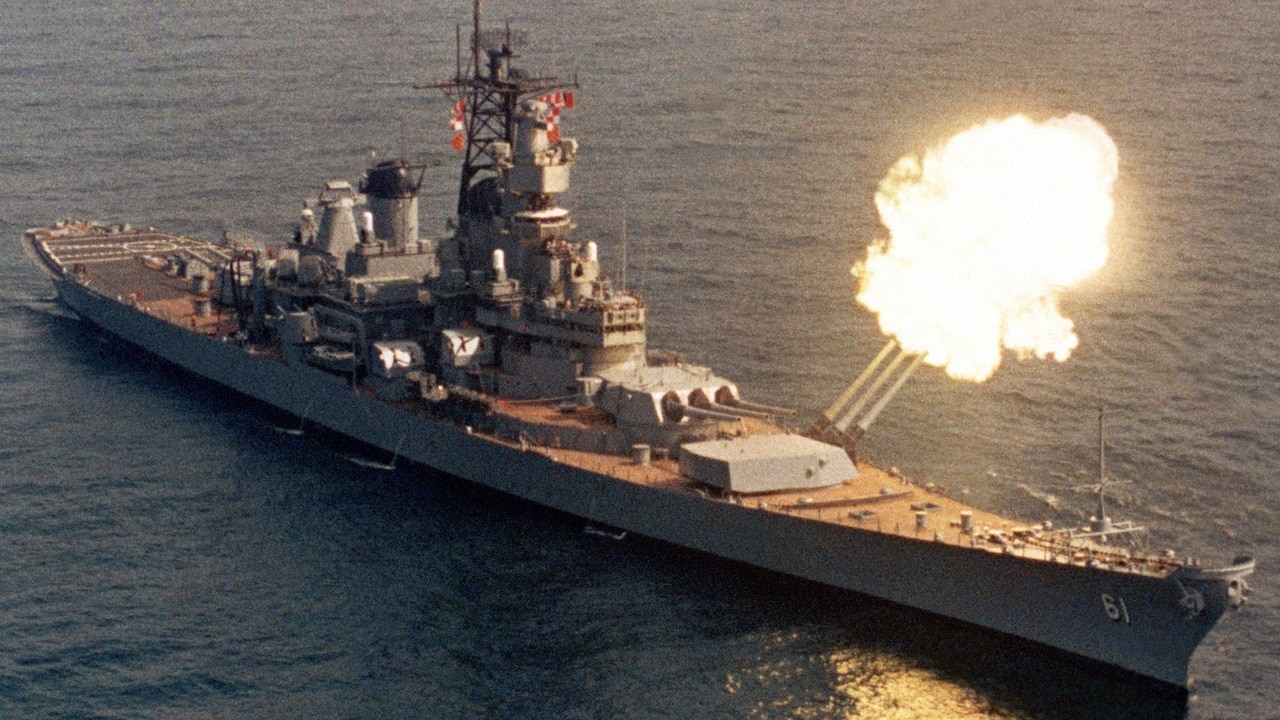
An aerial starboard bow view of the battleship USS IOWA (BB 61) firing a 2,700-pound projectile from the barrel of a forward 16-inch gun during sea trials off the coast of Mississippi. The IOWA is scheduled to be recommissioned into the fleet on April 28, 1984, after completion of modernization/reactivation construction at Ingalls Shipbuilding, Pascagoula, Mississippi.
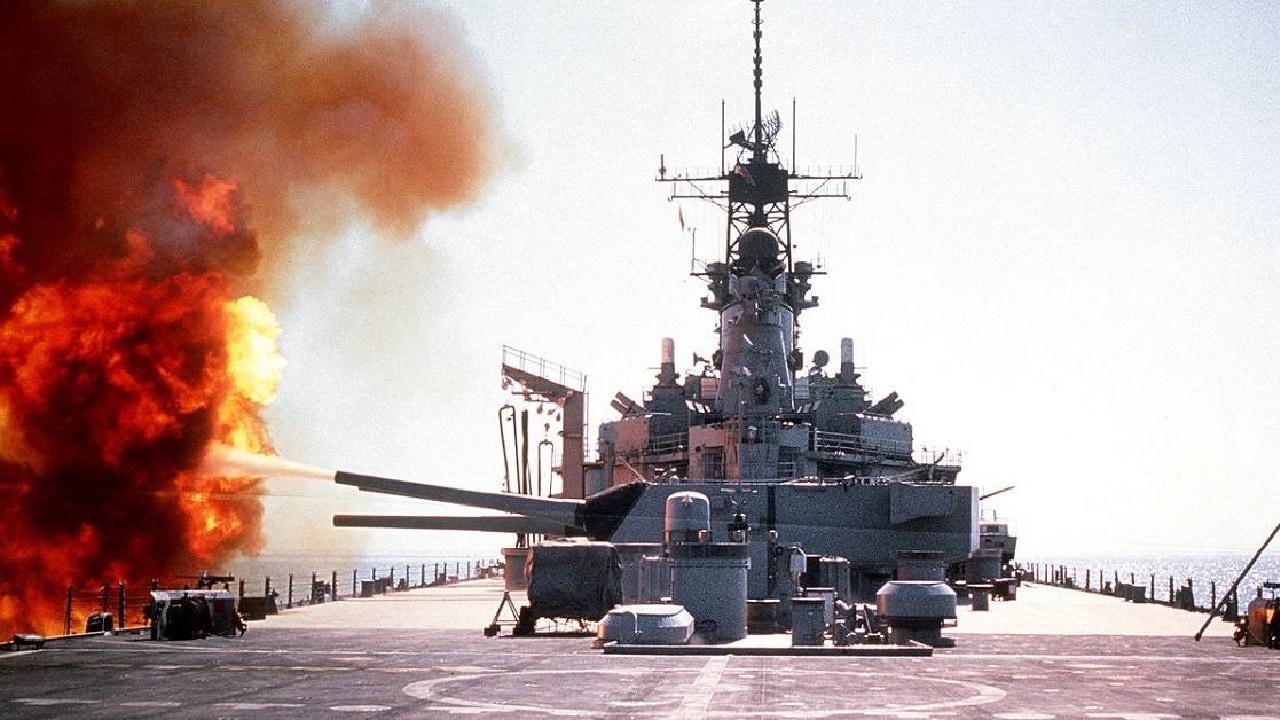
Image of Iowa-class battleships firing her 16-inch guns. Image Credit: Creative Commons.
The ship is intended to defend a carrier strike group, lead a surface action group, coordinate manned and unmanned forces, attack ships and submarines, and strike targets ashore. The Navy describes the proposed 15-ship force as the high end of a high-low fleet and says it is not a destroyer replacement.
128 Mk 41 Cells Do Not Equal One Fixed Missile Count
The clearest armament number is 128 Mk 41 cells, 32 more than an Arleigh Burke destroyer and six more than a Ticonderoga-class cruiser. The Mk 41 launches Standard Missiles, Tomahawks, Vertical Launch Anti-Submarine Rockets, and Evolved SeaSparrow Missiles.
One cell does not always mean one missile. Most large weapons occupy a full cell, but the Mk 25 canister quad-packs four Evolved SeaSparrow Missiles into one position. A Defiant carrying single-round weapons plus 12 hypersonic rounds would hold 140 major missiles. Quad-packed ESSMs would raise the physical total.
The real load would mix long-range air-defense interceptors, ballistic-missile-defense weapons, land-attack missiles, anti-submarine rockets, and shorter-range defensive rounds. Threat, available inventory, and escort composition would determine the balance. A deep magazine also creates a replenishment problem because the Navy still lacks a routine method for reloading Mk 41 cells at sea during combat.
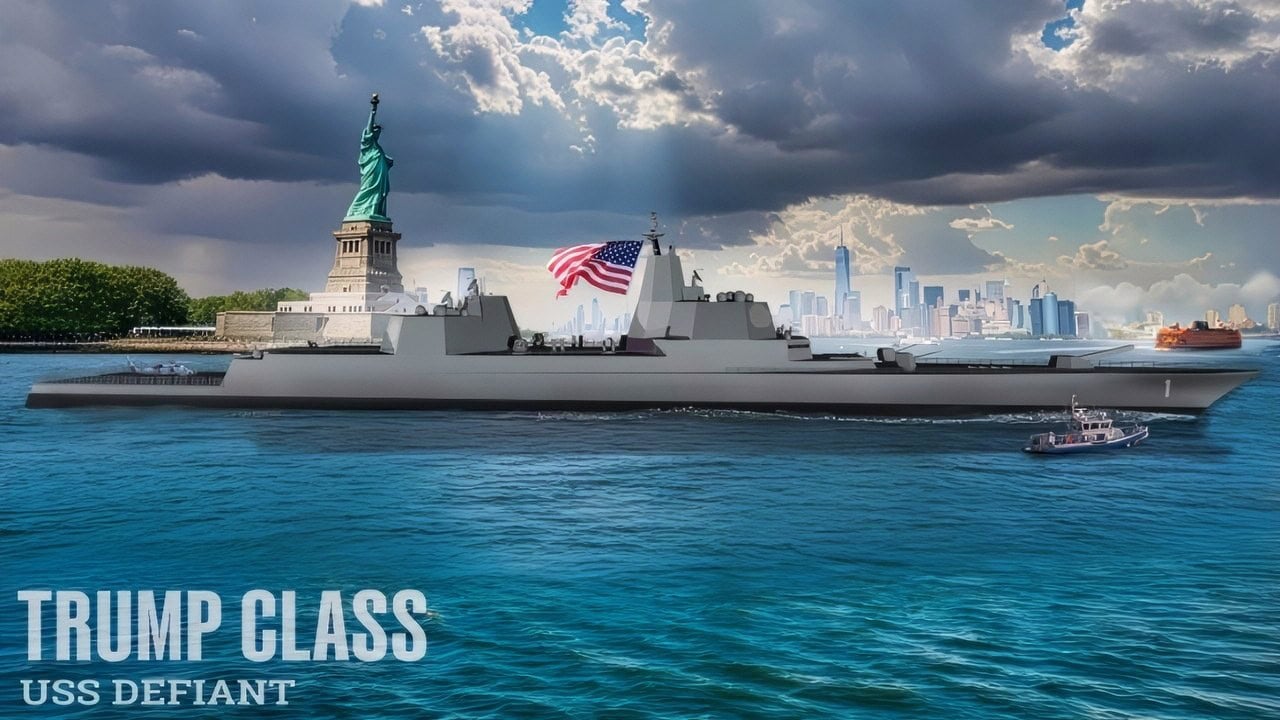
Trump-Class Battleship. Image Credit: Creative Commons/White House.
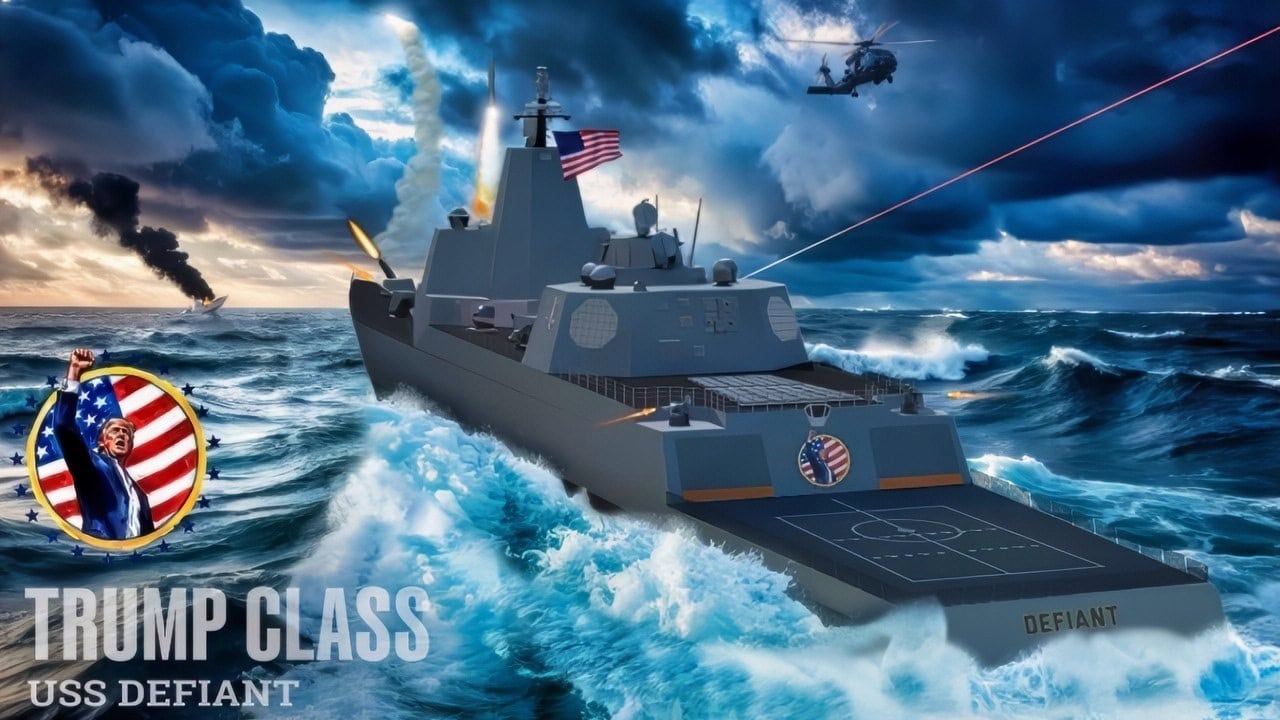
Trump-Class Battleship. Image Credit: Creative Commons/White House Photo.
The 12 Conventional Prompt Strike rounds sit outside the normal Mk 41 count because the hypersonic weapon is too large for that launcher. The Navy plans advanced payload modules and future vertical-launch systems for hypersonic weapons and other oversized payloads, but has not disclosed their arrangement or whether later ships would receive more capacity.
The class also has a Surface Launch Cruise Missile-Nuclear mission. The Navy has not published the number, location, or fielding date of those rounds. The planned missile battery would concentrate exceptional firepower on one hull, while part of that load depends on weapons still under development or entering limited production.
Lasers, Guns and Railguns Remain at Different Levels of Maturity
The Navy wants high-output lasers supported by far greater electrical generation than today’s destroyers possess. Early specifications referenced 300- and 600-kilowatt weapons. Chief of Naval Operations Adm. Daryl Caudle later said a one-megawatt laser was within the ambition for the class.
Lasers offer low-cost defensive shots against drones and, at greater power, some boats or incoming missiles. They also preserve vertical-launch cells. Weather, line of sight, beam control, cooling, and the time needed to hold energy on a target still limit performance. They would supplement missile defenses rather than replace them.
Electromagnetic railguns appear in Navy budget language as a future option. The earlier naval railgun program ended in 2021 after more than 15 years without an operational installation. No production weapon, ammunition contract, or fielding schedule exists for Defiant. The electrical plant preserves the option if development succeeds.
Conventional guns remain in the design. Early Navy data identified two five-inch guns, while the shipbuilding plan describes advanced naval gunfire for medium-range strike, amphibious support, and air defense. Early material also showed a flight deck and hangar for V-22 Ospreys, helicopters, and future unmanned aircraft. Mount numbers and the final point-defense battery remain unsettled.
Nuclear Power Supports Pacific Range and Electrical Demand
The Navy considered conventional propulsion before selecting nuclear power in May. Its stated reasons are longer endurance, higher speed, and the energy density required by future weapons. Officials told Congress that Defiant would use A1B reactor technology from the Ford class rather than a wholly new reactor family.
The exact number of reactors is not public. That choice affects cost, internal layout, crew size, survivability, and industrial demand. Current information establishes the technology family, not a completed propulsion architecture.
Nuclear propulsion suits a ship expected to move across the Pacific, remain at high readiness, and support power-hungry radars, electronic warfare systems, and lasers. It gives the design the electrical and operational margin the Navy says current destroyers lack, explaining why propulsion became central to the battleship plan.
A reactor does not make the ship independent of logistics. Defiant would still need missiles, food, spares, lubricants, and aviation fuel, while its escorts would require marine fuel. Nuclear power removes propulsion fuel from the battleship’s replenishment bill while adding specialized training, radiological controls, nuclear-yard maintenance, and costly dismantlement after service.
The $17.47 Billion Ford Comparison Needs a Dollar-Year Caveat
The lead estimate consists of $1 billion in advance procurement in fiscal 2027 and $16.47 billion in procurement in fiscal 2028. The second ship is estimated at $13.5 billion and the third at $12 billion. Navy leaders described those figures as early estimates before nuclear propulsion became final.
USS Gerald R. Ford cost $13.3 billion in nominal dollars appropriated between 2001 and 2021. By that measure, Defiant is $4.17 billion higher, supporting the comparison with the lead Ford-class carrier.
Inflation changes the result. The Congressional Budget Office converted Ford’s appropriations to $18.6 billion in 2023 dollars, excluding $6 billion in classwide research. It projected Ford’s at roughly $15.7 billion to $16.6 billion each in 2023 dollars. Defiant’s $17.47 billion is a then-year estimate, so this is not a clean constant-dollar comparison.
Aircraft for a carrier air wing and missiles for Defiant are funded separately. The useful point is that a 35,000- to 41,000-ton combatant has entered the same investment category as a nuclear supercarrier. The first three battleships and their research account for $47.426 billion through fiscal 2031 before operations, maintenance, modernization, or munitions.
Fifteen Ships Put the Class Near $155 Billion to $232 Billion
The original announcement described two initial ships, an eventual batch of 10, and a goal of 20 to 25. The May plan replaced that aspiration with 15 procurements through fiscal 2055. Purchases beyond the first five-year budget remain subject to later administrations and Congresses.
The Navy has not released a total class cost. CBO estimated that a lead-guided missile battleship ordered in 2030 would cost between $15.1 billion and $21.6 billion in 2025 dollars. It placed average follow-on ships between $10 billion and $15 billion.
Applying those bounds to one lead ship and 14 follow-on ships yields a rough procurement range of $155.1 billion to $231.6 billion. That is an arithmetic extension of CBO’s estimates, not a Navy baseline. Nuclear work, final survivability standards, weapons integration, and shipyard performance could move the total outside the range.
The Navy’s first three ships average about $14.51 billion in shipbuilding funds. Holding that average across 15 would produce roughly $217.6 billion. The long-range schedule shows only 11 battleships in the fleet by the end of fiscal 2056, with four still moving through construction, trials, or delivery after the final planned purchases.
Newport News and BWX Technologies Set the Schedule
The lead contract is planned for April 2028, construction for August 2028, and delivery for August 2036. The next two ships are projected for 2038 and 2039. Those dates require a clean-sheet nuclear combatant to mature quickly while an industrial base already late on carriers and submarines absorbs another capital-ship program.
Final assembly is planned for Dry Dock 12 at Newport News Shipbuilding, where Ford-class carriers are built. BWX Technologies is the only naval reactor supplier. Congressional language says reactor procurement begins two to three years before a vessel, and production takes six to eight years. The first advance-procurement money therefore affects the schedule years before hull assembly.
The Navy proposes digital engineering, modular construction, and distributed production, with other yards and suppliers building sections before final integration. That approach spreads work and may reduce rework. It does not create another American yard able to assemble and test a nuclear surface warship.
Congress has asked whether Defiant will worsen Ford-class delays or strain submarine and AUKUS reactor work. The concern behind competition with the carrier program is physical capacity as much as money. Lawmakers also directed the Navy to preserve work on a next-generation destroyer because a $12 billion to $17 billion battleship cannot replace an Arleigh Burke-class destroyer one-for-one, leaving the relationship between DDG(X) and BBG(X) unresolved.
Congress Has Not Approved the First Irreversible Step
House appropriators supported the requested $1 billion while noting that the Navy had not finalized the design, completed a formal analysis of alternatives, or stabilized requirements. House authorizers approved the money with restrictions and required studies of reactor capacity and the effect on Ford construction. Senate committees have been more skeptical.
The administration asked Congress to treat the $1 billion as an exception in a continuing resolution because an ordinary stopgap bars the start of new programs. The White House said that the omission would block the advance procurement of the nuclear-propulsion work needed for construction.
The bipartisan Senate proposal released on August 3 left out the exception. As of August 4, the House and Senate had not reconciled their stopgap bills, and the $1 billion needed to begin advance procurement of nuclear propulsion had not been enacted.
About the Author: Harry J. Kazianis
Harry J. Kazianis (@Grecianformula) was the former Senior Director of National Security Affairs at the Center for the National Interest (CFTNI), a foreign policy think tank founded by Richard Nixon based in Washington, DC. Harry has over a decade of experience in think tanks and national security publishing. His ideas have been published in the NY Times, The Washington Post, The Wall Street Journal, CNN, and many other outlets worldwide. He has held positions at CSIS, the Heritage Foundation, the University of Nottingham, and several other institutions related to national security research and studies. He is the former Executive Editor of the National Interest and the Diplomat. He holds a Master’s degree focusing on international affairs from Harvard University.

