
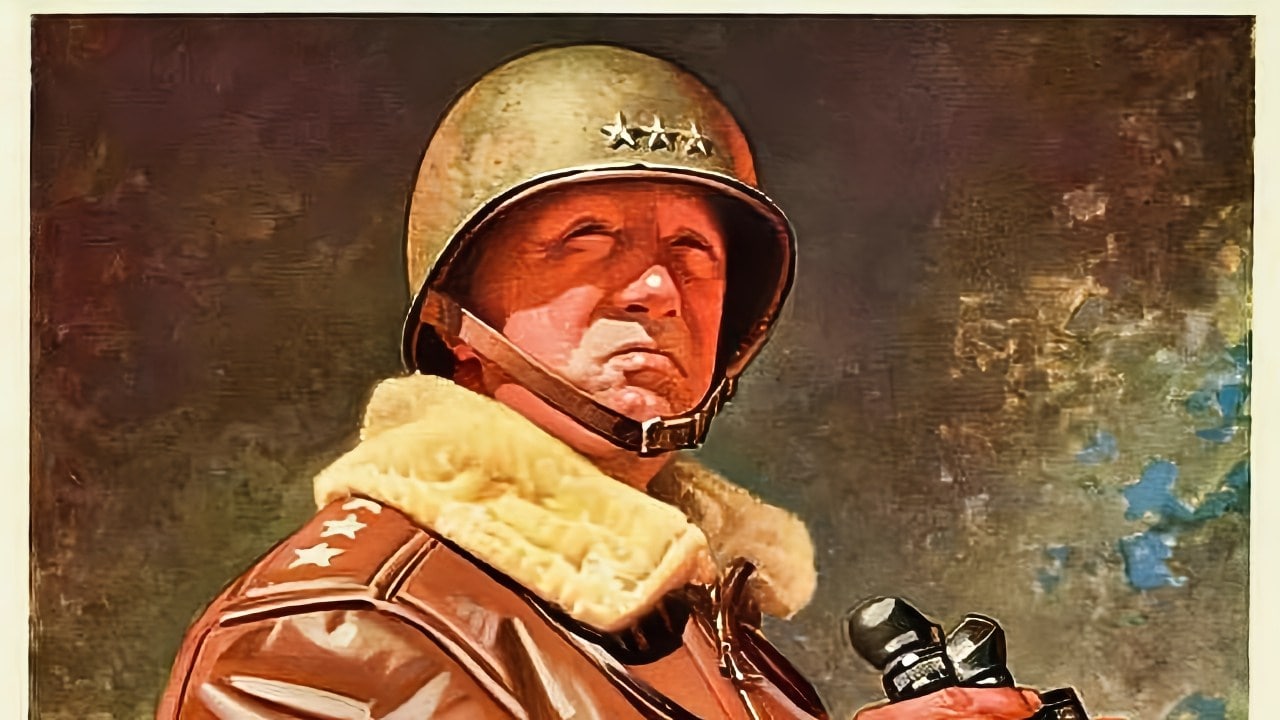
On the morning of December 19, 1944, in a cold stone barracks at Verdun, Dwight Eisenhower asked the assembled commanders of the Western Front when anyone could counterattack the German offensive then tearing through the Ardennes. George S. Patton answered for the Third Army. The promise has come down through eighty-one years of memory as forty-eight hours, and the room’s reaction has come down with it: officers stared, smiled, laughed, certain they were hearing theater. The documented form of the exchange is nearly as audacious as the legend.
Asked directly, “When can you attack,” Patton replied, by the account preserved in his own units’ histories: “On December 22, with three divisions, the 4th Armored, the 26th, and the 80th.”
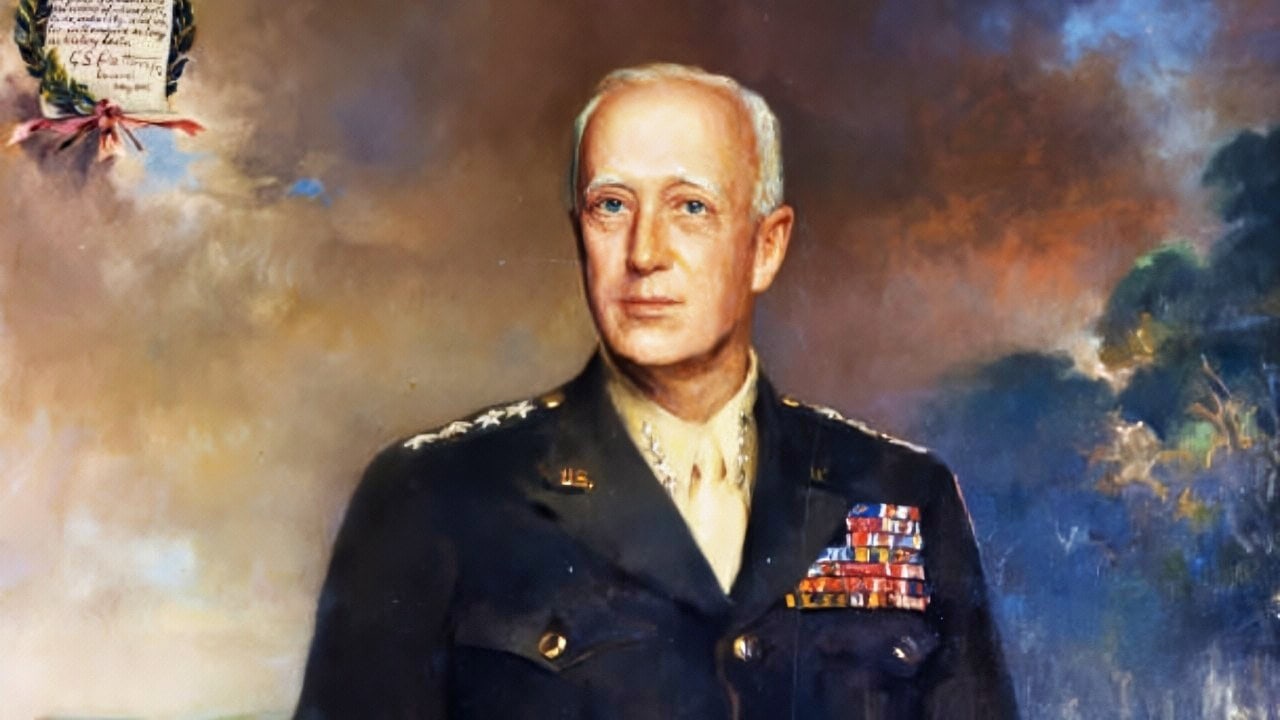
Portrait of Army General Patton. Image Credit: Creative Commons.
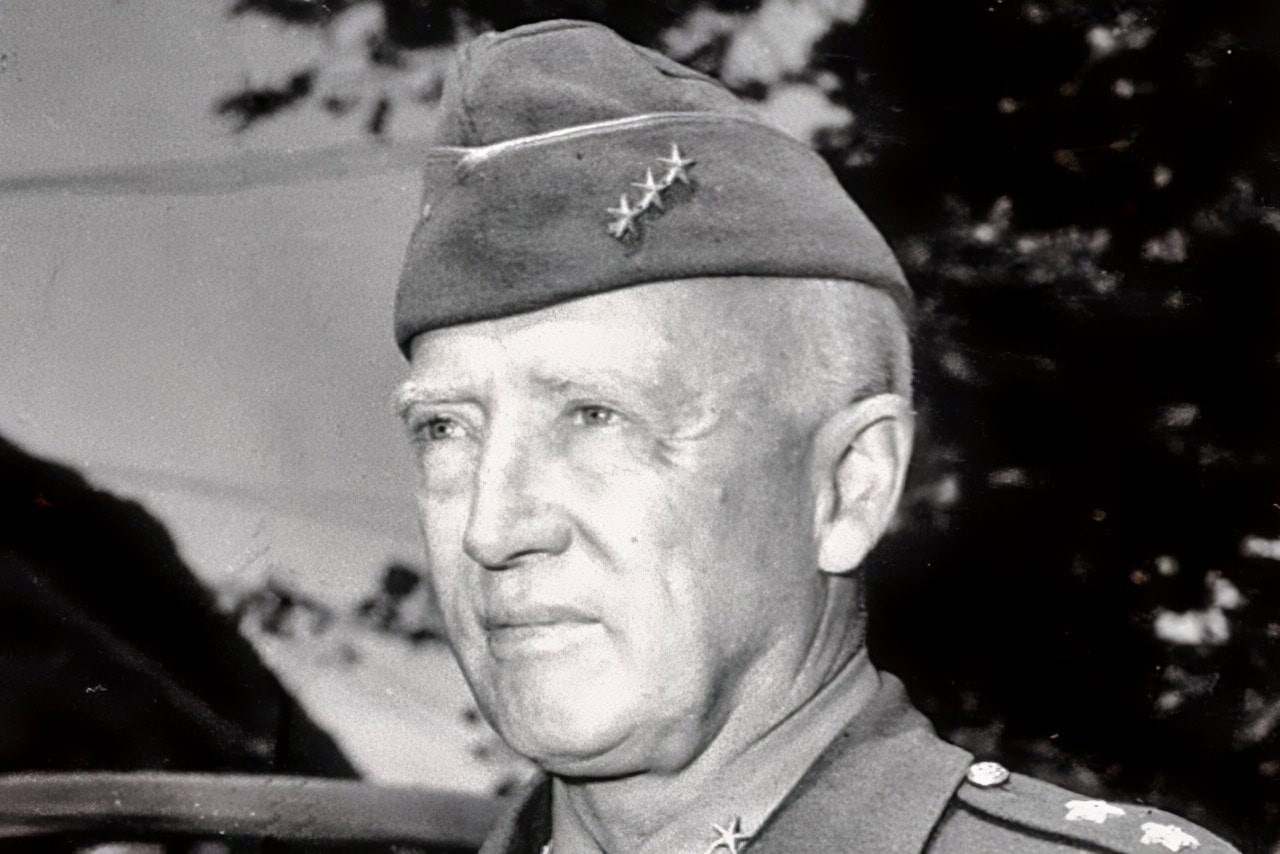
George S. Patton Quote of the Day. Creative Commons Image.
He was promising to break an entire field army out of one battle, turn it ninety degrees, move it as much as a hundred miles over iced winter roads, and throw it into a different battle, in about seventy-two hours, with the specific divisions already named.
One well-known account has him offering the morning of the 21st first and being told by Eisenhower not to be fatuous.
The men in the room can be forgiven their disbelief.
They did not know what Patton knew: that the movement had already started. This is the story of the promise and the delivery, in that order.
What the Room Did Not Know about US Army General George Patton
The audacity was manufactured in advance, and the manufacturing is the untold half.
German activity in the Ardennes began on December 16, and while most Allied headquarters read it as a local spoiling attack, Patton’s staff began sketching what Third Army would do if the crisis proved real.
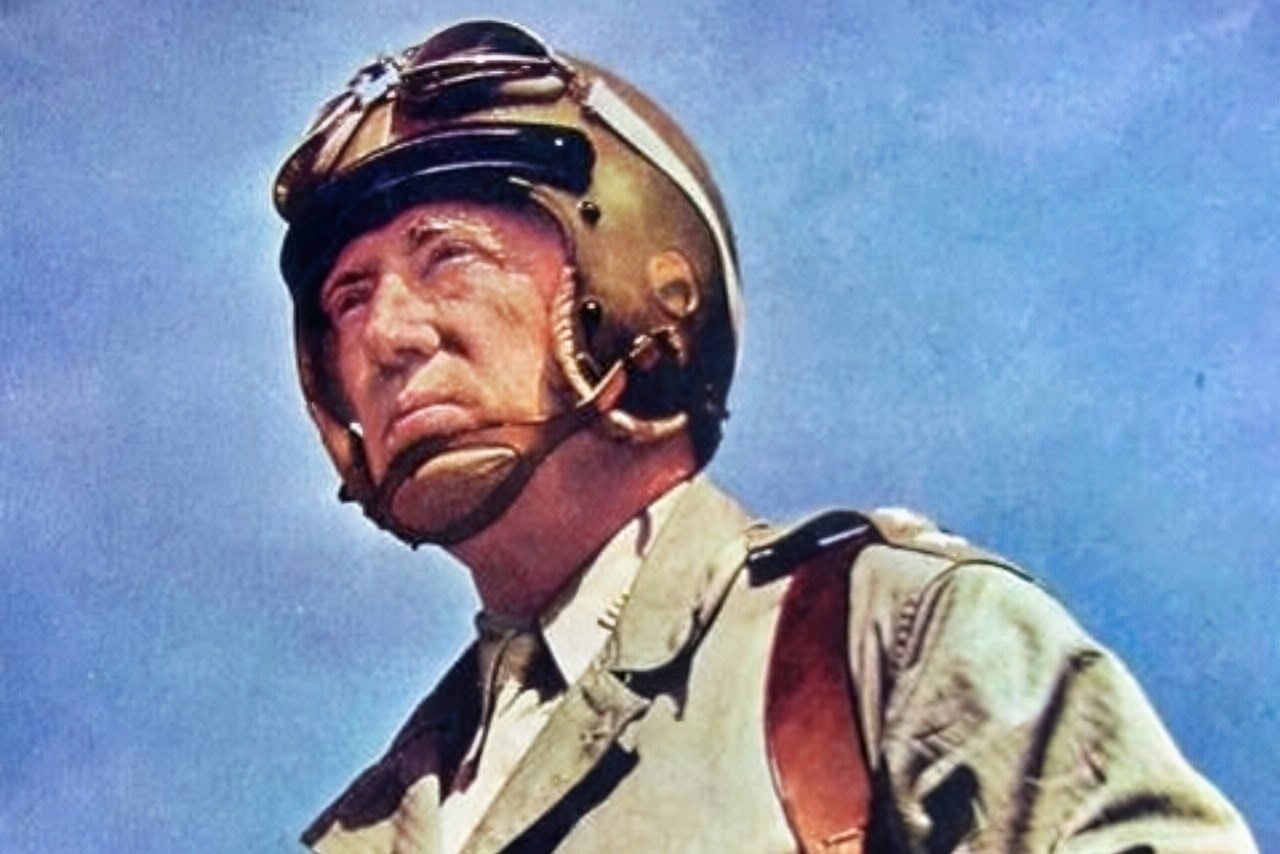
General George Patton of the U.S. Army. Image Credit: Creative Commons.
On December 18, Patton met with his principal staff officers and the incoming corps commander, agreed on the routes north before the objectives were even assigned, and took a ten o’clock call from Omar Bradley asking him to start moving.
By midnight on the 18th, a combat command of the 4th Armored Division was already rolling toward Longwy, and the Third Army staff worked through the night on the plans to swing the army. Patton drove to Verdun the next morning carrying three prepared attack options, each reduced to a code word, so that launching the chosen one required a single telephone call to his chief of staff.
The famous answer in the briefing room was therefore a report disguised as a boast. When the conference chose the Bastogne axis, Patton stepped out, made the call, and an army already leaning north began to run.
The Room Itself
Eisenhower, days into the bloodiest battle American forces would fight in the entire war, with more than 250,000 German troops attacking through the weakest sector of his line, opened by telling his generals that the situation was to be regarded as one of opportunity and not of disaster.
Patton, from down the table, proposed having the guts to let the enemy drive all the way to Paris so the Allies could cut them off and chew them up, a remark the scholarship records as drawing nervous laughter and few supporters.
The serious version of his aggression came with the attack date and the three named divisions. Eisenhower, who wanted mass rather than speed, pressed him to wait and strike with more; Patton held that a three-division blow delivered immediately was worth more than a six-division blow delivered after Bastogne fell.
The surviving documents of that week, the cables and situation maps in the Eisenhower archive, show a headquarters improvising at speed; inside that improvisation, one army commander had arrived with the answer written down. He left the meeting, by the popular account, before ten in the morning.
The Delivery
What followed is studied at staff colleges as the finest operational maneuver of the American war.
Third Army was attacking eastward in the Saar when the order came; disengaging meant pulling divisions out of contact with the enemy, a maneuver dangerous enough in summer, then reversing an army’s entire circulatory system.
The staff rescheduled convoy movements down to the hour, established traffic control points across Luxembourg and Lorraine, re-laid signal wire, shifted supply dumps, and rerouted fuel above all, because the armored spearheads would burn it faster attacking north than they had attacking east.
Roughly a quarter of a million men and their guns, hospitals, and trains turned ninety degrees in the coldest European winter in decades, on roads glazed with ice, in fog and snow, while the units they had been fighting in the Saar probed behind them.
Patton drove the routes himself in an open jeep, polished helmet visible, on the theory that soldiers who saw the army commander in the snow would believe the timetable. On the morning of December 22, on the date given in the briefing room, III Corps attacked north on a twenty-mile front with the 4th Armored, the 26th, and the 80th, the three divisions named at Verdun. The promise was kept to the day.
Bastogne
The attack itself was a grind, and honesty about it belongs in the record. The same morning the offensive stepped off, the surrounded garrison at Bastogne received a German surrender demand, and the acting commander of the 101st Airborne returned the one-word answer that entered legend that afternoon.
The weather that had grounded Allied airpower broke on December 23, the C-47s reached the perimeter, and the fighter-bombers went to work on the German columns; Third Army’s part in that story, the quarter-million prayer cards in its soldiers’ pockets, is its own tale.

M4 Sherman Tank from WWII Image: Creative Commons.
The relief force fought for every village. German resistance was severe, bridges were blown, the roads were ice, and the advance that some at Verdun may have imagined as a parade ran four days through prepared defenses.
On the afternoon of December 26, the lead tanks of the 4th Armored Division broke through at Assenois and opened the corridor into Bastogne; the siege was lifted, the wounded came out, and the supplies went in.
The wider battle ran another month, and Third Army fought it to the end, closing the Bulge at Houffalize in mid-January against resistance and weather that never relented. The campaign’s cost, on all sides, was enormous, and no account of the brilliant maneuver should pretend the men who executed it experienced brilliance; they experienced ice, fatigue, and fire.
The Promise at 81
Eighty-one years on, the scene in the briefing room keeps its place in American military memory because every element of it was real and none of it was improvised. The audacity was real: no army of that size had ever been asked to reverse itself at that speed in that weather. The laughter was real, and it was reasonable; the officers who doubted were applying the ordinary mathematics of armies.
The delivery was real, on the named date, with the named divisions. And the secret under all of it was preparation, three plans, three code words, one telephone call, staff work done in advance of the question.
Patton spent a career being remembered for profanity, showmanship, and speed.
The morning at Verdun preserved the truer portrait: a commander who had done the homework before the examination was announced, promised only what was already moving, and let the room laugh.
About the Author: Harry J. Kazianis
Harry J. Kazianis (@Grecianformula) is the former Senior Director of National Security Affairs at the Center for the National Interest (CFTNI), a foreign policy think tank founded by Richard Nixon based in Washington, DC. Harry has over a decade of experience in think tanks and national security publishing. His ideas have been published in the NY Times, The Washington Post, The Wall Street Journal, CNN, and many other outlets. He has held positions at CSIS, the Heritage Foundation, the University of Nottingham, and several other institutions related to national security research and studies. He is the former Executive Editor of the National Interest and the Diplomat. He holds a Master’s degree focusing on international affairs from Harvard University.

