
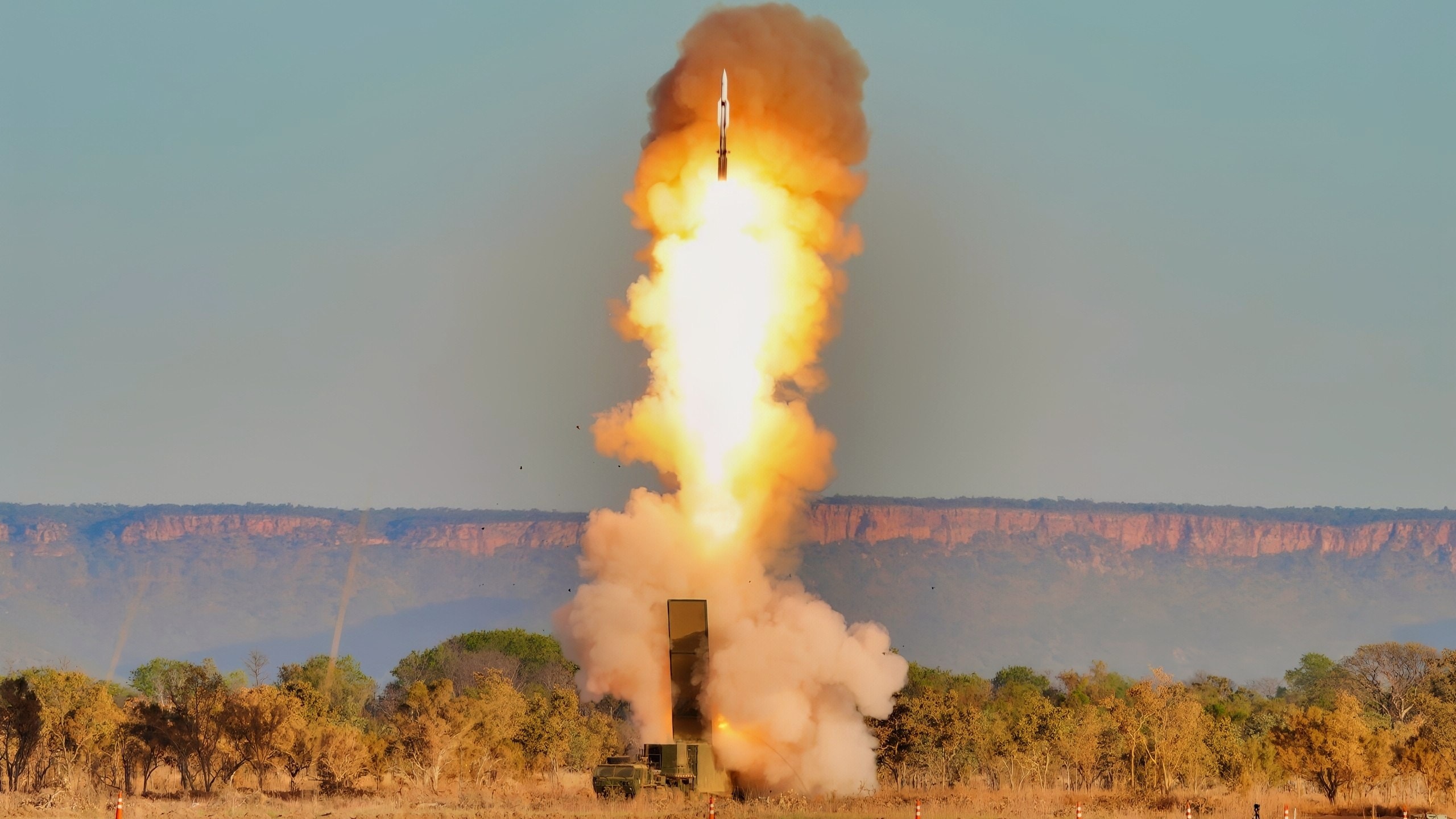
For decades, the United States’ ability to strike targets hundreds or thousands of miles away belonged almost exclusively to the U.S. Navy and Air Force.
Ships and aircraft carried the nation’s long-range firepower; however, the Army was largely confined to shorter-range battlefield weapons.
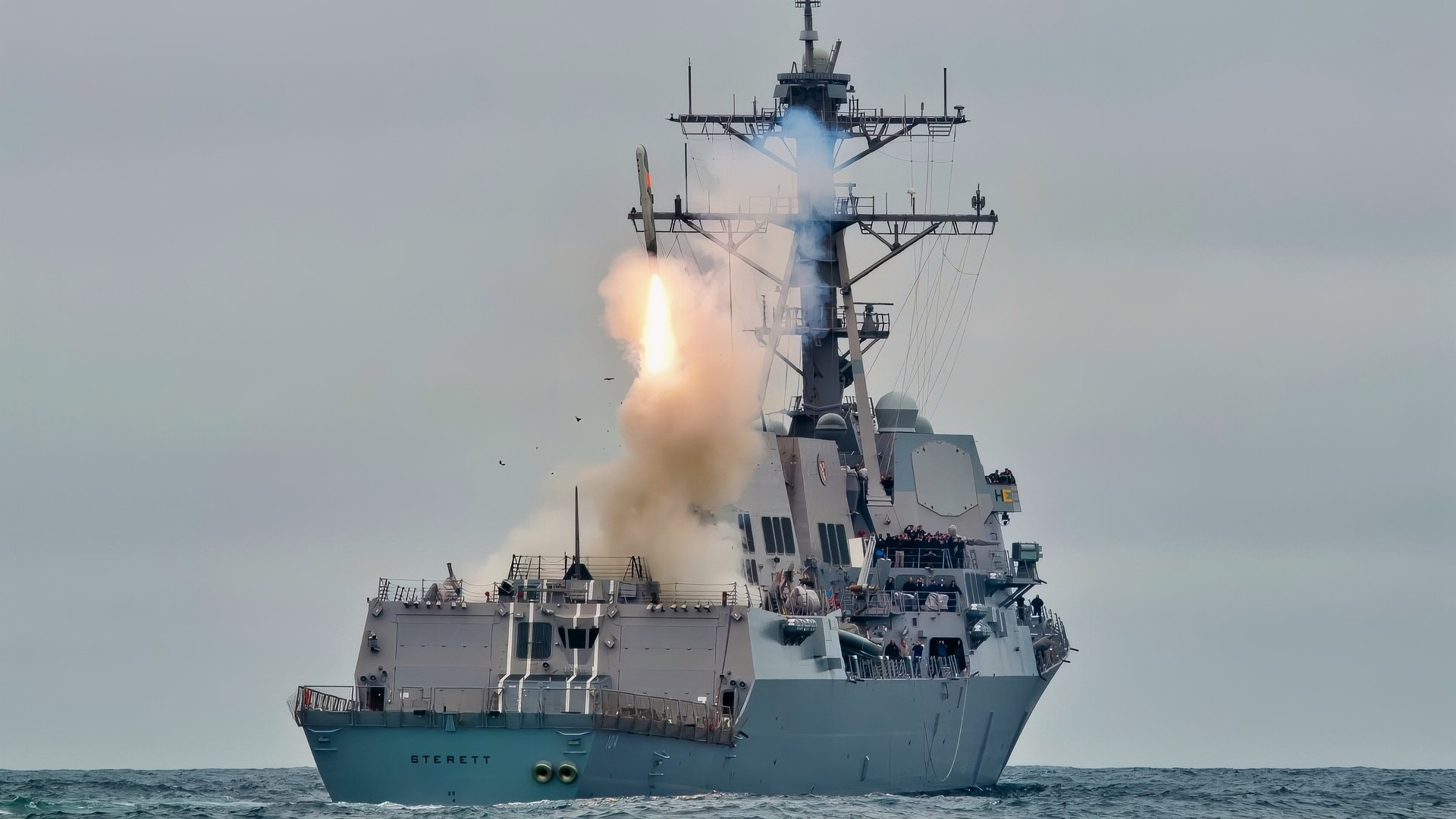
Tomahawk Missile USN Photo
The Typhon Missile System, formerly known as the Mid-Range Capability (MRC), is changing that narrative.
Developed by Lockheed Martin for the U.S. Army, Typhon has quietly become one of the most consequential additions to America’s arsenal in a generation, not because of any single technical breakthrough, but because of what it represents strategically, geopolitically, and doctrinally.
Meet The Typhon Missile System
At its core, Typhon is a ground-mobile missile battery built around components borrowed from the Navy.
It uses the Mk 41 Vertical Launch System and elements of the Aegis Combat System, the same technology that arms Navy destroyers and cruisers, but mounts them on a transporter erector launcher that can be driven, flown, or shipped to dispersed locations on land.
Each battery can fire two types of munitions: the SM-6, a multi-role missile with a range of roughly 300 miles that can strike ships or aircraft, and the Tomahawk cruise missile, capable of hitting land targets more than 1,500 miles away.
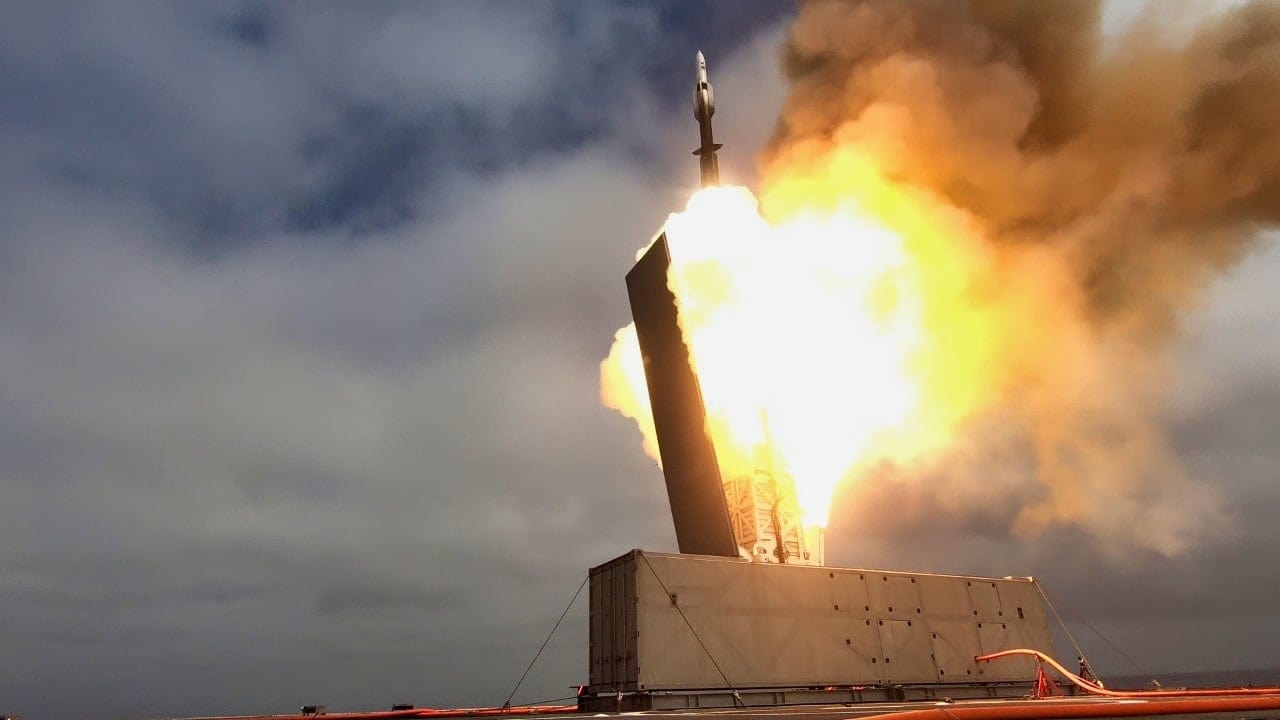
USS Savannah (LCS 28) conducts a live-fire demonstration in the Eastern Pacific Ocean utilizing a containerized launching system that fired an SM-6 missile from the ship at a designated target. The exercise demonstrated the modularity and lethality of Littoral Combat Ships and the ability to successfully integrate a containerized weapons system to engage a surface target. The exercise will inform continued testing, evaluation and integration of containerized weapons systems on afloat platforms.
That combination gives a single ground unit the reach to threaten warships, land installations, and command infrastructure alike, all from a launcher that can relocate constantly to avoid detection and counterattack.
Why The US Built The System
Typhon owes its existence to a treaty that no longer binds the United States. The 1987 Intermediate-Range Nuclear Forces (INF) Treaty banned American and Russian ground-launched missiles with ranges between 500 and 5,500 kilometers for more than three decades.
The US withdrew from the agreement in 2019 after Russia violated the treaty by developing, flight-testing, and deploying a prohibited ground-launched cruise missile system known as the 9M729 (designated by NATO as the SSC-8)
This opened the door for the US to produce exactly this kind of mobile, land-based system capable of intermediate-range strikes.
Typhon is the most visible result of that policy shift, and its rapid fielding reflects how seriously the Pentagon has taken the opportunity to close a capability gap that China, unconstrained by the treaty, has exploited for years.
The Typhon Will Fill The Gap In The Pacific
The system’s significance is clearest in the Indo-Pacific, where the first operational batteries were deployed to northern Luzon, Philippines, in April 2024.
That deployment gave the United States a persistent, land-based strike option along the First Island Chain, the string of territory running from Japan through Taiwan to the Philippines that shapes so much of Chinese military planning.
Analysts have described the resulting posture as a mobile “missile arc” that complicates China’s anti-access and area-denial strategy while providing a survivable deterrent across key chokepoints.
The US has expanded the use of the system. In 2026, a Typhon battery was deployed to Japan’s Kanoya Air Base in Kagoshima Prefecture as part of the biennial Valiant Shield exercise, with satellite imagery later confirming its continued presence there.
In May 2026, the system achieved a milestone during Exercise Balikatan, firing a Tomahawk missile from Leyte Island in the Philippines roughly 391 miles to strike a target, the first operational Typhon launch conducted from Philippine soil.
Earlier in 2026, U.S. officials confirmed plans to send additional MRC batteries to the Philippines, deepening a posture that began in Luzon and reinforcing the countries’ mutual defense relationship amid ongoing tension in the South China Sea.
Beyond the Pacific, The Typhon Is Equipping US European Forces
The U.S. Army has also moved to equip its 2nd Multi-Domain Task Force in Europe with the system by fiscal year 2026, extending the same long-range strike logic to the NATO theater.
In Europe, a mobile ground-launched missile capable of holding targets at risk from thousands of miles away strengthens the alliance’s deterrent posture without requiring new naval deployments or forward-based aircraft, giving commanders a flexible tool they can reposition as threats evolve.
Strategic and Political Significance
The Typhon system signals a doctrinal shift in how the Army sees its own role. No longer a force focused solely on ground combat, but one that can contribute directly to the “kill chain” against ships and strategic targets, working alongside the Navy and Air Force rather than depending on them.
Because Typhon launchers are mobile, dispersible, and relatively inexpensive compared to a destroyer or bomber wing, they let the United States distribute risk, turning what would once have been concentrated naval firepower into a network of smaller, harder-to-target mobile land units.
The system has also become a diplomatic flashpoint. Russia and China have publicly protested Typhon’s deployment to Japan, with Moscow’s Foreign Ministry spokeswoman warning that bolstering U.S. military infrastructure in the region poses a threat to regional stability, while both constantly tout their long-range mobile missile capabilities.
Those objections underscore how seriously rival powers view the system, as a valuable deterrence tool that could be used against either of them.
The Typhon Missile System gives the United States a mobile, land-based option to use against distant targets in two of the world’s most contested theaters, closes a capability gap opened by the end of the INF Treaty, and reflects a broader rethinking of how land forces contribute to modern deterrence.
As batteries continue to spread from the Philippines and Japan to Europe, Typhon is emerging as a defining symbol of how the U.S. military intends to compete in an era of renewed great-power rivalry.
Joint exercises with regional partners like Japan and the Philippines validate distributed maritime strike operations and signal deep defense integration against continued Chinese and Russian aggression.
About the Author: Steve Balestrieri
Steve Balestrieri is a National Security Columnist. He served as a US Army Special Forces NCO and Warrant Officer. In addition to writing on defense, he covers the NFL for PatsFans.com and is a member of the Pro Football Writers of America (PFWA). His work was regularly featured in many military publications.