
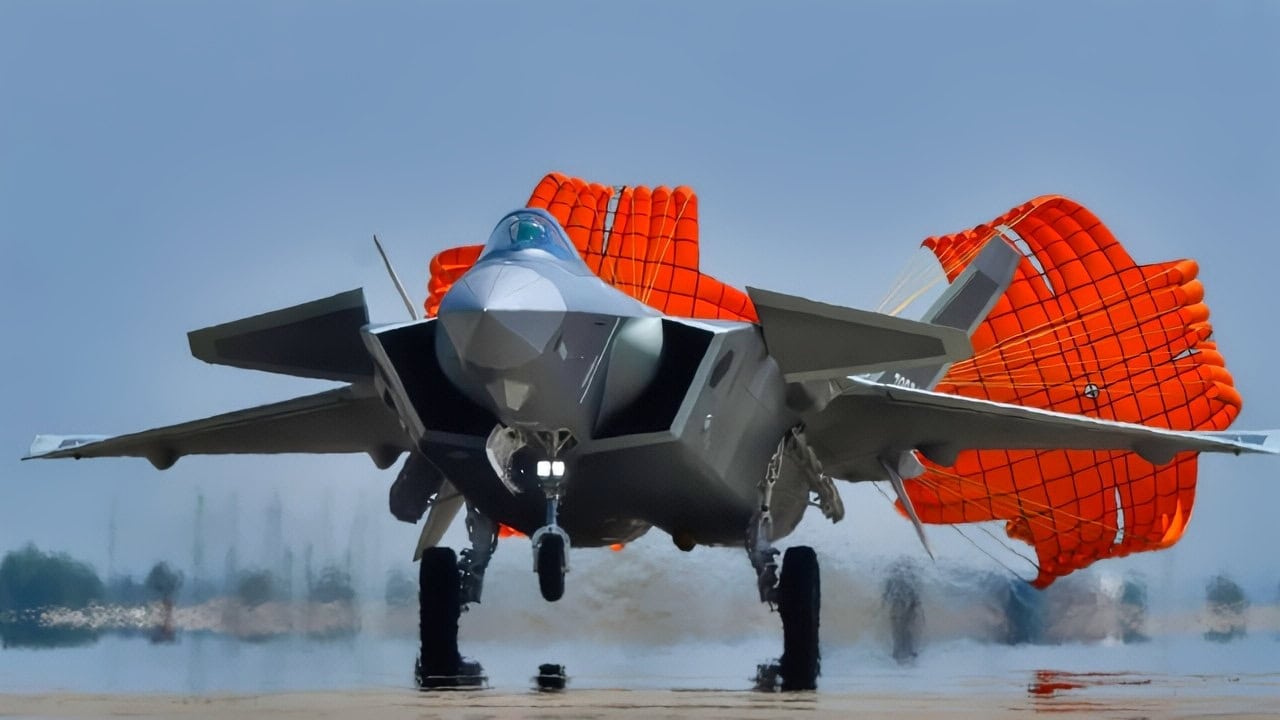
In the United States of America’s New Cold War with the People’s Republic of China (PRC)—not to mention China’s former “old” Cold War adversary cum present-day erstwhile ally Russia—one of the big debates rages as to which nation has the better 5th Generation stealth fighters.
The People’s Liberation Army Air Force has the Chengdu J-20 (“Mighty Dragon;” NATO reporting name “Fagin”), while the U.S. Air Force has the F-22 Raptor, and the USAF, U.S. Navy, and U.S. Marine Corps alike have the F-35 Lightning II.
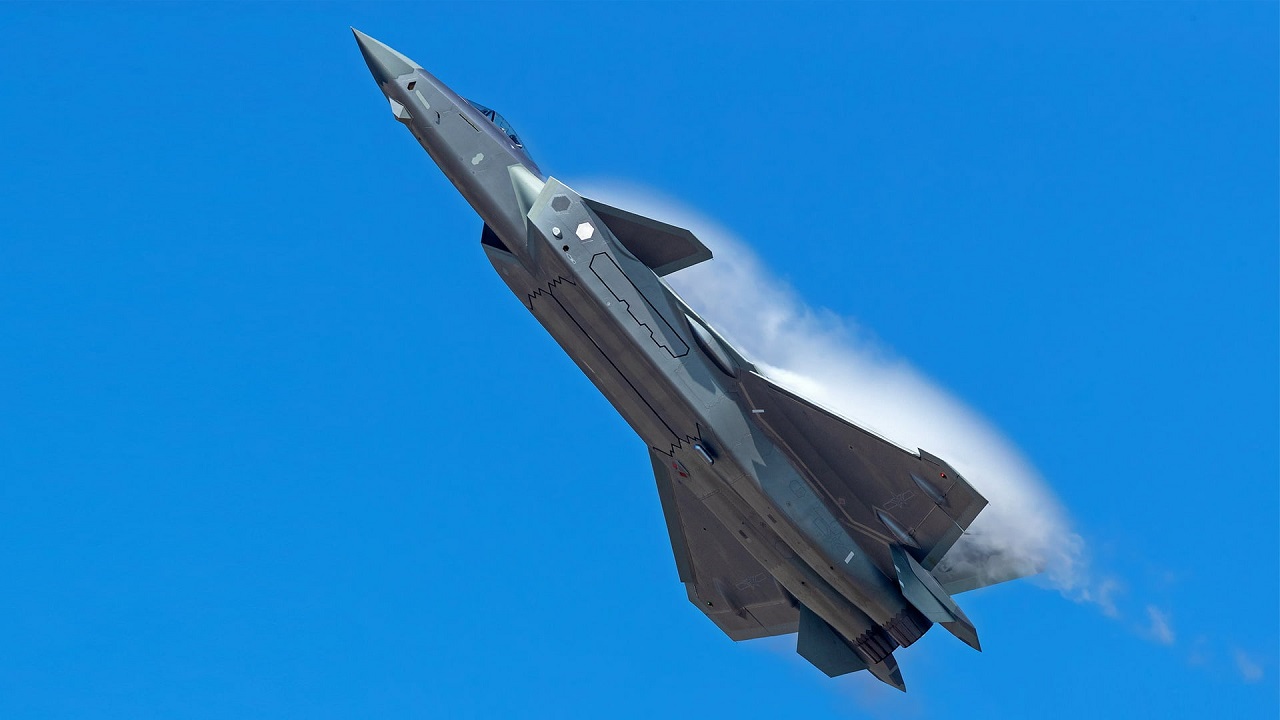
J-20 Stealth Fighter. Image Credit: Creative Commons.
The F-35 and F-22 alike—both of which are products of Lockheed Martin’s famed “Skunk Works” division—have distinct technological advantages over the J-20. But going by the saying that “Quantity has a quality of its own”—a proverb apocryphally attributed to Joseph Stalin but *correctly* attributed to British aerodynamicist Frederick Lanchester—the Fagin appears to be en route to beating both the Raptor and the Lightning II when it comes to the game of sheer production numbers.
Bottom Line Up Front (BLUF): The PLAAF’s Deadly Numbers Game with the J-20
Given the fact that the PRC is the world’s most populous nation, perhaps it’s not entirely surprising that they have the biggest number of stealth fighters, since they have both the world’s largest military—an estimated 395,000 personnel in the PLAAF alone—and the world’s largest potential civilian labor pool to draw from.
As cited a month ago by the ever-savvy Thomas Newdick of TWZ, the Royal United Services Institute (RUSI), a U.K.-based think tank, projected that, by late 2025, production rates for the Fagin had likely reached around 120 aircraft per year, and that around 300 of the “Mighty Dragons” were in service across at least 13 PLAAF regiments.
The January 2026 RUSI report ominously added that “The total produced is likely to be higher, since a significant number of newly produced fighters will still be awaiting delivery to units.”
To provide some historical context for those numbers, the first J-20 prototype—bearing tail number “2001”—made its maiden flight on 11 January 2011, sending a message to the Western world that China had officially entered the stealth era.
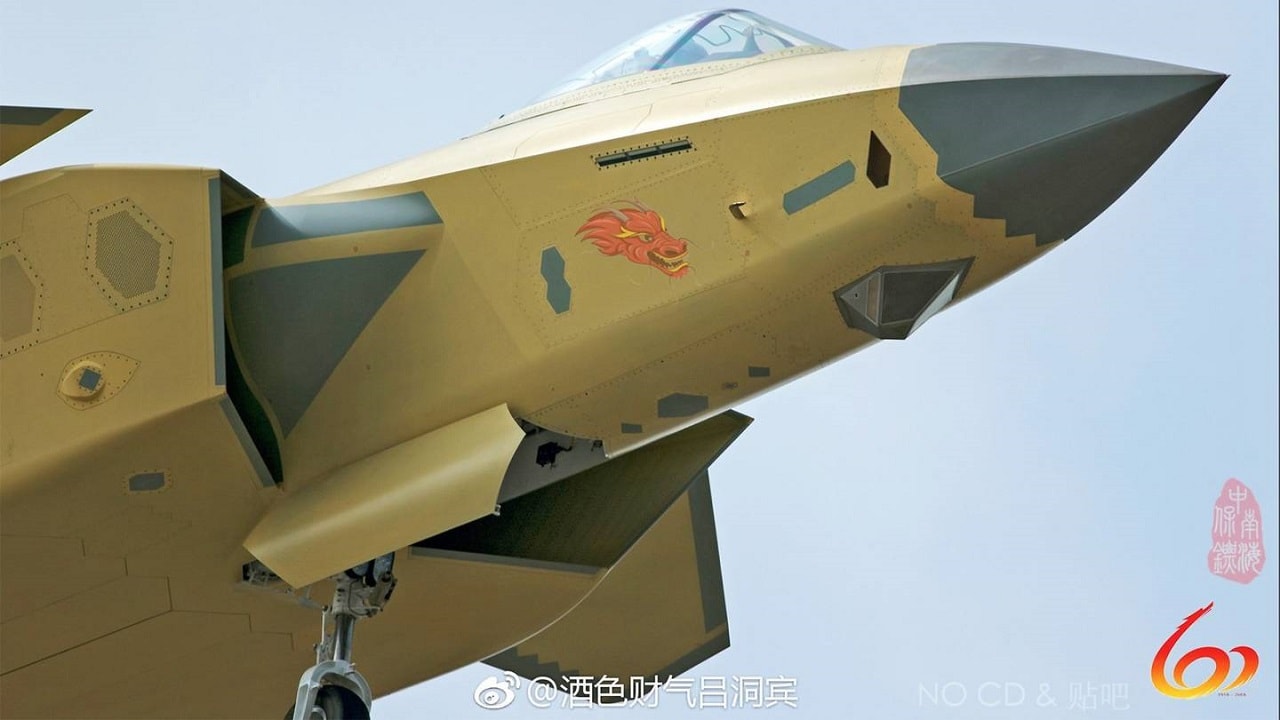
Chinese J-20 Stealth Fighter. Image Credit: Chinese Internet.
Low-rate initial production (LRIP) began in December 2015, with mass production starting after design finalization in October 2017.
The Chicoms officially introduced the “Mighty Dragon” into service on 9 March 2017, with the first combat unit declared operational by February 2018.
How Do the American Stealth Numbers Stack Up?
Total F-22 production stands at a measly 187 airframes, with production frozen for reasons we shall discuss shortly. They were built between 1996 and 2011, with an average of 12.4 Raptor specimens hatching per year.
As for the F-35’s production numbers, they’re bigger and therefore less depressing than those of the F-22, but still carry an ominous warning.
An estimated 1,345+ Lightning IIs have been built thus far, with more on the way, as 16 foreign military sales (FMS) customers have purchased the plane in addition to the U.S. military acquisitions, according to April 2025 figures.
For now, we’ll digress from going down the rabbit hole of the Canadian F-35 purchase controversy.
Although 1,345 is obviously a much more impressive figure than 187, when you recall that the Lightning II entered production 20 years ago, that averages out to 67.25 F-35s built per year, barely over half of the 120 J-20 airframes per annum figure cited in the previous section of this article.
So, Why the U.S. Stealth Shortfall?
Well, to put it bluntly, the F-22’s numerical shortfall can be narrowed down to two words: Bob Gates. Back in 2009, then-US Secretary of Defense (SECDEF) Robert Michael Gates made the incredibly short-sighted decision to kill the Raptor after only 49 percent of the originally planned number of airframes had been built.
For reasons that’re unfathomable to this writer and Air Force veteran, nobody seems to be willing to publicly ask the question if the Donald Trump Administration would be willing & able to order a resurrection of the F-22 program in the same way that the Ronald Reagan Administration resurrected both the B-1 bomber and the Nimitz-class carrier after the Jimmy Carter Administration had put the kibosh on both of those programs.
If the practical answer is “No,” then fine, fair enough, but why not at least broach the question in the first place!?
As to what’s handicapping the F-35’s rate of production, it boils down to the Pentagon’s extremely bloated and convoluted acquisition process, which is a far cry from the good ol’ days of World War II and Korean War munitions R&D and production alike.
The sheer mind-numbing nature of this bloated process is described in sordid detail by Hedrick Smith in his bestselling, Pulitzer Prize-winning 1988 book “The Power Game: How Washington Works;” yes, that publication date was long before 5th Generation stealth fighters became a reality, but the basic truisms of the bureaucratic chicanery and skullduggery remain the same.
President Trump and Secretary of War Pete Hegseth are doing their darnedest to reform that acquisition process, but they’re fighting an uphill battle.
Meanwhile, the PRC continues to churn out J-20s and J-35s, and despite the claims of the regime’s apologists and appeasers to the contrary, a hot war with that communist totalitarian dictatorship remains a very sobering future possibility.
About the Author: Christian D. Orr
Christian D. Orr is a Senior Defense Editor. He is a former Air Force Security Forces officer, Federal law enforcement officer, and private military contractor (with assignments worked in Iraq, the United Arab Emirates, Kosovo, Japan, Germany, and the Pentagon). Chris holds a B.A. in International Relations from the University of Southern California (USC) and an M.A. in Intelligence Studies (with a concentration in Terrorism Studies) from American Military University (AMU). He is also the author of the book “Five Decades of a Fabulous Firearm: Celebrating the 50th Anniversary of the Beretta 92 Pistol Series,” the second edition of which was recently published.