
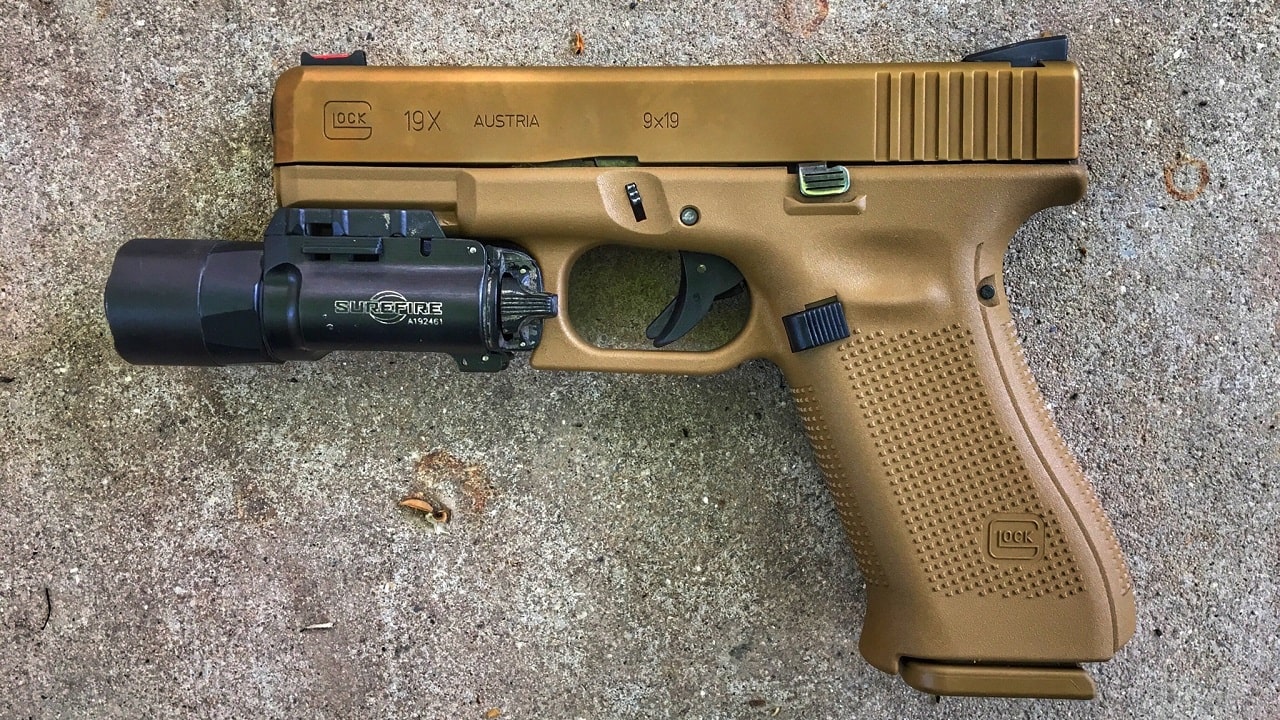
I own a Glock 19X, and every time I take it to the range, I am handling an artifact of one of the strangest procurement stories in modern American military history. The coyote-tan pistol in my case was not designed for me. It was designed, feature by feature, to a United States Army specification, built to win the largest military handgun contract in a generation. It lost. And then it went out and won something arguably harder: the American consumer market, by the hundreds of thousands. The story of how both things happened says a lot about the US Army, about Glock, and about why this pistol is so good.
The Prize and Glock 19X
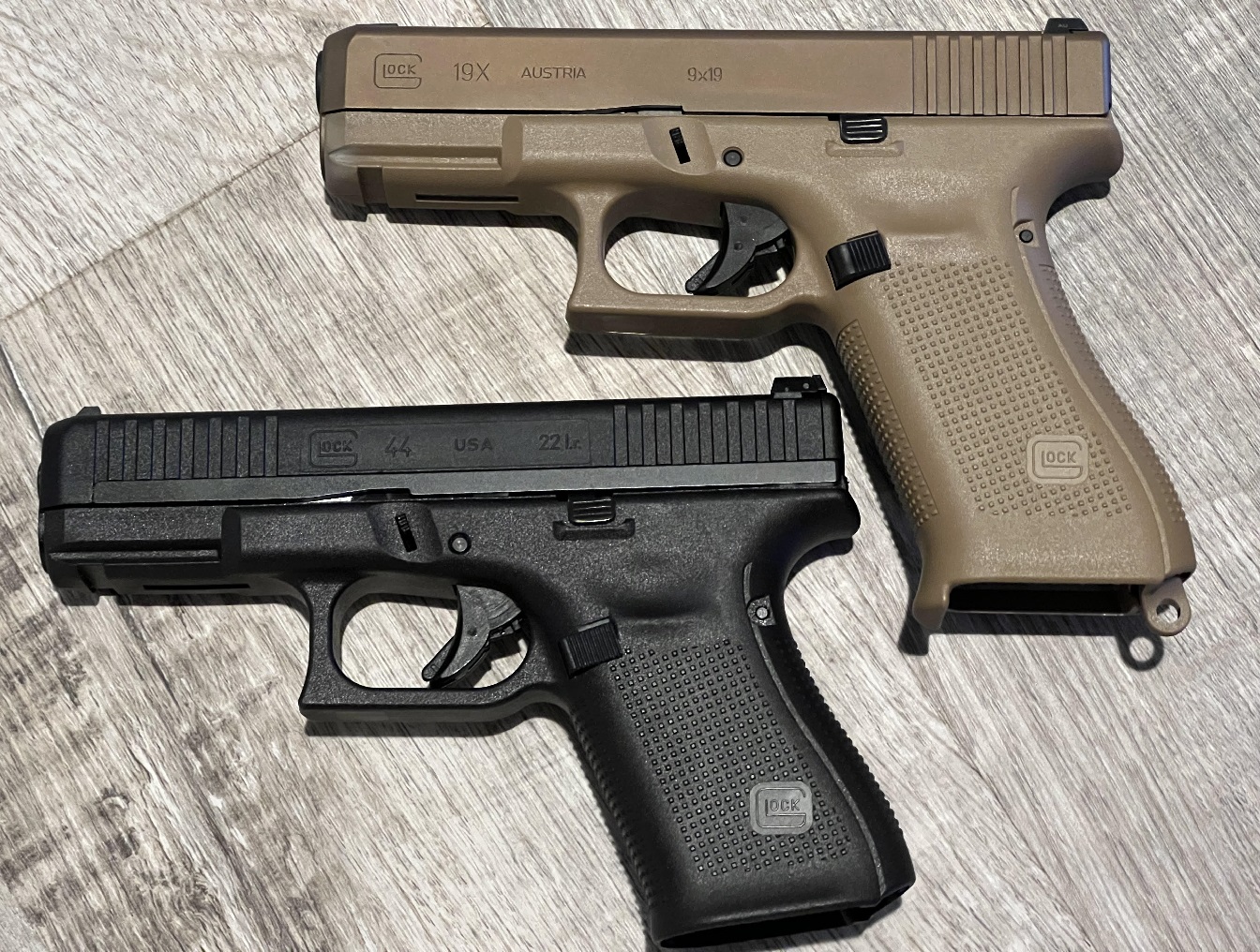
Glock 19X and Glock 44 side by side. Image Credit: 19FortyFive Original Image.
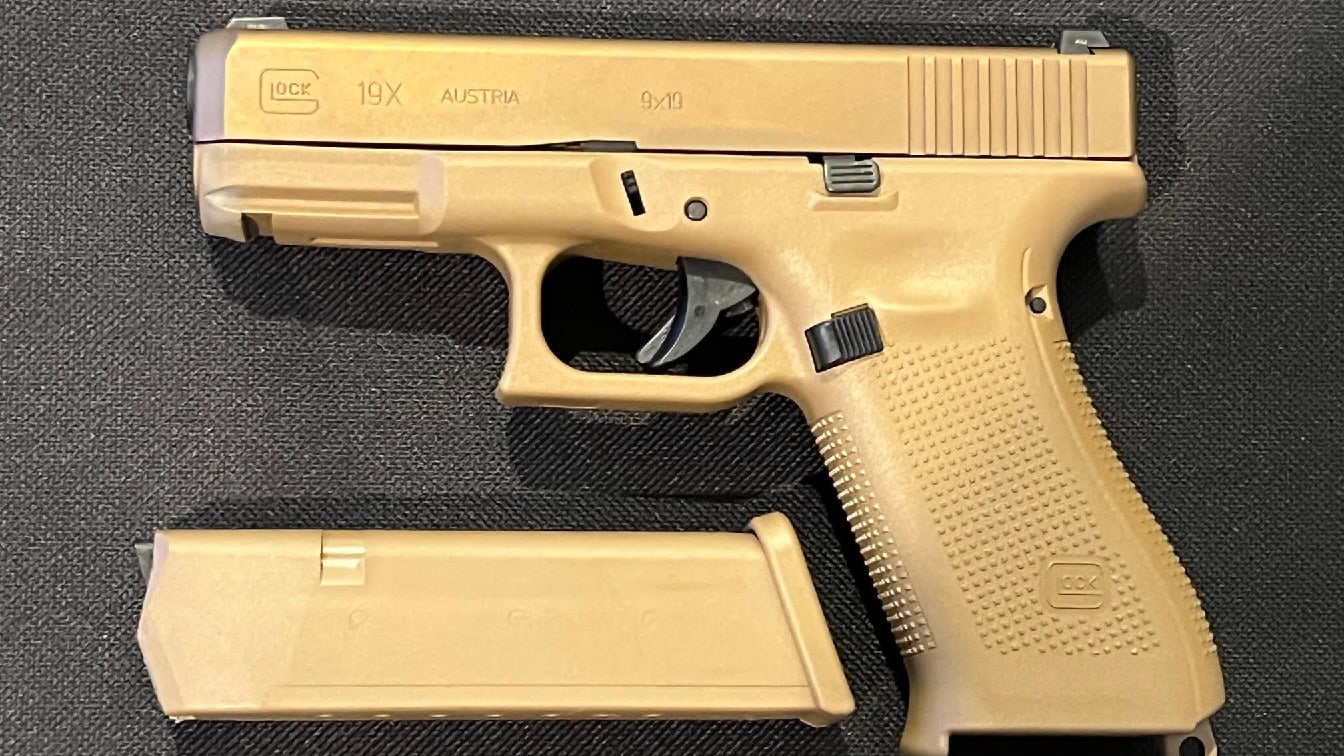
Glock 19X. Image Credit: Original Image from 19FortyFive.
By the mid-2010s, the US Army wanted to retire the Beretta M9 after three decades, and the Modular Handgun System competition it created was enormous: a 10-year contract worth up to $580 million, with the services planning to buy roughly 421,000 pistols, and every major gunmaker on Earth competing, Beretta, FN, Smith and Wesson, SIG Sauer, and Glock.
Glock’s entry was something it had never built before: a crossover, mating the full-size Glock 17 frame to the compact Glock 19 slide, finished in coyote tan, with a lanyard loop, ambidextrous controls, and the new Glock Marksman barrel, a pistol shaped in every detail by the Army’s solicitation.
Glock came in as the sentimental favorite, the sidearm of the FBI and countless police departments, and by many accounts assumed the contest was its to lose.
The Loss
On January 19, 2017, the Army chose SIG Sauer’s P320-based entry, now the M17 and M18, and the shock in the firearms world was genuine.
Glock filed a protest with the Government Accountability Office that February, and the GAO’s denial that June, laid out in a 17-page decision, told the real story.
It was not that the Army thought the SIG was a dramatically better pistol; the source selection judged the proposals close, with a slight technical edge to SIG. It was the money and the package: SIG’s bid came in at around $169.5 million against Glock’s roughly $272 million, a gap of more than $100 million, and SIG’s ammunition licensing and production plan rated Outstanding, while Glock’s rated lower.
The GAO found real errors in the Army’s evaluation and concluded they would not have changed the outcome, and the protest died there.
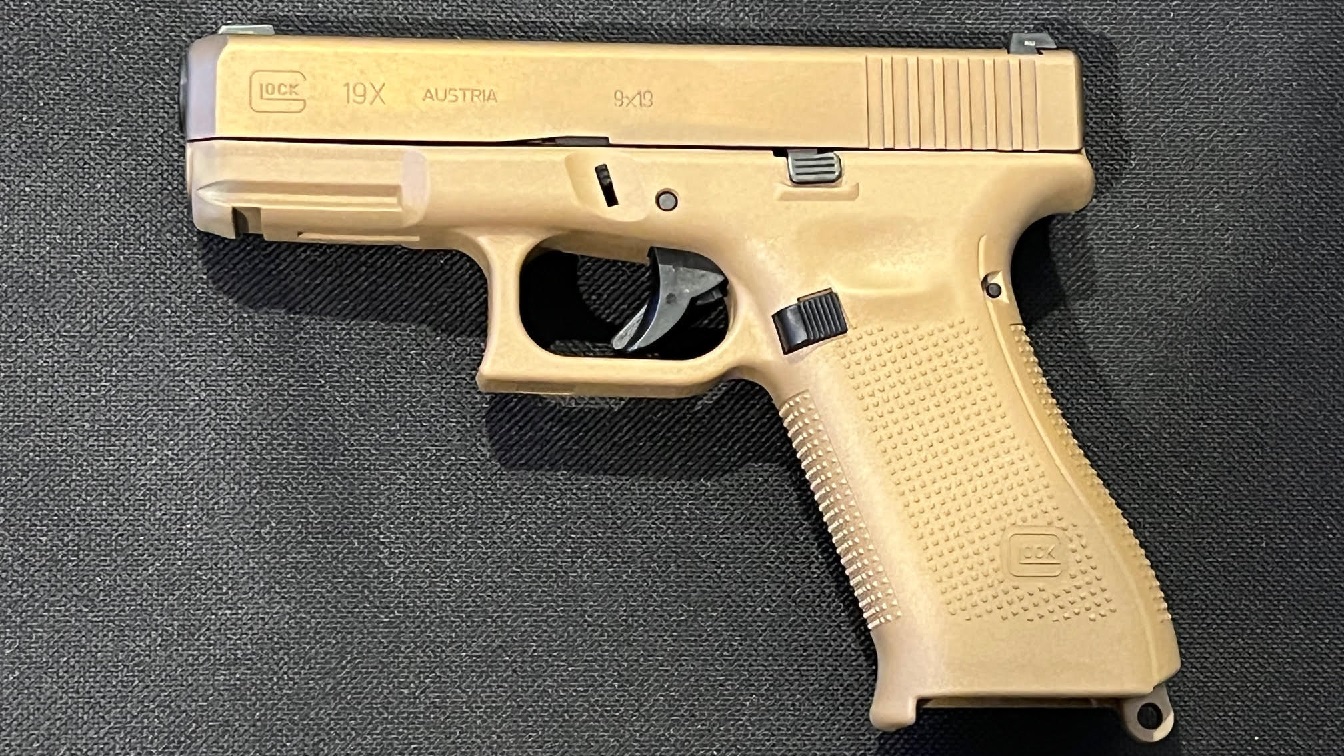
Glock 19X. Image Credit: 19FortyFive Original Image from August 2022.
The sharper hindsight critique is one the house analysis got right: the Army asked for modularity and placed heavy weight on a manual safety, and Glock offered a fixed-configuration pistol with its famous Safe Action trigger, betting the Army would favor Glock’s philosophy over its own written requirements.
The Army took its requirements.
The Market’s Verdict
Here is where the story turns, because Glock did something shrewd with its defeat.
In January 2018, it released the MHS pistol to the public essentially as submitted, minus the manual safety, and the market delivered the verdict the Army had not: more than 100,000 Glock 19X pistols sold in under six months, a pace the company’s own milestone announcement celebrated and the nation’s biggest wholesale distributor said had “exceeded our expectations.”
It has remained one of Glock’s best-selling models ever since, a fixture of a family of pistols that has sold in the tens of millions worldwide, and the reasons are the same ones Glock pitched to the Army.
The crossover layout solves a real problem: the full 17-frame grip fills the hand and holds 17-plus rounds, while the shorter 19-frame slide balances faster and carries easier, and the package arrives with night sights, the corrosion-proof nPVD finish, and magazine options up to 33 rounds.
Even the military door never fully closed: special operations units kept buying Glocks on their own authority, and in 2021, the Army itself awarded Glock a five-year contract for pistols and parts.
Meanwhile, the pistol that won, fielded across the force, has spent recent years dogged by lawsuits and agency reviews over alleged uncommanded discharges, claims SIG Sauer strongly denies, an epilogue nobody at that 2017 award ceremony saw coming.
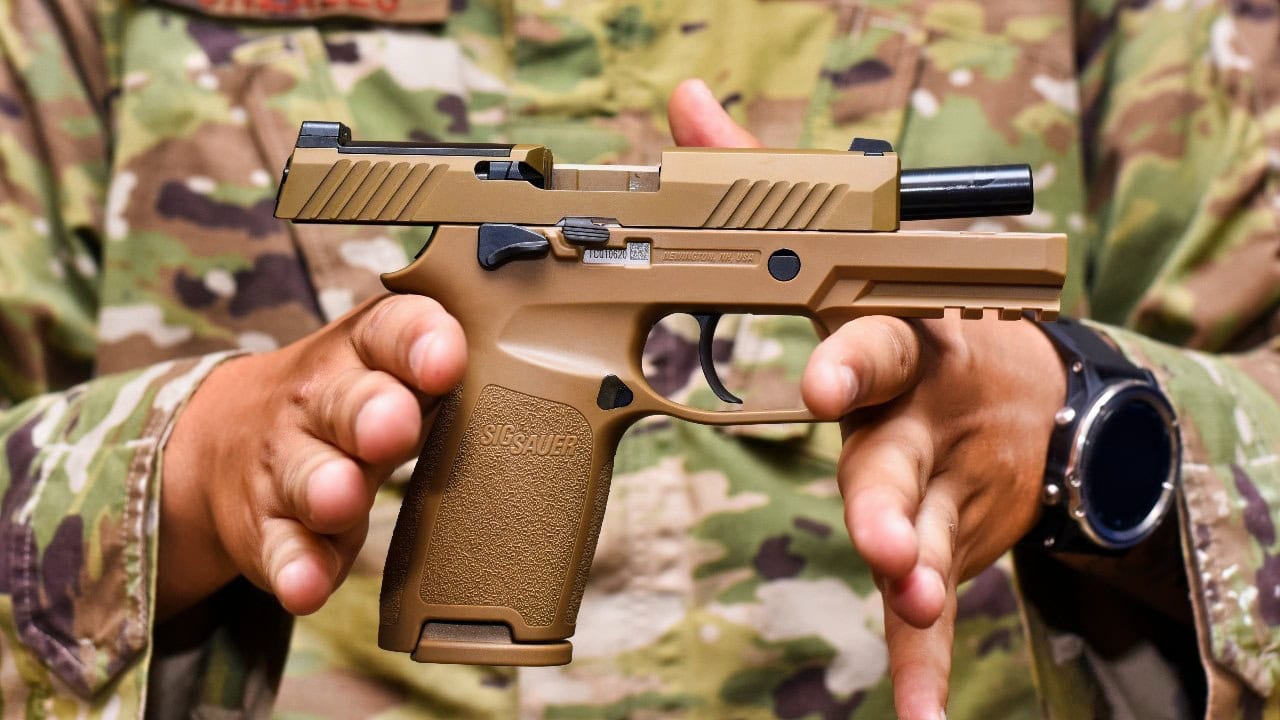
Staff Sgt. Will Gonzales, 36th Security Forces Squadron armory NCO in charge, displays a Sig Sauer M18 pistol on Andersen Air Force Base, Guam, Aug. 26, 2019. The M18 provides improved trigger pull, tritium night sights, larger ammo capacity, weapon reliability and durability to strengthen shooter lethality. (U.S. Air Force photo by Airman 1st Class Michael S. Murphy)
The Owner’s Verdict
As an owner of the Glock 19X, what strikes me is how little of the Army DNA was lost in translation.
The 19X still feels like what it was built to be, a duty pistol meant to run filthy, in gloves, in sand, for people whose lives depend on it, which is precisely why it makes such an easy pistol to live with.
The grip is the best Glock ships, the balance is right, and mine has simply never stopped working. The Army weighed it, tested it, praised it, and said no, and several hundred thousand Americans, one coyote-tan pistol at a time, have spent eight years overruling the decision. The M17 got the contract. The 19X got the country.
I would trust the Glock 19X to defend my home and property any day.
About the Author: Harry J. Kazianis
Harry J. Kazianis (@Grecianformula) was the former Senior Director of National Security Affairs at the Center for the National Interest (CFTNI), a foreign policy think tank founded by Richard Nixon based in Washington, DC. Harry has over a decade of experience in think tanks and national security publishing. His ideas have been published in the NY Times, The Washington Post, The Wall Street Journal, CNN, and many other outlets. He has held positions at CSIS, the Heritage Foundation, the University of Nottingham, and several other institutions related to national security research and studies. He is the former Executive Editor of the National Interest and the Diplomat. He holds a Master’s degree focusing on international affairs from Harvard University.

