

Alfa-Class by the Numbers: 40 Knots, a Titanium Hull and a 30-Person Crew: The Soviet Project 705 Lira, known to NATO as the Alfa class, was built around one extreme requirement: speed.
Seven submarines were completed with titanium pressure hulls, compact liquid-metal-cooled reactors, and enough power to exceed 40 knots underwater. The Soviet Navy wanted an interceptor capable of racing toward a reported contact, attacking it, and escaping, with weapons already in Western service.
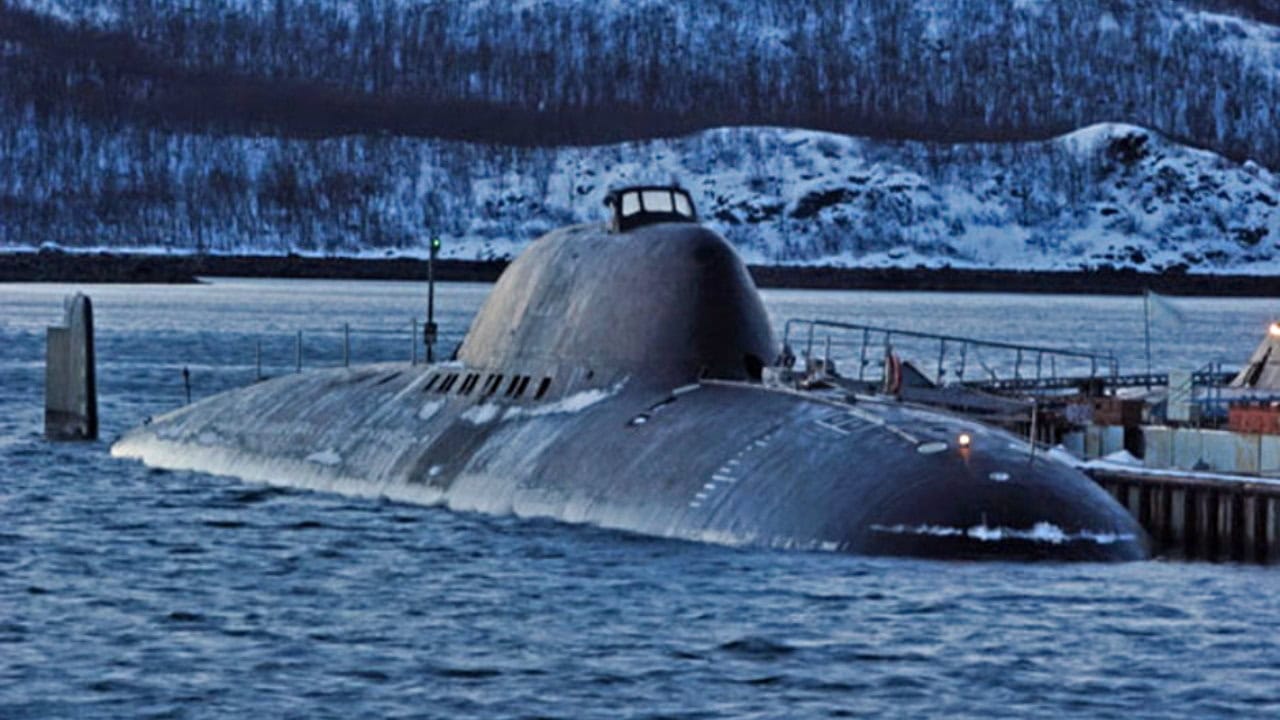
Alfa-Class Russian Navy. Image Credit: Creative Commons.
The Alfa-Class Story
The full price of an Alfa has never been published in a defensible form. A declassified CIA history estimated that titanium cost three to five times as much as steel and required new manufacturing methods, reconfigured shipyards, and retrained workers. The first submarine spent seven or eight years on the building ways, several times longer than a conventional Soviet nuclear boat.
The final design displaced roughly 2,300 tons on the surface and slightly more than 3,100 tons submerged. Depending on the production group, the hull measured about 80 meters long. One reactor supplied a 40,000-horsepower steam turbine driving a single propeller. Published specifications list the operational depth at around 320 meters and the maximum depth at around 400 meters.
Six bow-mounted 533mm torpedo tubes carried a total load of 18 torpedoes, anti-submarine missiles, or defensive weapons. The crew numbered roughly 29 to 32 people, far below the complement aboard most nuclear attack submarines. The small crew reflected an unprecedented level of automation, not a limited mission.
The Soviet Navy Wanted an Underwater Fighter-Interceptor
Design work began during the late 1950s, when Soviet planners feared that conventional submarines would not reach fast-moving NATO targets before contact data became obsolete. The goal was a small, highly maneuverable submarine hunter able to remain ready near its base, accelerate rapidly, and close the distance after receiving information from another sensor or command post.
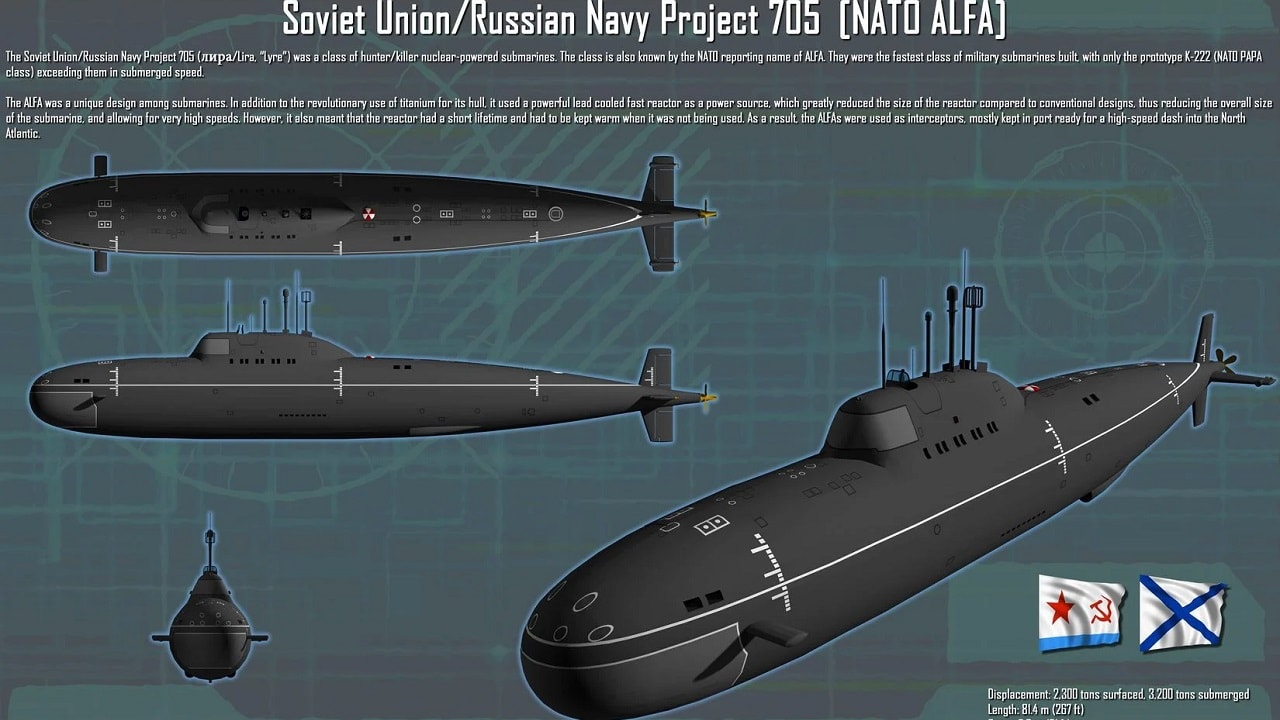
Alfa-Class Submarine. Image Credit: Creative Commons.
The original concept called for a displacement of only 1,500 tons, a speed above 40 knots, and a crew of 15 to 17 officers. The completed boats grew larger and carried more people, but the central idea survived. The Alfa was closer to an alert interceptor aircraft than a traditional submarine assigned to a long, quiet patrol.
A history written by designers from the Malachite bureau described the class as a high-speed submarine hunter built around a small power plant, extensive automation, and a nonmagnetic hull. The Alfa could fire weapons across its operating-depth range and carried an escape chamber intended to rescue the entire crew.
The design embodied the extraordinary ambitions behind the Project 705 submarine program. It also left little room for redundant personnel, manual backups, or maintainers able to repair complicated machinery during a patrol.
Titanium Made the Alfa Lighter, Stronger and Far More Expensive
Titanium offered several advantages. It was stronger than ordinary shipbuilding steel for its weight, resisted corrosion, and produced a smaller magnetic signature. The lighter pressure hull allowed designers to allocate more displacement to the reactor, machinery, and weapons while preserving speed and depth performance.
The material was difficult to shape and weld. Soviet yards needed controlled working conditions because hot titanium reacts with oxygen and other gases. Welders required specialized equipment and training, while entire sections of the production process had to be isolated or filled with inert gas.
The Soviet Union assigned work to yards in Leningrad and Severodvinsk. Four boats were built at the former Sudomekh facility, later part of Admiralty Shipyards, while three Project 705K submarines were built by Sevmash. A further hull was started but never completed.
The class demonstrated that the Soviet industrial system could build a series of titanium-hulled nuclear submarines. It did not demonstrate that titanium was economical for a large fleet. Every hull depended on specialized suppliers, skilled welders, and repair procedures unavailable at ordinary naval facilities.
The Lead-Bismuth Reactor Produced Power and a Permanent Maintenance Problem
A conventional pressurized-water reactor would have been too large and heavy for the original design goals. Soviet engineers instead used liquid lead-bismuth as the primary coolant. The system operated at lower pressure, transferred heat efficiently and provided exceptional power density inside a compact machinery space.
The coolant created a severe operating requirement. Lead-bismuth solidifies below approximately 123 degrees Celsius. Once frozen inside reactor piping, pumps and fuel assemblies, it becomes extremely difficult to remove. The reactor therefore had to remain hot, or receive reliable external heating, even when the submarine was tied to a pier.
The first boat, K-64, entered service at the end of 1971. Its reactor suffered serious coolant trouble in 1972, and solidified metal left the plant beyond practical recovery. K-64 never returned to operational service. The failure interrupted the program before six production boats entered the fleet between 1977 and 1981.
Shore infrastructure became part of the propulsion system. Naval bases needed steam and electrical support to keep the coolant liquid while reactors were shut down. When that support proved unreliable, crews often kept reactors operating at low power. The arrangement consumed fuel life and required constant technical attention.
The consequences became unmistakable aboard K-123 in 1982. A coolant leak contaminated the reactor compartment with liquid metal and radioactive material. Workers eventually removed and replaced the entire compartment. The repair took eight or nine years, and K-123 did not return to service until 1991.
More Than 40 Knots Created Speed at the Expense of Stealth
The Alfa’s speed was real. The CIA detected one exceeding 40 knots in March 1979, and specialist sources commonly place maximum performance between 40 and 43 knots. Only the one-off Soviet K-222 attack submarine achieved a higher recorded underwater speed.
Speed did not arrive quietly. At high power, machinery vibration, water flow around the hull and propeller cavitation generated an enormous acoustic signature. A technical study of the class stated that Soviet designers considered the noise acceptable because the submarine was expected to evade contemporary torpedoes through acceleration and speed.
That assumption weakened as Western weapons improved. A submarine detected at long range still had to survive aircraft, surface ships and attack submarines working together. Newer torpedoes gained speed, endurance and better guidance, reducing the value of a boat trying to escape through raw performance.
The United States followed a different path. American submarines remained steel-hulled and increasingly emphasized acoustic superiority, a choice reflected in the Navy’s rejection of titanium construction. Later Soviet designs also placed much greater weight on quieting, including the titanium-hulled Sierra class and the steel-hulled Akula class.
The Alfa Forced NATO to Rethink Torpedo Performance
Western navies had to assume that some existing torpedoes lacked the speed or energy to catch an Alfa under favorable conditions. Britain developed the high-performance Spearfish, while the United States improved the Mark 48 family. The precise influence of one Soviet class on each program is difficult to isolate, but Alfa performance became a central Western anti-submarine warfare concern.
The CIA later reported that early intelligence on the submarine helped American naval engineers avoid approximately $325 million in unproductive torpedo-development work. The Alfa therefore imposed costs on NATO before it demonstrated sustained operational reliability.
Its combination of speed, titanium and reactor technology also gave the class a reputation larger than its seven hulls. Public accounts often treated Western torpedo development as the direct answer to Soviet titanium submarines, even though the undersea competition involved many classes and missions.
The Hunt for Red October Turned the Alfa Into a Movie Villain
The Alfa’s public image reached its peak in the 1990 film The Hunt for Red October. The fictional V.K. Konovalov, commanded by Captain Viktor Tupolev, pursues the defecting Red October and becomes the final Soviet adversary in the climactic torpedo sequence.
The choice made sense for the story. An Alfa represented the Soviet submarine most closely associated with acceleration and pursuit. Its small hull and high speed made it a believable hunter for the fictional Typhoon-class ballistic-missile submarine.
The film preserved the class as a symbol of Soviet technical aggression long after its practical weaknesses were understood. The real Alfa-class record was far more mixed: an exceptional test of materials, automation and propulsion paired with poor maintainability and a reactor system the fleet struggled to support.
Russia Retired the Alfa Class as Quiet Submarines Took Priority
Five operational Alfas left service around 1990 as the Soviet Union reduced spending and the Cold War ended. Their unique reactors, limited support network, and expensive repairs made continued operation difficult. The growing value of quietness also weakened the case for a submarine designed around high-speed interception.
Disposal created another bill. Titanium required specialized cutting and processing, while frozen coolant and highly enriched reactor fuel complicated nuclear dismantlement. One study estimated that Sevmash lost about one billion rubles, then converted to roughly $2.5 million, dismantling K-463 because the recovered materials did not cover the work.
The wider titanium-submarine experiment remained too demanding for American adoption. Soviet and Russian designers retained lessons in automation, escape systems and high-strength construction, while later attack submarines pursued quieter ways to hunt the U.S. Navy.
K-123 returned to service after its reactor compartment was replaced. Russia decommissioned it on July 31, 1996, making it the final operational Alfa-class submarine to leave the fleet.
About the Author: Harry J. Kazianis
Harry J. Kazianis (@Grecianformula) was the former Senior Director of National Security Affairs at the Center for the National Interest (CFTNI), a foreign policy think tank founded by Richard Nixon based in Washington, DC. Harry has over a decade of experience in think tanks and national security publishing. His ideas have been published in the NY Times, The Washington Post, The Wall Street Journal, CNN, and many other outlets worldwide. He has held positions at CSIS, the Heritage Foundation, the University of Nottingham, and several other institutions related to national security research and studies. He is the former Executive Editor of the National Interest and the Diplomat. He holds a Master’s degree focusing on international affairs from Harvard University.