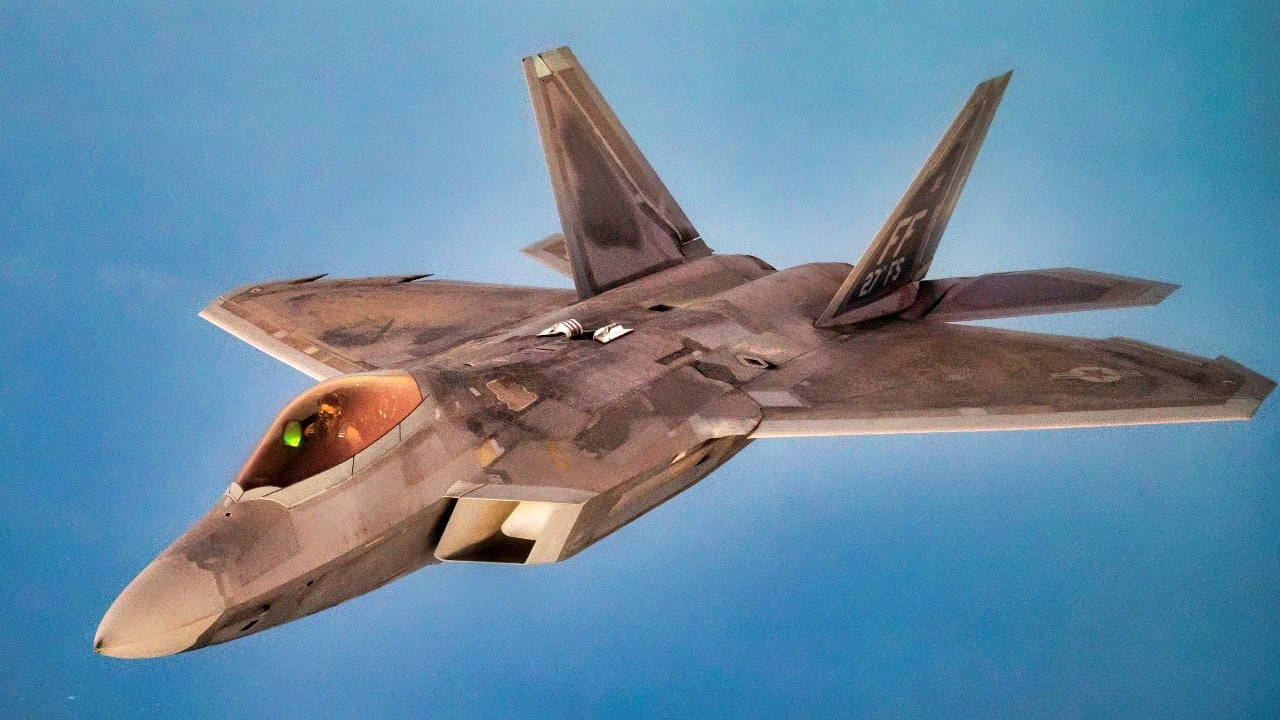
Had the United States Navy bought a carrier-capable “Sea Raptor” F-22 variant in the 1990s, its air wings today would be far better at winning the first days of a high-end war against a peer rival, but it would come at a considerable cost to the overall size of the fleet, its strike capacity, as well as adaptability to other threats.
The Navy, in fact, estimates that an F-22 Sea Raptor program would cost $66,100,000 in total. That was compared to the Super Hornet program, which succeeded at just $3,300,000,000
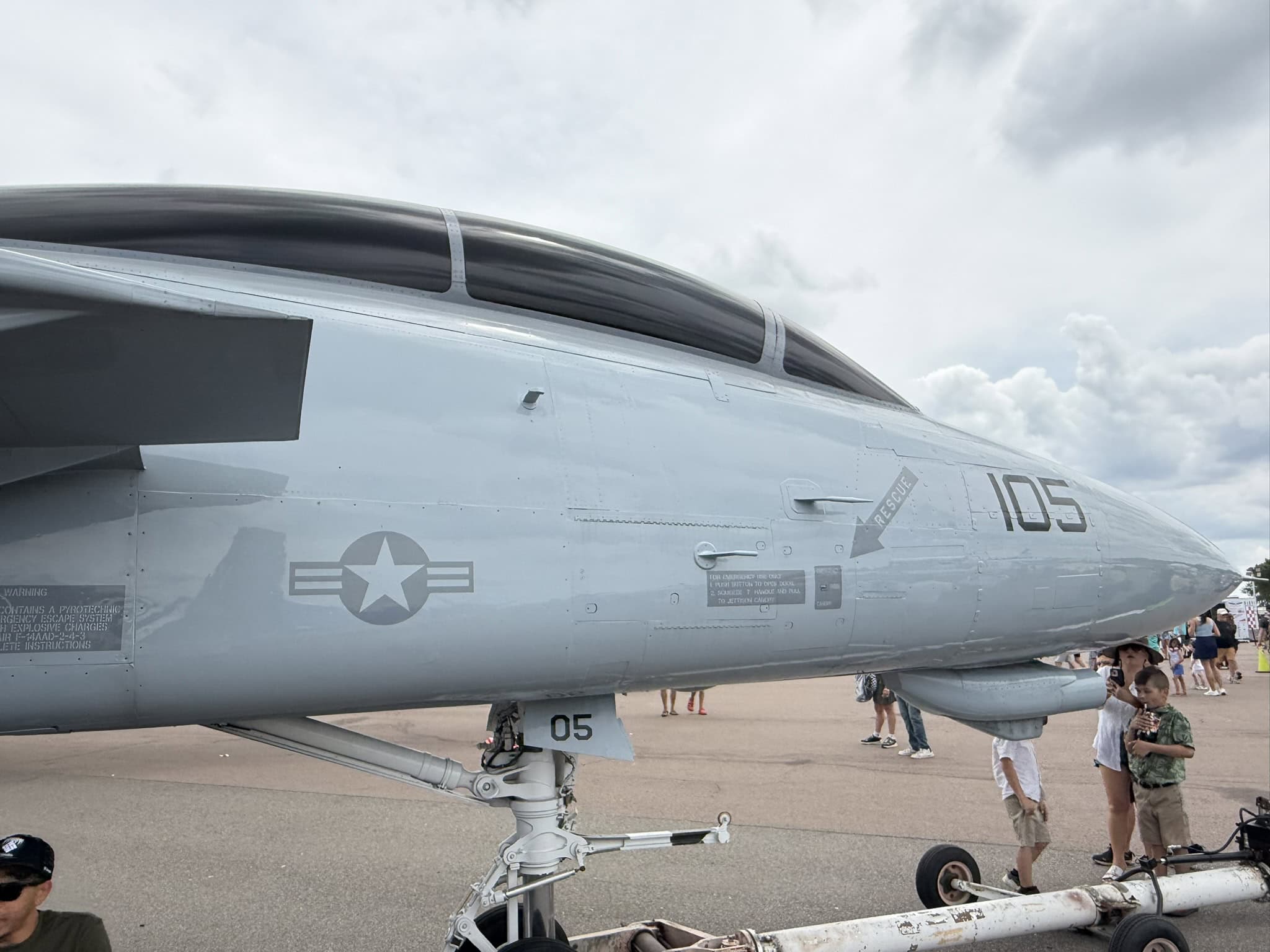
F-14D Tomcat from Lakeland, Florida Airshow. Image Credit: 19FortyFive.com. Taken on 4/19/2026.
The hypothetical is retrospective rather than something official, and the U.S. Navy’s canceled concept envisaged an F-14 replacement derived from the F-22, likely with variable-sweep wings and a substantially reworked airframe strengthened for carrier operations.
A Different Kind of Air Wing
The principal gain would have been air dominance at sea. A navalized F-22 Raptor would have married the Raptor’s low observability, high-altitude performance, powerful radar and supercruise with the reach and persistence the U.S. Navy wanted after the F-14 Tomcat.
In a Pacific contingency, that would have made it a formidable forward screen to detect and engage Chinese or Russian fighters before they could threaten the carrier strike group, while complicating an opponent’s airborne early-warning and maritime strike options. The original concept also considered the carriage of weapons such as the AIM-152 long-range air-to-air missile, HARM anti-radiation missiles, and Harpoon anti-ship missiles.
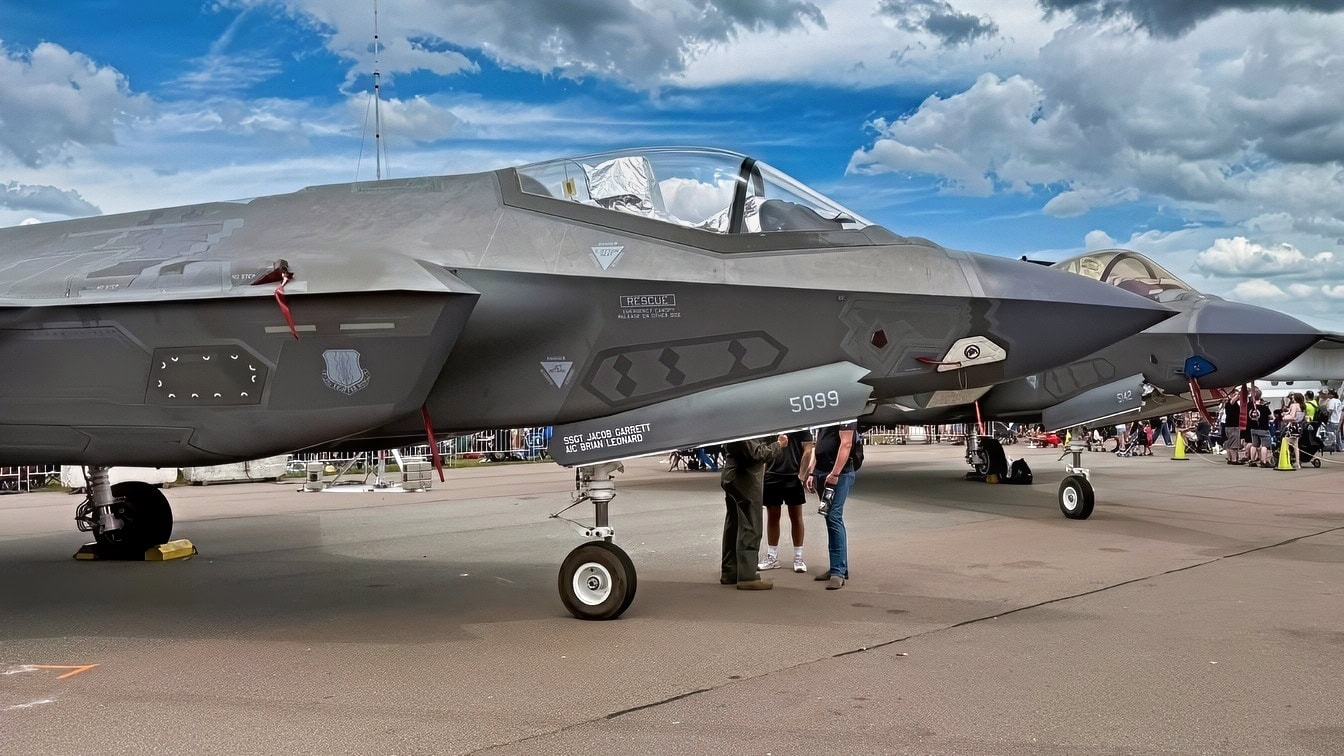
F-35C Lakeland Airshow 19FortyFive.com Image
That matters because the U.S. Navy’s present carrier air wing divides its work between the F-35C — an excellent stealthy sensor and strike aircraft — and the F/A-18E/F, which supplies much of the mass, electronic attack, and missile carriage.
A Sea Raptor squadron would have given the carrier a dedicated, stealthy counter-air fighter with markedly greater kinematic performance than either of the others.
It could have opened corridors for F-35Cs, Growlers, and bomb-carrying Super Hornets rather than requiring those aircraft to operate under a dense enemy fighter and missile umbrella.
The change would have been most visible in the 2000s and 2010s.
The U.S. Navy retired the F-14 without acquiring a comparably long-legged fleet-defense interceptor; the Super Hornet was a versatile substitute, but not a replica.
The U.S. Navy itself has long treated the F/A-XX as the eventual replacement for Super Hornets and EA-18Gs, an implicit admission that the air wing needs more range, survivability, and capability than its present mix can deliver against major powers.
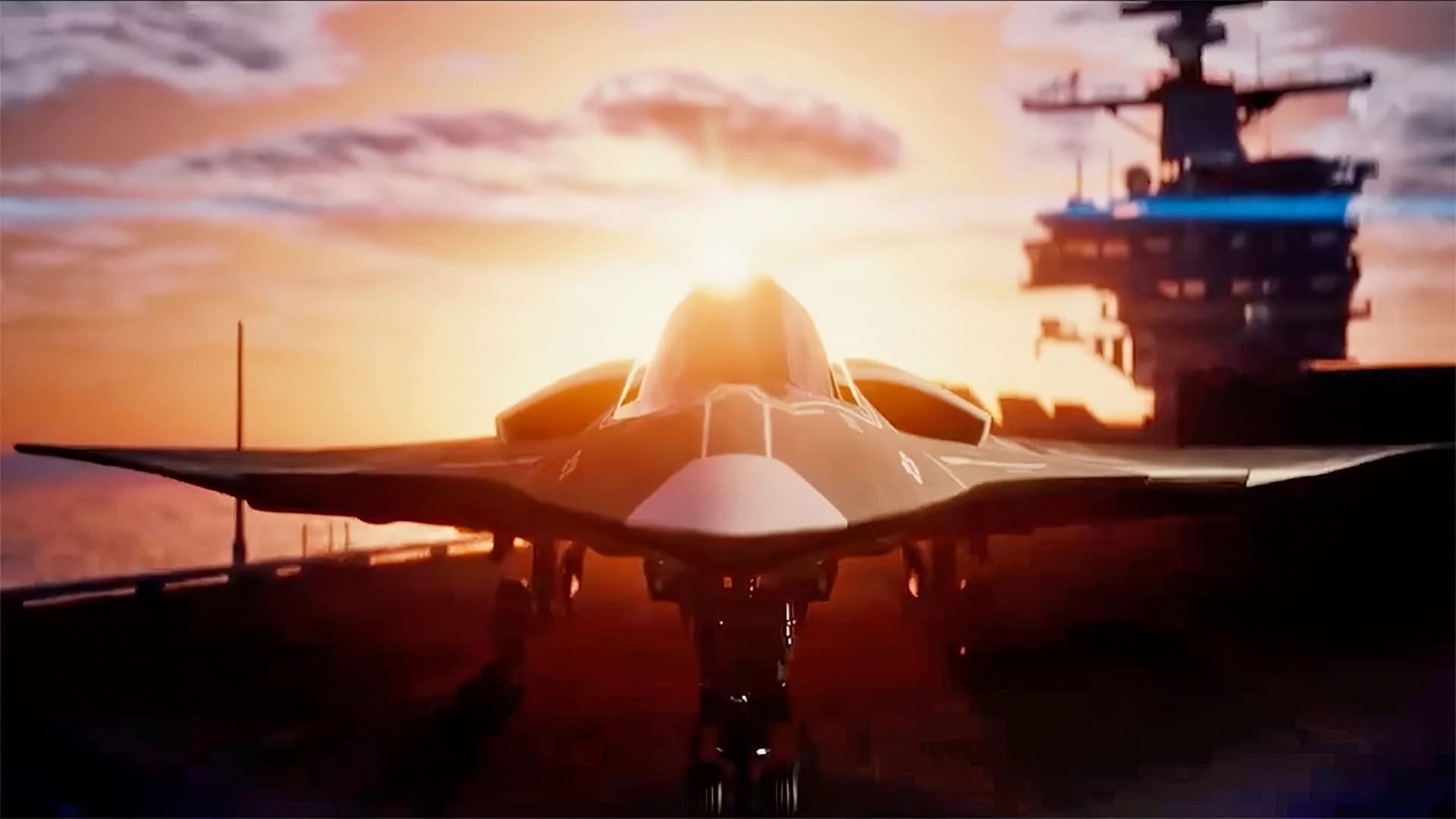
FA-XX Fighter Video Screenshot. Image Credit: NG Video Screencap.
The Price of Entry
Yet this would not have been simply the navalisation of an existing jet.
Carrier aircraft must endure arrested recoveries, catapult launches, corrosion, and constrained deck handling.
The U.S. Navy’s requirement for lower approach speeds while preserving Mach-2 performance reportedly proved the concept toward variable-sweep wings, the kind of solution that made the F-14 effective, but large, expensive, and mechanically demanding.
The bill would have been punishing. Even the land-based F-22 suffered from shrinking production runs and escalating unit costs.
The Government Accountability Office, a federal watchdog, reported that program acquisition unit costs rose significantly as planned quantities fell from 648 to just 188.
The operational U.S. Air Force buy ultimately stopped at 187 aircraft.
A naval derivative, bought in smaller numbers while retaining separate training, spares, depot and software arrangements, would probably have been even more expensive.
F-22 Sea Raptor: More Capable but Less Flexible
The most plausible outcome is a U.S. Navy with perhaps several Sea Raptor squadrons concentrated on the carriers most likely to face China, and a sharper but more uneven air wing.

The US Air Force (USAF) F/A-22 Raptor, flown by USAF Major (MAJ) David Thole, 422nd Test and Evaluation Squadron (TES), Nellis Air Force Base (AFB), Nevada (NV), heads out to the Nevada Test and Training Range (NTTR) for an operational test mission.
Those ships would be harder to approach from the air and better able to conduct the air-to-air campaign.
But readiness would likely be more fragile, given the maintenance burden of a unique, complex naval stealth fighter and the limited number of airframes available to absorb attrition.
It would also have created a formidable institutional obstacle to the current F/A-XX. The U.S. Navy would either be attempting to prolong a 1990s-designed stealth fighter beyond its sensible lifespan, or paying for an early replacement after decades of unusually high operating costs.
The F/A-XX is now intended to complement the F-35C and replace the Super Hornet from the 2030s. As of August this year, the U.S. Navy still expected an engineering and manufacturing award very soon.
In summary, the Sea Raptor would have made America’s carriers more dangerous in the narrow, vital contest for air superiority.
But it would not have abolished the modern carrier’s larger problem of survivability and striking at range against a missile-armed peer.
It might have given the U.S. Navy a sharper sword, but left less funding for the rest of the program competing for support.
About the Author: Caleb Larson
Caleb Larson is an American multiformat journalist based in Berlin, Germany. His work covers the intersection of conflict and society, focusing on American foreign policy and European security. He has reported from Germany, Russia, and the United States. Most recently, he covered the war in Ukraine, reporting extensively on the war’s shifting battle lines from Donbas and writing on the war’s civilian and humanitarian toll. Previously, he worked as a Defense Reporter for POLITICO Europe. You can follow his latest work on X.