
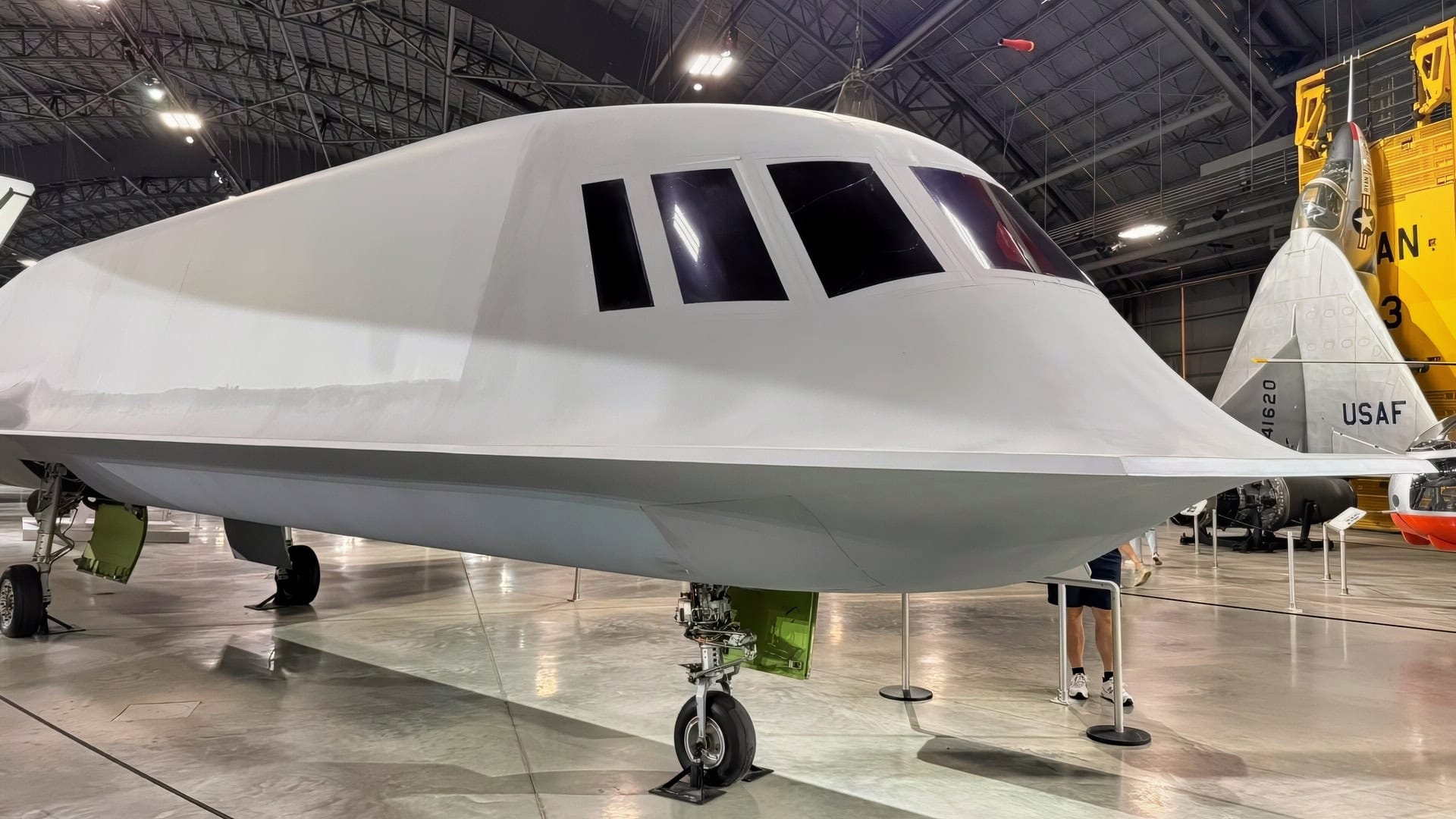
Northrop’s Tacit Blue was a uniquely distinct aircraft, with a rounded nose, boxy fuselage, tiny wings, and almost none of the sleekness normally associated with stealth aircraft. But appearances were deceptive.
Tacit Blue was one of the most important classified experimental aircraft of its era, demonstrating technologies that helped make modern low-observable surveillance aircraft—and especially the B-2 Spirit stealth bomber—possible.
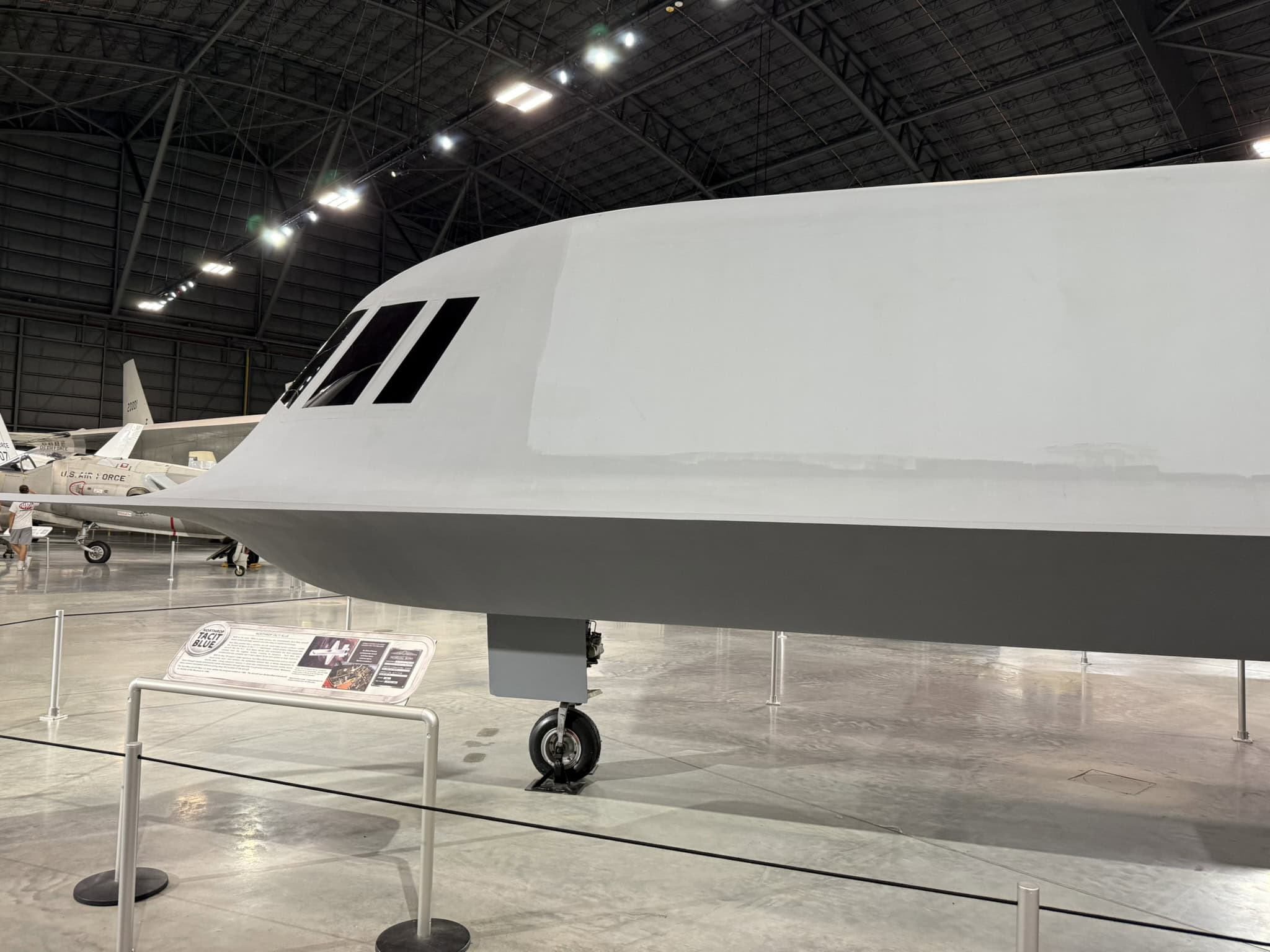
Tacit Blue Taken at the National Museum of the Air Force Back on July 19, 2025 for 19FortyFive.com.
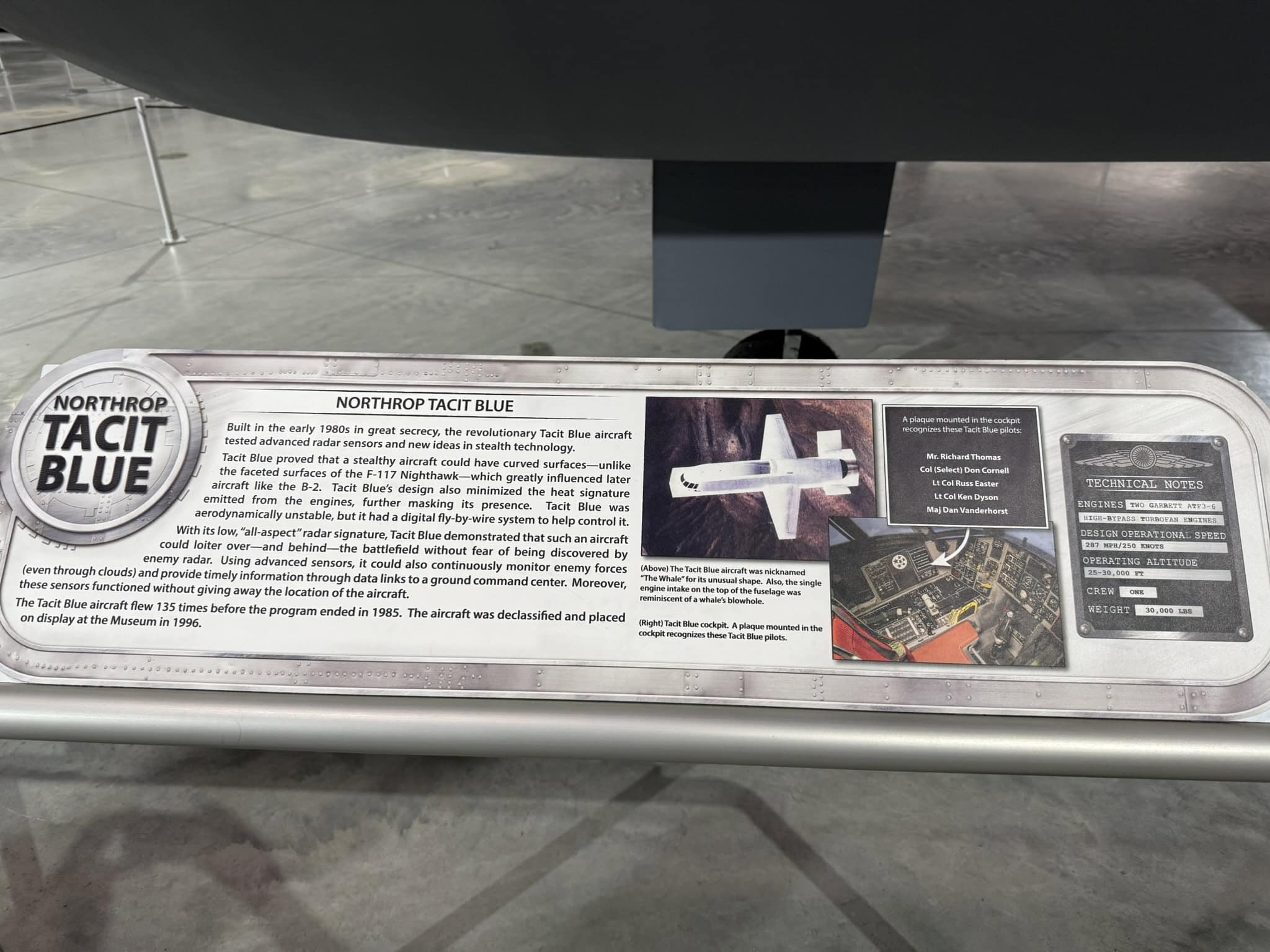
Tacit Blue. 19FortyFive.com image.
DARPA and the US Air Force first flew it under the Battlefield Surveillance Aircraft-Experimental (BSAX) program in February 1982.
The purpose of the program wasn’t necessarily to produce an operational aircraft, but rather to answer fundamental questions like: could a surveillance aircraft operate close to Soviet ground forces without being immediately detected?
The program remained highly classified until 1996, by which point the technology had already diffused into subsequent American aircraft designs.
Cold War Problems
Tacit Blue grew out of late-1970s and early-1980s concerns about how NATO could prevent Soviet armored formations from moving across the European plains.
Accordingly, the United States developed the Assault Breaker concept, which aimed to detect Soviet formations deep behind the front and destroy them with precision-guided weapons before they could enter the battle and seize territory in Europe.
This Assault Breaker concept required an aircraft capable of finding and tracking moving tanks, armored vehicles, and other ground formations.
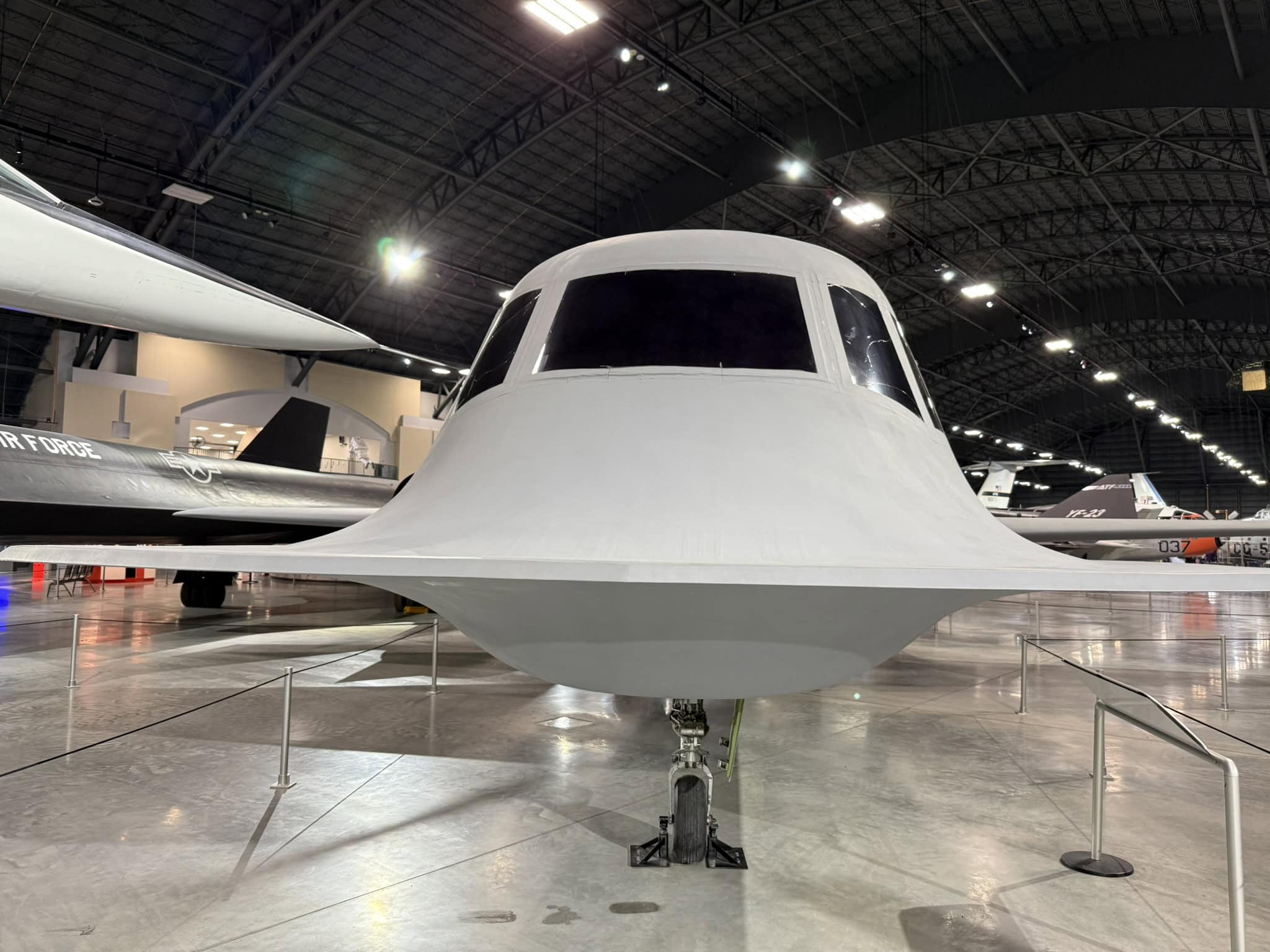
Tacit Blue Stealth Plane 19FortyFive.com Image
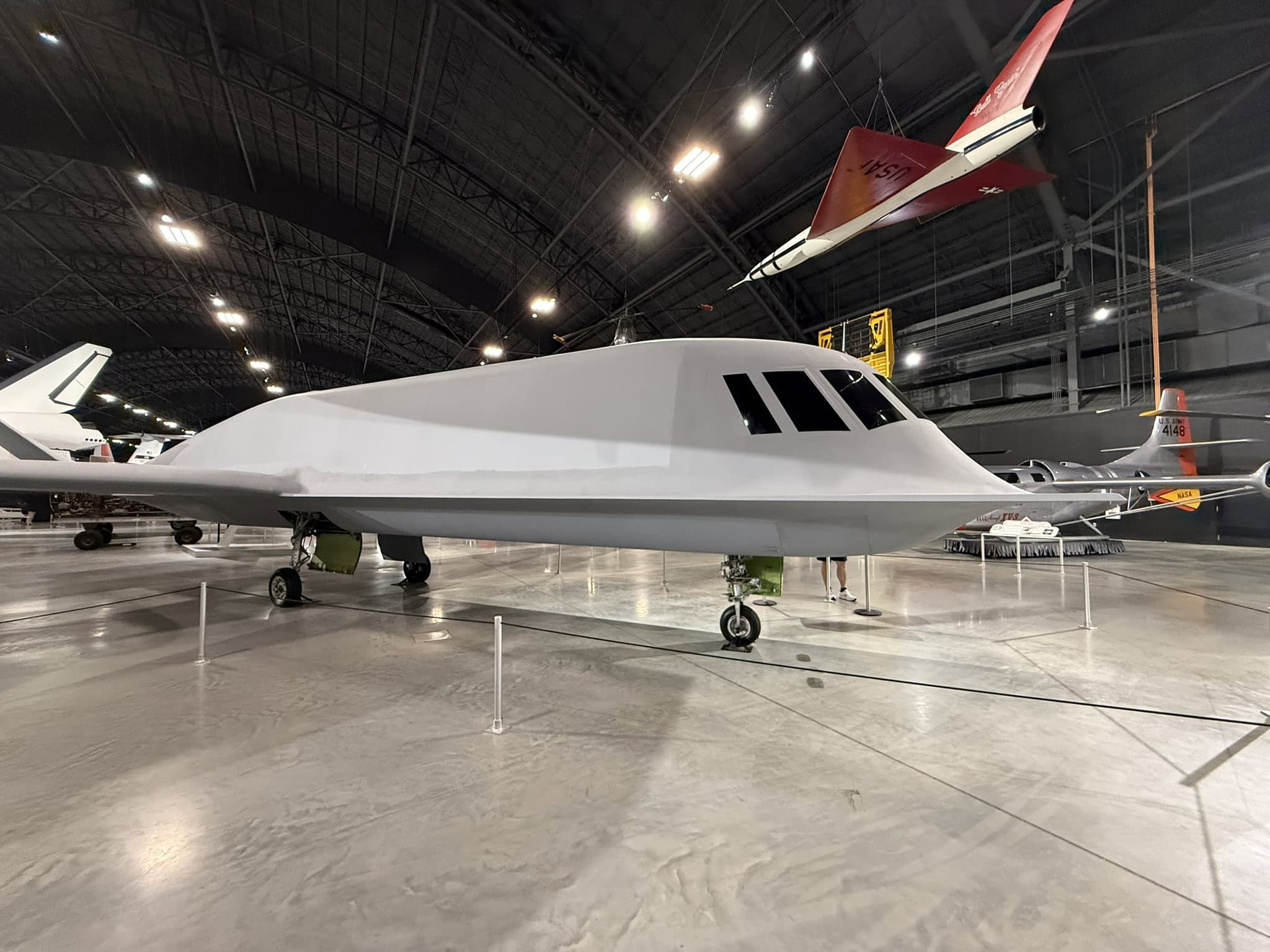
Tacit Blue Stealth Plane 19FortyFive.com Image
Conventional reconnaissance aircraft could detect these ground formations, but Soviet fighters and SAMs made survival unlikely.
So, the US began conceiving an ambitious solution that combines powerful ground-surveillance radar with a stealth aircraft capable of orbiting relatively close to hostile territory.
Tacit Blue was therefore a proof of concept for something like an early stealth ISR aircraft.
Ungainly Features
Tacit Blue looked odd. Early stealth development produced unusual airplanes, including the Tacit Blue, because engineers were still learning how to shape an aircraft to deflect radar signatures.
For example, Lockheed’s Have Blue program—which led to the F-117 Nighthawk—relied heavily on flat, sharply angled facets to scatter radar energy away from its source. The result was a highly unusual aircraft.
Northrop pursued a different approach with Tacit Blue: its airframe incorporated smooth, continuously curved surfaces, particularly around the nose and fuselage.

F-117 Nighthawk at National Museum of Air Force 19FortyFive Photo
This mattered because computing technology had advanced enough for engineers to begin designing and predicting the radar behavior of curved surfaces, rather than relying exclusively on simplified facets like those used in the Have Blue program.
This philosophy of using curved surfaces became relevant in later stealth aircraft, including the B-2; smooth, blended contours are radically different from the highly angular F-117.
Flying the Whale
Tacit Blue earned the nickname “the Whale.” It fits. The airplane’s aerodynamics were unconventional and whale-like.
With two Garrett turbofan engines, the aircraft measured 55 feet long with a 48-foot wingspan.
The jet was subsonic, as speed was never really the point. As one might imagine, the aircraft was inherently difficult to fly, requiring a digital fly-by-wire flight-control system to keep the aircraft manageable.
Tacit Blue, therefore, reflected another emerging reality of modern aircraft design: computers can make aerodynamically undesirable shapes operationally usable.
Indeed, computers have been used to keep un-aerodynamically intuitive aircraft like the F-16 and F-117 from falling out of the sky.
Out of Area 51
Tacit Blue made its first flight at Area 51 on February 5, 1982. Only one aircraft was ever built, yet that single demonstrator reportedly completed 135 flights over roughly three years—often flying several times per week.
The volume of testing provided valuable insights and data, especially regarding low-observable shaping, radar integration, flight controls, aerodynamics, and maintaining stealth during prolonged surveillance operations.
The program ended in 1985 after the demonstrator accomplished its objectives, yielding a wealth of useful information.
Tacit Blue proved that certain technologies could work, that an aircraft could combine low observability, curved stealth shaping, advanced radar, and computerized flight controls—all while serving as a persistent battlefield sensor.
Today, the demonstrator rests on display at the National Museum of the US Air Force in Dayton, Ohio. In fact, many of the photos in this article are from our own time spent with Tacit Blue roughly a year ago when we visited the museum.
MORE – A Chinese Submarine Surfaced 5 Miles from a US Navy Carrier
About the Author: Harrison Kass
Harrison Kass is a writer and attorney focused on national security, technology, and political culture. His work has appeared in Tablet, City Journal, The Hill, The Spectator, and The Cipher Brief. He holds a JD from the University of Oregon and a master’s in Global & Joint Program Studies from NYU. More at harrisonkass.com.