
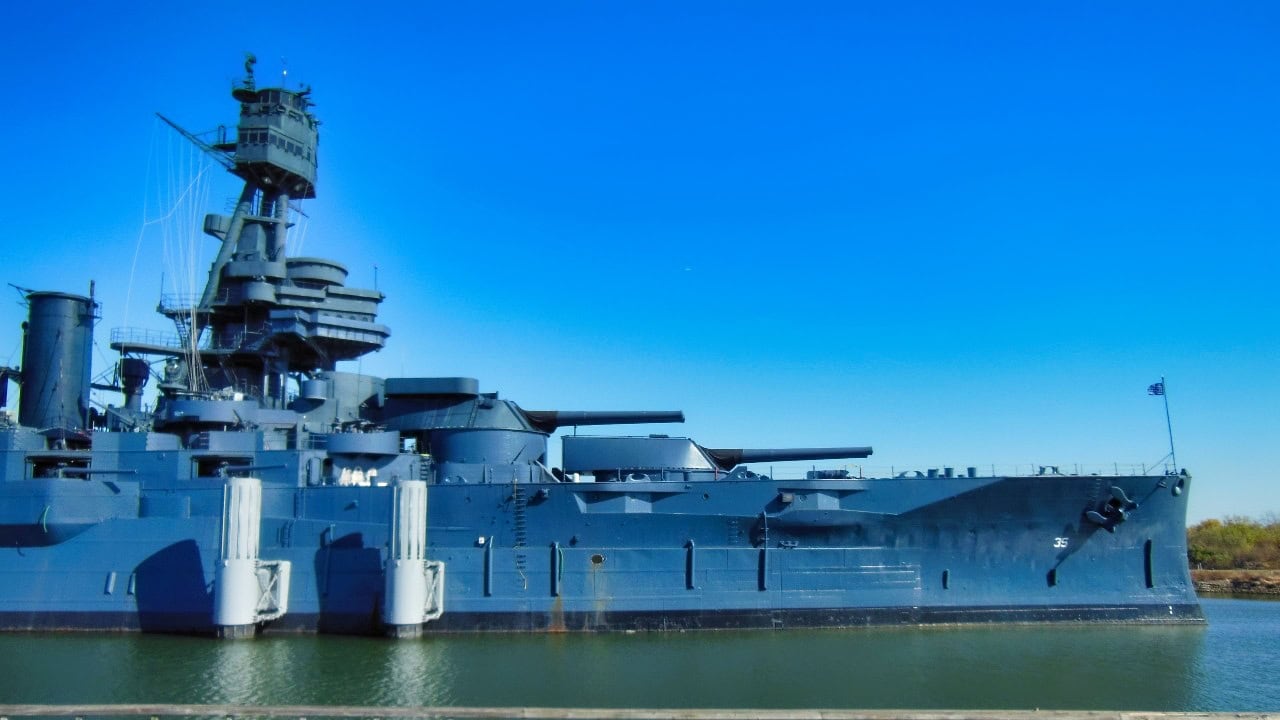
The USS Texas (BB-35) is currently the world’s oldest surviving battleship and is undergoing maintenance to be restored as a museum ship.
Originally built in 1914, this steel behemoth served in both WWI and WWII before being decommissioned in 1948.
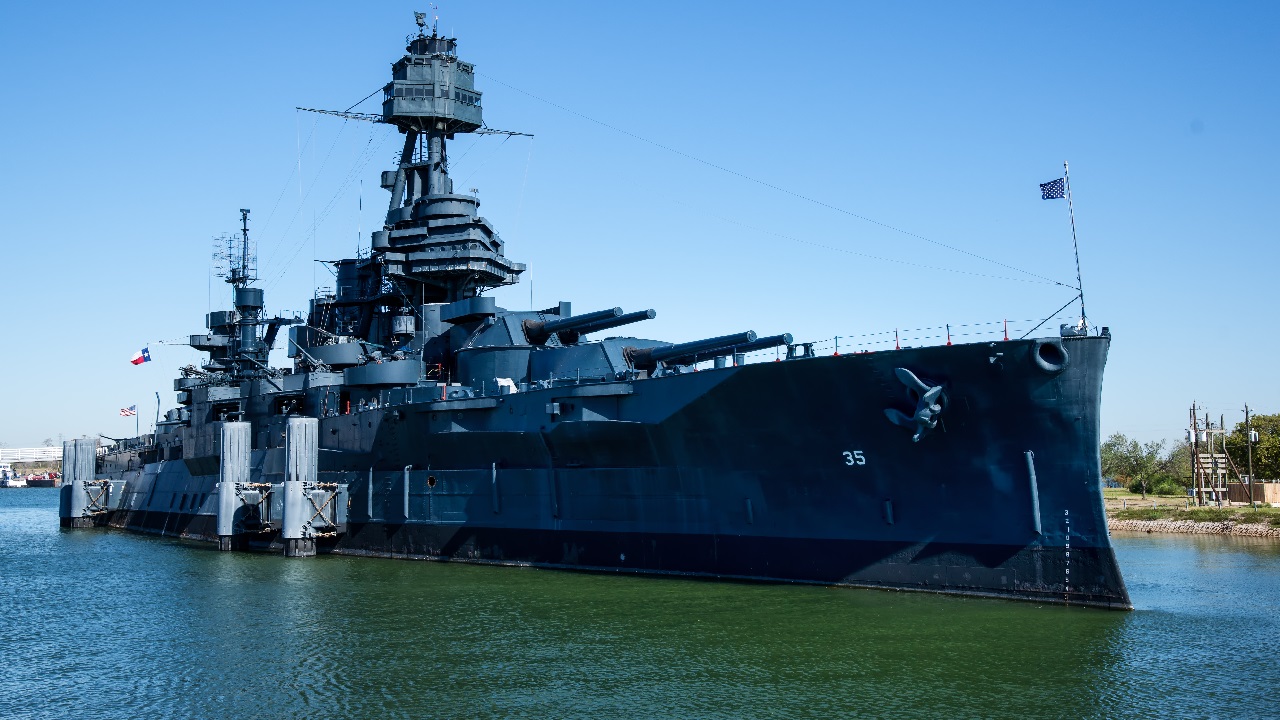
Battleship USS Texas from 2011. Image Credit: Creative Commons.
Rather than being scrapped, she was recommissioned as a Museum ship in 1947 and stationed at the Houston Ship Channel near the San Jacinto Monument.
Over time, however, the elements took their toll on the battleship’s aging hull, and the ship gradually deteriorated.
In the 2010s, several leaks were discovered, requiring urgent dry-dock repairs, during which she remained until 2025.
Texas is currently completing the final steps of her restoration; after that, she will be moved to her new pier and officially reopen in 2027.
Long Service History for USS Texas
Construction on Texas began in 1910. She was one of the last U.S. dreadnought battleships and entered service during the final years of the dreadnought concept.
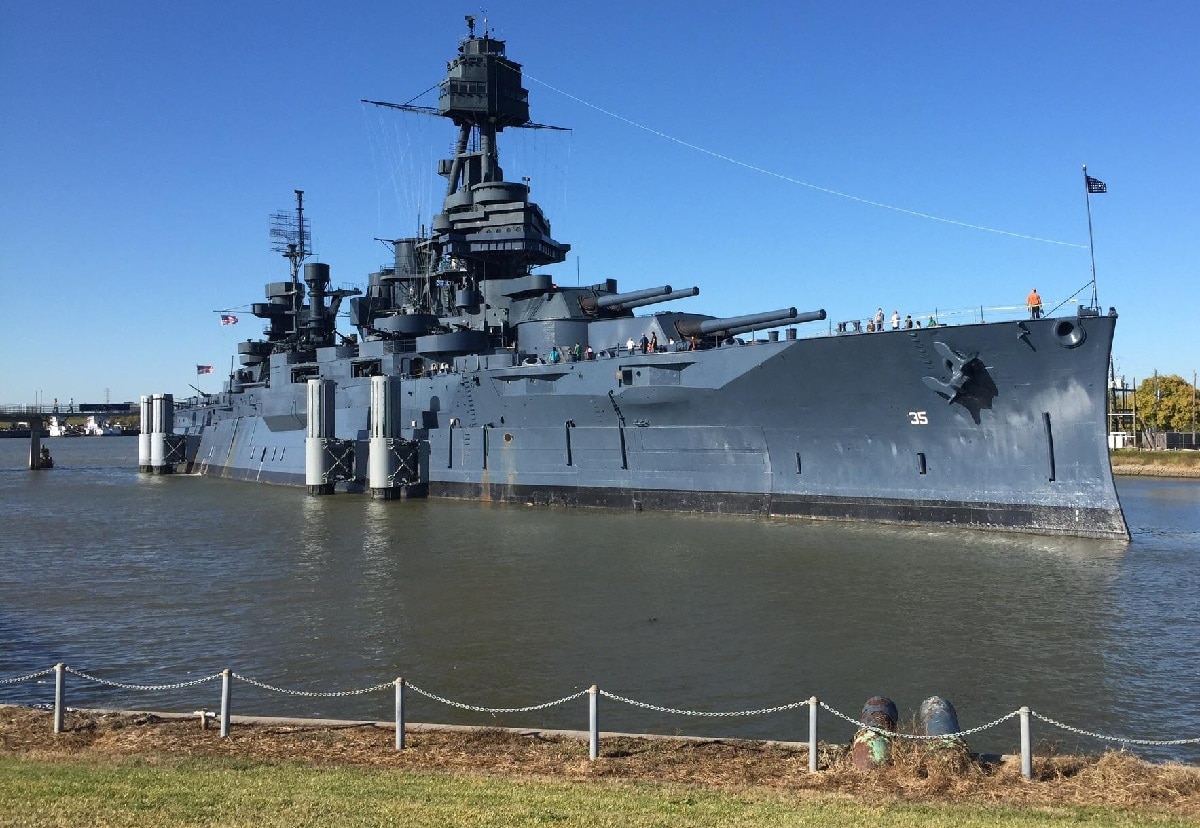
She was the second and final New York-class battleship, measuring 573 feet in length and with a displacement of 27,000 tons with a standard load.
She was armed primarily with five turrets, each with two 14-inch (356 mm) guns, with a secondary armament of 21 five-inch (127 mm) guns, four torpedo tubes, and multiple smaller gun turrets.
In many respects, Texas was a trailblazer for the U.S. Navy. She was the first battleship to be fitted with anti-aircraft guns, the first to be fitted with fire-control systems, and the first to be fitted with a 14-inch gun.

USS Texas. Image: Creative Commons.
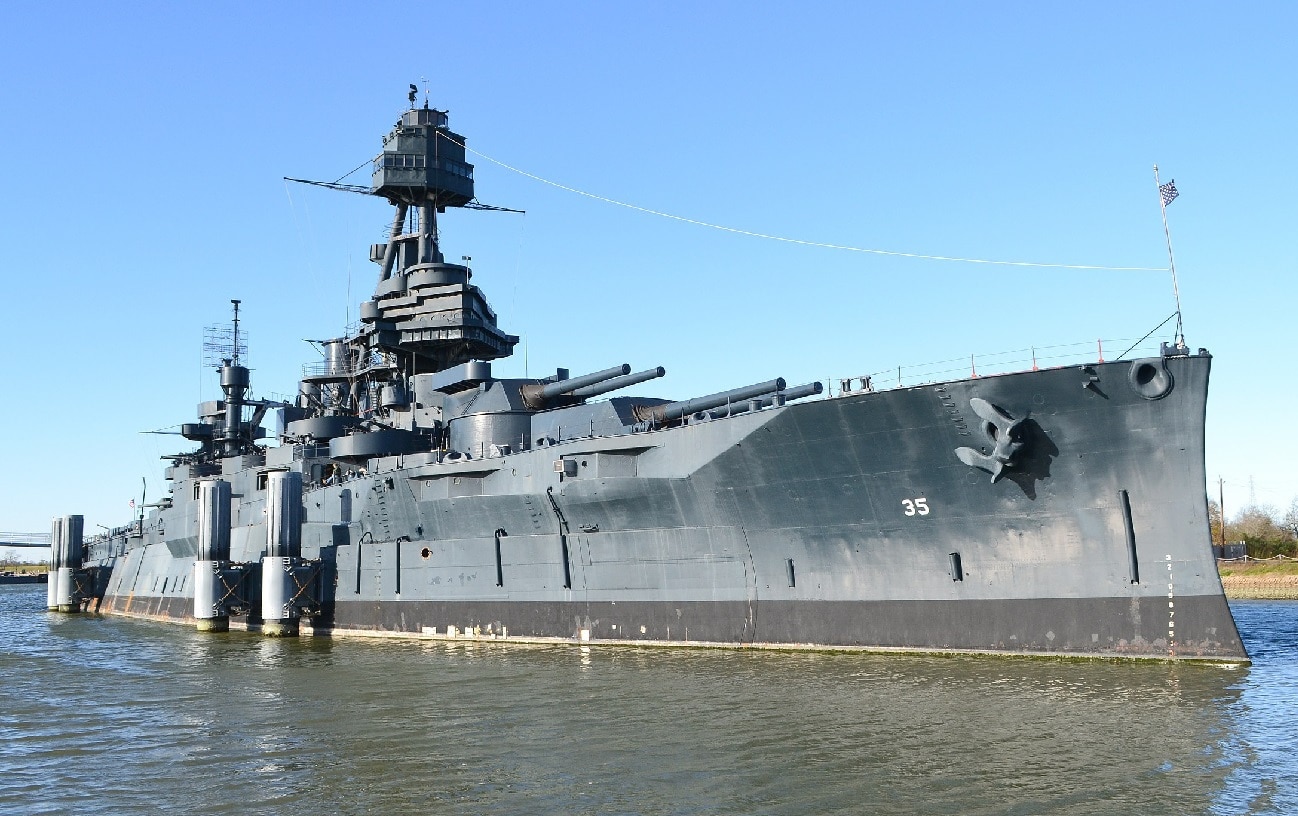
Image: Creative Commons.
USS Texas. Creative Commons Photo.
Upon entry into service, Texas took part in the Tampico Incident, in which American forces landed at Tampico in Mexico and seized a local storehouse in a show of force to the Mexican government.
During the First World War, she was relegated mainly to escort duty, accompanying transport convoys bringing goods to and from Europe.
Occasionally, she was sent to reinforce the UK Royal Navy’s squadron in the North Sea whenever German heavy warships posed a threat.
Throughout the war, however, she never encountered any combat.
WWII, however, was much more dramatic.
She supported Operation Torch during the Africa campaign, then provided fire support at Omaha Beach during the D-Day Landings.
After supporting operations in Europe, Texas was then transferred to the Pacific theater, where she assisted with Operation Detachment in Iwo Jima and Operation Iceberg in Okinawa.
Life as a Museum Ship
After World War II ended, Texas was one of the oldest battleships in the U.S. Navy and had built a successful career.
She was officially decommissioned in 1948 and placed in the care of the Battleship Texas Commission (BTC). The ship found her new home in the Houston Ship Channel at San Jacinto State Park.
Unfortunately, BTC funding was insufficient to keep the ship in top shape. As a result, Texas’ condition steadily deteriorated.
She was held together largely by the efforts of other independent charitable organizations, which contributed extra funds to the BTC to keep the legendary battleship afloat.
In the 1980s, the state of Texas formally abolished the BTC, and control of the battleship transferred to the Texas Parks and Wildlife Department (TPWD).
Immediately after acquiring the ship, the Department hired a firm of naval architects to assess the battleship’s condition and determine what actions should be taken to preserve her.
The subsequent report was grim.
Texas’ watertight integrity was compromised, her hull was taking on water in many areas, and rainwater had accumulated in many of her lower decks.
The architects therefore recommended transferring the ship to a dry dock for emergency repairs and restoration.
Modern Restoration
In 1988, Texas was sent to the dry docks for the first time since her decommissioning.
During her time in dry dock, her deck was completely replaced, and several tons of rusted steel were stripped away and replaced.
By 1990, when she finally left dry dock, more than 15% of her hull had been replaced.
After months of effort and a new coat of paint, Texas returned to her berth at San Jacinto and reopened as a public museum in 1990.
Unfortunately, these repairs were only temporary; a decade later, signs of disrepair reappeared. In the early 2000s, the TPWD weighed a number of options to address Texas’ mounting issues.
One of which involved moving her to a permanent dry berth. However, because of the cost, the Department instead opted to repair and restore the ship.
Following a series of leaks discovered throughout her hull, Texas was moved into dry dock for a second time in 2022.
During this period, the TPWD and the newly formed Battleship Texas Foundation (BTF) decided to find Texas a new home once her repairs were complete.
The Port of Galveston agreed to host the aged battleship at Pier 15 whenever she completed her time in dry dock. She officially left dry dock in 2024 and arrived at her new home in 2025.
Currently, Texas is still undergoing the final stages of her restoration.
In May, she fired blanks from her forward 14-inch guns, marking the first time that any battleship had fired its main guns.
The BTF expects the ship to officially reopen to the public in 2027, where she will hopefully remain for many years.
About the Author: Isaac Seitz
Isaac Seitz, a Defense Columnist, graduated from Patrick Henry College’s Strategic Intelligence and National Security program. He has also studied Russian at Middlebury Language Schools and has worked as an intelligence Analyst in the private sector.

