
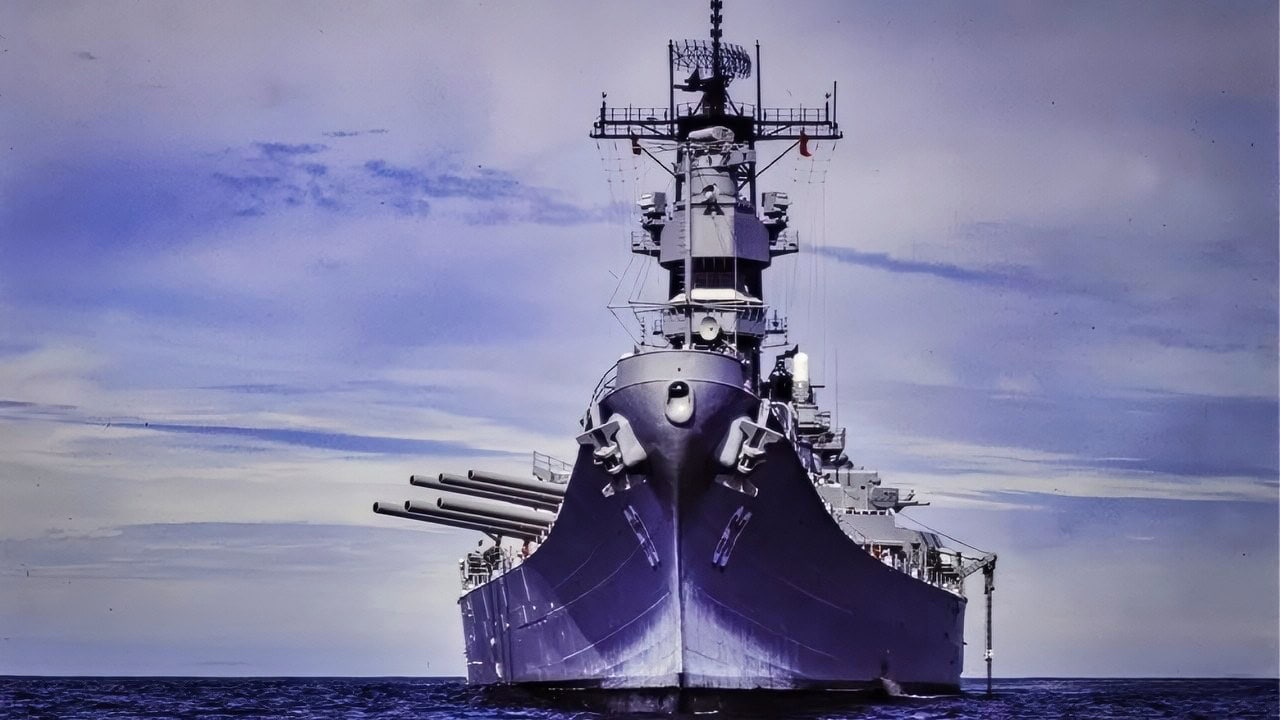
USS Missouri by the Numbers: Nine 16-Inch Guns, 212,000 Horsepower, and 58,000 Tons – USS Missouri’s combined numbers; no later American battleship matched in one active career. The Iowa-class ship displaced 58,000 tons fully loaded, stretched 887 feet 3 inches, generated 212,000 shaft horsepower, and carried nine 16-inch guns. She was the last battleship completed by the United States.
Her construction price requires one qualification. An official Navy design history placed the planned cost of each Iowa-class battleship at about $125 million in wartime dollars. The public record does not provide one final audited invoice for BB-63, making the figure a class-level estimate rather than an exact receipt.
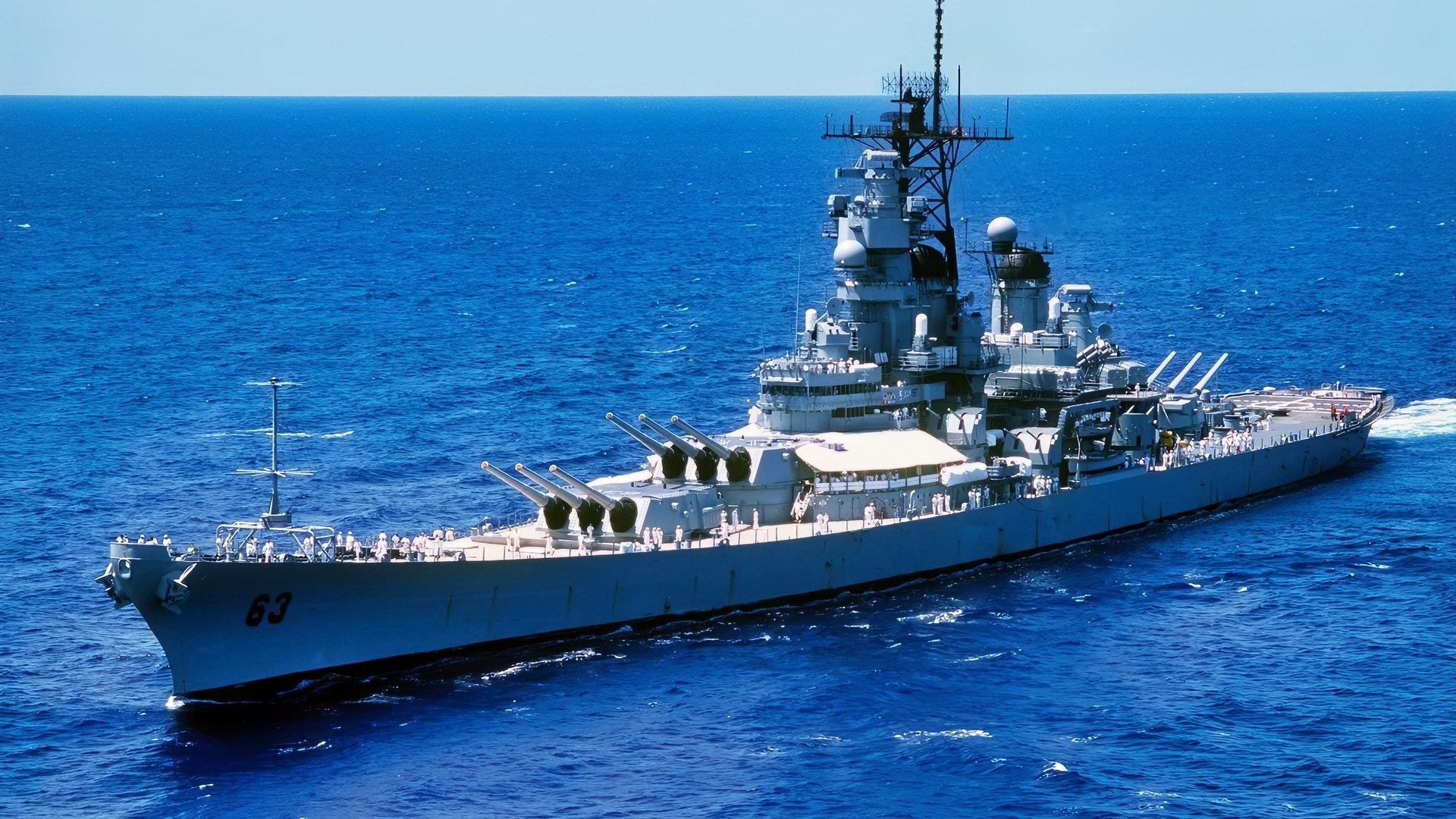
USS Missouri Iowa-Class USN. Image Credit: U.S. Navy.

USS Missouri Iowa-Class Battleship Broadside. Image Credit: Creative Commons.
Nine 16-inch/50-caliber Mark 7 guns fired 2,700-pound armor-piercing shells or 1,900-pound high-capacity projectiles. A full armor-piercing broadside placed 24,300 pounds of steel in the air.
Missouri served about 16 years and seven months in commission across almost 48 years. She fought in World War II, the Korean War, and the Persian Gulf War, and hosted Japan’s surrender in Tokyo Bay. Her final operational mission came at Pearl Harbor on December 7, 1991.
About $125 Million Built a 58,000-Ton Battleship
The $125 million figure was a design-era estimate rather than a final receipt. The familiar $100 million shorthand for an Iowa-class battleship remains an approximation. Either figure bought an exceptional concentration of steel, machinery, armor, and weapons during World War II.
Missouri’s keel was laid at the New York Naval Shipyard on January 6, 1941. She was launched on January 29, 1944, and commissioned on June 11. The museum’s official fact sheet says the design consumed 175 tons of blueprint paper, and construction required more than 3 million man-days.
The hull measured 108 feet 3 inches across the beam and drew 38 feet of water. Her main belt reached 13.5 inches, and the conning tower had 17.3 inches of protection. The wartime crew listed by the memorial totaled 2,534 officers and sailors.
Nine 16-Inch Guns Fired a 24,300-Pound Broadside
Each 16-inch gun assembly was 68 feet long and weighed about 134 tons. Six 110-pound powder bags propelled each round. The guns reached 23 miles and were rated at two rounds per minute, giving the complete battery a theoretical maximum of 18 shells per minute.
The Mark 7 combined a long barrel, heavy projectile, and radar-directed fire control. The 2,700-pound Mark 8 armor-piercing shell gave the Iowa class exceptional striking power without the weight penalty imposed by Japan’s 18.1-inch guns. That balance supports the argument that the Iowas represented the high point of the fast battleship.
As built, Missouri also carried twenty 5-inch/38-caliber guns in ten twin mounts, plus 40mm and 20mm antiaircraft weapons. The 1980s rebuild removed four twin 5-inch mounts, leaving twelve 5-inch guns and creating room for missile launchers.
Eight Boilers Produced 212,000 Shaft Horsepower
Missouri had eight Babcock & Wilcox boilers and four geared General Electric steam turbines. Each turbine drove one shaft, producing 212,000 shaft horsepower through four propellers. The Navy listed a maximum speed above 30 knots, fast enough to operate with carrier task forces.
Fuel capacity reached 2.5 million gallons of fuel oil, with another 30,000 gallons of aviation fuel and 239,000 gallons of freshwater. Missouri lacked the nearly unrestricted propulsion range of a nuclear carrier, but the fuel load supported long ocean passages before replenishment.
The 1986 Rebuild Added 48 Missiles and Four Phalanx Guns
Missouri returned to commission on May 10, 1986, after three decades in reserve. The Iowa-class reactivation program retained the main battery while adding up to 32 Tomahawk cruise missiles, 16 Harpoon anti-ship missiles, and four Phalanx close-in weapon systems.
Each Phalanx mounted a radar-controlled 20mm gun capable of firing 3,000 rounds per minute. New radars, electronic-warfare equipment, and communications updated targeting and self-defense. The modernization turned the battleships into missile platforms without removing their heavy guns.
The altered weapons fit, and newer systems reduced the crew. Missouri returned with 1,515 officers and enlisted personnel, more than 1,000 fewer than the memorial’s World War II figure.
Missouri Fought Three Wars and Fired Thousands of Heavy Shells
In 1945, Missouri screened carriers, supported the invasions of Iwo Jima and Okinawa, bombarded industrial targets in Japan, and survived a kamikaze strike. Japan signed the Instrument of Surrender aboard the ship on September 2, 1945.
The Korean War produced her heaviest recorded ammunition expenditure. Across two deployments, Missouri fired 6,756 16-inch rounds and 12,422 5-inch rounds. Her targets included rail lines, bridges, artillery positions, and coastal facilities. North Korean shore batteries fired on the battleship in March 1953.
During Operation Desert Storm, Missouri launched 28 Tomahawks and fired 759 16-inch rounds. Her explosive-ordnance team disarmed ten mines. On February 25, 1991, HMS Gloucester intercepted an Iraqi Silkworm missile approaching the battleship.
The record behind Missouri’s reputation spans carrier escort, shore bombardment, cruise-missile attack, mine warfare, and the formal end of World War II. She was decommissioned for the final time on March 31, 1992.
Local News: Visitors Can Walk the Surrender Deck at Pearl Harbor in Hawaii Right Now
The Navy transferred Missouri to the nonprofit memorial association in 1998, and the ship opened to the public in 1999. The claim that Missouri was America’s greatest battleship draws strength from a record extending from Iwo Jima to Desert Storm.
The Battleship Missouri Memorial is open daily from 8 a.m. to 4 p.m. on Ford Island at Pearl Harbor, where the deck marked by the September 2, 1945, surrender ceremony remains part of the public tour.
About the Author: Harry J. Kazianis
Harry J. Kazianis (@Grecianformula) was the former Senior Director of National Security Affairs at the Center for the National Interest (CFTNI), a foreign policy think tank founded by Richard Nixon based in Washington, DC. Harry has over a decade of experience in think tanks and national security publishing. His ideas have been published in the NY Times, The Washington Post, The Wall Street Journal, CNN, and many other outlets worldwide. He has held positions at CSIS, the Heritage Foundation, the University of Nottingham, and several other institutions related to national security research and studies. He is the former Executive Editor of the National Interest and the Diplomat. He holds a Master’s degree focusing on international affairs from Harvard University.