
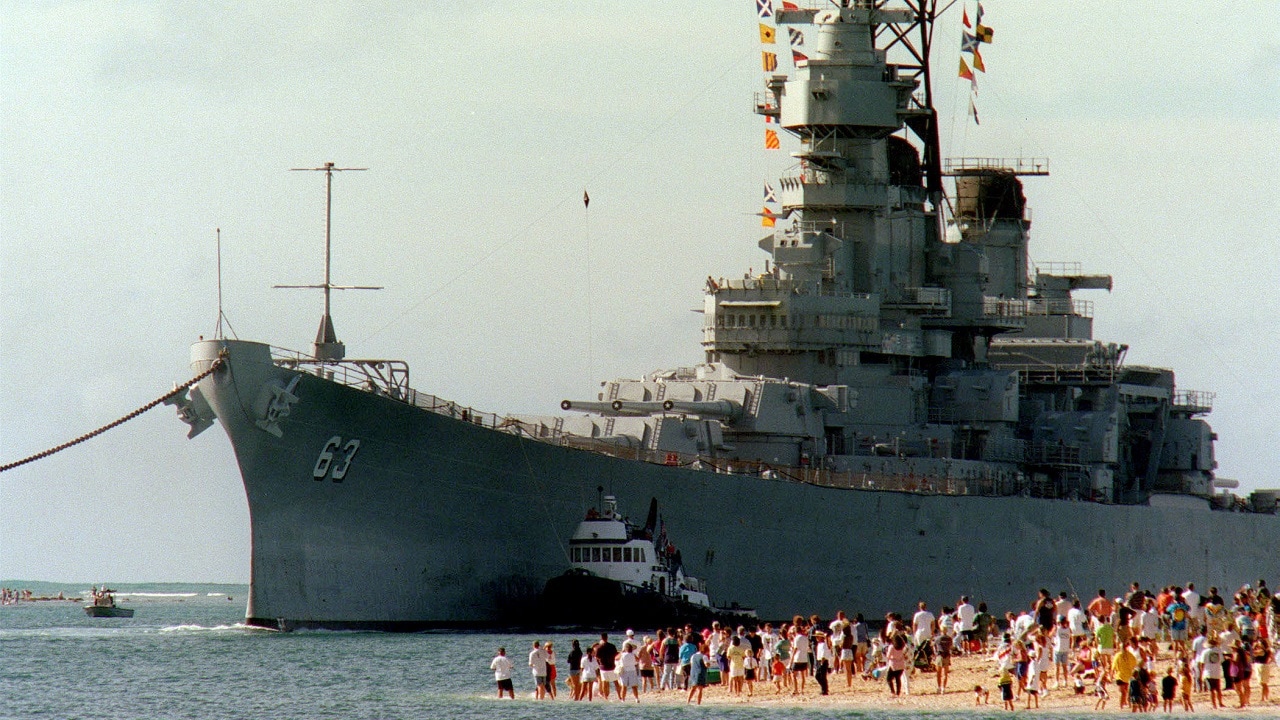
Synopsis: The Battleship Missouri (BB-63) entered service in 1944 as a fast Iowa-class battleship built for carrier-era warfare—high speed, heavy armor, and nine 16-inch guns.
-After arriving in the Pacific in early 1945, it supported campaigns at Iwo Jima and Okinawa and later hosted Japan’s surrender ceremony with figures like Chester Nimitz and Douglas MacArthur aboard.
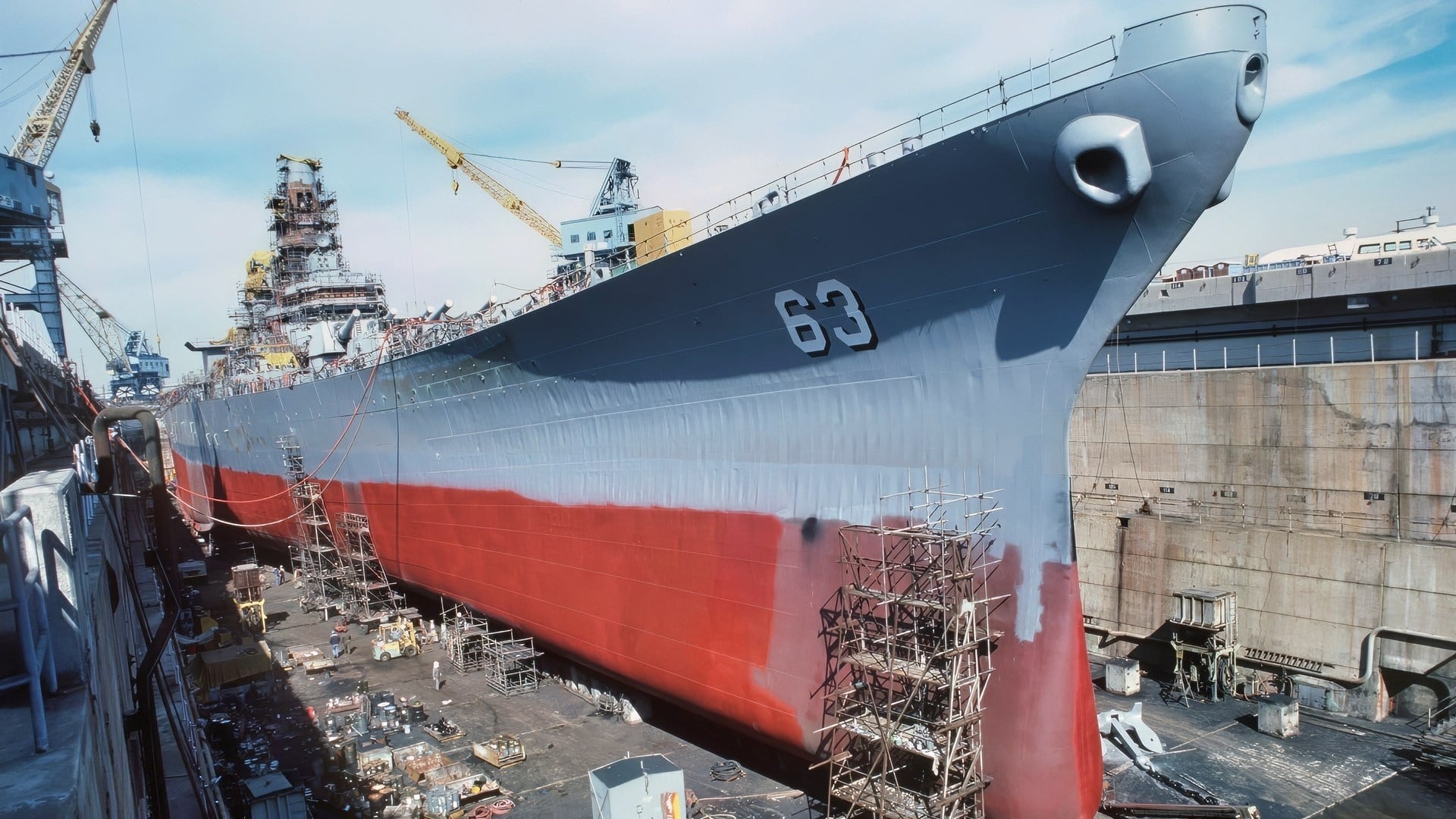
A starboard bow view of the battleship USS MISSOURI (BB 63) in dry dock for reactivation/modernization work prior to recommissioning. Image Credit: Creative Commons.
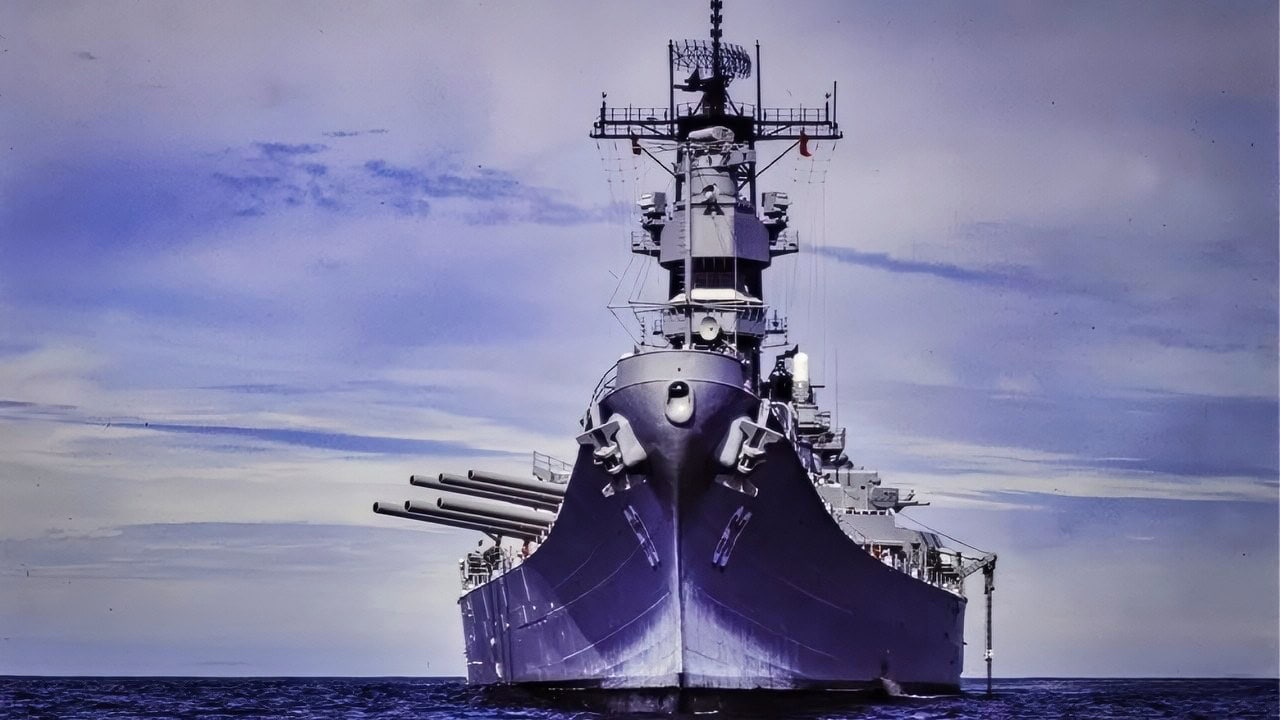
USS Missouri Navy Battleship. Image Credit: Creative Commons.
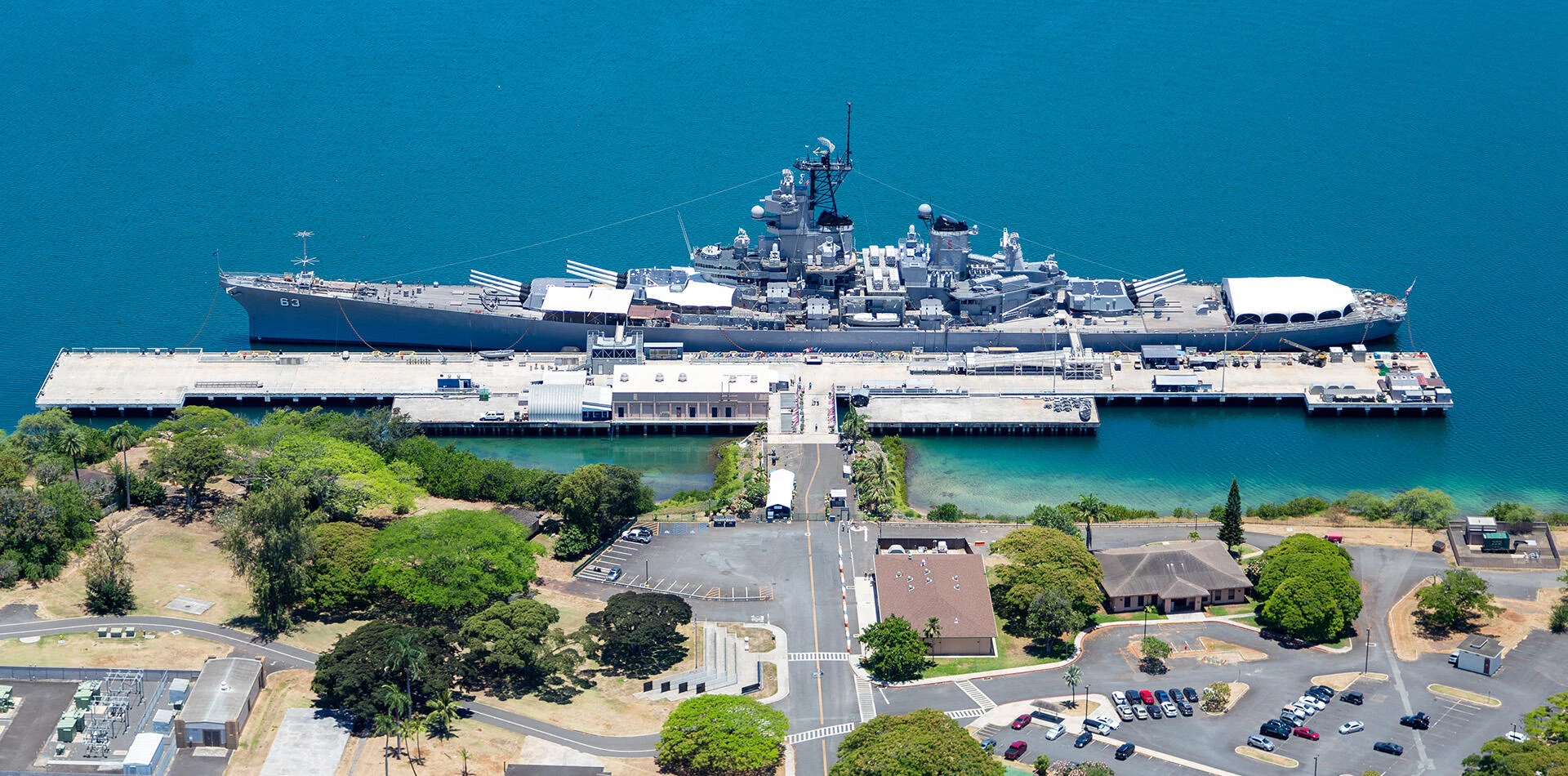
USS Missouri. Image Credit: USS Missouri.
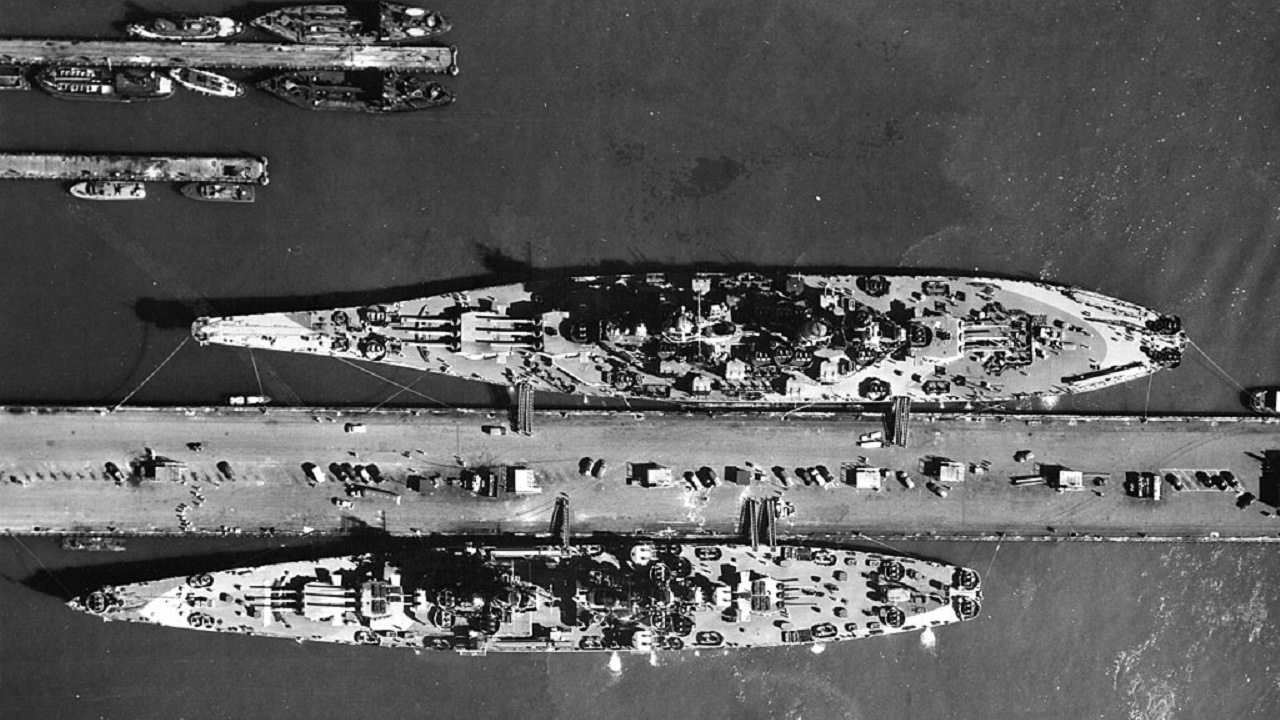
Aerial view of warships at the base piers of Norfolk Naval Base, Virginia (USA), circa August 1944. Among them are: the battleship USS Missouri (BB-63), the largest ship; the battlecruiser USS Alaska (CB-1), on the other side of the pier; the escort carrier USS Croatan (CVE-25), and two destroyers, a Fletcher-class destroyer at the pier and a Clemson/Wilkes-class-destroyer moored outboard.
-Missouri later served in Korea, spent decades in reserve, returned in the 1980s with modern missiles and CIWS, fought in 1991, and ultimately became a memorial at Pearl Harbor.
-Many experts have concluded that the USS Missouri might be the U.S. Navy’s best battleship ever, but, of course, this is disputed.
The Battleship USS Missouri, “The Big Mo”
The Iowa-class battleships were icons of U.S. naval power, serving from World War II through the Cold War. Many naval experts agree that these are the best battleships ever to sail. Conceived in the late 1930s and built during World War II, these ships were designed to be the fastest and most powerful battleships ever constructed by the United States Navy.
The class consists of four completed ships: USS Iowa (BB-61), USS New Jersey (BB-62), USS Missouri (BB-63), and USS Wisconsin (BB-64). Two additional ships, USS Illinois (BB-65) and USS Kentucky (BB-66), were planned but never completed.
Iowa Class USS Missouri (BB-63), Icon Of The Best Battleships
The Iowa-class battleships were among the most iconic warships ever built by the United States Navy.
First commissioned during World War II, these ships — Iowa, New Jersey, Missouri, and Wisconsin — represented the pinnacle of American naval firepower and technological sophistication at the time.
The US Navy’s battleship USS Missouri (BB-63) is renowned for its remarkable career, which included multiple periods of service, often returning to active duty after periods of inactivity.
Meet The Battleship USS Missouri (BB-63)
The USS Missouri, a 58,000-ton Iowa-class battleship built by the New York Navy Yard, was commissioned on June 11, 1944. She spent the remainder of that year doing shakedown cruises, preparing for combat duty, and transferring to the Pacific in November.
The Missouri’s 887’3″ length accommodated four large engines with 212,000 shaft horsepower, allowing the battleship to hit speeds over 33 knots, a significant improvement from the 27 knots of the previous South Dakota class of battleship, and faster than the 26-knot capability of Japanese ships of the time. She could easily keep up with the carrier task forces in the Pacific.
The main armor of the hull is 13.5″ tapering 19 degrees vertically to 1.62″ aft. For the protection of the propellers and shafts, the armor is 13.5. Other armor thicknesses are: Turret faces: 17″, Turret tops: 7.25″, Turret backs: 12″, Turret sides: 9.25″, Second deck armor: 6″, Conning tower sides: 17.3″
The main armament was nine 16″.50 caliber guns in three, three-gun turrets. Range: 23 miles. Projectiles: Armor piercing – 2,700 pounds, High capacity – 1,900 pounds. Powder: standard load of six, 110-pound bags. Rate of fire: two rounds per minute, per gun.
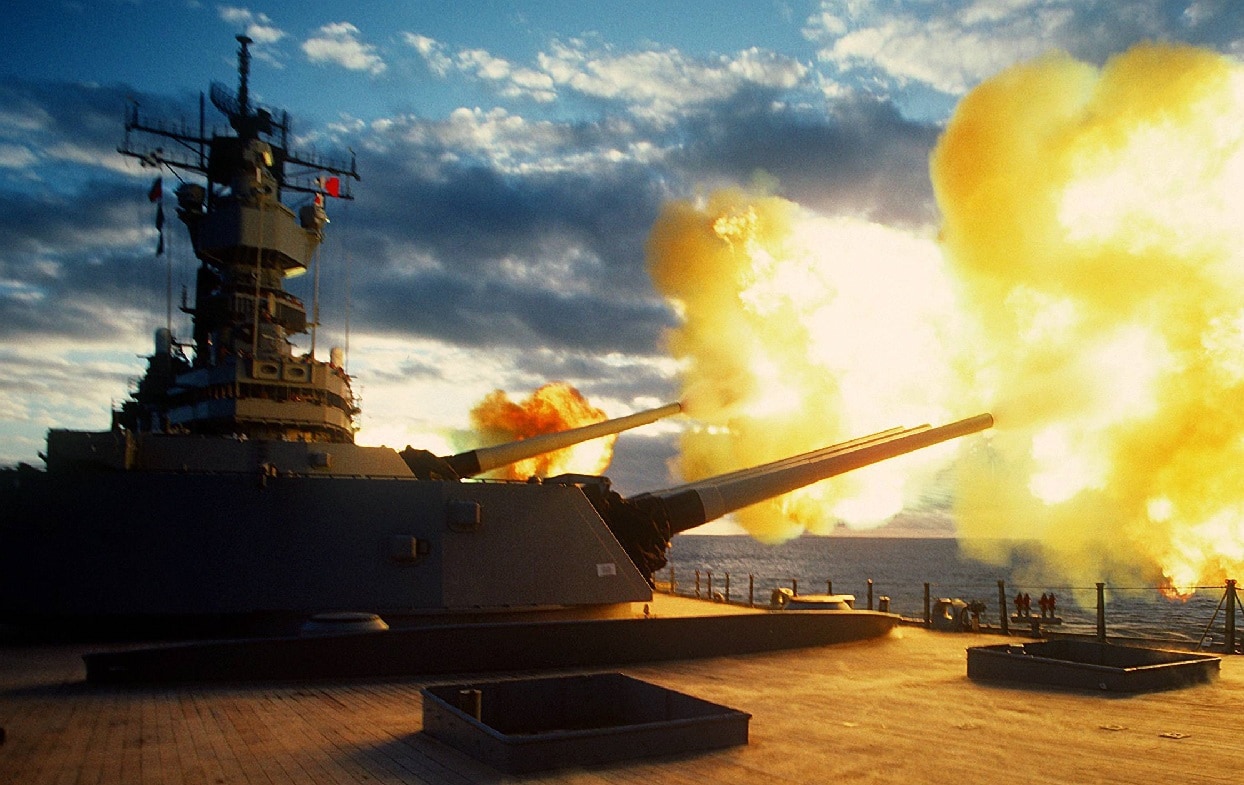
Image: Creative Commons.
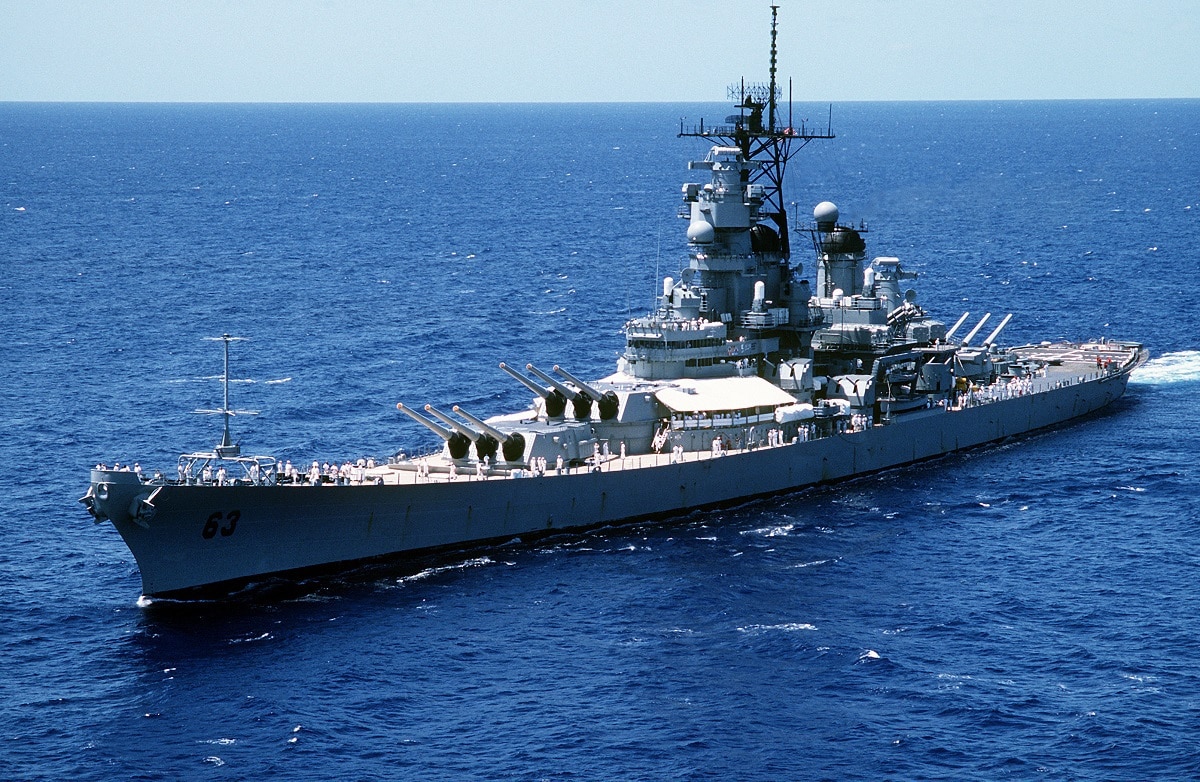
A port bow view of the battleship USS MISSOURI (BB-63) underway.
The secondary armament consists of twelve 5″/38 caliber guns in six dual mounts. Range: 9 miles. Projectiles: 55 pounds. Powder: 30 pounds. Rate of fire: 15 rounds per minute, per gun. Use: Anti-surface, anti-air, and shore bombardment.
Air Defense in the 1980s consisted of Four Phalanx Close-In Weapons Systems (CIWS) Gatling-style guns, capable of firing 20mm ammunition at a rate of 50 rounds per second (3000 rounds per minute) for self-defense against missiles and aircraft
Missiles were included in the 80s as well. Capable of carrying up to 32 Tomahawk Anti-Surface or Land Attack missiles and up to 16 Harpoon anti-surface missiles
The Big Mo’s Service, Inactivations, And Comebacks
Arriving in the war zone in January 1945, Missouri supported the Iwo Jima invasion, the Okinawa campaign, and raids on Japan’s home islands during the following months. In May, she became the Third Fleet flagship.
She was the site of the September 2, 1945, ceremony attended by high-ranking military officials from all the Allied Powers, including Fleet Admiral Chester Nimitz and General of the Army Douglas MacArthur, who came aboard the Missouri to meet Japanese representatives for the Japanese surrender ceremony that ended World War II.
Following the end of the war, Missouri returned to the United States and participated in a great naval review in New York in October 1945. In March 1946, she embarked on a diplomatic mission to the Mediterranean.
Throughout the rest of the 1940s and into the 1950s, the battleship operated extensively in the Atlantic area. She was the centerpiece of a major grounding incident off Hampton Roads, Virginia, in January 1950, but was quickly repaired and returned to service.
Missouri was the only U.S. battleship on active duty in June 1950, when the Korean War began, and made two combat deployments to the Western Pacific.
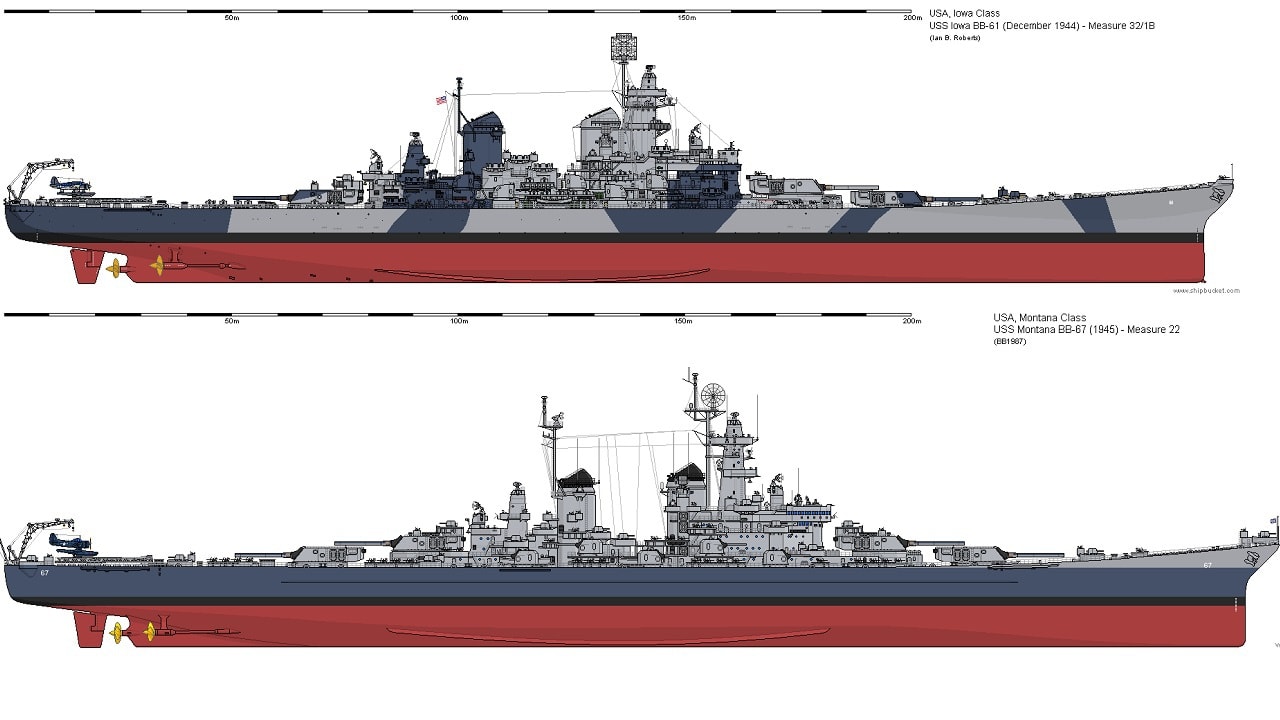
Image of Iowa-class battleship compared to Montana-class battleship that was never built. Image Credit: Creative Commons.
Following the Korean conflict and several training cruises to Europe, she decommissioned in February 1955. For the next three decades, she was in reserve at Bremerton, Washington, and became an important tourist attraction.
All four Iowa-class battleships were reactivated in the 1980s, with Missouri recommissioning in May 1986. Her next six years were busy ones, including, among other activities, a cruise around the World and a combat role in the 1991 Persian Gulf War. The Big Mo provided fire support and launched Tomahawk missiles, showcasing her adaptability to modern warfare.
The Battleship Missouri (BB-63) was decommissioned for the last time in March 1992. Stricken from the Naval Vessel Register in 1995, Missouri was transferred to Pearl Harbor, Hawaii, in June 1998 to become a memorial.
The Big Mo and her sister battleships represent the best of American power, engineering, and naval power. The legacy of the battleship Missouri is one of awesome American firepower.
About the Author: Steve Balestrieri
Steve Balestrieri is a National Security Columnist. He served as a US Army Special Forces NCO and Warrant Officer. In addition to writing on defense, he covers the NFL for PatsFans.com and is a member of the Pro Football Writers of America (PFWA). His work was regularly featured in many military publications