
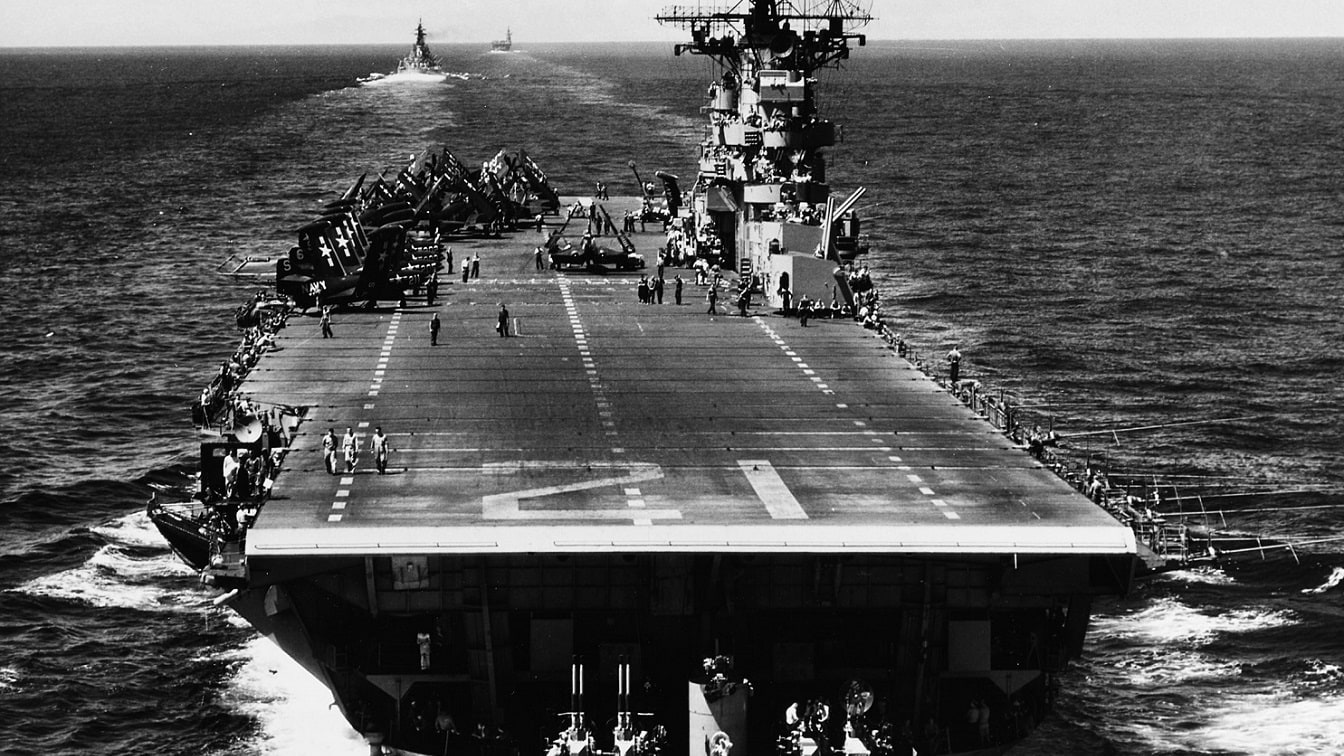
Key Points and Summary – The U.S. Navy’s Essex-class aircraft carriers were the “monsters” of the Pacific, serving as the fleet’s backbone during World War II without a single vessel lost in combat.
-Freed from treaty restrictions, these 40,000-ton warships featured superior armor, firepower, and air capacity, allowing them to survive devastating kamikaze attacks like those on the USS Franklin.

Essex-Class Aircraft Carrier. Image Credit: Creative Commons.
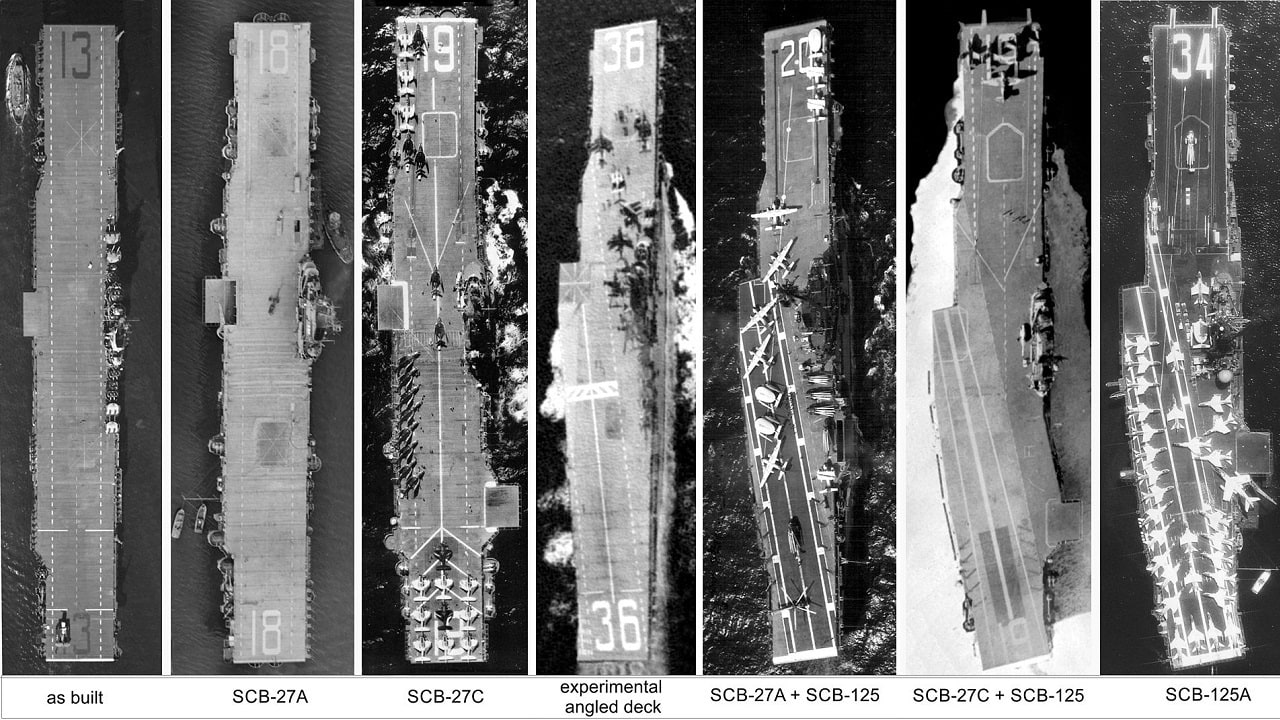
Seven aerial photographs showing the major different modernizations of the U.S. Navy Essex-class aircaft carriers (l-r): USS Franklin (CV-13), a “short hull” type as delivered, 21 February 1944. Franklin, USS Bunker Hill (CV-17), USS Boxer (CV-21), USS Princeton (CV-37), USS Tarawa (CV-40), USS Valley Forge (CV-45) and USS Philippine Sea (CV-47) received no or little modernization. USS Wasp (CV-18), after her SCB-27A conversion in late 1951: new hydraulic catapults, new island, removal of the deck guns, new bow. Modernized as such were USS Essex (CV-9), USS Yorktown (CV-10), USS Hornet (CV-12), USS Randolph (CV-15), Wasp, USS Bennington (CV-20), USS Kearsarge (CV-33) and USS Lake Champlain (CV-39). USS Oriskany (CV-34) was completed as such. USS Hancock (CV-19) after her SCB-27C modernization, circa 1955: like SCB-27A but new steam catapults and relocation of the aft elevator to the deck edge. USS Intrepid (CV-11) and USS Ticonderoga (CV-14) also received SCB-27C. USS Antietam (CV-36) after the installation of an experimental angled deck, circa 1954. USS Bennington (CV-20) after SCB-125: enclosed hurricane bow, angled deck, starboard deckedge elevator. USS Essex (CV-9), USS Yorktown (CV-10), USS Hornet (CV-12), USS Randolph (CV-15), Wasp, USS Bennington (CV-20) and USS Kearsarge (CV-33) received SCB-125. USS Hancock (CV-19) after SCB-125 in April 1957. The three SCB-27C ships were modernized as such an had the starboard deckedge elevator located further aft. The forward elevator was enlarged. USS Oriskany (CV-34) received SCB-125A, here on 30 May 1974. Similar to SCB-27C/SCB-125, only the starboard deckedge elevator was located further forward, as with the SCB-27A/SCB-125 ships. USS Lexington (CV-16), USS Bon Homme Richard (CV-31) and USS Shangri-La (CV-38) received SCB-27C/SCB-125 in one refit but had the starboard elevator in the same position as Oriskany.
-Their adaptable design ensured a legacy that extended through the Korean and Vietnam Wars, cementing their status as arguably the most successful carriers in history.
The Essex-class Aircraft Carriers Were Monsters In Combat
The U.S. Navy’s Essex-class aircraft carriers were incredible warships, acting as the backbone of U.S. naval power in the Pacific during World War II and serving for decades afterward. They are arguably the best, most successful carriers ever designed by the Navy.
The Essex-class was a significant upgrade from previous designs, featuring larger flight decks, increased air-group capacity, and more anti-aircraft guns. Thanks to their large size, capacity for many aircraft, strong damage control, and adaptability, these ships were pivotal in establishing the U.S. as a dominant naval power. Their robust design, adaptability, and sheer numbers—24 were completed—proved critical in winning the war, and, despite sustaining heavy damage, none were lost in combat.
During World War II, 32 of these ships were ordered, 8 canceled, 24 laid down, and 17 completed early enough to see combat. Fourteen actually saw combat.
That none were lost to enemy action during World War II was a testament to how well armored these ships were. They stayed afloat despite heavy damage, especially by kamikaze attacks late in the war.
The Essex-Class Aircraft Carriers Were Freed From Treaty Limits
After Japan departed from interwar naval treaties in 1936, the U.S. realized it needed to bolster its maritime strength. Congress passed the Naval Expansion Act on May 17, 1938, enabling a new 40,000-ton limit for aircraft carriers. The class included short-hull and long-hull versions.
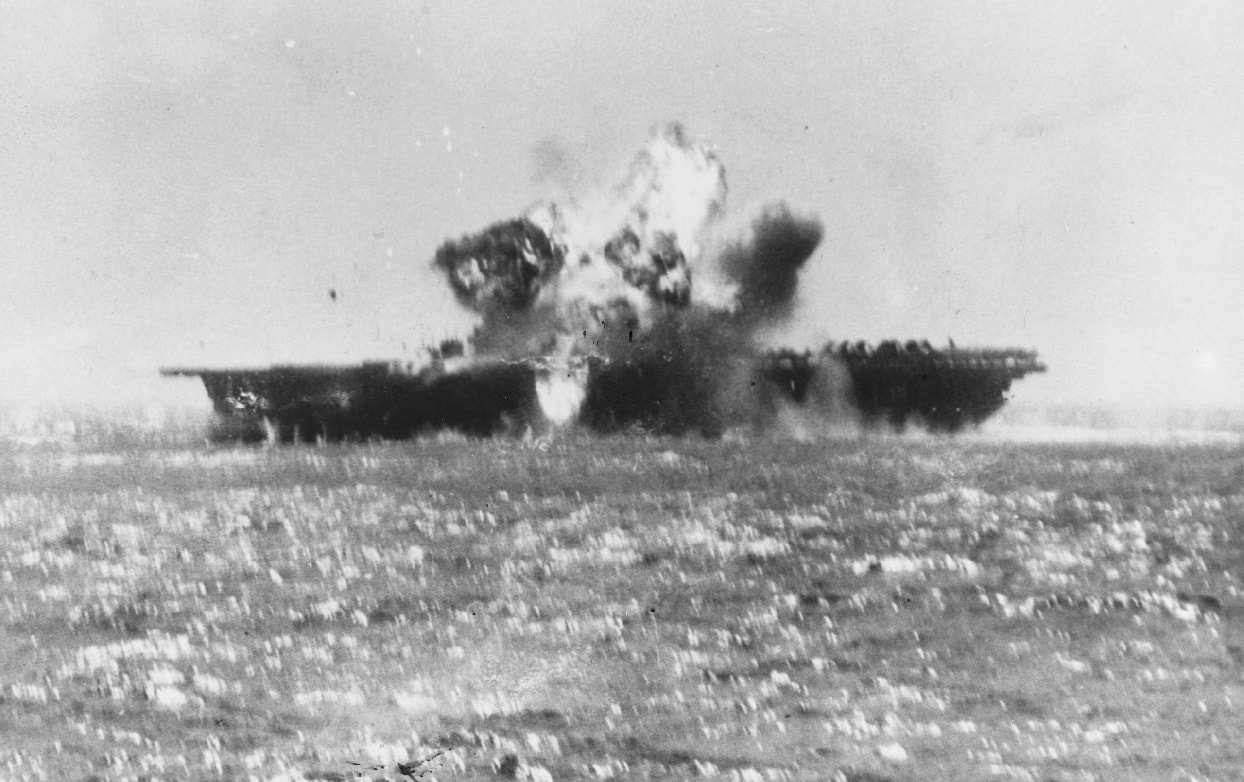
A kamikaze aircraft explodes after crashing into Essex’s flight deck amidships 25 November 1944.
The Essex-class was designed to surpass previous carriers, offering a good balance of speed, armor, and striking power. It was freed from the restrictions of the Washington Naval Treaty after Japan rejected it, with the beginning of the Naval Expansion Act of 1938.
The Essex-class was crucial to the U.S. victory in the Pacific theater during World War II. The carriers swept the Imperial Japanese Navy from the Pacific. It brought massive firepower wherever it went in the Pacific, something the Japanese could not hope to compete with.
After the war, the carriers underwent multiple modernizations and upgrades to handle the new aircraft and helicopters of the jet age. Updates included angled flight decks. The carriers continued as the foundation of U.S. naval air power into the Korean and Vietnam Wars before gradually being replaced by larger classes of supercarriers.
Meet The Essex-Class Carrier, Designed For Success
Compared to Yorktown-class carriers, the Essex-class ships were more than 60 feet longer (888 feet); nearly ten feet wider (147.5 feet); and more than a third heavier (36,960 tons with a full combat load).
A longer, wider flight deck and a deck-edge elevator facilitated more efficient aviation operations. The Essex carriers had better armor protection than their predecessors, improved facilities for handling ammunition, increased fuel capacity, and more effective damage-control equipment.
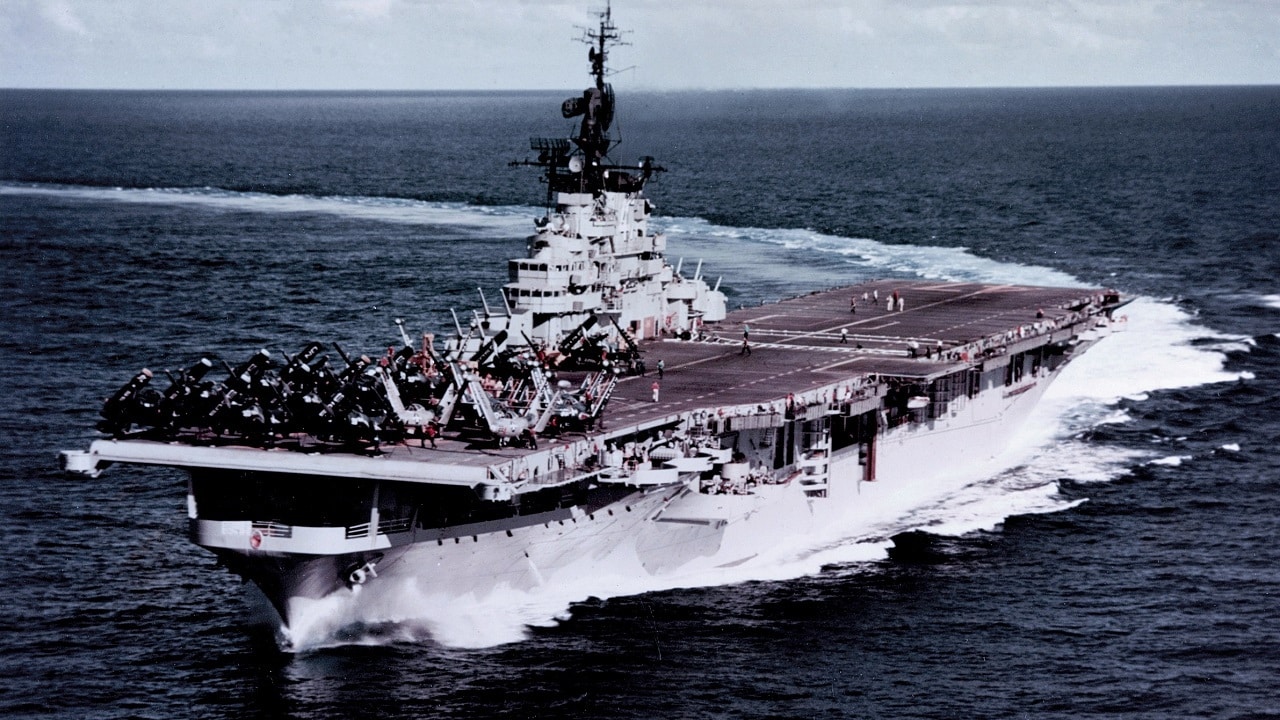
The U.S. Navy aircraft carrier USS Philippine Sea (CVA-47) makes a sharp turn to starboard, while steaming in the Western Pacific with the U.S. Seventh Fleet, 9 July 1955. Philippine Sea, with assigned Air Task Group 2 (ATG-2), was deployed to the Western Pacific from 1 April to 23 November 1955.
Yet, these ships were also designed to limit weight and the complexity of construction, for instance by incorporating extensive use of flat and straight metal pieces, and of special treatment steel, a nickel-chrome steel alloy that provided the same protective qualities as Class B armor plate, but which was fully structural.
The Essex-class was powered by eight Babcock & Wilcox boilers and propelled by Westinghouse-geared turbines with four screw propellers. It had a top speed of 33 knots and a range of 20,000 nautical miles.
Essex-class Carriers Armament
The carriers mounted twelve 5-inch (130-mm) 38 caliber guns. These were carried in four enclosed twin mounts located near the island on the starboard side, and four single open mounts located on the port side.
The guns had a maximum range of 7 miles and a rate of fire of 15 rounds per minute. The 5-inch guns could fire VT shells—proximity-fused shells that detonated when they came within range of an enemy aircraft.
The 5-inch guns could also aim into the water, creating waterspouts that could bring down low-flying aircraft such as torpedo planes.
There were also seventeen quadruple Bofors 40-mm anti-aircraft guns and 65 single Oerlikon 20-mm cannon. The Bofors guns were a significant improvement over the 1.1-inch/75-caliber guns mounted on the earlier Lexington and Yorktown classes and were controlled by Mark 51 optical directors with integrated gyro gun-sight lead-angle calculators.
The Essex-class aircraft carriers carried 90 aircraft: 36 F6F Hellcat fighters; 36 Douglas SBD Dauntless dive bombers, which were later replaced by the inferior Curtiss SB2C Helldiver; and 18 Grumman TBF Avenger torpedo bombers.
The Essex Class Dominated In the Pacific Theater
By the end of 1943, thanks to the contributions of the Essex- and Independence-class carriers, the Navy had turned the Pacific War toward America’s favor, starting with the recapture of the Gilbert Islands. Lost Japanese carriers and aircrews earlier in 1942 were never adequately replaced, and U.S. carriers’ guarantee of air superiority marked the beginning of the end of Japanese supremacy in the Pacific.
From late 1944, the Essex-class aircraft carriers were primarily used to attack Japan itself, a role that was later taken over by B-29 long-range bombers.
Kamikazes Over Leyte Gulf Changed The War:
On October 30, 1944, during the Battle of Leyte Gulf, the first recorded use of kamikazes by the Japanese was noted when three kamikazes attacked the USS Franklin (CV-13). One hit the flight deck with such force that it penetrated to the hangar deck, igniting a massive fire that killed 56 crewmen and injured 60 others.
After repairs, the Franklin returned to action. She was later hit by Japanese high-altitude bombers in March 1945 with her flight deck loaded with 30 aircraft warming up and fully combat-loaded. The attack killed 796 crewmen, bringing the total of USS Franklin’s fatalities during the war to nearly 1,000—second only to the USS Arizona (BB-39), which was sunk at Pearl Harbor.
Essex-Class Carriers in The Korean And Vietnam Wars:
After World War II ended, the Essex-class carriers were upgraded to handle larger and heavier jet aircraft. Modifications included jet-blast deflectors, greater aviation fuel capacity, stronger decks, and elevators.
Also included were British innovations such as an optical landing system, steam catapults, and an angled flight deck.
Twenty-two of the Essex-class carriers saw extensive use during the Korean War years, with 11 participating in battle. Thirteen saw action during the Vietnam War, and several of the carriers were used by NASA as recovery platforms for space aircraft returning from lunar missions.
They were all retired by the late 1970s, except for the Lexington, which served as a training carrier until 1991.
Their decades of service confirm the excellence of the class’s design. The Essex-class carriers are arguably the most successful ship design in U.S. Navy history.
About the Author: Steve Balestrieri
Steve Balestrieri is a National Security Columnist. He served as a US Army Special Forces NCO and Warrant Officer. In addition to writing on defense, he covers the NFL for PatsFans.com and is a member of the Pro Football Writers of America (PFWA). His work was regularly featured in many military publications.