
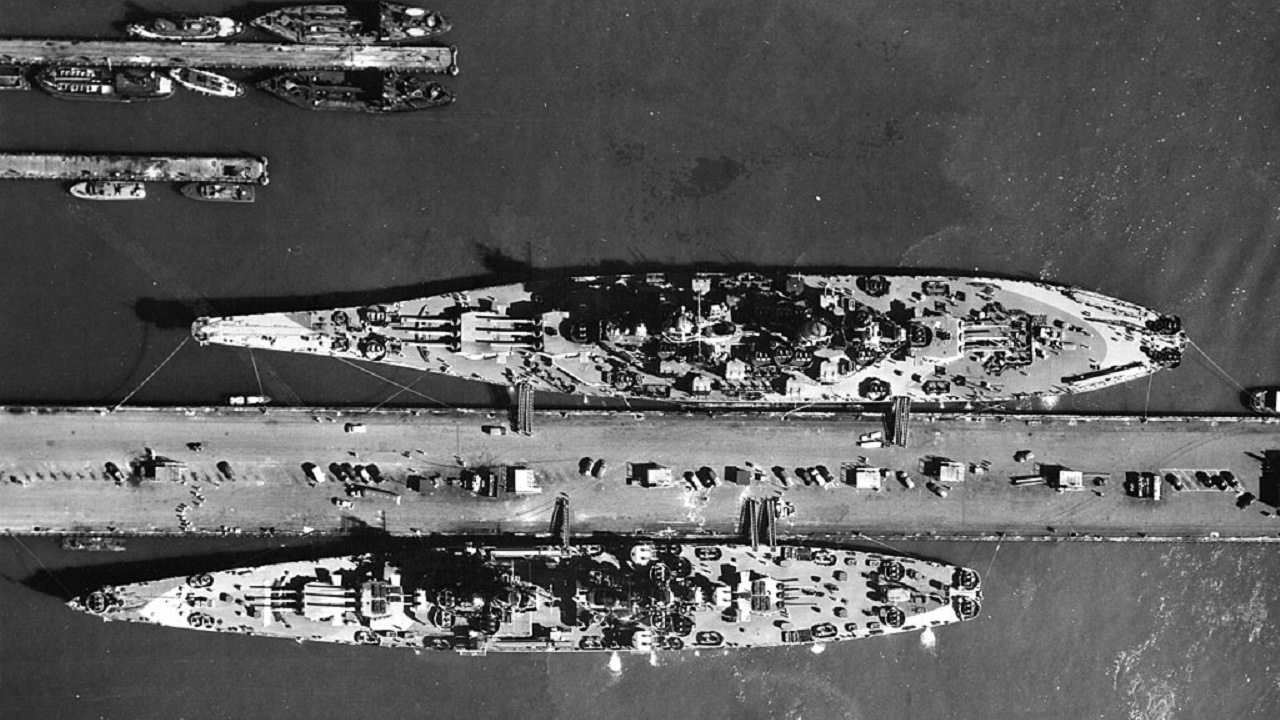
The US Navy Built Two 35,264-Ton Alaska-Class Cruiser Killers. They Never Fought the Enemy Cruisers They Were Built to Kill – USS Alaska and USS Guam each cost $45,616,000, nearly twice the cost of USS Baltimore at $23,618,000. Each Alaska-class ship stretched 808 feet 6 inches. Design data listed 27,000 tons standard, while Bureau of Ships records gave a 35,264-ton trial displacement and 150,000 shaft horsepower.
The Navy called them “large cruisers” and assigned the CB hull classification. They are widely described as battlecruisers because they combined capital-ship size and guns with cruiser-style protection. Six were ordered, two entered service, one remained unfinished, and three never reached the keel blocks.
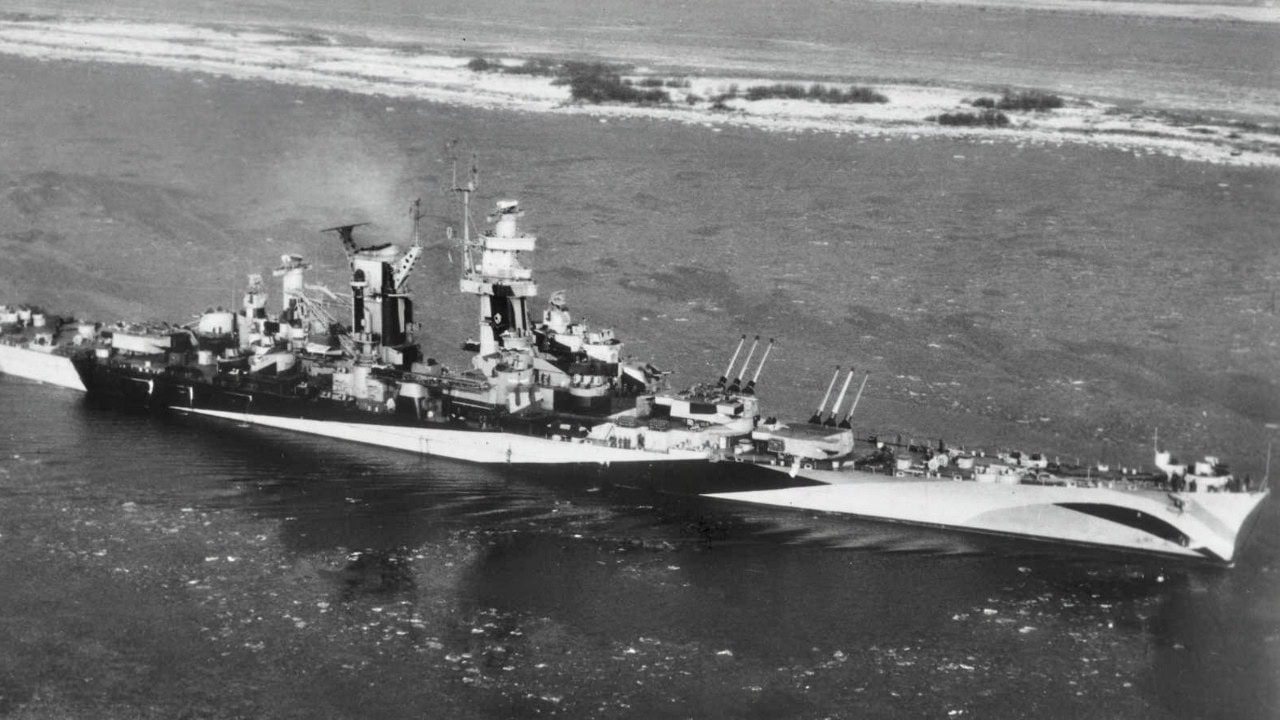
Alaska-Class U.S. Navy Cruiser
Each completed ship carried 111 gun barrels: nine 12-inch guns, twelve 5-inch guns, fifty-six 40 mm Bofors barrels, and thirty-four 20 mm Oerlikons. The full gun battery sat on a hull able to accommodate as many as 140 officers and 2,111 enlisted sailors.
The ships looked formidable and performed useful work in 1945. Their procurement case still failed. Alaska and Guam screened carriers, fought aircraft, and bombarded islands, but neither exchanged main-battery fire with the enemy cruisers whose 12-inch guns were designed to destroy. The presumed Japanese super-cruiser threat never entered production, and most of Japan’s existing surface fleet was gone before the two American ships reached combat.
Six Alaska-Class Ships Were Ordered, and Only Two Were Completed
The Navy began studying an intermediate warship in 1938 as treaty limits weakened. Reports suggested Japan might build cruisers more powerful than American heavy cruisers, while German commerce raiders reinforced concerns about surface ships capable of overpowering convoy escorts. The Alaska-class experiment aimed to produce a hunter fast enough to catch cruisers and strong enough to destroy them.
The Two-Ocean Navy building program ordered six ships in September 1940. All were assigned to New York Shipbuilding Corporation at Camden, New Jersey, across the Delaware River from Philadelphia. Alaska was laid down on December 17, 1941, Guam followed on February 2, 1942, and Hawaii was laid down in December 1943.
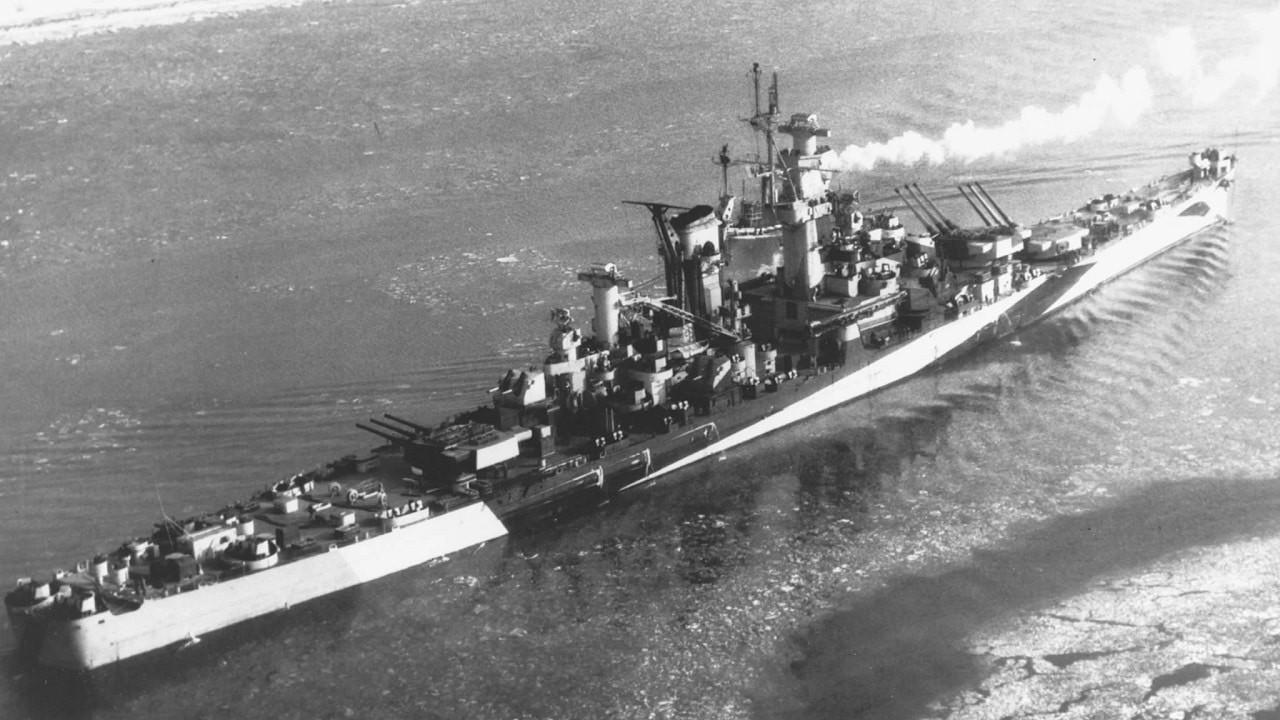
Alaska-Class. Image Credit: Creative Commons.
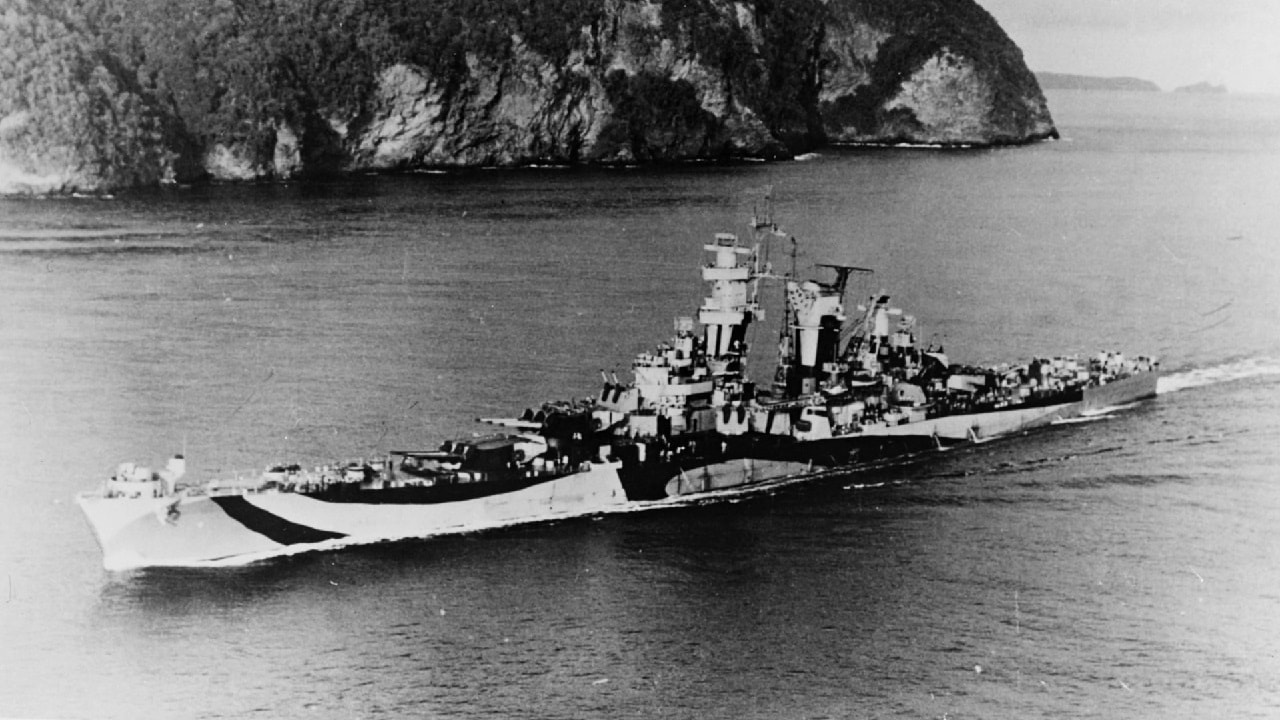
The U.S. Navy large cruiser USS Guam (CB-2) underway off Trinidad on 13 November 1944 during shakedown training.
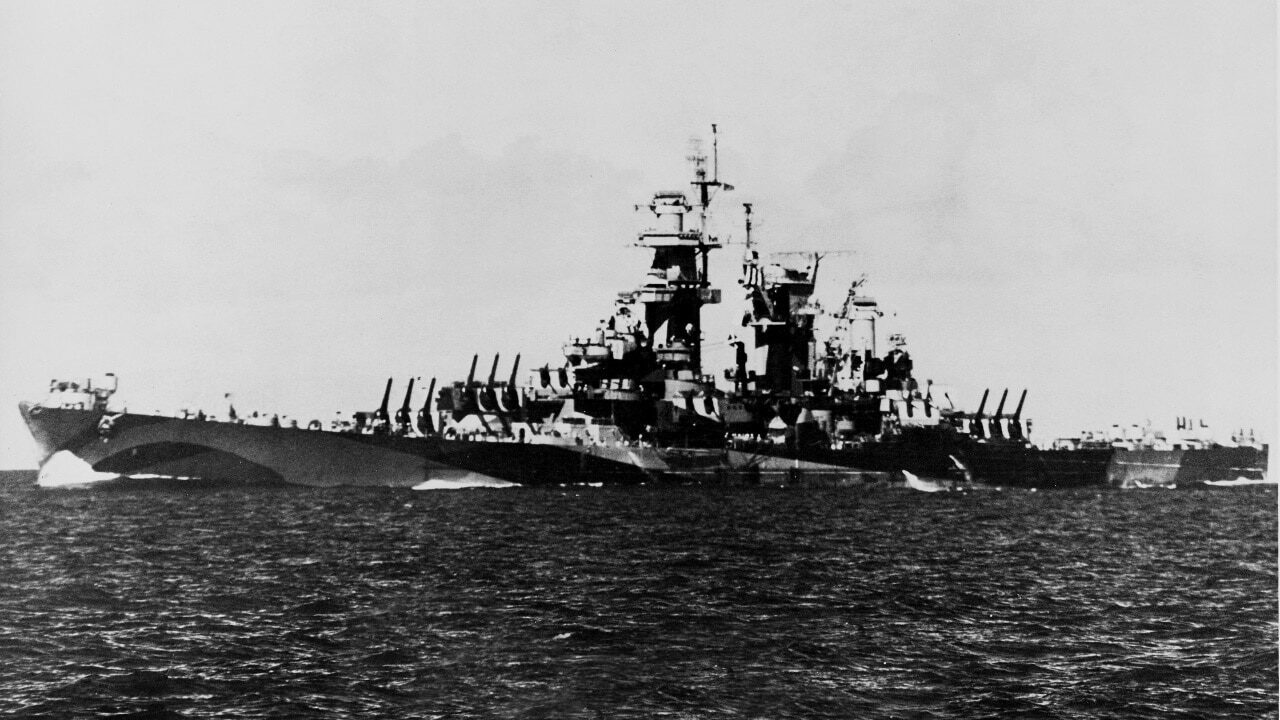
Alaska-Class USS Guam. Image Credit: Creative Commons.
Wartime priorities cut the class before the first ship launched. The Navy suspended Hawaii, the Philippines, Puerto Rico, and Samoa in May 1942 to redirect steel toward escorts and landing craft. The final three were canceled in June 1943. Hawaii returned to construction and launched in November 1945, but work stopped with the hull more than four-fifths complete. The six-ship plan ended with two operational vessels.
Nine 12-Inch Guns Produced a 10,260-Pound Broadside
The Mark 8 main gun was developed specifically for the Alaska class. Each weapon weighed 121,856 pounds with its breech and fired a 1,140-pound armor-piercing projectile at 2,500 feet per second. The lighter high-capacity shell weighed 940 pounds. The maximum range for the high-capacity round reached 38,021 yards at a 45-degree elevation.
Three triple turrets placed six guns forward and three aft. One armor-piercing broadside carried 10,260 pounds, or 5.13 short tons, of projectiles. At the rated 2.4 to three rounds per minute, all nine barrels theoretically sent 24,624 to 30,780 pounds of armor-piercing shells per minute. Ammunition spaces allowed 166 rounds per gun.
The secondary battery contained twelve 5-inch/38 dual-purpose guns in six twin mounts. Fourteen quadruple Bofors mounts supplied the 56 medium antiaircraft barrels, while 34 single Oerlikons handled closer threats. Four floatplanes, two catapults, and amidships hangars supported reconnaissance and gunfire spotting. In combat, the anti-aircraft weapons contributed more than the 12-inch cruiser-killing battery.
150,000 Horsepower Bought Speed Without Battleship Protection
Eight oil-fired boilers supplied four General Electric geared turbines, one for each propeller shaft. Bureau of Ships records gave the class a trial speed of 31.4 knots, while operational descriptions often rounded maximum speed to 33 knots. That was fast enough to work with the carrier force and pursue nearly any cruiser.
The hull was long and narrow for its displacement. The class used one large rudder, which made turning more difficult than its speed suggested. Its underwater protection also followed cruiser standards rather than battleship practice. The ships lacked the layered side compartmentation and specialized protection used to absorb torpedo explosions on American battleships.
Armor was sufficient for a fight against 8-inch cruisers, not a duel with a modern battleship. The main belt was about 9 inches thick, while battleship guns reached 14, 15 or 16 inches. The design therefore carried much of a capital ship’s cost, crew, and displacement without equivalent resistance to shells and torpedoes. The weakness reflected the same trade-off behind earlier battlecruiser losses, even though the Navy insisted the Alaskas were large cruisers.
The Japanese Super-Cruiser Threat Never Reached the Water
The concern was not invented. Japan explored Type B-65 cruisers armed more heavily than treaty cruisers, and Germany had demonstrated the disruption a fast surface raider might cause. A ship able to outrun battleships and outgun cruisers had an apparent place in 1940.
Intelligence and timing broke the concept. Japan developed B-65 plans partly in response to the Alaska class but never ordered the ships. The large cruisers entered construction without a matching enemy class to hunt. Their fallback target was Japan’s existing heavy-cruiser force.
Japan’s surface fleet had already been worn down in the Solomons and at Leyte Gulf before Alaska and Guam reached the western Pacific. The Philippine Sea had also broken Japanese carrier aviation, while fuel shortages kept many surviving warships close to home waters. The mission disappeared faster than the shipyards could finish the hulls.
Alaska and Guam Reached Combat During the Final Months of World War II
Alaska was commissioned on June 17, 1944, and Guam followed on September 17. After shakedown work and final modifications, both passed through the Panama Canal and joined the fast carrier force in early 1945. Alaska reached Ulithi in February; Guam joined the next month.
The large cruisers screened carriers during strikes supporting Iwo Jima and Okinawa. Their radars, 5-inch guns, and light anti-aircraft battery helped defend the formation against conventional aircraft and kamikazes. After USS Franklin was hit on March 19, Alaska and Guam joined the ships escorting the damaged carrier away from the combat area.
Guam bombarded the airfield on Minami Daito on March 27 and 28. On June 9, Alaska and Guam conducted a 90-minute bombardment of Okino Daito. Their 12-inch guns were powerful tools against shore installations, though a smaller cruiser or battleship could perform the same mission.
The two ships later formed the core of a surface force that entered the East and Yellow Seas, searching for Japanese shipping. The sweep produced a few targets. They supported the occupation of Korea and helped bring American personnel home after the surrender. Alaska received three battle stars, and Guam received two. Neither ship is credited with a main-battery action against an enemy surface combatant.
The Navy Had Cheaper Ways to Perform Their Remaining Missions
The Alaska class was not a mechanical failure. The ships were fast, their guns worked, and their crews completed every assigned combat mission. The failure was the relationship between cost and purpose. Alaska cost almost twice as much as Baltimore, yet the surviving mission was carrier escort, where radar and anti-aircraft guns mattered more than 12-inch shells.
American fast battleships could keep pace with carriers while bringing thicker armor, stronger underwater protection, and 16-inch guns. Heavy cruisers offered adequate anti-aircraft defense and bombardment at lower cost and with smaller crews. Carrier aircraft reached hundreds of miles beyond any naval gun. The Alaskas occupied an expensive middle position after the fleet no longer needed a dedicated cruiser killer.
Postwar technology narrowed the case further. Jet aircraft and guided missiles changed carrier defense, while the Navy faced a large surplus of new wartime ships. Alaska served about 32 months and Guam 29 months before both were decommissioned at Bayonne, New Jersey, on February 17, 1947. Their brief careers became part of the broader argument against hybrid capital ships.
The Navy still searched for another use. Congress authorized $58,772,000 to finish Hawaii as a tactical command ship, including $30 million for conversion. No contract followed, and the project ended in 1954. Other missile proposals also failed to produce a funded return to service. The mini-battleship model had no durable postwar mission.
Boston Metals and Lipsett Reduced the Three Hulls to Scrap
Hawaii left first. The Navy struck the unfinished ship on June 9, 1958, and sold her to Boston Metals Company of Baltimore, Maryland, in 1959. Scrapping began that June without the ship ever entering commission.
Alaska was struck on June 1, 1960, and sold on June 30 to the Lipsett Division of Luria Brothers of New York City. Photographic records place her dismantling in Newark, New Jersey, in 1961.
Guam was sold to Boston Metals on May 24, 1961. Tugs moved the powerless hull from Bayonne to Baltimore and deliberately grounded it beside the company’s main pier in the Patapsco River. A later federal court record placed the 808-foot ship there shortly after dismantling began.
About the Author: Harry J. Kazianis
Harry J. Kazianis (@Grecianformula) was the former Senior Director of National Security Affairs at the Center for the National Interest (CFTNI), a foreign policy think tank founded by Richard Nixon based in Washington, DC. Harry has over a decade of experience in think tanks and national security publishing. His ideas have been published in the NY Times, The Washington Post, The Wall Street Journal, CNN, and many other outlets worldwide. He has held positions at CSIS, the Heritage Foundation, the University of Nottingham, and several other institutions related to national security research and studies. He is the former Executive Editor of the National Interest and the Diplomat. He holds a Master’s degree focusing on international affairs from Harvard University.

