
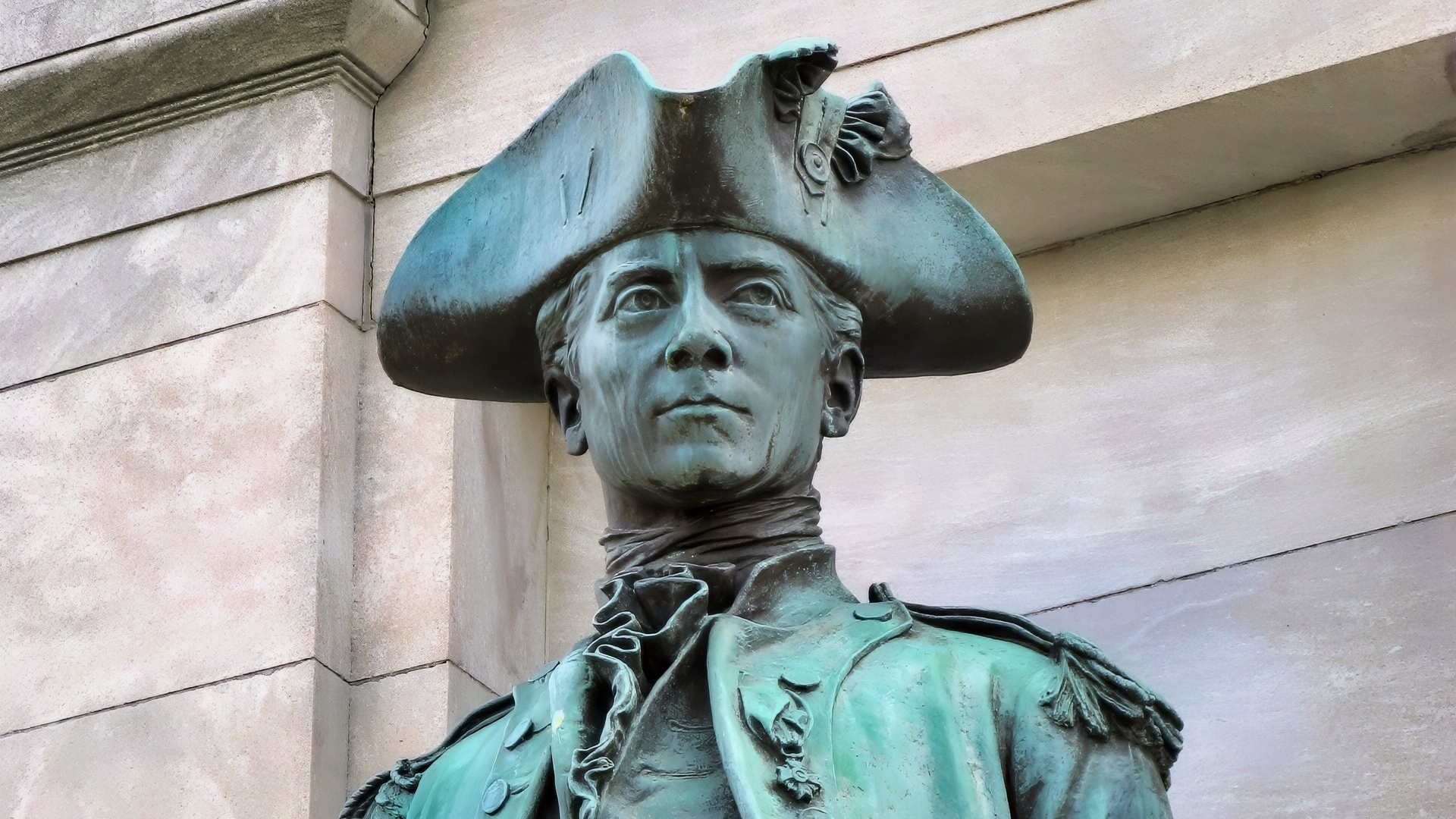
Summary and Key Points: “I have not yet begun to fight.” John Paul Jones is said to have shouted it across the water off Flamborough Head on 23 September 1779, when Captain Richard Pearson of HMS Serapis called over to ask whether the American ship had struck her colors. Bonhomme Richard was burning and taking on water at the time, which is what made the answer worth remembering. The line reaches us through one man — Lieutenant Richard Dale, who was aboard, and who set down his recollection years afterward.
Military Quote of the Day: By Captain John Paul Jones
“I have not yet begun to fight!” — Captain John Paul Jones
Captain John Paul Jones was probably the most famous Naval commander of the American Revolution.
Born in 1747 in Kirkcudbright, Scotland, Jones first went to sea at age 12, according to his bio on the Naval History and Heritage Command website. Born as John Paul, he had a fascinating story of how he came to serve in his position.
“He became first mate on a slaver brigantine in 1766, but soon left that trade in disgust. He was appointed master in 1769,” the biography said.
“In 1773, he killed the leader of his mutinous crew in self-defense at Tobago, in the West Indies. To avoid trial, he fled to Virginia, and the British considered him a fugitive. He concealed his identity by adding the surname Jones.”
Jones in the Revolution
In 1775, just before the American Revolution, Jones joined the Continental Navy.
He was given his first commission as a lieutenant aboard the Alfred, but was soon promoted to captain of the Providence.
Early on, the biography said, Jones “destroyed British fisheries in Nova Scotia and captured sixteen prize British ships.”
Cannon Firing. Image Credit: Creative Commons.
Jones’ next command was the Ranger in 1777 and 1778, during which he made “audacious raids on England’s shore,” the Naval History and Heritage Command bio said. This led to his command of more ships, including the flagship Bonhomme Richard.
“I Have Not Yet Begun to Fight.”
Jones’s famous quote came on September 23, 1779, when he engaged in what the bio describes as “one of the bloodiest engagements in naval history” with the Serapis, a 44-gun Royal Navy frigate commanded by Captain Richard Pearson.
According to AmericanRevolution.org, the battle took place off the coast of Yorkshire.
“Upon discovering the Franco-American group, the British merchant ships fled to the coast, while their escorts stayed to fight, marking the beginning of the Battle of Flamborough Head,” the account said.
The famous “I have not yet begun to fight” line was reportedly spoken as Jones’ ship was burning and sinking, yet he refused to surrender.
Pearson asked Jones, “Has your ship struck?” another way of asking whether he planned to surrender. He answered with the famous quote.
Lt. Richard Dale, an American naval officer, is the source of Jones’s statement.
Hours later, Jones not only refused to surrender but emerged victorious, successfully pulling off what’s known as a “grappling maneuver,” which involved tangling the two ships together.
“The one advantage of the Bonhomme Richard was that it was the taller of the two boats, so its crew was able to fire down onto the deck of the British warship. Eventually, explosives were dropped, disabling many of the British ship’s guns,” the AmericanRevolution.org account said.
“Miraculously, after three and a half hours of fighting, the Serapis was defeated, and its crew surrendered to the Americans.”
Jones’ Bonhomme Richard was nearly destroyed, but it still won the battle. AmericanRevolution.org describes Jones’ defiance and refusal to surrender as “arguably the best encapsulation of American defiance during the Revolutionary War,” and it is now inscribed on the John Paul Jones Memorial in Washington.
About the Author: Stephen Silver
Stephen Silver is an award-winning journalist, essayist, and film critic, and contributor to the Philadelphia Inquirer, the Jewish Telegraphic Agency, Broad Street Review, and Splice Today. The co-founder of the Philadelphia Film Critics Circle, Stephen lives in suburban Philadelphia with his wife and two sons. For over a decade, Stephen has authored thousands of articles that focus on politics, national security, technology, and the economy. Follow him on X (formerly Twitter) at @StephenSilver, and subscribe to his Substack newsletter.