
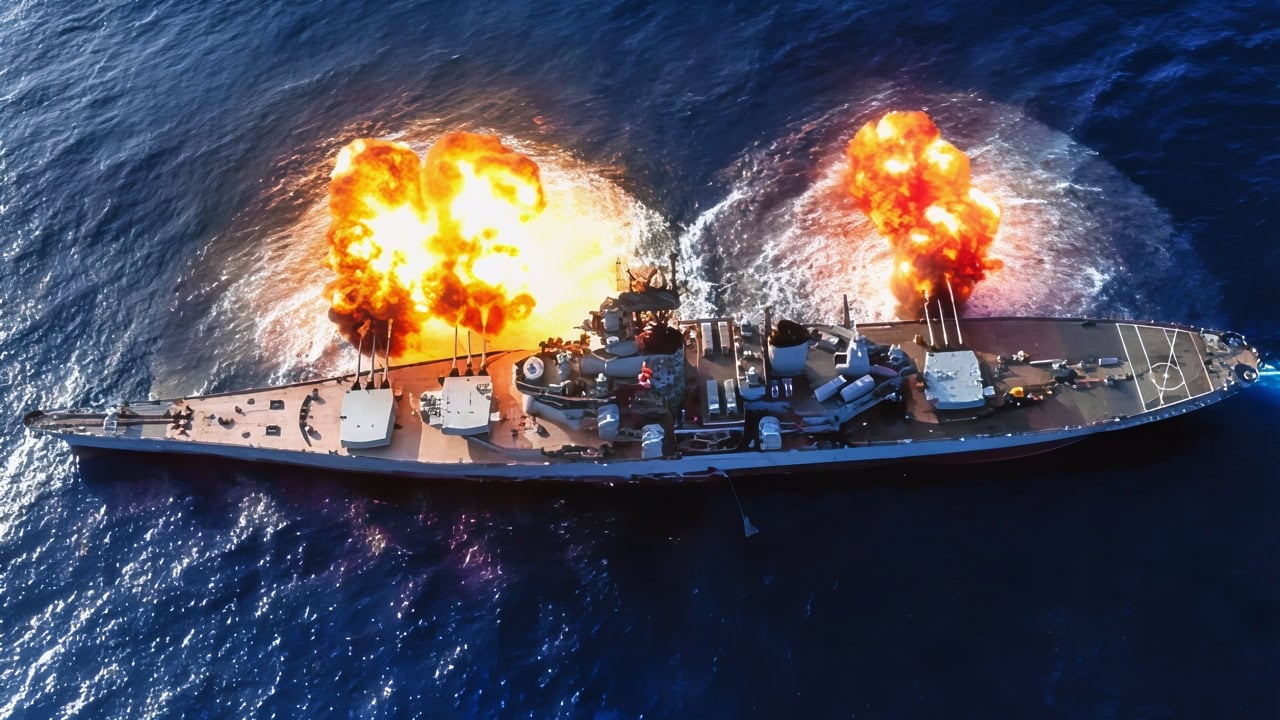
Summary and Key Points: An Iowa-class battleship’s main battery threw a 2,700-pound armor-piercing shell roughly 24 miles. That was the state of the art in 1944, and it was still the state of the art in 1980, which was the problem. So the US Navy removed four of the 5-inch gun mounts and bolted on 8 armored box launchers carrying 32 BGM-109 Tomahawk cruise missiles — each with a 992-pound warhead, a range of 1,553 miles, and a price tag of $2,000,000. It added 4 quad launchers with 16 Harpoons and 4 Phalanx close-in weapon systems, each firing 4,500 rounds per minute through six rotating barrels, or 75 rounds per second. A 1940s battleship came out of the yard able to hit something sixty times farther away than its own guns could reach.
The Great Iowa-Class Battleship Upgrades
The heyday of battleships as the “capital ships” of surface warfare is sadly long gone.
However, at least in the case of the Iowa-class fast battleships of the United States Navy, the retirement of these battlewagons certainly wasn’t due to a lack of versatility or adaptability.
Indeed, during the glorious decade of the 1980s, the 57,500-ton Iowa-class received multiple, highly sophisticated weapons system upgrades that made them even fiercer warships and kept them fighting right up until the end of the Cold War.
Iowa-Class Battleships’ Weaponry Upgrade #1: The Phalanx Close-In Weapon System (CIWS)
Back in World War II, the Iowas’ secondary battery of 5-inch/38-caliber dual-purpose guns and tertiary battery of Bofors 40 mm and Oerlikon 20 mm anti-aircraft guns were sufficient against aerial assailants such as kamikazes. However, the Cold War also ushered in the Jet Age; that meant that missile-armed, jet-propelled enemy warplanes required a more accurate, faster-firing anti-aircraft defense system.
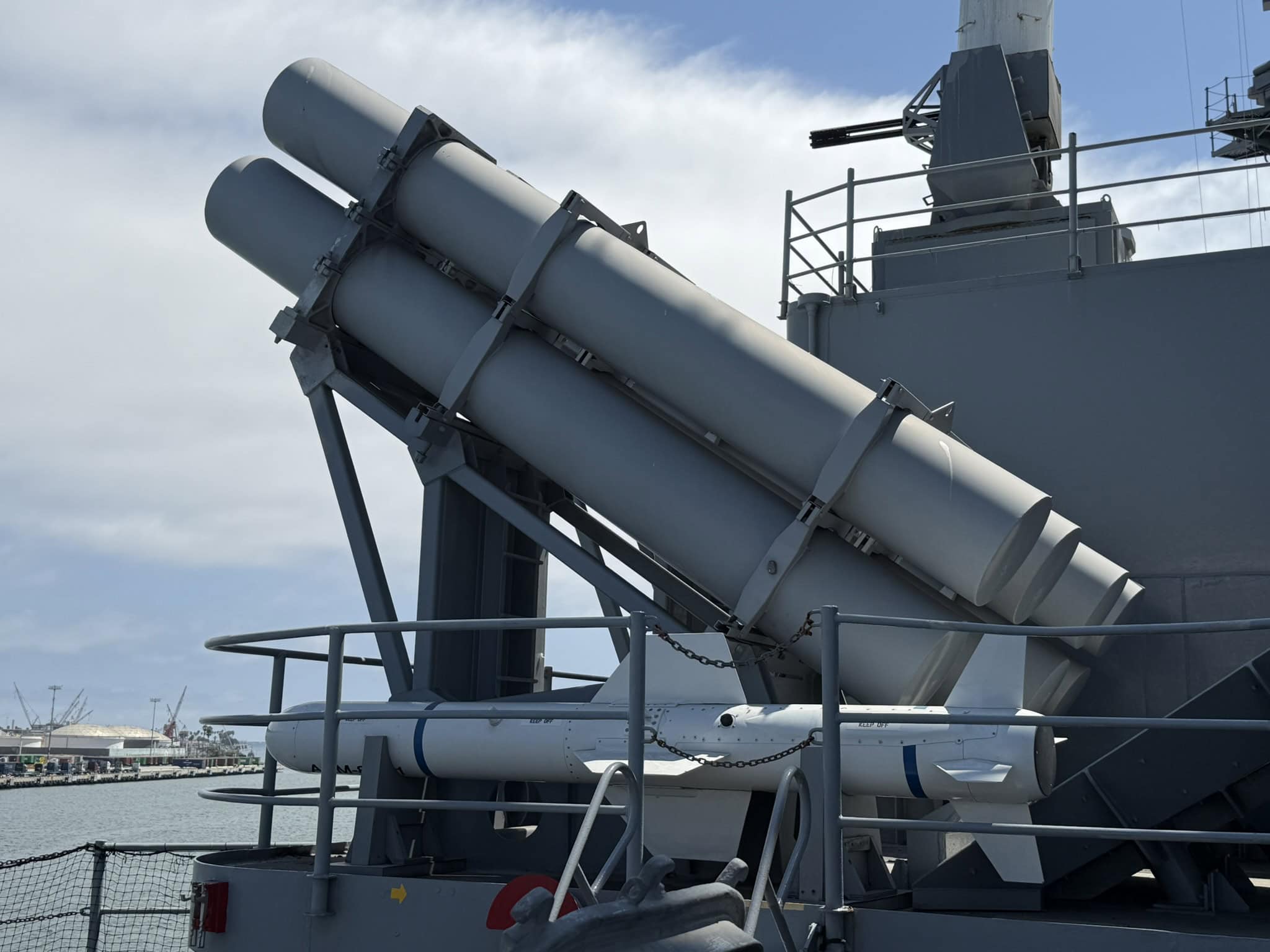
USS Iowa Harpoon Missiles. Photo Credit: 19FortyFive
Enter the Phalanx Close-In Weapon System (CIWS; pronounced “sea-whiz”).
This was—and still is— a fast-reaction, detect-through-engage, radar-guided, 20-millimeter gun weapon system that employs a six-barreled M-61A1 Gatling Gun with an incredible rate of fire of 4,500 rounds per minute, or 75 rounds per second! When it fires, it sounds a bit like a buzzsaw, making it far deadlier than its cuddly R2D2-lookalike appearance notwithstanding.
Each Iowa-class warship was equipped with four Phalanx mounts, two of which sat just behind the bridge and two which were next to the ship’s aft funnel.
Iowa-Class Battleships’ Weaponry Upgrade #2: The Harpoon Anti-Ship Missile
The Iowas’ main battery of nine 16-inch (406 mm)/45 caliber Mark 6 guns—two triple-gun turrets fore, one aft—was absolutely fearsome, no doubt. But naval warfare of the 1980s and beyond also necessitated a “smarter” anti-ship weapon that could give true standoff attack capabilities.
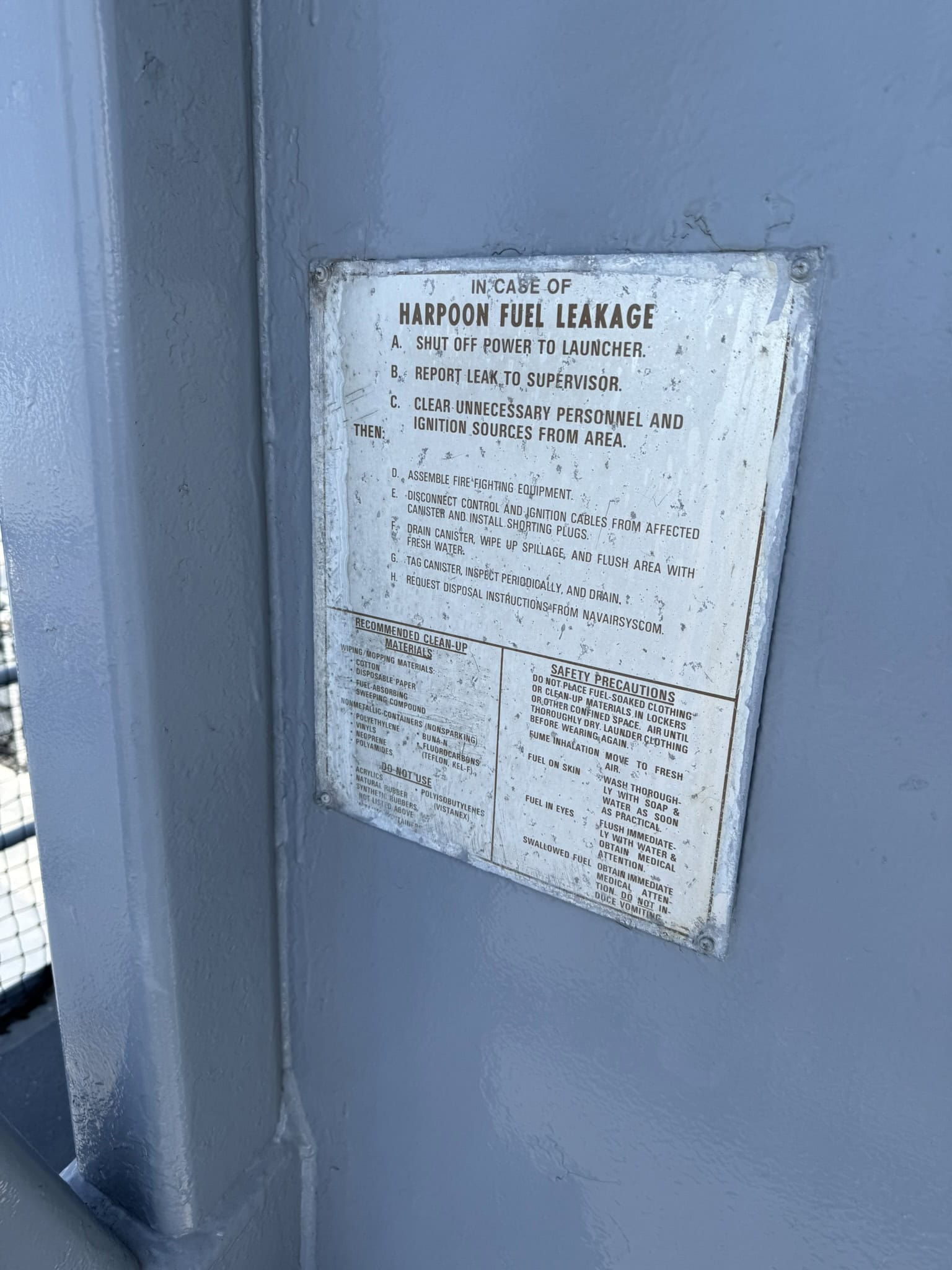
Harpoon Missile Equipment Aboard USS Iowa. Image Credit: 19FortyFive
Hence, the RGM-84 Harpoon anti-ship missile, which could deliver a 478-lb. warhead to targets up to 150 nautical miles away; for basis of comparison, whilst the 16-inch naval shells packed a walloping 2,700 lbs., they could only reach out to 24 statute miles.
Ergo, the battleships were retrofitted with four “shock-hardened” Mk 141 quad-cell launchers, each packing four Harpoons, for a total of 16 such missiles.
Iowa-Class Battleships’ Weaponry Upgrade #3: The Tomahawk Cruise Missile
Saving the best for last, as these would turn out to be the most historically significant and meaningful weapons upgrade, for reasons we shall discuss momentarily.
Four of the five-inch gun mounts were removed to make way for eight quad-cell Armored Box Launchers (ABLs), each of which packed four BGM-109 Tomahawk Land Attack Missiles (TLAMs), for a total of 32 such missiles.
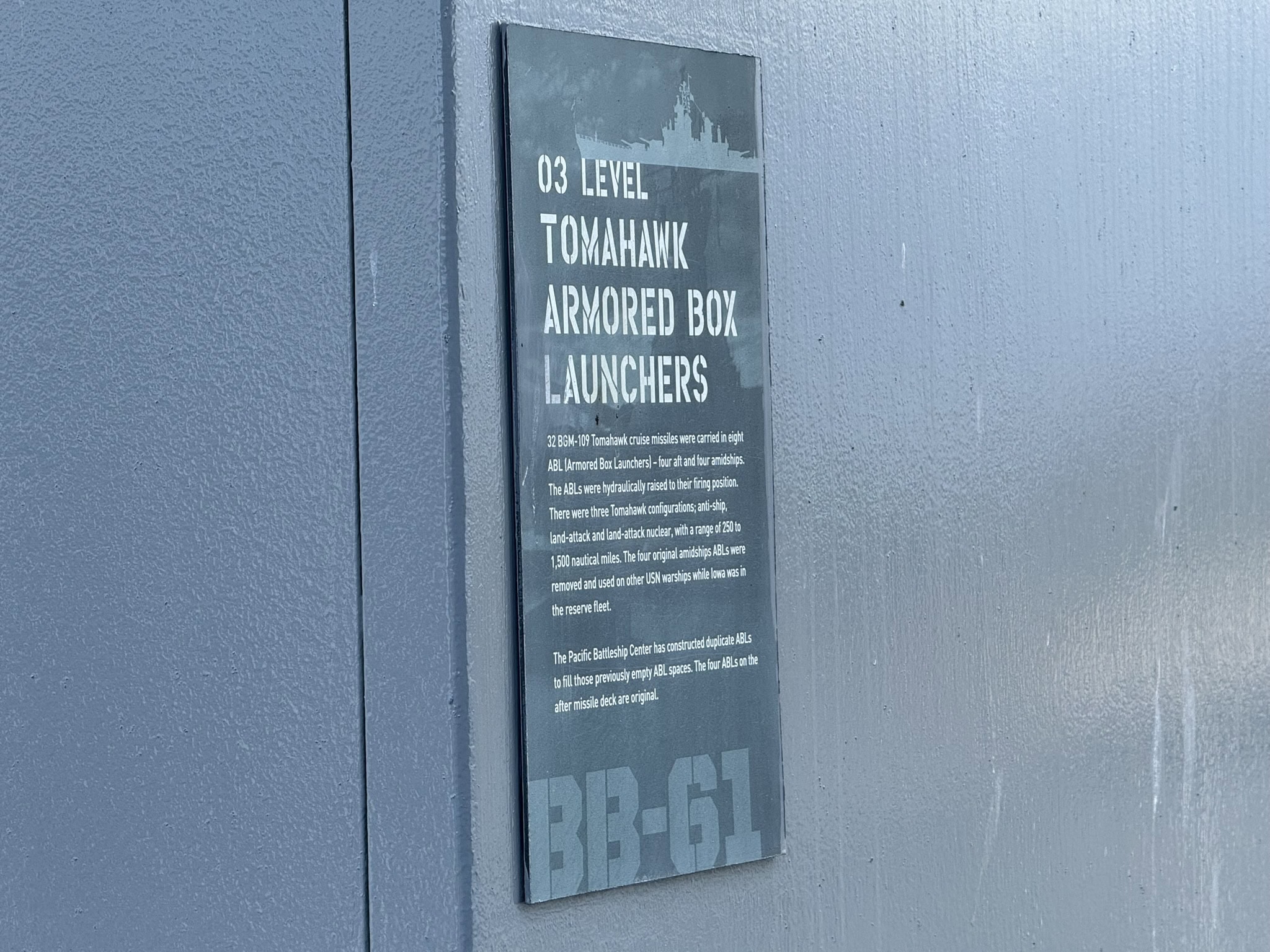
Tomahawk Box on USS Iowa. 19FortyFive.com Image.
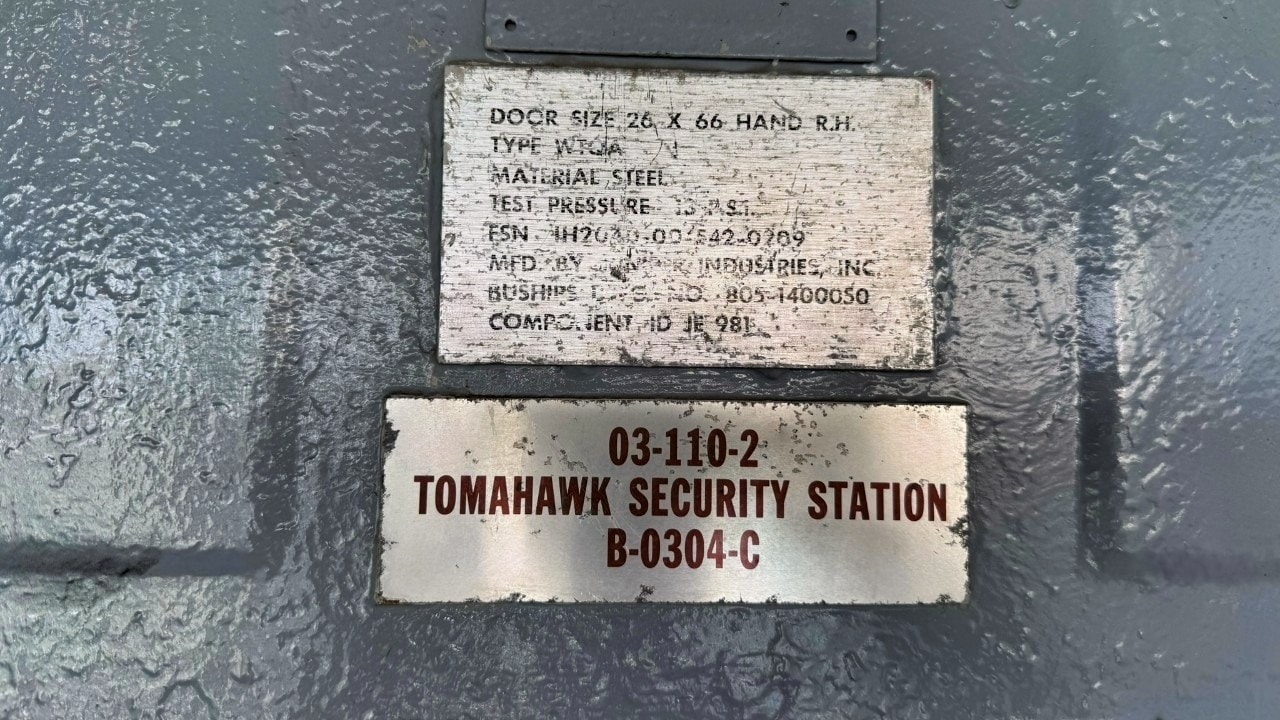
Battleship USS Iowa Tomahawk Missile Container. Taken by Harry J. Kazianis for 19FortyFive.com abord USS Iowa.
These highly accurate cruise missiles cost $2 million apiece but provided plenty of proverbial “bang for the buck,” with a maximum range of 1,553 miles, a max airspeed of 549 mph/Mach 0.9, and a warhead of 992 lbs.
Proof of Concept in Combat: Operational History of Missile-Armed Iowas in Brief
As far as this writer can ascertain, the Iowa BBs never got to fire their Harpoon missiles nor their “R2D2 guns” in anger; if any of our dear readers know otherwise, please let us know in the Comments section.
But they certainly did get to wield their TLAMs in grand fashion, in America’s last “hot war” of the Cold War era, that being the 1991 Persian Gulf War, AKA Operation Desert Storm.
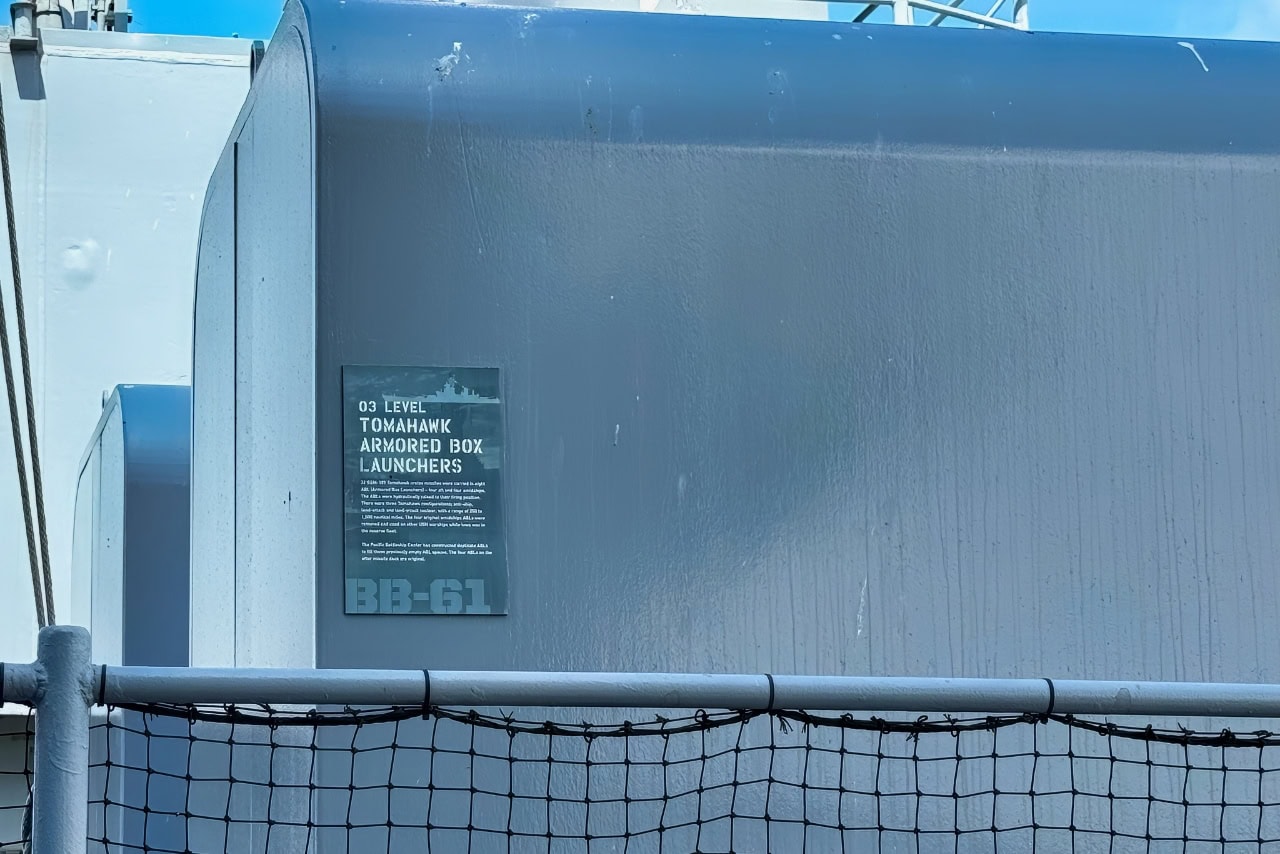
USS Iowa 19FortyFive image of Tomahawk Missiles on USS Iowa.
Therein, USS Missouri (BB-61) fired 28 Tomahawks against the forces of then-Iraqi dictator Saddam Hussein, who were illegally occupying the oil-rich Gulf Arab nation of Kuwait; “Mighty Mo” fired the first of these missiles at 1:40 a.m. on the very first night of the war, January 17, 1991.
Not to be outdone, her sister ship, USS Wisconsin (BB-64), AKA “Big Wisky,” fired 24 Tomahawks of her own at Iraqi targets. “Mighty Mo” and “Big Wisky” also brought their big, booming 16-inch main guns into the fray, and thus it came to pass that these two venerable battlewagons made history as the last battleships in history to fire their shots in anger.
Talk about “going out with a bang,” or, if you prefer, “in a blaze of glory!”
Postscript
Thankfully, all four of the Iowa-class battleships have been preserved for posterity as floating museums, and from having toured USS Iowa (BB-61) multiple times, I can vouch that the missile launchers and Phalanx are quite accessible.
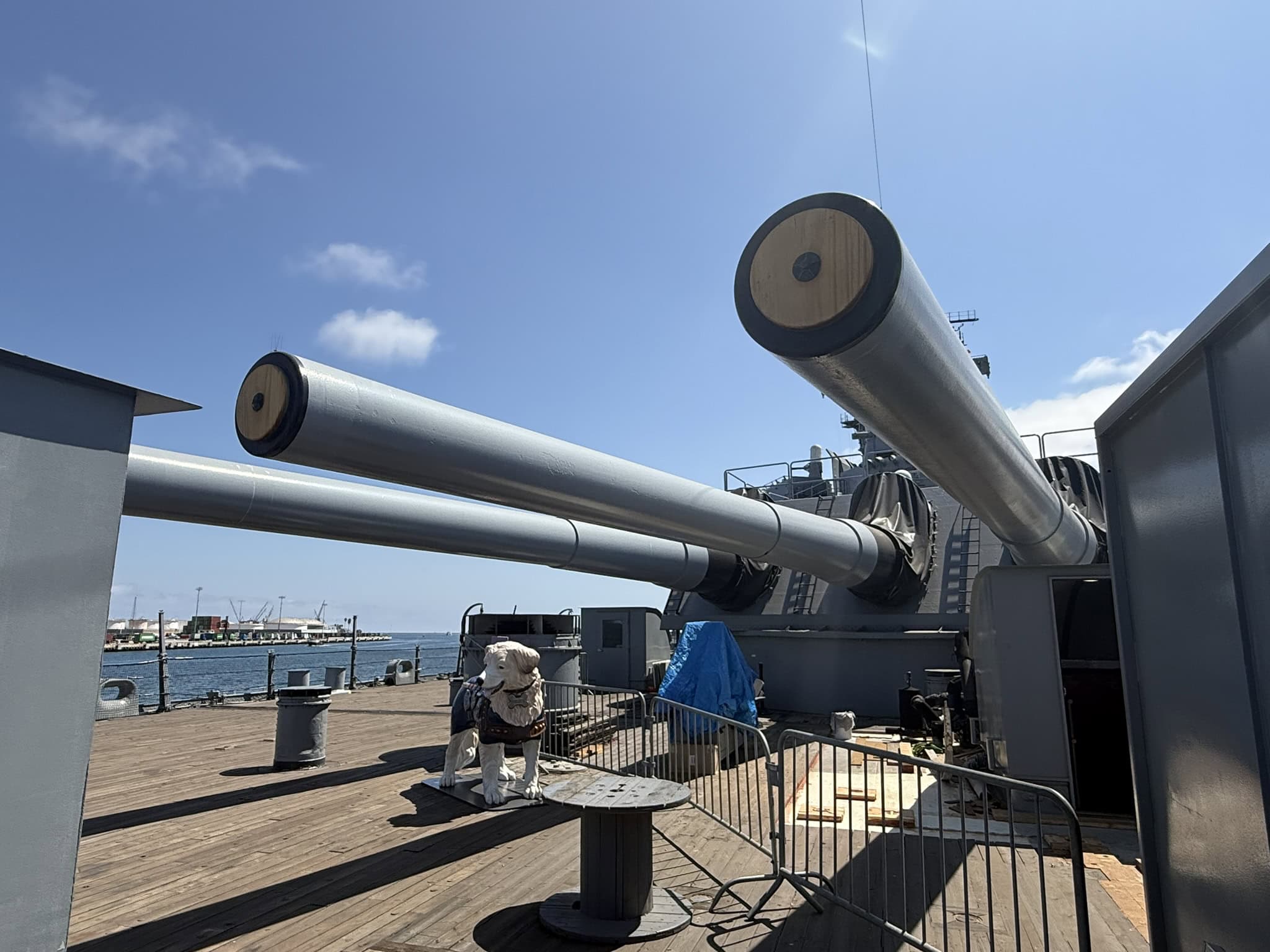
USS Iowa 16-Inch Guns. Image Credit: Harry J. Kazianis.
In the meantime, this writer is also honored to note that he has been invited to be the guest speaker at the USS Wisconsin’s Reunion Dinner this coming Columbus Day weekend!
I hope to report back with lots of cool shipboard pictures, including the missile launchers and Phalanx; stay tuned, dear readers.
About the Author: Christian D. Orr
Christian D. Orr is a Senior Defense Editor. He is a former Air Force Security Forces officer, Federal law enforcement officer, and private military contractor (with assignments worked in Iraq, the United Arab Emirates, Kosovo, Japan, Germany, and the Pentagon). Chris holds a B.A. in International Relations from the University of Southern California (USC) and an M.A. in Intelligence Studies (with a concentration in Terrorism Studies) from American Military University (AMU). He is also the author of the book “Five Decades of a Fabulous Firearm: Celebrating the 50th Anniversary of the Beretta 92 Pistol Series,” the second edition of which was recently published.