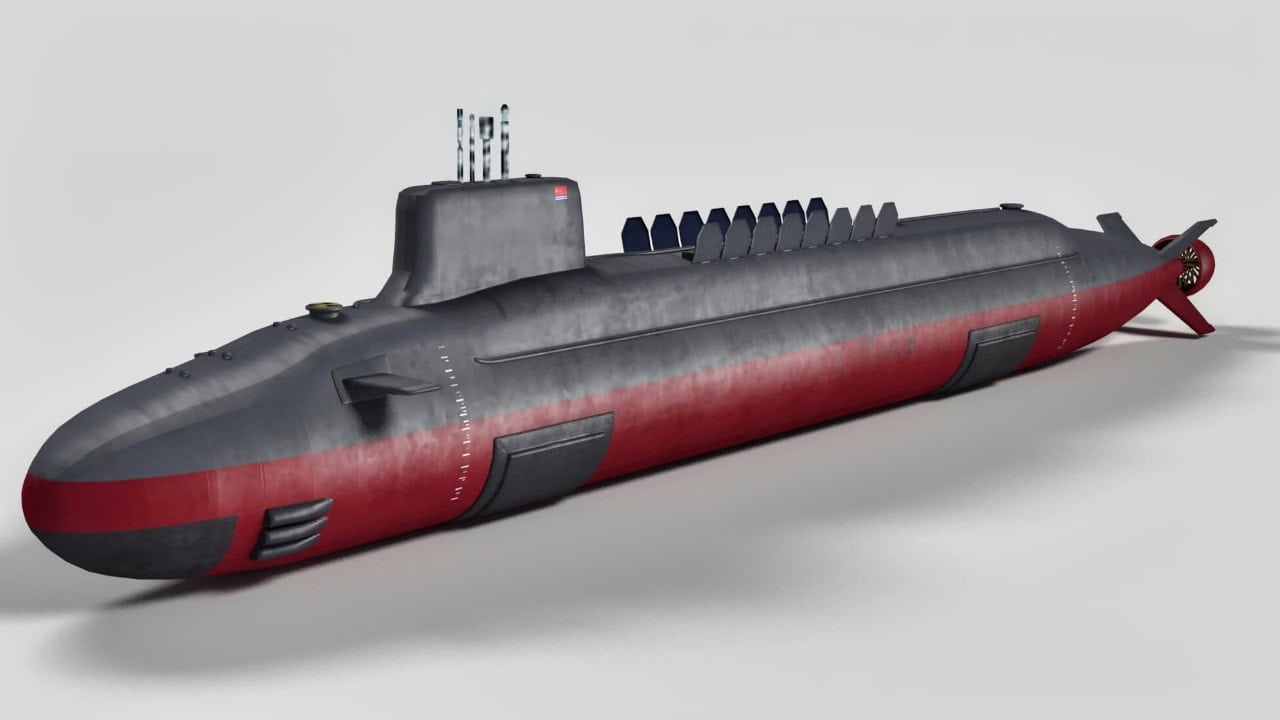
Summary and Key Points: China operates around 21 Type 039 Yuan-class attack submarines, each 77.6 meters long, displacing about 3,600 tons submerged, and carrying 6 533mm torpedo tubes loaded with Yu-6 heavyweight torpedoes and YJ-18 anti-ship cruise missiles. They are slower than any American nuclear submarine, and they will always be slower. That does not matter, because a Yuan-class boat is not built to chase a US Navy carrier strike group across the Pacific. It is built to sit in a chokepoint on air-independent propulsion, generating power without surfacing, and wait for one to come to it. The moment a conventional submarine is most detectable is the moment it snorkels to recharge — and air-independent propulsion is what removes that moment.
China’s Type 039 Yuan-Class Submarines Are No Joke
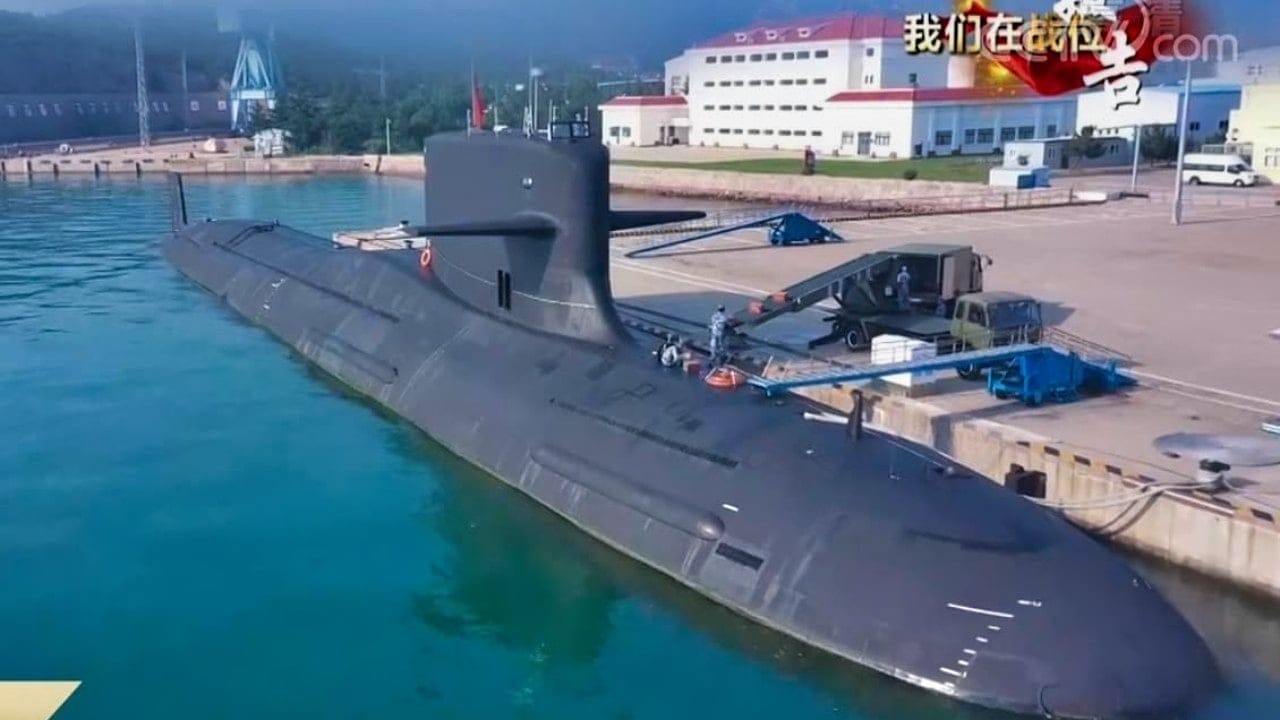
Type 093B Submarine from China. Image Credit: Screengrab.
Far too many analysts in the West downplay the rise of China’s submarine force as a significant (and growing) threat to the continued dominance of the United States Navy’s submarine force.
But it is.
China is currently expanding in all directions — including at sea (and beneath the sea).
One of the most important components of China’s undersea warfare capability remains the conventionally powered Type 039A/B/C Yuan-class submarine.
The Yuan-class
A diesel-electric attack submarine equipped with air-independent propulsion (AIP), the Yuan-class represents a massive improvement over the older Type 039 Song-class diesel-electric submarine.
In fact, the Yuan-class attack submarine has become the backbone of the People’s Liberation Army Navy’s (PLAN) submarine force. The
Nuclear Threat Initiative estimates that China operates around 21 Yuan-class submarines.
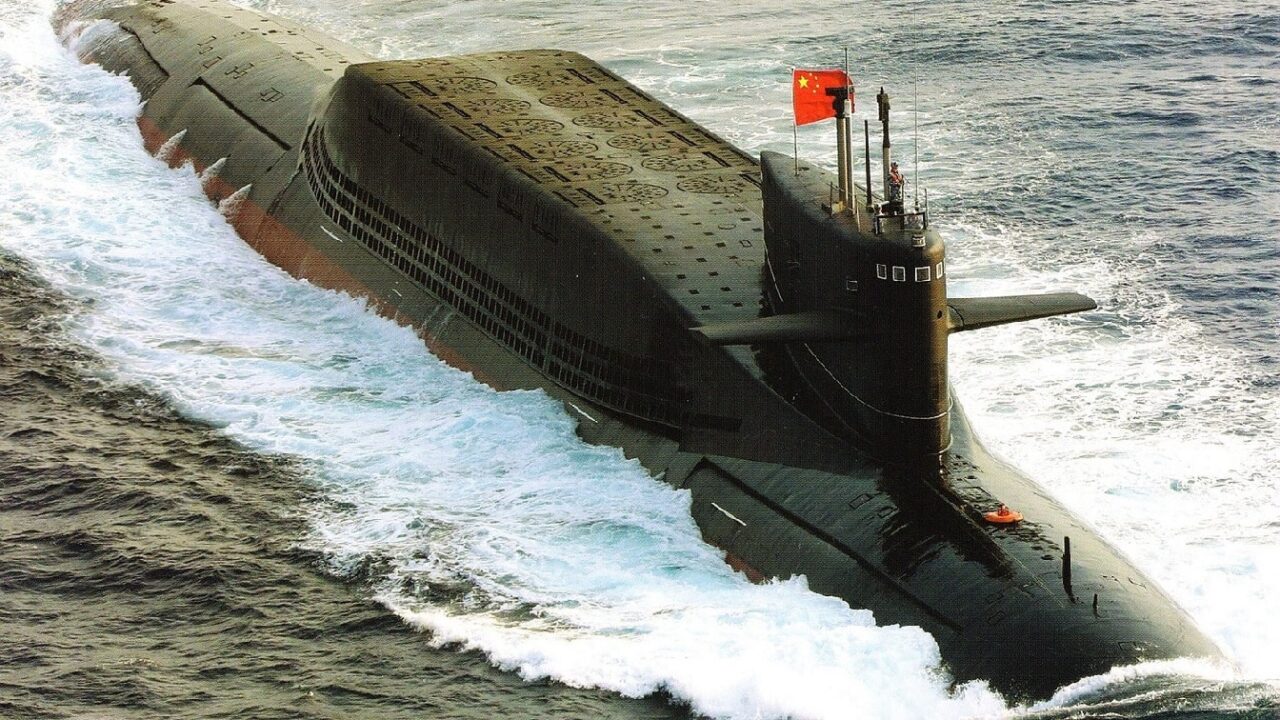
SSBN China Submarine. Image Credit: Creative Commons.
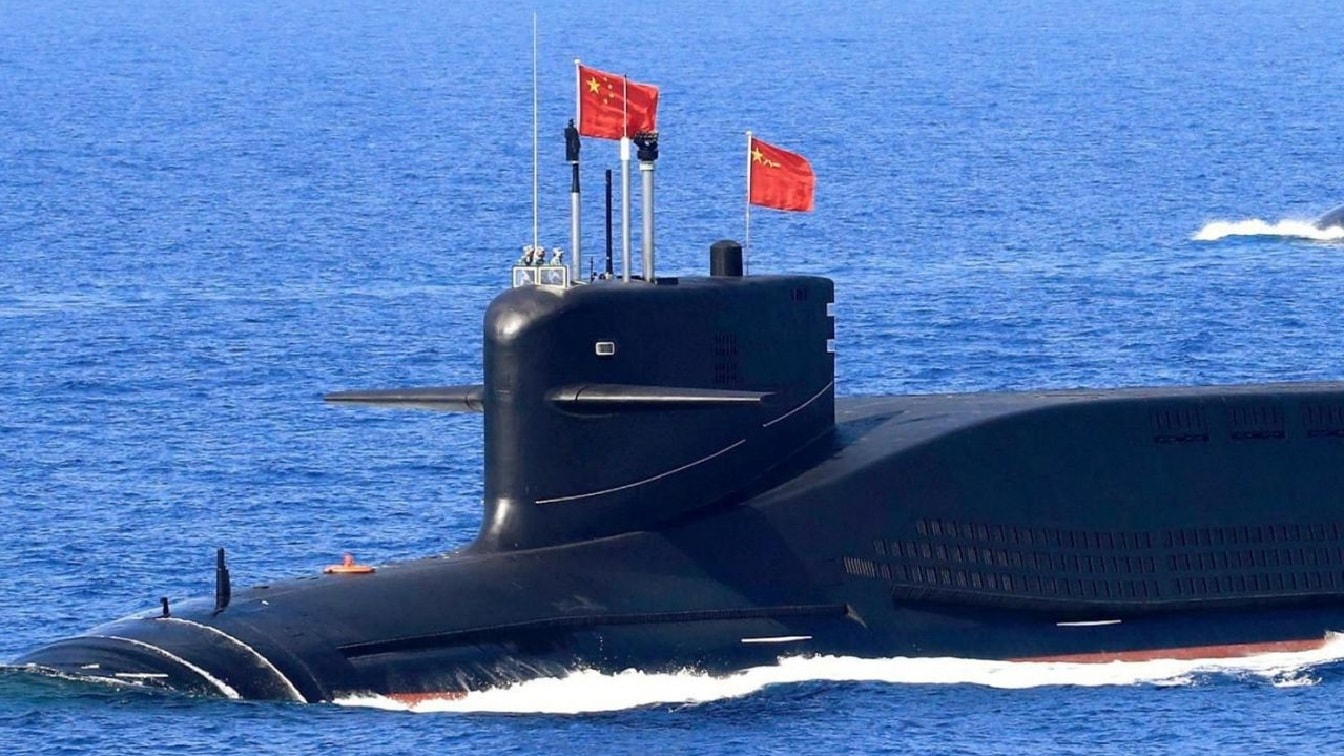
Chinese nuclear missile submarines. Image Credit: Creative Commons.
Entered service in the mid-2000s, the Yuan-class has undergone a series of iterations, each improving the design.
For instance, four early Type 039As were followed by a substantially larger production run of the enhanced Type 039B submarines.
In 2021, the newest variation of the Yuan-class, the Type 039C, appeared publicly with a dramatically redesigned sail.
The Type O39A/B is fairly large.
It is approximately 77.6 meters long and has a displacement of around 3,600 tons when submerged.
That puts the Yuan-class in the same category (in fact, it is slightly bigger) as Russia’s Project 636 Kilo-class submarine and only 15 percent smaller than Japan’s Soryu-class submarine.
So the Yuan-class attack submarine gives Beijing a real open-ocean capability, whereas previous PLAN submarine classes gave China only coastal defense.
In other words, one might soon encounter Yuan-class boats throughout the East and South China Seas, or even farther into the Western Pacific rather than merely hanging close to China’s shores in shallower littoral waters.
A Silent Killer
AIP is the Yuan-class attack submarine’s greatest advantage.
That’s because a conventional diesel-electric boat runs diesel engines while surfaced (or snorkeling).
By running the diesel engines at the surface, the submarine can still move while recharging its batteries.
Once submerged, however, a conventionally powered submarine operates off battery power.
Eventually, however, the conventionally powered diesel submarine must resurface to recharge those batteries that sustain it while submerged.
During those snorkeling periods, rival anti-submarine forces can identify and target the submarine.
By adding China’s indigenously produced Stirling-engine AIP system on the Yuan-class, the PLAN now has a submarine that can generate power underwater without the need to surface and snorkel constantly.
Of course, the AIP (unlike nuclear power) does not give the Yuan-class unlimited endurance.
But it can significantly increase how long the boat can remain submerged.
There is, of course, a tradeoff as with anything.
That tradeoff is speed. Nuclear submarines can sustain high-speed operations over enormous distances.
A conventional AIP submarine is instead particularly effective when it moves slowly and waits.
This also makes the submarine harder to detect for a navy that wants to deny its opponent–the United States–access to contested waters, which can be a useful combination.
China’s Yuan-class comes equipped with six 533mm torpedo tubes that can launch heavyweight torpedoes and anti-ship missiles.
Specifically, China’s Yu-6 heavyweight torpedo and submarine-launched anti-ship weapons, like the YJ-18 anti-ship cruise missile, are among the Yuan-class submarine’s formidable arsenal.
The submarine features anechoic tiles, machinery isolation, and a skewed propeller to reduce its acoustic signature.
The Type 039B introduced what’s known as a flank sonar array to improve the submarine’s ability to detect other ships and submarines passively.
In essence, the new Yuan-class subs can listen more quietly than the Type 039A or other, older submarine classes in the PLAN fleet.
The Newest Sub In the Pack
As for the new Type 039C introduced in 2021, its most unique feature is its unusual sail.
The reshaped sail is believed to reduce its acoustic signature.
US-based observers have dubbed it a “stealth” sail and a towed sonar array.
It remains unclear, however, if the “stealth sail” significantly reduces the submarine’s overall acoustic signature.
The Type 039A/B/C is one of the most relevant platforms in China’s growing fleet of systems for any conflict with the Americans in the Western Pacific.
A Yuan-class attack submarine operating on batteries or AIP does not need to chase an American carrier strike group across the Pacific Ocean.
It can simply patrol likely transit routes in the region, set traps in known chokepoints, and wait for these US ships to approach.
The PLAN has clearly moved away from older Soviet-derived submarines toward indigenous systems that now populate much of its fleet.
Like any real industrial power, the Chinese Type 039A/B/C clearly gets better with each iteration.
A Strategic Nightmare for the US Navy
China’s nuclear submarines may have greater range, speed, and be of greater strategic importance.
But the Yuan-class offers the PLAN something different: a relatively quiet, heavily armed conventional submarine that can remain underwater for protracted periods of time.
What’s more, they can be produced in large numbers (and are cheaper than nuclear-powered boats).
Given the kind of war that China’s military might need to fight at sea soon, these submarines are much better suited than any other.
And that’s a major problem for a US Navy that is increasingly strained and primed to fight a twentieth-century war in the mid-twenty-first century.
About the author: Brandon J. Weichert
Brandon J. Weichert is the Senior National Security Editor at 19FortyFive.com. He also manages The Weichert Brief on Substack. Weichert also hosts “National Security Talk” on Rumble. He is the author of four bestselling national security books, the most recent of which is A Disaster of Our Own Making: How the West Lost Ukraine (Encounter Books). Follow him via Twitter/X @WeTheBrandon.