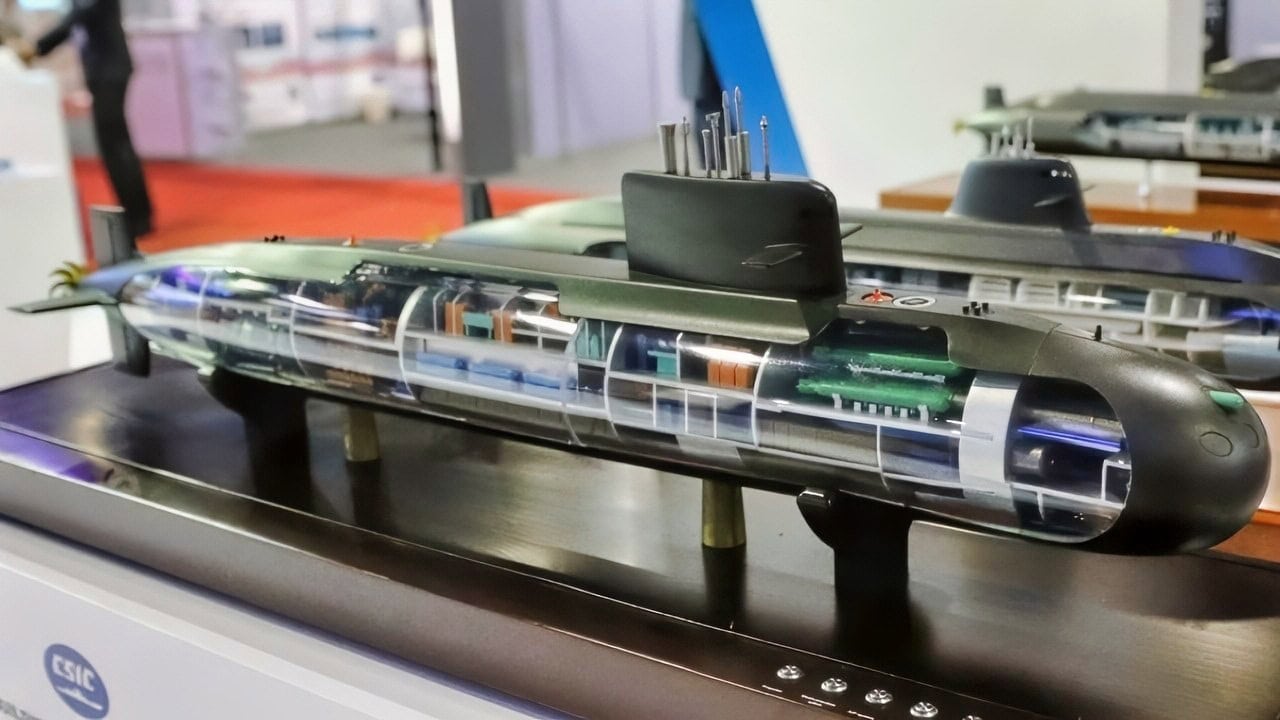
Key Points and Summary – China’s latest Yuan-class submarine, the Type 039C, represents a significant evolution in the PLAN’s non-nuclear fleet, designed specifically for littoral combat within the First Island Chain.
-Featuring a distinctive angled conning tower similar to Swedish designs, the submarine utilizes Air-Independent Propulsion (AIP) and acoustic coatings to remain submerged longer and harder to classify on sonar.
-While not strictly “invisible,” these stealth enhancements, combined with potential vertical launch capabilities, make the Type 039C a potent asset for scenarios involving a blockade or invasion of Taiwan.
In 1 Word: Stealth
Inside China’s New Yuan-Class Submarine and Its Unique Angled Sail Design
China’s Yuan-class submarine is the People’s Liberation Army Navy’s (PLAN) newest series of non-nuclear, conventionally powered diesel-electric attack submarines equipped with air-independent propulsion technology.
They come in several variants and, in essence, form the backbone of the PLAN’s non-nuclear submarine fleet. Building on previous Chinese submarine designs, such as the Type 039 Song-class submarines and older submarines inherited from the Soviet Navy, the Yuan-class submarines are smaller and optimized for littoral operations in shallower coastal waters.
An Evolving Line
Though grouped as a single class, the submarines have been produced in several variants that are thought to incorporate higher-performance technologies and upgrades as those technologies mature gradually. For this analysis, the latest variant, dubbed by observers the Type 039C, will be the focus.
The latest of the Yuan-class is noted for seeming enhancements to its stealth and incorporates measures to reduce its acoustic signature.
First and foremost among these is the submarine’s conning tower, which, unlike the vertical towers of previous submarines, is canted at distinct angles and is not unlike the A-26 Blekinge-class submarine, a Swedish design.
It is presumed that this feature is intended to reduce the submarine’s acoustic signature and thus thwart enemy submarines’ attempts to locate it.
Not Transparent, Nor Invisible
Though often equated to an invisibility cloak, like that of Harry Potter fame, even the newest Yuan-class’s redesigned conning tower would not render the submarine completely invisible.
The submarine could still appear on a sonar screen — but what it would be exactly would be difficult to ascertain with complete certainty.
“The size of the stealth features on the Chinese submarine suggests that it is intended to work against medium frequency sonars,” HI Sutton, a naval expert, explains.” It will be less effective against lower-frequency sonars with long wavelengths. But those only tell the enemy that something is there, not what it is. They will also be less effective against short-wavelength sonars such as those on a torpedo. But that is also where the submarine’s other stealth feature, a rubberized anechoic coating, plays a part.”
Sutton adds that the submarine will be far from invisible. Instead, the attention paid to the submarine’s contouring might not be so much to make the submarine invisible as to complicate its identification and add a layer of uncertainty to battlefield calculus.
“So we can deduce that the new stealth shaping is mainly aimed at complicating classification. Medium-frequency active sonar can be used to classify or identify targets. With the new shape, the enemy will have difficulty determining the submarine’s true nature. This may cause delays or miscalculations, which the submarine can use to its advantage.”
“The new shaping will only reduce the signal strength by a few decibels. Even so, combined with the sound-absorbing rubber coating covering the hull [sic] side of the boat, it may be enough to save the submarine.”
Diving Time and the Underwater Hourglass
The more important aspect of the Yuan-class acoustic reduction strategies is its Air-Independent propulsion technology.
Unlike the larger nuclear-powered submarines in the navies of the United States or other countries, the Yuan-class must, on occasion, break the surface of the ocean.
While snorkeling, or indeed on top of the surface entirely, the submarine can recharge its batteries. But the submarine’s AIP technology allows it to remain underwater for long periods, a boon for staying unseen and undetected.
Operating AIP technology is also quieter than traditional diesel-electric submarines, and, in tandem with the submarine’s anechoic coatings, the latest Yuan-class is thought to be significantly quieter than its predecessors, though how it compares to advanced Western designs remains hotly debated.
The upgraded Yuan-class submarines would have obvious strategic application in a Chinese blockade or invasion of Taiwan, given the complications they could pose for an enemy flotilla in finding and identifying them.
The submarines have been observed operating with the PLAN’s East Sea Fleet, giving credence to the idea that Yuans would be applied to military action against Taiwan.
Indeed, some reports indicate that the newest Yuan-class builds may feature a Vertical Launch System, given their somewhat longer hulls compared to older subs in the class.
If confirmed, the submarines could launch longer-range missiles with a higher warhead payload than would physically fit inside the submarine’s torpedo tubes.
Though the Yuan-class lacks the globe-trotting range of other nuclear-powered submarines and would be unlikely to undertake voyages beyond the Indo-Pacific, that may not be of consequence given their potential operational application.
Contesting the waters of the first island chain and its outskirts is the kind of operation these submarines are rather well-suited to perform, given their more modest weapon loadout and endurance.
About the Author: Caleb Larson
Caleb Larson is an American multiformat journalist based in Berlin, Germany. His work covers the intersection of conflict and society, focusing on American foreign policy and European security. He has reported from Germany, Russia, and the United States. Most recently, he covered the war in Ukraine, reporting extensively on the war’s shifting battle lines from Donbas and writing on the war’s civilian and humanitarian toll. Previously, he worked as a Defense Reporter for POLITICO Europe. You can follow his latest work on X.