Chester Nimitz Knew How to Command: “When you’re in command, command,” said United States Navy Admiral Chester Nimitz, the iconic naval commander of American forces in the Pacific Theater of the Second World War. Nimitz was talking about what presidential historians like John Meacham call the “presidential timber.” In this case, it’s a leadership quality needed to lead men into the crucible of battle.
For Nimitz, one needed to take charge—that is, to make choices—even life-or-death ones—without hesitation or visible fear.
To do that, leaders had to stay calm. Any sign of stress or doubt would undermine unit cohesion and morale — in turn, undermining the unit’s ability to achieve its mission objectives.
Then one had to accept whatever the outcome was.
One had to roll with the punches, too.
Rolling with the Punches
And Nimitz repeatedly proved his adaptability in the most dangerous circumstances.
Even at the outset of the Second World War for the United States, the Japanese surprise attack on Pearl Harbor saw the Pacific Fleet’s main surface warfare force — the vaunted battleships — effectively taken offline in the attacks (without so much as firing a shot or departing their moorings that horrific morning).
So, Nimitz had to improvise when it came to counterattacking the Japanese. He had to rely disproportionately on the Navy’s carrier force at a time when aircraft carriers were viewed as ancillary support vessels for the more prestigious battleships.
By turning into the development of aircraft carriers out of necessity — and making it look easy in the process — Nimitz kept the broken Pacific Fleet in fighting shape to ensure it could press hard against the Japanese, avenging America for the Pearl Harbor attacks and then generating sufficient momentum to allow for America’s ultimate victory.
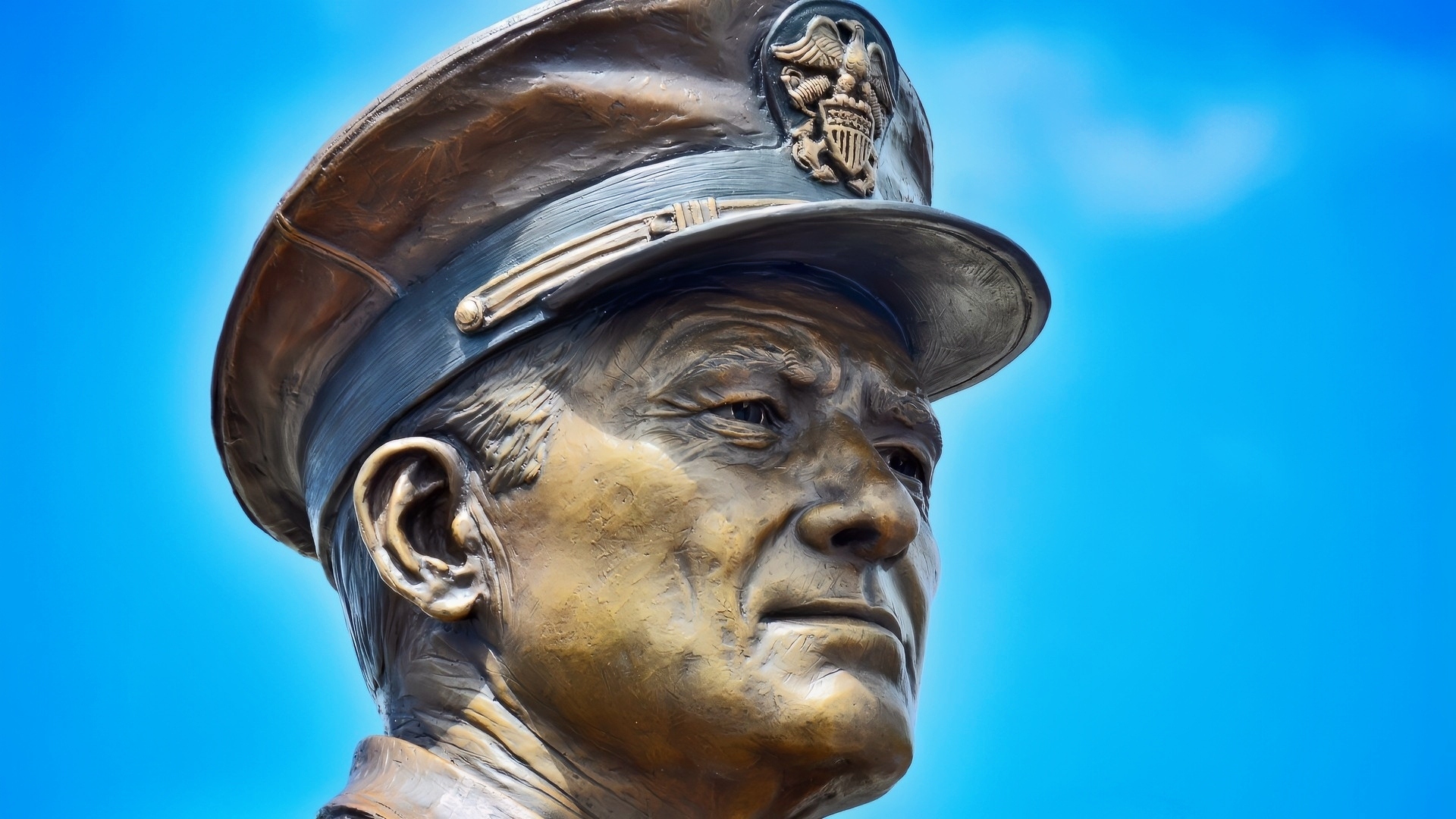
A 9-foot tall bronze statue of Fleet Adm. Chester Nimitz is unveiled at a statue dedication ceremony in front of the Battleship Missouri Memorial. Created by sculptor Rip Caswell, the statue depicts Nimitz as he appeared in battle in 1944. Nimitz commanded the largest ocean area and most ships of any single commander in history. (U.S. Navy photo by Mass Communication Specialist 1st Class Daniel Barker/Released)
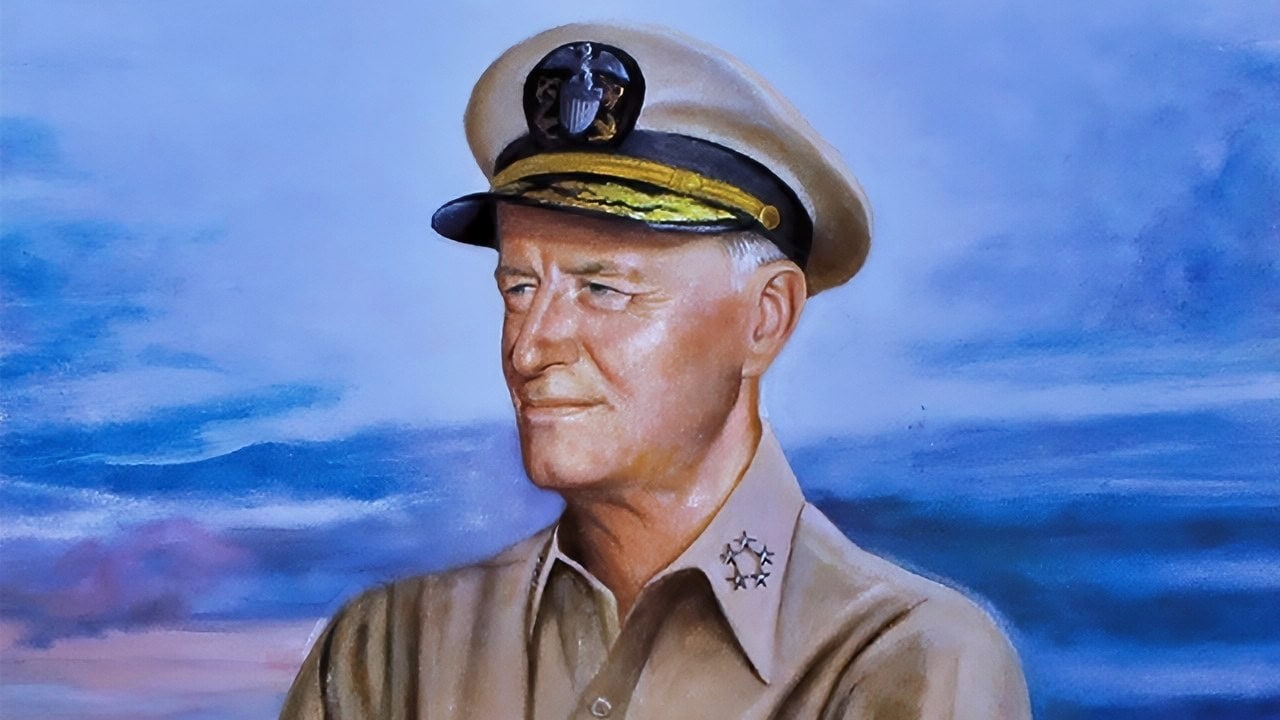
Chester Nimitz Navy Admiral. Image Credit: Creative Commons.
Nimitz’s decisive roles at the Battles of the Coral Sea in May 1942 and Midway the following month secured his status as a legend on par with John Paul Jones in the annals of America’s naval warfare.
At the Battle of the Coral Sea, Nimitz presided over what was essentially the first-ever carrier-on-carrier battle. During that eventful battle, the opposing ships never saw each other or fired directly at one another.
Instead, the air wings of aircraft carriers handled all the combat. And because of Nimitz’s leadership during that unique battle — a kind of battle that no one had really trained for — the Americans were able to check the Imperial Japanese Navy’s advance toward Australia.
That battle ended Japan’s drive to take the islands closest to Australia and effectively lock Australia out of the wider war in the Pacific.
It also dealt a vital blow to Japan’s otherwise impressive aircraft carrier force and the myth of invincibility surrounding the Imperial Japanese Navy.
Decisive Battles
Then came the Battle of Midway a month after the Battle of the Coral Sea.
Thanks to the superior cryptologic capabilities of US intelligence, the Americans learned of Japan’s plans to attack Midway, the key US military base in the Pacific.
Anticipating their strike on the Midway Atoll, Nimitz sailed his carrier fleet out to ambush the Japanese fleet. The goal was simple: sink the Imperial Japanese Navy’s aircraft carriers to effectively cripple Japan’s offensive capabilities for the rest of the war.
Nimitz was successful in sinking four of the Japanese aircraft carriers, permanently altering the tempo and balance of the war in America’s favor. Japan had a great navy. But it lacked the industrial capacity that the United States enjoyed.
While the Japanese scored some early, key hits against the US military, Tokyo’s forces never had the capacity to defeat the American fleet as its leaders wanted. America’s military was too big, too spread out, and its industrial base was far too great.
Nimitz then led the Navy’s role in the island-hopping campaign (alongside US Army Gen. Douglas A. MacArthur, who commanded the ground component) against the Empire of Japan, driving US and Allied forces straight into the heart of Japan.
Nimitz commanded the Central Pacific thrust of that island-hopping campaign, bypassing heavily fortified Japanese islands and placing US forces much closer — at lower cost — to the Japanese Home Islands.
The quote listed at the top of this piece is a snapshot into the leadership style that defined Adm. Nimitz’s command.
He was aggressive but highly calculating. He always stood by his subordinates, even those who made mistakes (as long as they were honest mistakes, of course).
Any semblance of hesitation or lack of aggression, however, Nimitz had no compunction about booting those individuals.
Early Jointness
In fact, Nimitz was a bit of a pioneer. Today, we take for granted the “jointness” of the United States Armed Forces, that is, the nearly seamless integration of the Army, Navy, Air Force, and Marine Corps, as well as more modern branches like the Space Force.
But in the 1940s, such a concept was novel. Nimitz was an early practitioner of joint maneuver warfare at sea.
This level of aggression, coupled with boldness and calculation, explains why Nimitz was such a legendary leader in the US Navy.
It also explains why the Americans so decisively defeated the Japanese.
About the Author: Brandon J. Weichert
Brandon J. Weichert is the Senior National Security Editor at 19FortyFive.com. He also manages The Weichert Brief on Substack. Weichert also hosts “National Security Talk” on Rumble. He is the author of four bestselling national security books, most recently A Disaster of Our Own Making: How the West Lost Ukraine (Encounter Books). Follow him on Twitter/X @WeTheBrandon.