Summary and Key Points: Douglas MacArthur remains one of the most admired and most criticized generals in American history. He posted one of the best academic records West Point had ever seen, earned seven Silver Stars in World War I, and promised to return to the Philippines after Franklin D. Roosevelt ordered him out to Australia in 1942. He kept that promise at Leyte on October 20, 1944, presided over Japan’s surrender aboard USS Missouri, and ran the postwar occupation of Japan. Then President Harry S. Truman fired him during the Korean War.
US Army General Douglas MacArthur: How Does History Judge Him?
“A true leader has the confidence to stand alone, the courage to make tough decisions, and the compassion to listen to the needs of others. He does not set out to be a leader, but becomes one by the equality of his actions and the integrity of his intent.” — Douglas MacArthur.
In many ways, Douglas MacArthur was a larger-than-life figure. Although he served with distinction in multiple wars, he was also incredibly controversial.
In the eyes of some, he was a belligerent egotist and something of a rogue, while in the eyes of others, he was an inspirational war hero and a man of courage and leadership.
Early Life and Military Career
MacArthur was born in Little Rock, Arkansas, on January 26, 1880.
His father, Arthur MacArthur, was an Army officer assigned to protect railroad workers from hostile Native American attacks in New Mexico, and later became a Union Hero during the American Civil War.
As a young boy, Douglas MacArthur developed a love of military affairs while attending the West Texas Military Academy in 1893, where he excelled in Academics and military discipline.
In 1899, he attended the Military Academy at West Point, where he distinguished himself. Academically, MacArthur earned 2424.12 out of 2470 merits, a score of 98.14%, the third-highest score in West Point history.
After graduating from the Academy, MacArthur was commissioned as a second lieutenant in the U.S. Army Corps of Engineers.
Ironically, his first deployment was to the Philippines.
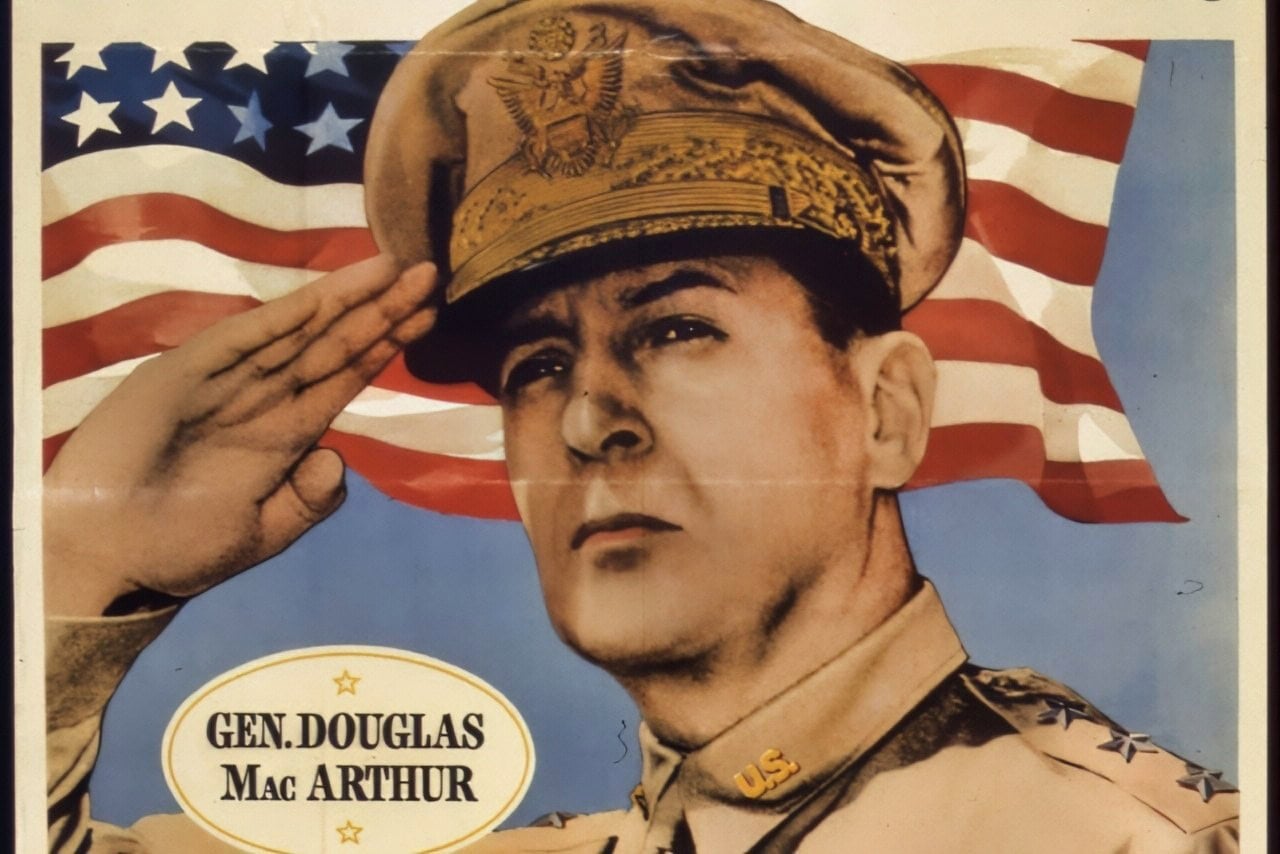
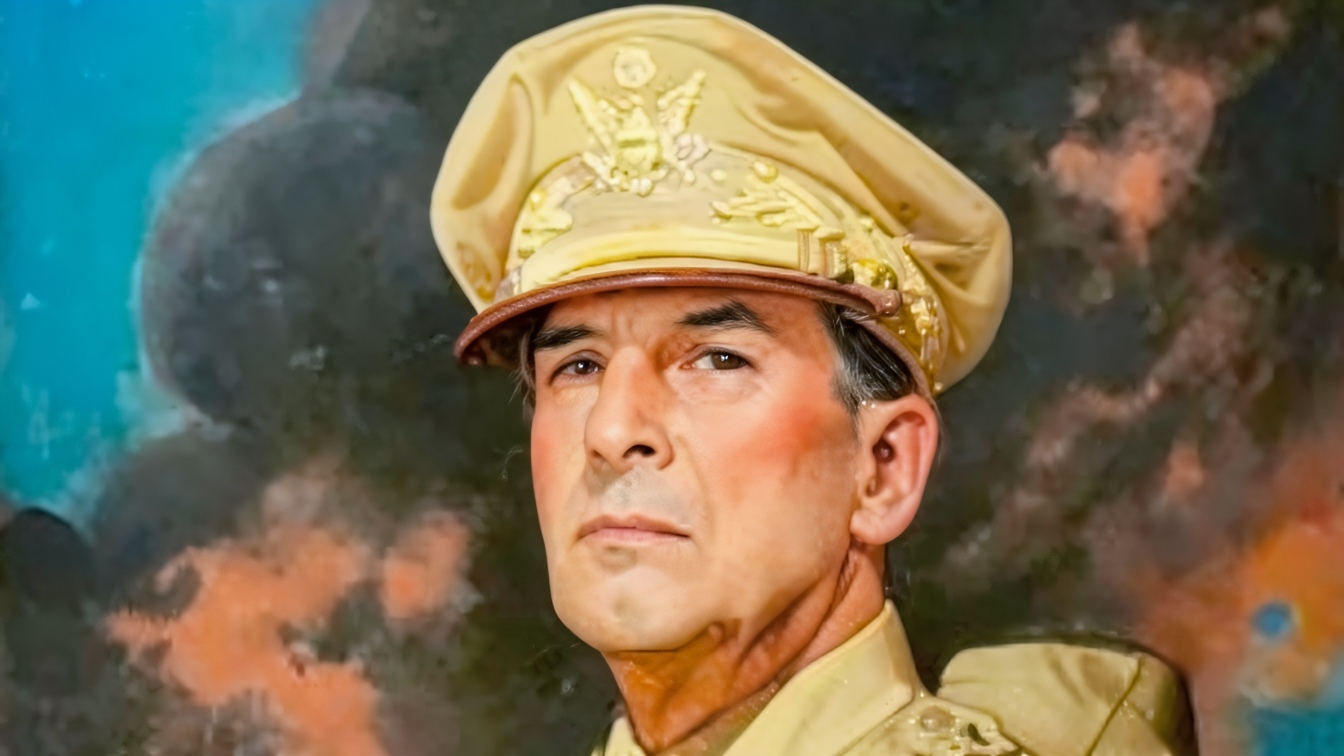
Douglas MacArthur. Image Credit: Creative Commons.
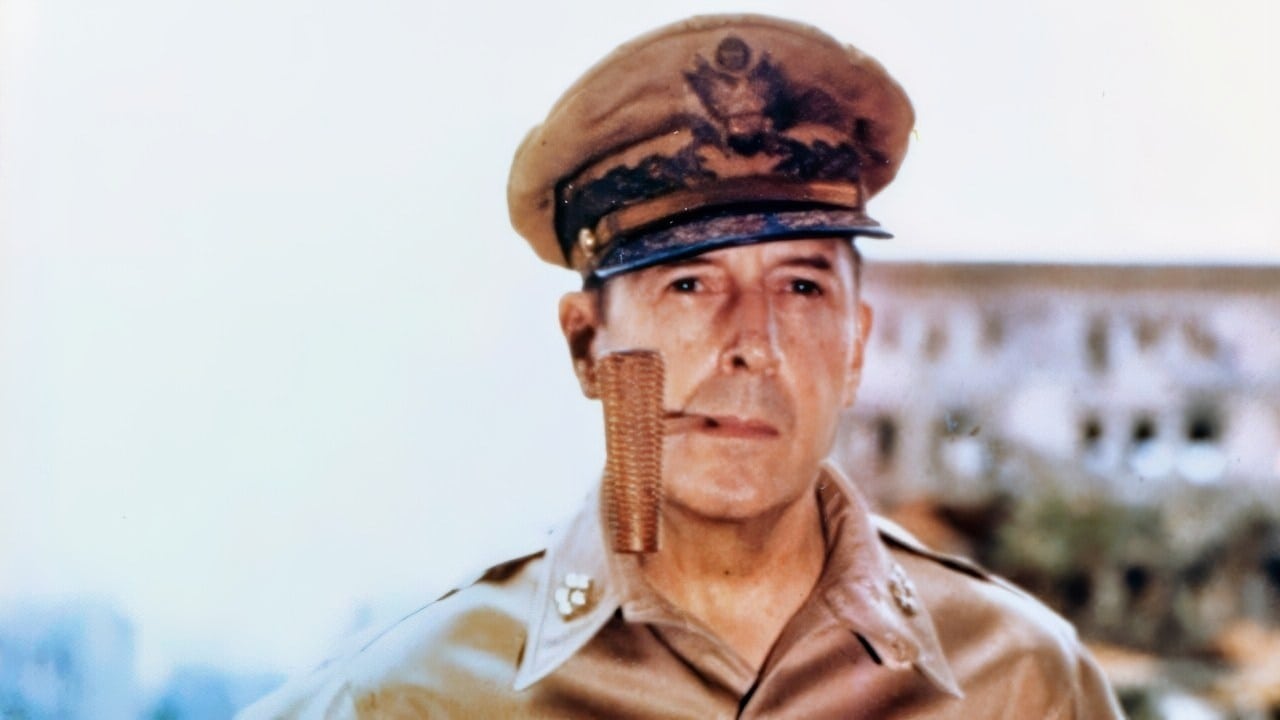
General Douglas MacArthur. Image Credit: Creative Commons.
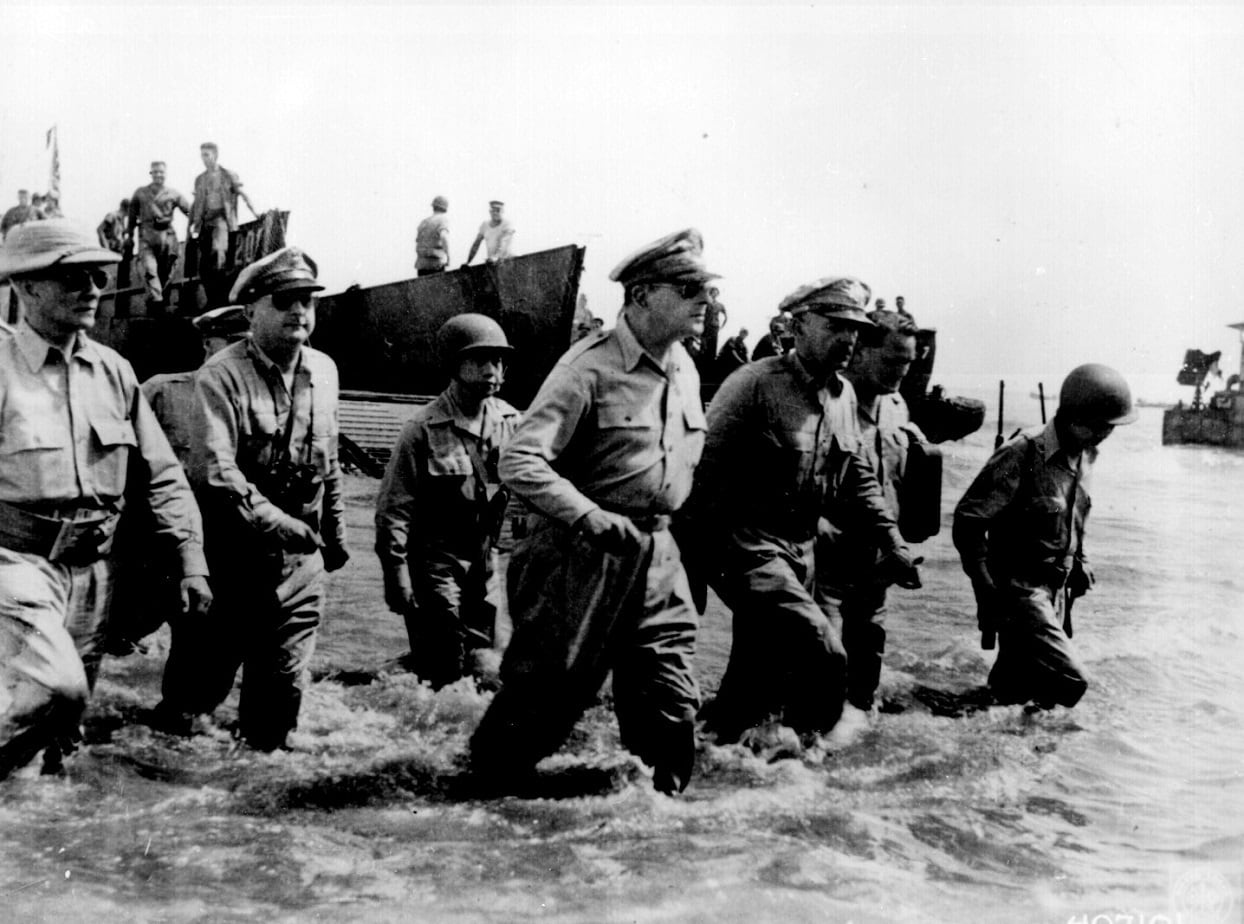
“General Douglas MacArthur wades ashore during initial landings at Leyte, P.I.” October 1944.
He served alongside his father, then a general, on a series of tours throughout Asia.
From 1905 to 1906, MacArthur toured bases in Japan, China, Malaysia, Indonesia, Myanmar, Thailand, Vietnam, India, Pakistan, Afghanistan, and Sri Lanka.
In 1912, his father died, and he returned to Washington, D.C., to care for his mother and serve as a military aide in the White House under President Theodore Roosevelt.
WWI and Interwar Years
When the United States finally entered WWI, MacArthur was a Major.
He assisted with the creation of the 42nd “Rainbow Division” (so named because it was composed of men from over 26 different states).
In 1917, the 42nd Division arrived in France and participated in some of the fiercest fighting American soldiers experienced during the war.
MacArthur performed heroically during that war.
He was injured twice in separate mustard gas attacks and earned two Distinguished Service Crosses, a Distinguished Service Medal, seven Silver Stars, and two Purple Hearts.
WWI was also the first time that MacArthur briefly butted heads with George C. Marshal.
It would not be the last time.
After the First World War, MacArthur was appointed superintendent of West Point.
During his tenure, he implemented several reforms to the Academy’s curriculum, adding courses in the liberal arts, economics, and government.
The academic board strongly resisted many of his reforms, and it initially rejected several.
However, in subsequent years, his policies were gradually re-implemented.
In 1930, President Herbert Hoover appointed him Chief of Staff of the U.S. Army, and he later became involved in the controversial Bonus Army affair, which nearly ended his career, but he weathered the incident with only minimal damage to his public image.
In 1935, he stepped down as Chief of Staff and returned to the Philippines, where he was appointed as Field Marshal of the Philippine Army.
By this point, the clouds of war were once again on the Horizon as Japan prepared to make its move in the Pacific.
MacArthur and the War in the Pacific
Shortly after Japan attacked Pearl Harbor, the Japanese also attacked the Philippines.
In an instance of poor intelligence and poor judgment on MacArthur’s part, Japanese aircraft attacked Clark Field and the fighter base at Iba Field and destroyed the majority of the U.S. air assets in the Philippines.
MacArthur and his troops put up a valiant defense of the Philippines, but they were outmatched and outnumbered by the invading forces.
In February 1942, President Franklin D. Roosevelt ordered him to retreat from the Philippines to Australia.
Upon his arrival in Melbourne, Australia, he declared to the world that he would return to the Philippines.
Although the attack at Pearl Harbor and the fall of the Philippines were a rough start to the war, MacArthur’s confidence and theatrical bravado were instrumental in maintaining morale and turned him into a near-mythical figure at home.
MacArthur would not fulfill his promise for another two years, after a campaign through Guiana and a brutal island-hopping campaign.
However, on October 20, 1944, MacArthur and his forces waded ashore in Leyte in a legendary, though highly staged, entrance.
He had returned.
Despite his confidence, retaking the Philippines proved harder than he first thought, as the number of Japanese defenders was much larger than originally estimated.
By the time the Philippines had been liberated in 1945, Japan’s defeat was all but certain.
MacArthur was planning the invasion of mainland Japan when the U.S.
dropped the atomic bombs on Hiroshima and Nagasaki. He signed the formal Japanese surrender aboard the battleship USS Missouri.
Postwar Years
After the War, MacArthur was appointed as Supreme Commander for the Allied Powers (SCAP) in the Pacific.
During his time as SCAP, he headed the occupation of Japan, reshaping the defeated nation into the modern state that it is today. He also served as commander when the Korean War broke out in 1950.
His tenure was again mired in controversy when he recommended using nuclear weapons against North Korea and China, leading President Harry S. Truman to dismiss him from command.
Although his Army career ended abruptly, MacArthur remained a prominent figure in the American imagination.
Later in life, his health deteriorated before he died of primary biliary cholangitis in 1964 at age 84.
About the Author: Isaac Seitz
Isaac Seitz, a Defense Columnist, graduated from Patrick Henry College’s Strategic Intelligence and National Security program. He has also studied Russian at Middlebury Language Schools and has worked as an intelligence Analyst in the private sector.