
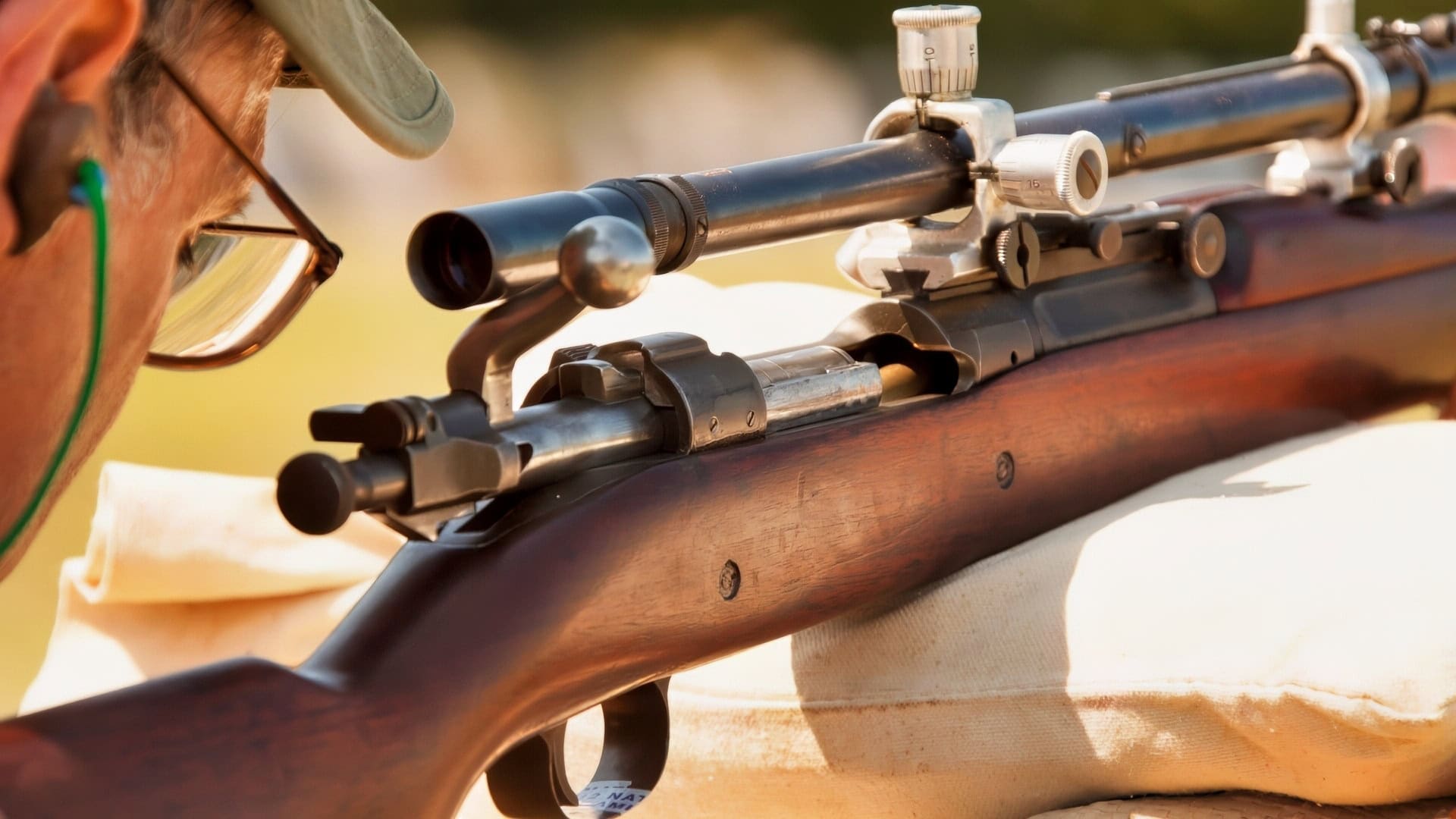
For nearly seven decades, the M1903 Springfield rifle stood as a fixture of American military life, carried by doughboys in the trenches of France, GIs storming beaches in the Pacific, and snipers picking off targets well into the Vietnam era.
Few weapons in U.S. history earned the loyalty and respect that soldiers gave the “Springfield” or, as it was affectionately nicknamed, the “aught-three.” But the story of how this rifle came to be is as much a tale of international patent law as it is of battlefield performance.
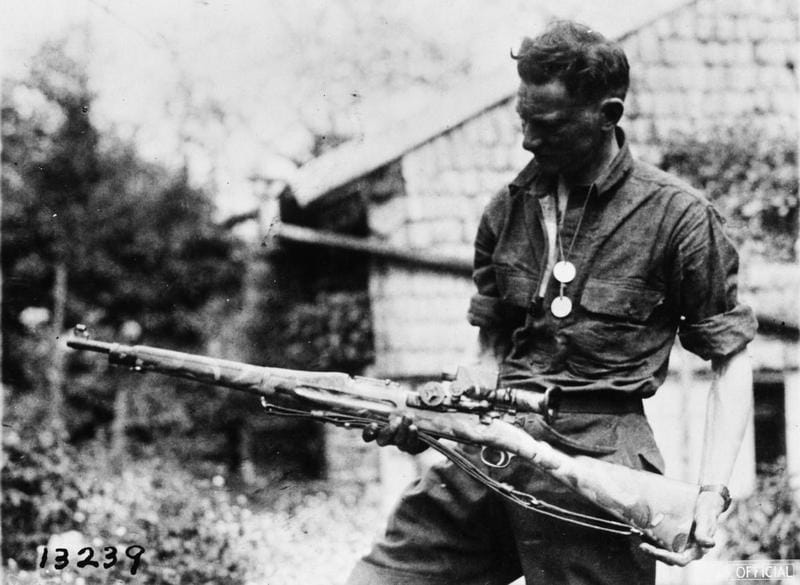
Camouflaged M1903 Springfield sniper’s rifle with Warner & Swasey telescopic sight, in France, May 1918.
Having owned one for a short time, I fired it extensively and found it extremely accurate with standard surplus ammunition, which the doughboys and GIs of WWI and early WWII would have used.
Born From Being Outgunned By The Spanish
The Springfield’s origins trace back to a humiliating lesson learned during the Spanish-American War in 1898.
American troops, armed with the aging Krag-Jorgensen rifle, found themselves outclassed by Spanish forces carrying Mauser Model 1893 rifles.
The Mauser fired a high-velocity, flat-shooting cartridge and could be reloaded instantly using five-round stripper clips.
The American Krag-Jorgensen, with its slow, single-loading side-gate and weaker action, was hopelessly outclassed.
The Mauser made a lasting impression on U.S. Army Ordnance officials, who returned home determined to build something better, and that something looked remarkably like what they had just faced in combat.
Springfield Armory engineers set to work developing a new rifle that draws heavily on Mauser’s design philosophy: a controlled-round-feed bolt action, a robust dual front-locking lug system, and a stripper-clip-fed box magazine.
The result, adopted in 1903 as the United States Rifle, Caliber .30, Model of 1903, was so close to the German design that it created an international incident in the courts.
Paying the Piper Until World War I
The resemblance wasn’t just aesthetic.
When the Mauser company reviewed the new American rifle, it determined that Springfield’s engineers had crossed the line from “inspired by” into outright infringement.
The US Patent Office agreed.
Despite modifications like a two-piece firing pin intended to sidestep the patents, U.S. Ordnance officials ultimately acknowledged that the ’03 violated five separate Mauser rifle patents and two patents covering the stripper clip itself.
Rather than face a drawn-out legal battle, the two governments settled.
Starting in 1904, the United States agreed to pay Mauser 75 cents per rifle and 50 cents per thousand clips, continuing until it reached a cap of $200,000, a deal finalized by 1909. Once the US entered WWI, all payments ceased.
However, a separate German firm later filed suit over the pointed “spitzer” bullet design used in the improved .30-06 cartridge; that claim, initially dismissed, was revived after World War I and resulted in a 1920 judgment costing the U.S. government more than $400,000.
All told, Washington paid out well over half a million dollars to German patent holders for the privilege of arming its own soldiers.
An American Cousin, Not a Kar98k Copy
A common misconception is that the M1903 was a copy of the Karabiner 98k, the shortened carbine that became the German Wehrmacht’s standard rifle in World War II.
That’s a matter of timing: the Kar98k wasn’t adopted until 1935, more than three decades after the Springfield entered production.
However, the relationship runs the other way: both rifles share a common ancestor in the Mauser Gewehr 98 and the earlier Model 1893, meaning the Springfield and the Kar98K are better described as parallel weapons descended from the same German bloodline rather than one copying the other.
As I’ve written before, my Dad brought a 98K back from WWII.
With that in my possession, and given the similarities to the 03 Springfield, I took them both out to a medium-to-long-distance range to try them against one another.
Using standard surplus ammunition, the recoil between the .30-06 caliber and the 7.92mm Mauser was very similar, nearly identical.
Accuracy was also extremely close, with perhaps the ‘03 getting a razor-thin edge, due to its sights and trigger pull, which IMO were slightly better.
Both have that ultra-smooth, like-butta, Mauser action.
I still have the 98K, for sentimental reasons, and the two weapons were so close that it didn’t make sense to keep both.
The American Troops Loved It
Despite its legally sketchy birth, the M1903 earned its reputation the hard way, through performance.
Its Mauser-derived action was renowned for smoothness and reliability, cycling cleanly even when fouled with mud or sand.
The rifle was exceptionally accurate for its era, with a flat-shooting .30-06 cartridge that gave it range and stopping power.
Soldiers trusted it in the trenches of World War I, where its accuracy made it a favorite for designated marksmen, and legendary shooters such as SGT Alvin York used it to devastating effect.
Even after the semi-automatic M1 Garand replaced it as the standard-issue infantry rifle in the late 1930s, the M1903 refused to fade away.
Its inherent accuracy made it the natural choice for a dedicated sniper variant, the M1903A4, which saw extensive use in World War II.
An Excellent If Complicated Legacy
The M1903 Springfield is a rifle whose story defies simple narratives.
It was, by any honest account, a rifle built by borrowing, without permission, from a foreign design.
Yet American engineers refined it, American factories produced it by the millions, and American soldiers carried it through nearly every major conflict of the first half of the twentieth century.
Whatever royalties Washington paid to Mauser, the Springfield paid for itself many times over in the confidence it gave the men who carried it.
About the Author: Steve Balestrieri
Steve Balestrieri is a National Security Columnist. He served as a US Army Special Forces NCO and Warrant Officer. In addition to writing on defense, he covers the NFL for PatsFans.com and is a member of the Pro Football Writers of America (PFWA). His work was regularly featured in many military publications.