
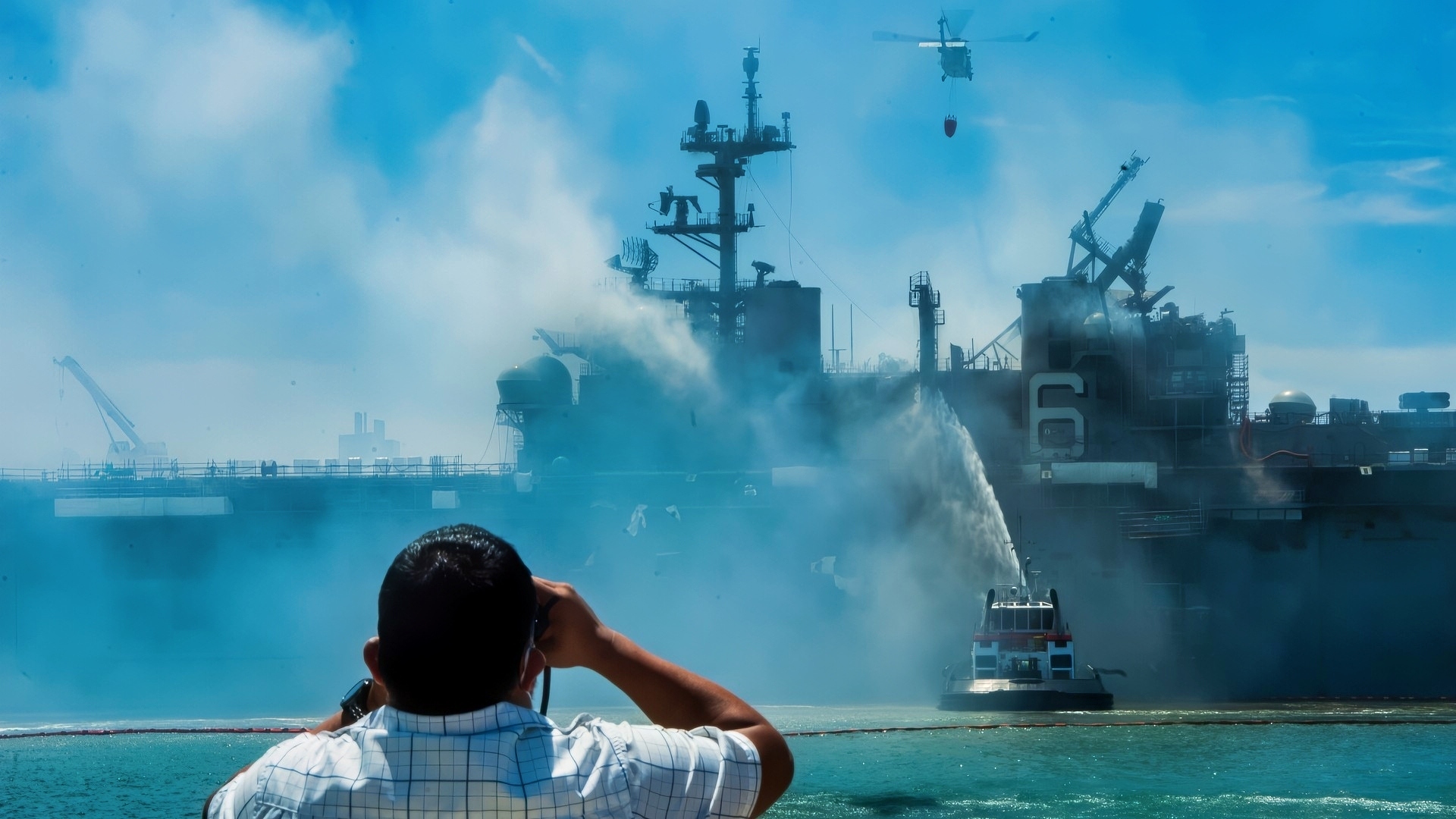
USS Bonhomme Richard burned at a pier in San Diego from July 12 to July 16, 2020. The Navy later said fixing the Wasp-class amphibious ship could cost as much as $3.2 billion and take five to seven years. It sold the remaining hull to a Texas shipbreaker for $3.66 million. An August 2026 investigation into an 11-hour fire on USS New Orleans said the crew’s response drew on lessons from that incident.
USS Bonhomme Richard: How a US Navy Warship Burned At the Pier
In August 2026, a Navy investigation released findings on an 11-hour fire aboard USS New Orleans. The crew ultimately put it out, and the ship returned to service, with investigators saying that the crew’s response benefited from lessons learned after the fire that destroyed a different amphibious ship six years earlier: USS Bonhomme Richard.
The Bonhomme Richard fire began when the ship was tied to a pier in San Diego.
It burned for more than four days in July 2020, and the Navy later estimated repairs could cost as much as $3.2 billion.
Instead, workers removed equipment that could be used elsewhere, and a Texas company bought the remaining hull for $3.66 million and scraped it.
A Warship for the Marines
The Bonhomme Richard was commissioned in 1998. It was a Wasp-class amphibious assault ship with a broad flight deck capable of accommodating helicopters and various other aircraft. Its interior spaces were designed for Marines, vehicles, and other equipment.
Landing craft could take troops and supplies from the ship to the shore, and at around 40,000 tons, it was a major warship – even if its role was different from that of a conventional aircraft carrier.
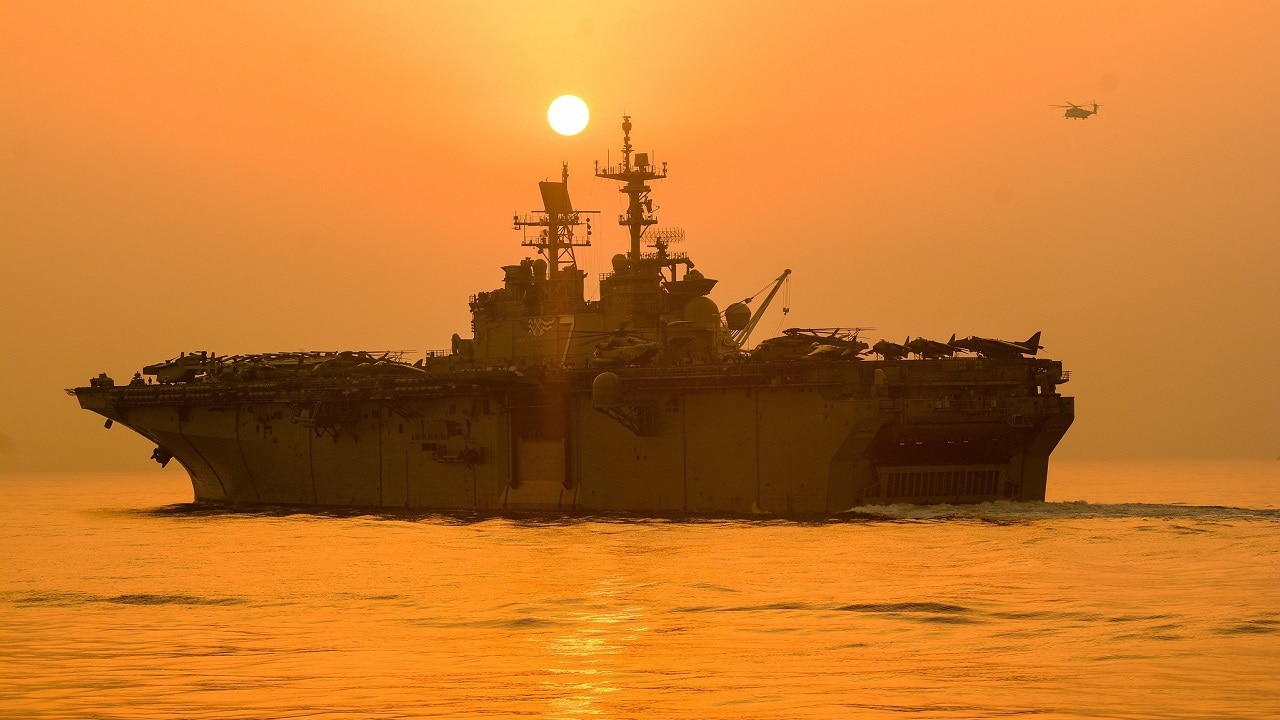
(Aug. 4, 2021) The Wasp-class amphibious assault ship USS Iwo Jima (LHD 7) transits the Strait of Hormuz, Aug. 4, 2021. Iwo Jima is deployed to the U.S. 5th Fleet area of operations to ensure maritime stability and security in the Central Region, connecting the Mediterranean and the Pacific through the western Indian Ocean and three strategic choke points. (U.S. Navy photo by Seaman Logan Kaczmarek)
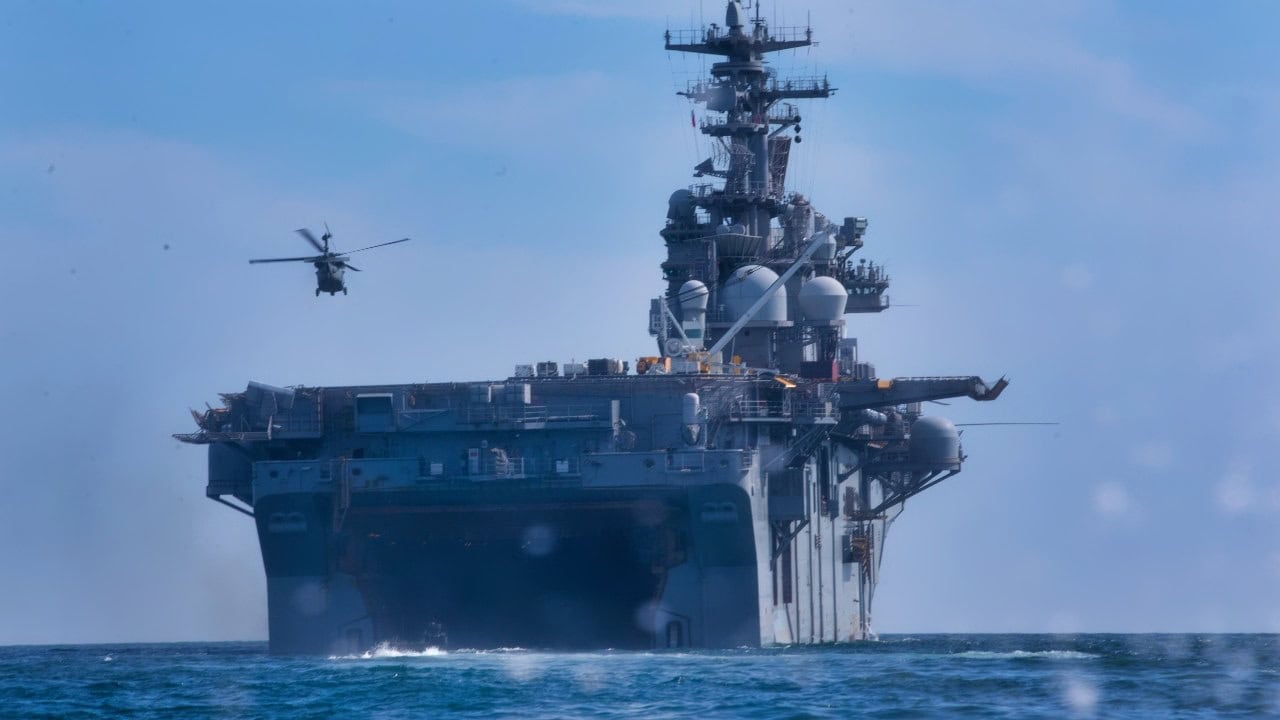
U.S. Marines with Bravo Company, 2d Assault Amphibious Battalion, 2d Marine Division approach the USS Wasp (LHD 1) in assault amphibious vehicles off of Onslow Beach during a three-day ship-to-shore exercise on Camp Lejeune, N.C., June 27, 2020. During the exercise, the Marines conducted amphibious maneuvers and dynamic ship-to-shore operations with the USS Wasp (LHD 1). (U.S. Marine Corps photo by Lance Cpl. Jacqueline Parsons)
In the 1990s, the ship cost roughly $750 million to build — and by 2020, it had served for 22 years and was undergoing an overhaul that cost around $250 million.
The work was intended to keep the ship in service, but during the maintenance period at the pier, a fire broke out below the decks.
The Fire
The fire started on the morning of July 12, 2020, in a lower vehicle storage area while the ship was docked at Naval Base San Diego.
Smoke quickly spread throughout the ship, and firefighters struggled to find the source for some time.
A combination of local firefighters and sailors, along with crew members from other Navy ships, worked together to mitigate the damage and stop the spread of the fire as helicopters and fireboats poured water over the burning vessel.
But the process took days.
The fire continued into July 16, and by the time crews extinguished it fully, the flames and heat had reached large parts of the ship and caused substantial damage — and it all came from a small fire that began in a compartment below decks.
The fire was so big, too, that it could be seen from across San Diego.
The Navy was now tasked with figuring out how the fire had spread so far and whether anything was left worth repairing.
The Fire Was A Disaster
The subsequent investigation determined that multiple failures in fire prevention and training, in the equipment used, and in the response itself contributed to the blaze becoming so large.
The ship was already in a lengthy maintenance period when the fire began, when the ordinary routines and systems that keep the ship functioning had been disrupted.
The investigation noted that the response was not quick enough and did not bring the fire under control while it was still small; afterward, the Navy conducted a broader review of major shipboard fires following the loss of Bonhomme Richard.
The investigation even determined that the fire may have been caused by a sailor, who was later charged with igniting it; however, a military judge acquitted him in 2022.
Billions In Repairs
After the wreck was inspected, the Navy concluded that it was simply too costly to repair and restore Bonhomme Richard — and even if it wasn’t, it would still take five to seven years to complete the work.
With a $3 billion price tag, it didn’t make sense to move forward with repairs.
At one point, they even considered rebuilding it for a different role, but the price tag was still too high, and in November 2020, the Navy decided to decommission the ship.
But that didn’t mean the whole ship was worthless. In fact, there was an enormous amount of material onboard the ship that could be repurposed—but not necessarily for the military.
The Navy planned to remove all usable systems for other ships, but the rest of the fire-damaged hull was effectively useless. Instead, it was sold.
The Last Voyage
In April 2021, Bonhomme Richard was officially decommissioned and towed from San Diego to a shipbreaking yard in Brownsville, Texas.
To prepare the ship for the voyage, workers removed parts of its upper structure so the hull could pass through the Panama Canal.
International Shipbreaking took possession of the remains for $3.66 million, selling any valuable materials it found on board to private industry and other customers.
About the Author: Jack Buckby
Jack Buckby is a British researcher and analyst specializing in defense and national security, based in New York. His work focuses on military capability, procurement, and strategic competition, producing and editing analysis for policy and defense audiences. He brings extensive editorial experience, with a career output spanning over 1,000 articles at 19FortyFive and National Security Journal, and has previously authored books and papers on extremism and deradicalization.