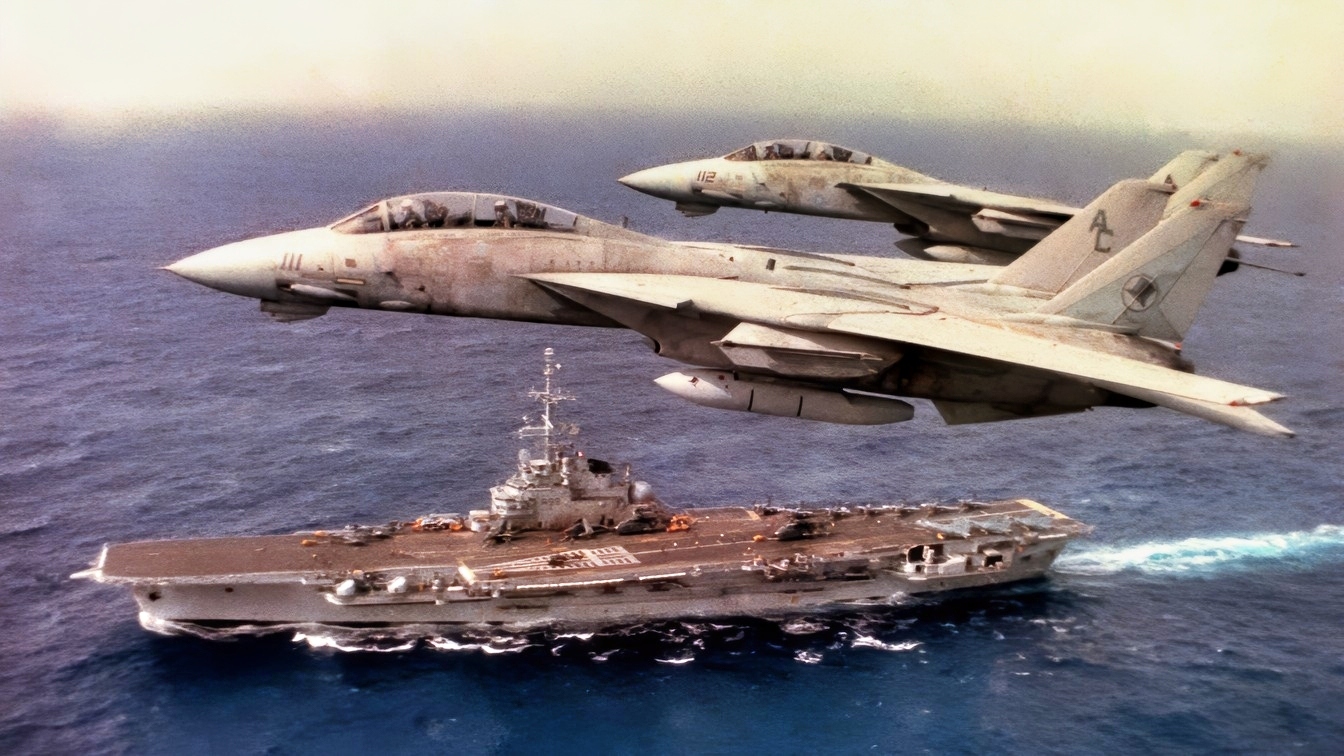
A missile capable of hitting targets more than 100 miles away was carried by the U.S. Navy’s F-14 Tomcat. Back on January 5, 1999, two of these jets had the opportunity to fire these weapons in combat. However, neither of the AIM-54 Phoenix missiles hit its target. Separately, an Iraqi MiG-23 fighter jet crashed when it ran out of fuel during the same period of heightened tensions over southern Iraq.
Iraqi Jets Violate No-Fly Zone: MiG-23 vs. F-14 Tomcat
As noted by Aviation Geek Club a few weeks back, the confrontation happened during Operation Southern Watch, the U.S. effort to enforce a no-fly zone over southern Iraq from August 1992 all the way until the U.S. invasion of Iraq in March 2003.
Following December 1998’s Operation Desert Fox, tensions had spiraled. The State Department described the no-fly zones on January 5 as a “necessary and important means to contain Saddam Hussein,” while White House spokesman Joe Lockhart said the United States would “continue to enforce the no-fly zones.”
The campaign involved joint strikes launched by the U.S. and the United Kingdom, following Iraq’s interference with United Nations inspectors that sought to investigate multiple sites for potential weapons of mass destruction.
U.S. Jets Miss Targets
Two different aerial confrontations transpired that same morning.
At around 10:15 a.m. in Iraq, a pair of MiG-25s targeted two Air Force F-15s with radar.
According to the Washington Post account published at the time, the Eagles fired a single AIM-7 Sparrow and a trio of AIM-120 AMRAAMs.
All four missed as the Iraqi aircraft “turned sharply and beat a hasty retreat.”
The Air Force F-15s flew from Prince Sultan Air Base in Saudi Arabia, while the Navy F-14s launched from USS Carl Vinson in the Persian Gulf.
About 15 minutes in, two more MiG-25s entered the no-fly zone to the south.
Two Navy F-14s operating from USS Carl Vinson fired two AIM-54 Phoenix missiles at them.
The Defense Department reported that the F-14 crews sighted Iraqi aircraft within the boundary and fired two Phoenix missiles.
The Iraqi jets managed to fly away without being downed.
One U.S. official said that the Iraqi conduct was “fairly aggressive… more aggressive than what we’ve seen before.”
The Phoenix at War
NAVAIR describes the Phoenix as the Navy’s “only long-range air-to-air missile” and gives it a range “in excess of 100 nautical miles.” It could also support near-simultaneous attacks against up to six targets.
The F-14D was an “advanced interceptor and air superiority fighter,” according to the National Naval Aviation Museum, and its AN/APG-71 weapons system enabled it to engage multiple aircraft with the Phoenix missile.

MiG-23. Image Credit: Creative Commons.

MiG-23. Image Credit: Creative Commons.

MiG-23. Image Credit: Creative Commons.
Not all of the documentation is firm on these matters. Contemporary Pentagon reporting established that both missed.
However, officials first said they were unsure why the American missiles used that day did not hit their targets.
Retired F-14 radar intercept officer Dave “Bio” Baranek later offered a more specific explanation. Recalling the Navy’s combat use of the Phoenix, he said that during the January engagement “the rocket motors failed and the missiles fell to earth,” although he noted that other sources described the incident differently.
Baranek called the absence of a U.S. Phoenix combat kill “one of the disappointments of my life.”
What About the MiG-23?
The Mikoyan-Gurevich MiG-23 jets, nicknamed “Flogger” by NATO, were designed by the Soviet Union in the 1960s. Baghdad purchased the jets from Moscow in the mid-1970s, shortly after the 1973 Yom Kippur War.
The Washington Post, citing Pentagon officials the following day, reported that an Iraqi MiG-23 had crashed after running out of fuel but described the loss as “apparently unrelated” to the aerial engagements. A senior Pentagon official similarly said that “most indications are against us having shot it down.”
Central Command chief Gen. Anthony Zinni later joked that the Iraqi pilot had probably been “pressing that MiG-23 pedal to the metal” so hard that he missed his fuel level.

F-14 Tomcat at Aviation Museum of Kentucky. Taken on March 1, 2026. By Christian D. Orr.

F-14 Tomcat Fighter In a Museum Hanger

National Naval Aviation Museum F-14. Image Credit: Creative Commons.
Zinni framed the Iraqi tactics during this episode as an attempt to “cheat and retreat.”
A U.S. fighter was therefore not credited with destroying the MiG-23.
The Phoenix was retired from U.S. Navy service back in 2004, while the Tomcat formally left service in 2006, following more than 30 years of service.
About the Author: Georgia Gilholy
Georgia Gilholy is a journalist based in the United Kingdom who has been published in Newsweek, The Times of Israel, and the Spectator. Gilholy writes about international politics, culture, and education.