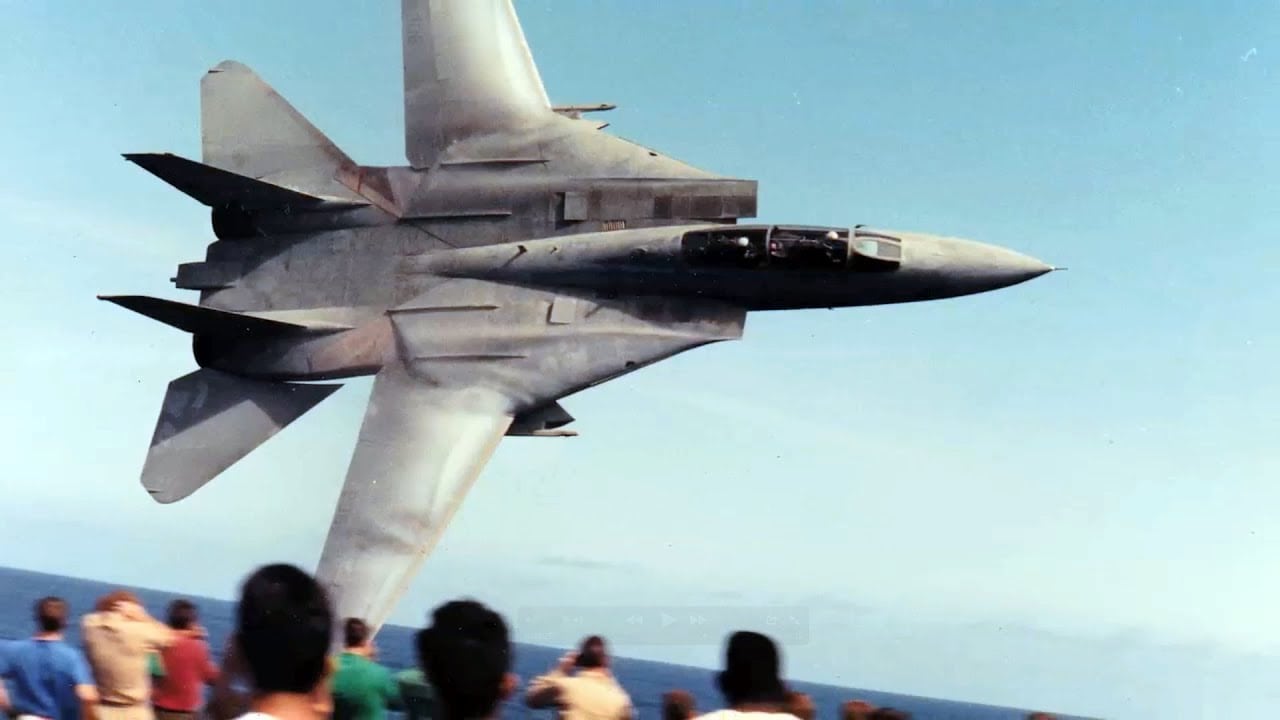
In the early 1990s, after the collapse of the Soviet Union and the end of Cold War-era hostilities, the United States Navy was eager to extend the service life of one of its workhorses: the F-14 Tomcat.
One proposal from Grumman, the defense firm that designed and built the versatile fighter, called for several upgrades and modifications to the fighter, provisionally called the ST-21, or Super Tomcat for the 21st century.
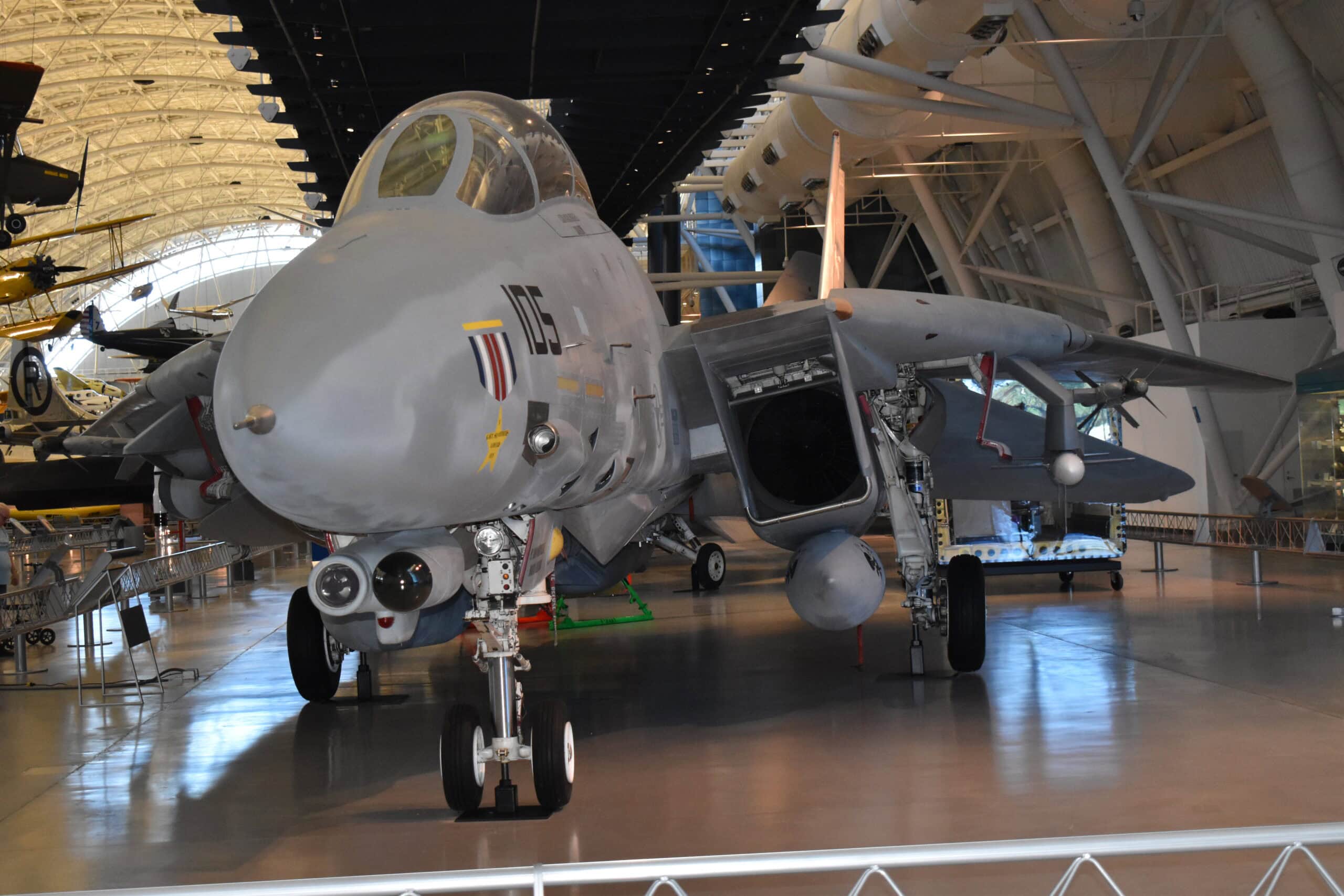
F-14 Tomcat at the Smithsonian. 19FortyFive.com original photo.
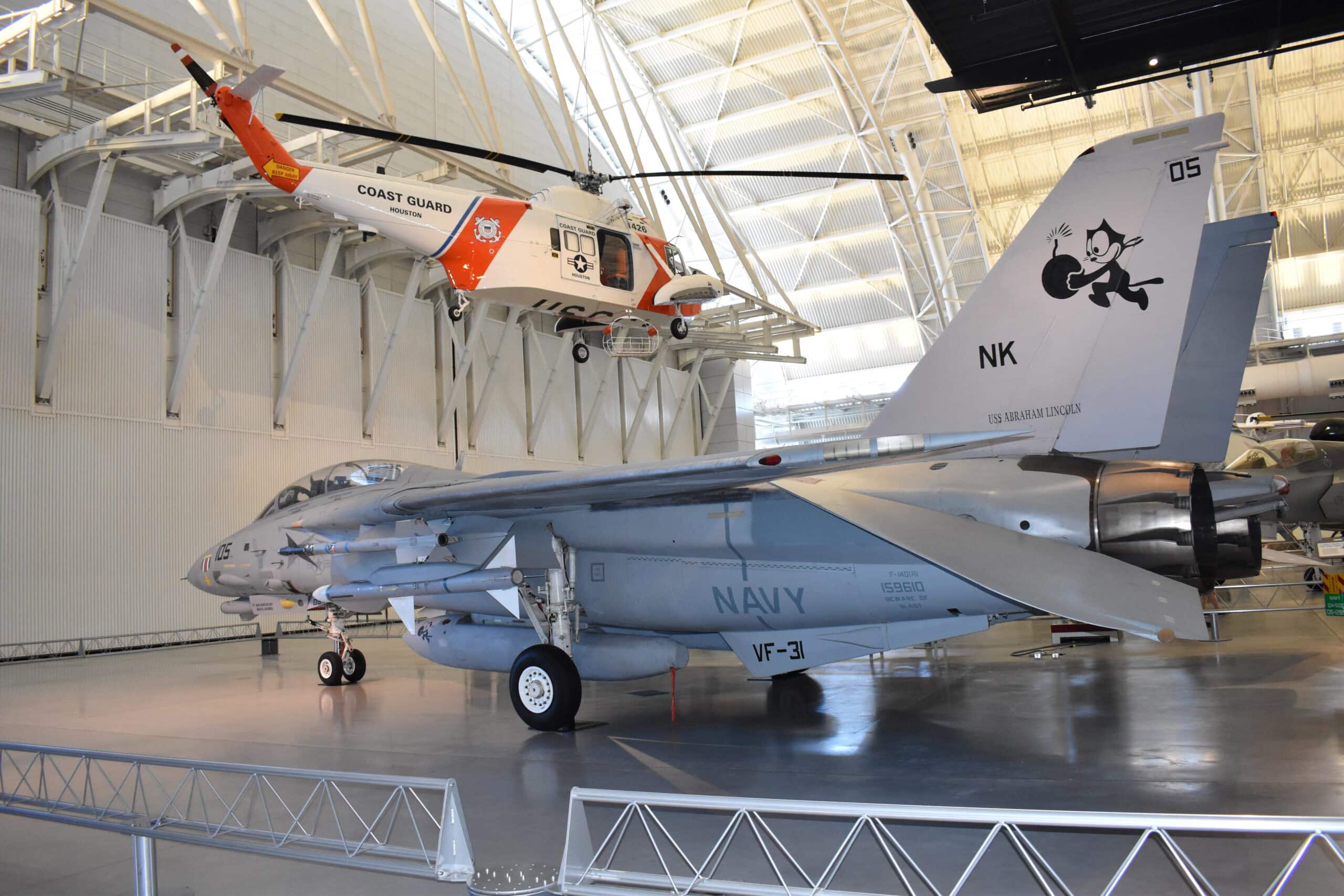
F-14 Tomcat at the Smithsonian. Image Credit: 19FortyFive.com
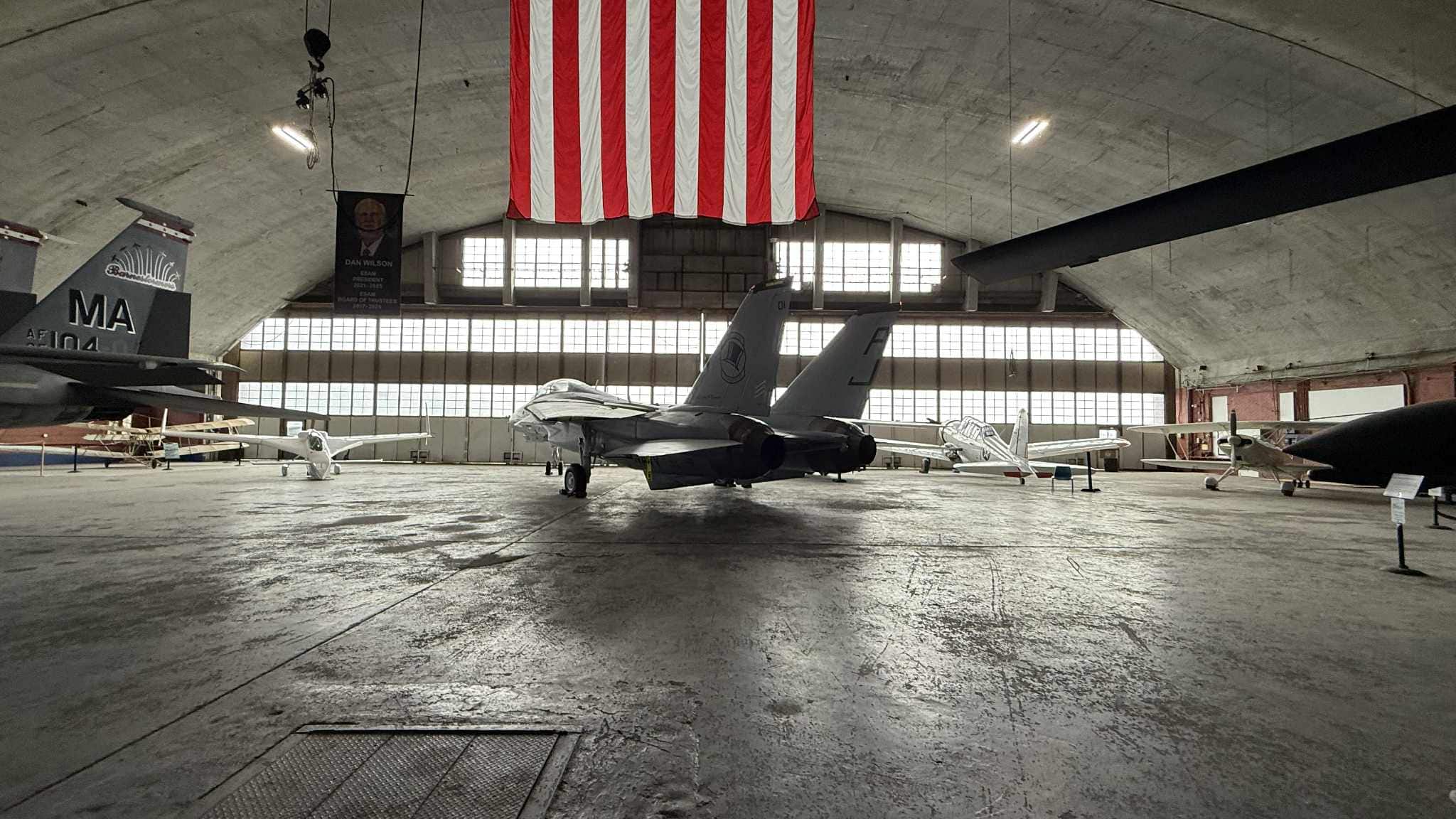
F-14 Tomcat. Image Credit: 19FortyFive.com
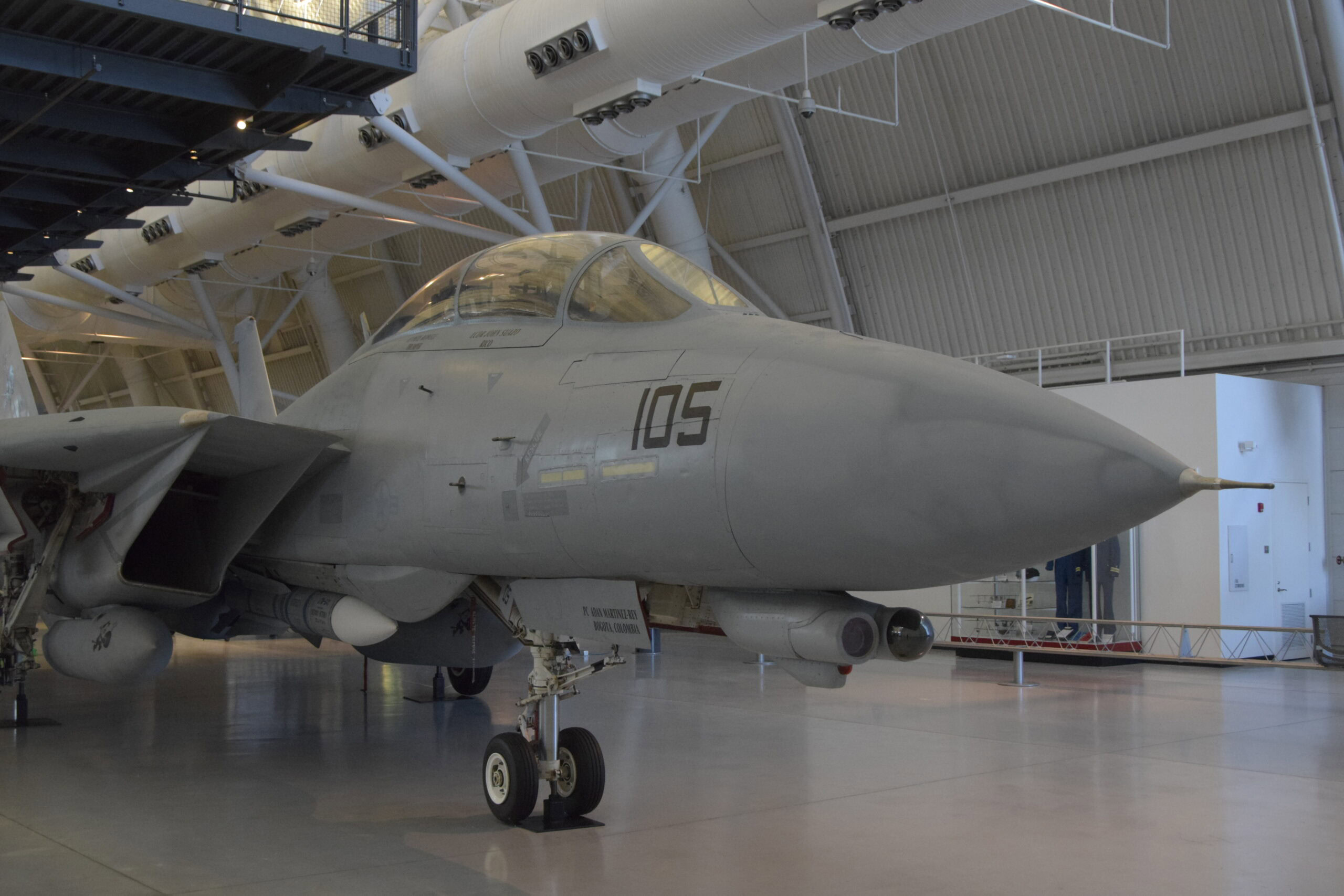
F-14 Tomcat at the Smithsonian. Image Credit: 19FortyFive.com
Despite its designation and name, the ST-21 was only a hypothetical aircraft.
Grumman never built even pre-production prototypes, let alone a final Super Tomcat fighter.
What is known about the modified F-14 Tomcat comes from a few rough schematics and a small-scale model — but even the very initial engineering work never began.
The Super Tomcat
By far one of the biggest improvements to the U.S. Navy’s large fighter would have been re-engining the fighter and mating General Electric’s F110-GE-429 turbofan engines to the Tomcat airframe.
Found in some F-16s and F-15s, GE’s engine would have allowed the Super Tomcat to supercruise without using the fuel-inefficient afterburner.
In addition, modifications to Tomcat’s leading edges would have given the fighter about 4,400 pounds more fuel.
Grumman proposed several other modifications to the Tomcat to keep it combat-relevant in the post-Cold War era.
One of these would have seen a more powerful radar integrated into the jet, as well as digital cockpit controls in place of the fighter’s original analog suite.
Taken together, the raft of improvements and capability augmentations would certainly have significantly boosted the baseline Tomcat’s performance, particularly in terms of range and engagement ranges.
But it was never to be realized.
Changing Times, Changing Priorities
Remarkable though Grumman’s proposed Super Tomcat was, there were a number of roadblocks to its realization that would ultimately prove insurmountable. One of the fighter’s most significant obstacles was money.
Unlike the previous Tomcat A, B, and C variants, the ST-21 would have been the most ambitious Tomcat variant, and less an iterative improvement than a vastly modified aircraft.
Capable though it would have been, it would have also been an expensive project to realize.
One of the F-14’s complexities was its logistics train. Thanks in part to the Tomcat’s variable-sweep wings, the fighter needed a particularly robust airframe, both of which required regular maintenance and support attention.
The proposed design update would not necessarily have reduced this burden.
And at a time when the Cold War was over, and the United States faced no real challengers, an expensive upgrade program for an incremental increase in capabilities was not a particularly compelling argument for the United States Navy to pursue and pitch to a Congress keen to save on defense costs where possible.
But by the 1990s, the world had changed drastically from the one the F-14 Tomcat was born into in the late 1960s.
Platforms were increasingly designed using digital methods, and modularity was gaining traction, promising gains through open, modifiable systems architecture and reduced lifecycle costs.
Higher performance aircraft were becoming the norm, and early iterations of stealth aircraft were on the horizon.
Timing was bad for a proposed Super Tomcat — there was simply little interest, and even fewer dollars available, to squeeze a bit more performance out of an aircraft that was around a quarter of a century old.
In tandem with declining defense budgets and the rise of stealthy aircraft, the advent of a new, from-scratch naval fighter preempted ST-21’s future: the F/A-18 Hornet.
By starting with a clean-sheet naval fighter, the U.S. Navy could sidestep an upgraded Tomcat that was nevertheless nearing the end of its upgrade cycle.
With the F/A-18, the Navy had a new fighter that could more easily implement and integrate future technologies than one whose genesis was in the Vietnam era.
Flying into the Future
Grumman’s proposed ST-21 would undoubtedly have been a remarkable fighter, but the U.S. Navy would not have relied on it for long.
Following the advent of the F-22 Raptor, thanks to the U.S. Air Force’s Advanced Tactical Fighter program, as well as the later Joint Strike Fighter, which ultimately yielded the F-35, another stealth fighter, a definitive shift came to the United States military — one that has slowly been realized by a handful of other nations around the world today: radar-evading fifth-generation aircraft.
As that technology has proliferated worldwide, it is now apparent that even an ST-21 would have been at a distinct disadvantage in today’s threat environment and unable to evade adversary radar.
The fighter, though certainly superior to its predecessors, would have taken valuable defense dollars from today’s crop of stealth aircraft that followed it.
Hindsight is 20-20, but it was ultimately best for that aircraft to remain proposed rather than enter service.
About the Author: Caleb Larson
Caleb Larson is an American multiformat journalist based in Berlin, Germany. His work covers the intersection of conflict and society, focusing on American foreign policy and European security. He has reported from Germany, Russia, and the United States. Most recently, he covered the war in Ukraine, reporting extensively on the war’s shifting battle lines from Donbas and writing on the war’s civilian and humanitarian toll. Previously, he worked as a Defense Reporter for POLITICO Europe. You can follow his latest work on X.