
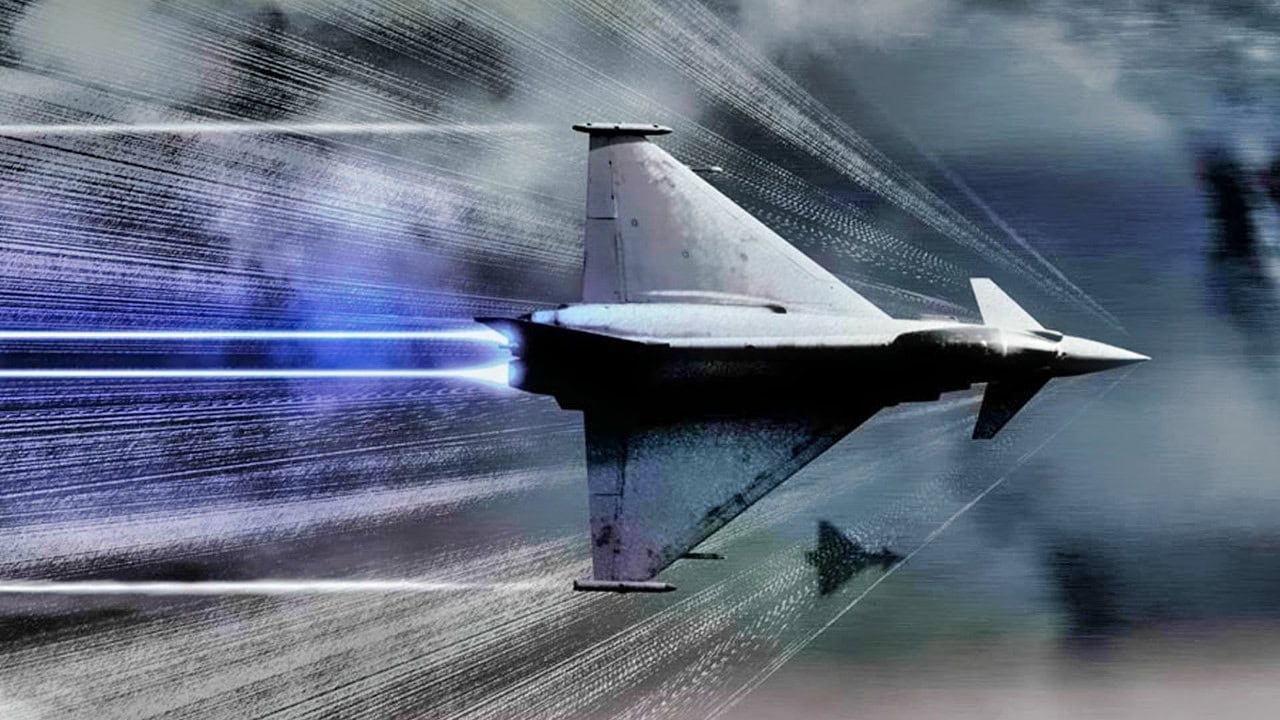
Summary and Key Points: The Eurofighter Typhoon was designed in the 1980s as a Cold War interceptor and first flew in 1994, years before stealth became the price of admission to modern air combat. It cannot be made stealthy — the canard-delta layout and external weapons stations rule it out permanently. More than 700 have been built, and it is still in production and still winning export orders, which raises an obvious question about how a non-stealthy fighter stays relevant against F-22s, F-35s, J-20s and Su-57s.
The Eurofighter Typhoon: No Stealth, No Problem
The Eurofighter Typhoon is a very successful fourth-generation multirole aircraft designed and produced by a consortium comprising Airbus, BAE Systems, and Leonardo.
The Eurofighter Typhoon was designed in the 1980s as a Cold War air-superiority interceptor, long before “stealth” became the price of admission to modern air combat.
Thirty-plus years later, with F-22s, F-35s, J-20s, and Su-57s filling the skies, the Typhoon is still in production and still winning export deals.
It survives not by hiding from radar, but by out-sensing, out-jamming, and out-shooting anything that can see it, an approach its operators now informally brand as the “Super Typhoon.”
The Typhoon’s first flight was back in 1994.
Since then, Austria, Germany, Italy, Kuwait, Oman, Saudi Arabia, Spain, the UK, and Qatar have produced and operate over 700 Typhoons. The aircraft’s popularity stems from its speed, range, and maneuverability.
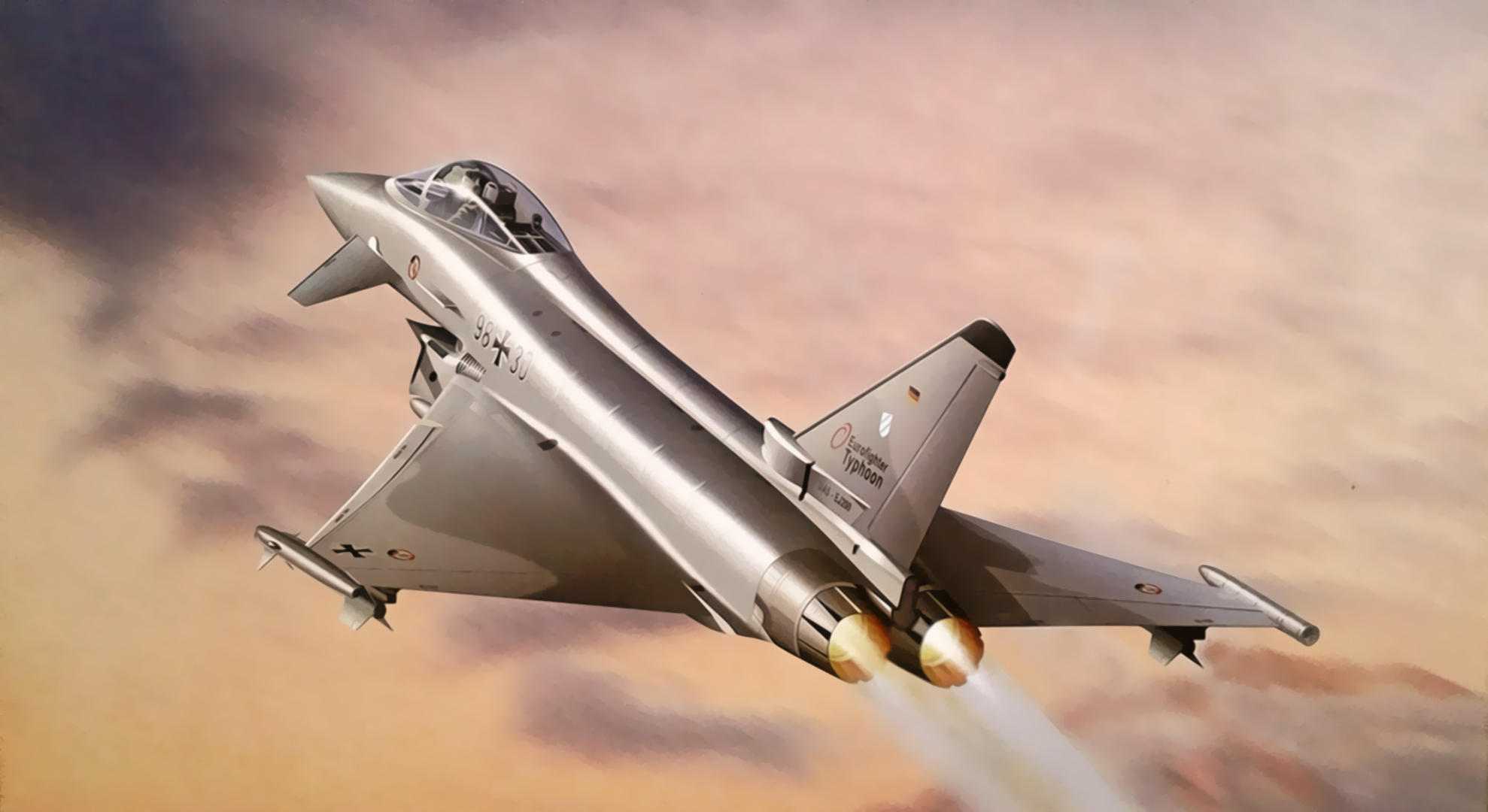
Eurofighter Typhoon. Image Credit: Creative Commons.
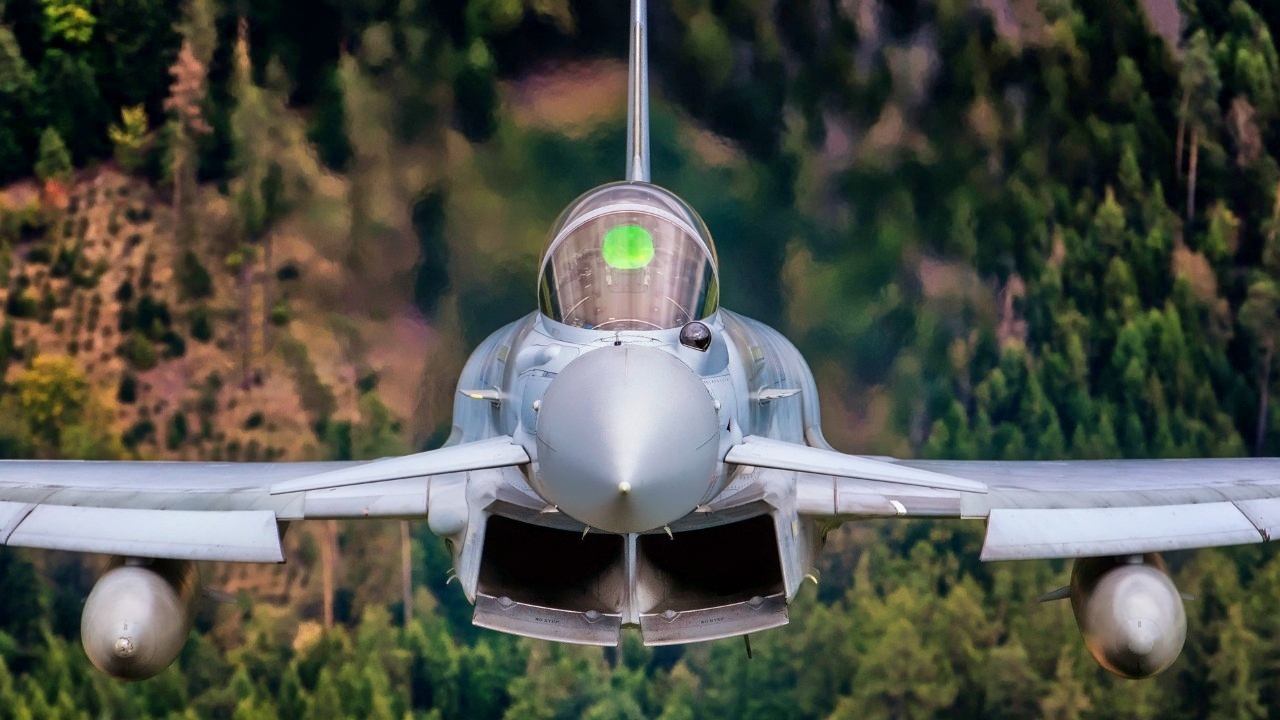
Eurofighter Typhoon. Image Credit: Creative Commons.
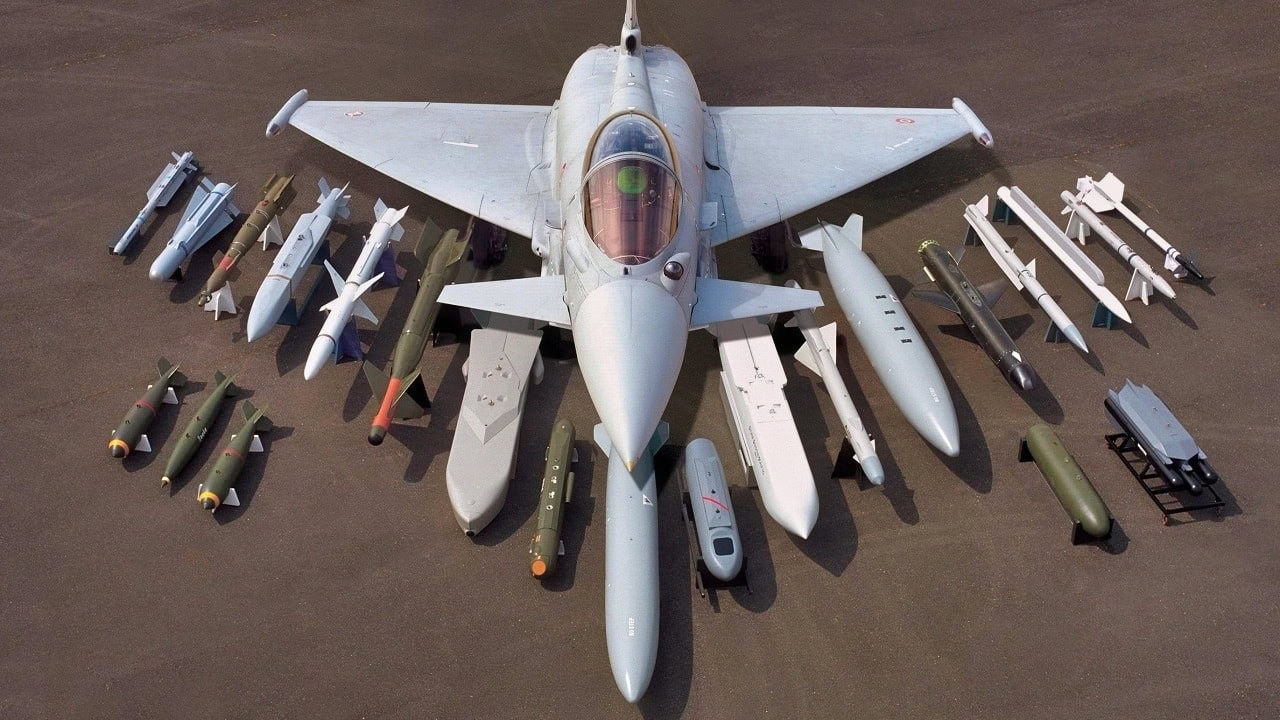
Eurofighter Typhoon. Image Credit: Creative Commons.
The Typhoon is widely considered one of the top-performing “4.5 generation” non-stealth fighters in the world, ranked alongside the Dassault Rafale, the Saab JAS-39 Gripen, and other aircraft as a superior 4th-generation jet in air-to-air combat, speed, and maneuverability.
It is a premier European air superiority fighter, excelling in dogfights and beyond-visual-range (BVR) combat situations.
The Radar Is the Whole Story: ECRS Mk2
The single biggest upgrade driving the Typhoon’s relevance is the European Common Radar System Mark 2 (ECRS Mk2), a next-generation AESA radar built by Leonardo UK and integrated by BAE Systems.
It replaces the Typhoon’s mechanically scanned Captor-M radar with a wide-angle, gallium-nitride (GaN) electronically scanned array that does far more than search and track.
The ECRS Mk2 folds radar, electronic warfare, and jamming into a single system with a roughly 200-degree field of regard, well beyond the fixed cone of a traditional nose-mounted radar.
Because it uses GaN transmit/receive modules rather than older gallium arsenide technology, it delivers higher power density and better thermal performance, enabling it to simultaneously track multiple air and surface targets while actively jamming enemy sensors.
That combination effectively hands the Typhoon a Suppression of Enemy Air Defenses (SEAD) role it never had before, letting it kick down radar “doors” so stealthier or less-defended aircraft can follow through.
The radar finished its first UK test flight at BAE’s Warton facility in late 2024, and in January 2026 the UK government signed off on a £453.5 million full-rate production contract for 40 units destined for RAF Tranche 3 jets, on top of an earlier £2.35 billion UK technology investment in Typhoon capability.
Some estimates put the total cost of the ECRS Mk2 program at nearly $1 billion.
The “Super Typhoon” Package
While the ECRS Mk2 gets the headlines, the Eurofighter’s modernization is really several parallel programs bundled loosely under the “Super Typhoon” nickname, a label the manufacturer itself hasn’t officially adopted:
-Phase 4 Enhancement (P4E): adds automated sensor management, an updated cockpit interface, new radio-frequency interoperability, and defensive-suite upgrades, targeted for around 2028.
-Meteor missile integration: the ramjet-powered, “no-escape-zone” long-range air-to-air missile gives the Typhoon a reach that rivals or exceeds that of many stealth-fighter loadouts.
-Defensive Aids Sub-System (DASS) updates: improved radar warning, jamming, and countermeasure suites meant to offset the lack of a low-observable airframe.
-Avionics and computing overhaul: reports describe roughly a 200-fold jump in avionics processing power compared with early Typhoon builds.
-Engine and aerodynamic modification work: incremental thrust and handling improvements aimed at extending the airframe’s competitive life into the 2040s.
The strategic goal isn’t to out-stealth the F-35. It’s to serve alongside the Lightning II as a bridge, a highly capable 4.5-generation “electromagnetic warfare node,” until Europe’s sixth-generation programs, the UK/Italy/Japan-led GCAP and whatever replaces the France/Germany/Spain FCAS, mature.
Aviation analysts frequently compare the upgraded Typhoon’s role to that of the American F-15EX: not stealthy, but a powerful sensor, jamming, and missile-truck platform that can operate alongside stealth aircraft rather than replace them.
What Does It All Cost, And How Does That Compare?
Typhoon pricing varies widely by tranche, country, and included equipment, but rough figures give a workable picture:
-Eurofighter Typhoon: unit “flyaway” costs are typically cited at around $80–120 million, depending on configuration and buyer, with a Spanish 2022 order pricing new jets at about €62.9 million (about $68 million) apiece before extras; total program development costs have run into the tens of billions of pounds.
-Operating costs are estimated around £50,000–£100,000 (roughly $65,000–$130,000) per flight hour, and the UK’s National Audit Office has previously flagged Typhoon sustainment costs as higher than expected. That is about 20-30 percent higher than an F-35.
-F-35A (Lockheed Martin): unit cost is generally quoted in the $80–95 million range, depending on lot and variant (A/B/C), making it broadly comparable to, or cheaper than, a fully equipped Typhoon on a per-airframe basis. Its flight-hour cost runs around $42,000, with the Pentagon pushing to get it under $30,000.
-F-22 Raptor (Lockheed Martin): out of production since 2011, with a total program unit cost (including R&D) often cited near $350 million per aircraft, though flyaway cost alone was closer to $150 million. It remains the most expensive to fly, at roughly $68,000 per flight hour.
A modernized Typhoon can cost about the same to buy as an F-35A and considerably less than an F-22, while lacking either jet’s low-observable airframe.
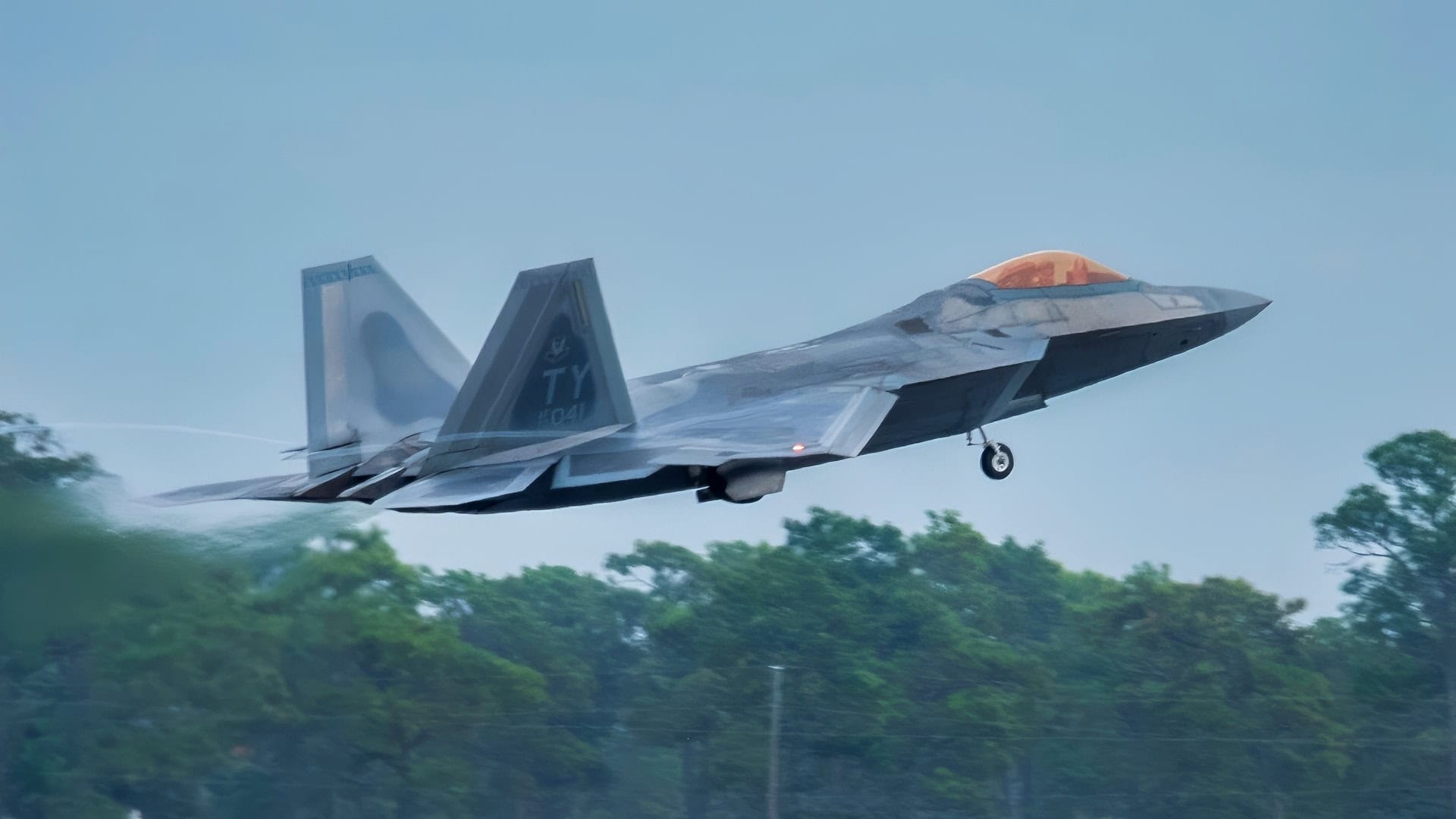
A 325th Fighter Wing F-22A Raptor takes off for a mission Oct. 28 at Eglin Air Force Base, Fla. A squadron of the wing’s Raptors have been at Eglin since Hurricane Michael devastated Tyndall Air Force Base in 2018. (U.S. Air Force photo/Jaime Bishopp)
Its bet is that a powerful radar, heavy jamming, and long-range missiles can substitute for stealth in many scenarios, especially in the SEAD and escort-jamming roles ECRS Mk2 is built for, at a price point that keeps it competitive on the export market against pricey fifth-generation rivals.
Role And Viability In The Stealth Age
The Eurofighter Typhoon was not designed as a stealth aircraft and cannot be converted into one due to fundamental aerodynamic design choices (such as the canard-delta configuration and external weapon points).
However, its survival strategy in the stealth era relies on several key factors.
The primary operational concept involves the Typhoon operating alongside fifth-generation stealth fighters like the F-35. In this “force mix” strategy, the stealth aircraft would penetrate contested airspace, destroy air defenses, and feed targeting data back to the Typhoons operating from a safer distance.
About the Author: Steve Balestrieri
Steve Balestrieri is a National Security Columnist. He served as a US Army Special Forces NCO and Warrant Officer. In addition to writing on defense, he covers the NFL for PatsFans.com and is a member of the Pro Football Writers of America (PFWA). His work was regularly featured in many military publications.