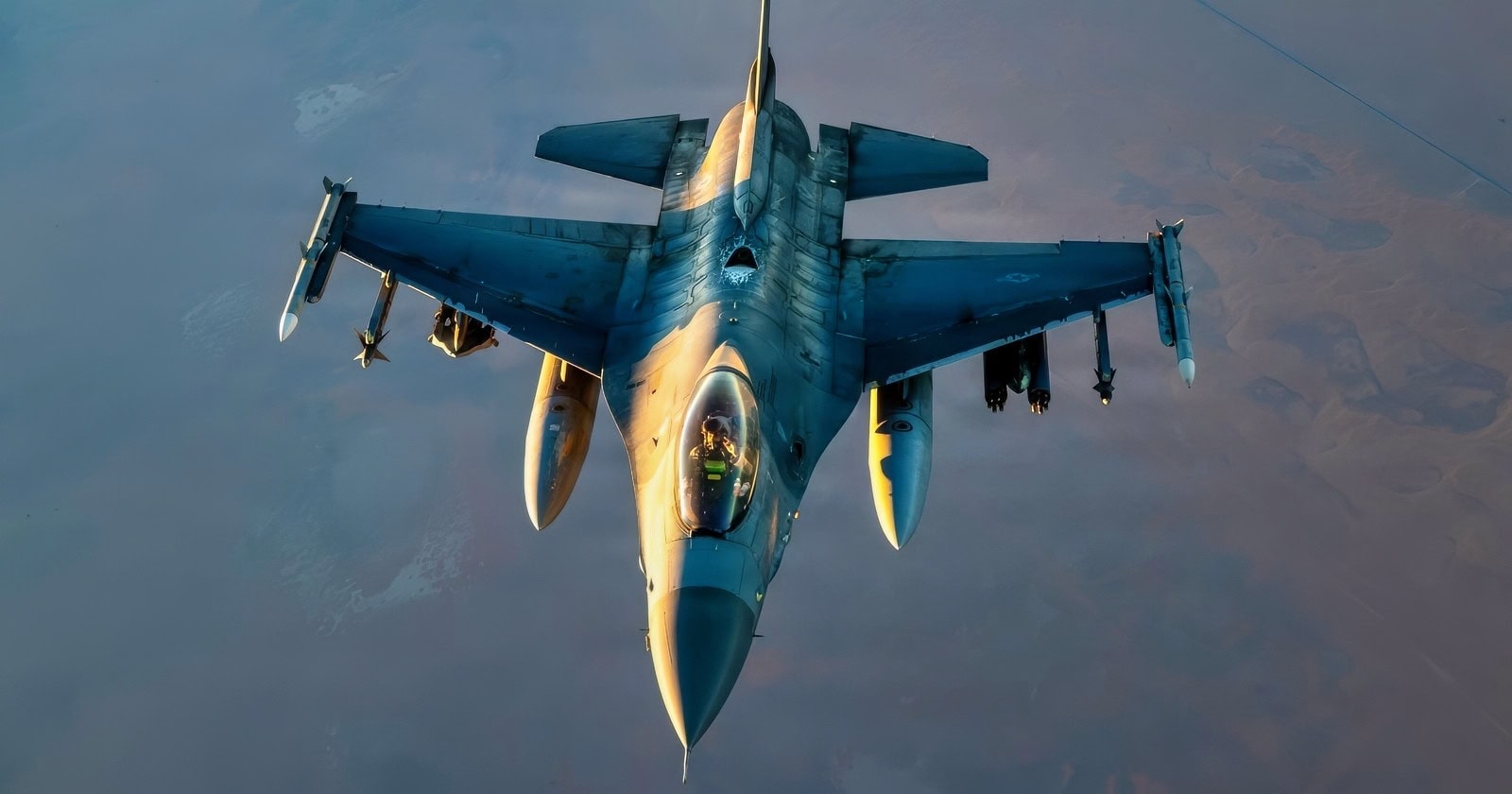
For all their efficiency, the United States Air Force’s Fighting Falcons are showing their age. The incoming F-35A and F-15EX will not be enough to make up for it in time. Those clued up on the Lockheed side of things have already dubbed the plane the F-16G, even though the U.S. Air Force has yet to put its stamp of approval on a purchase, so the designation is unconfirmed for now.
What Would the F-16G Look Like?
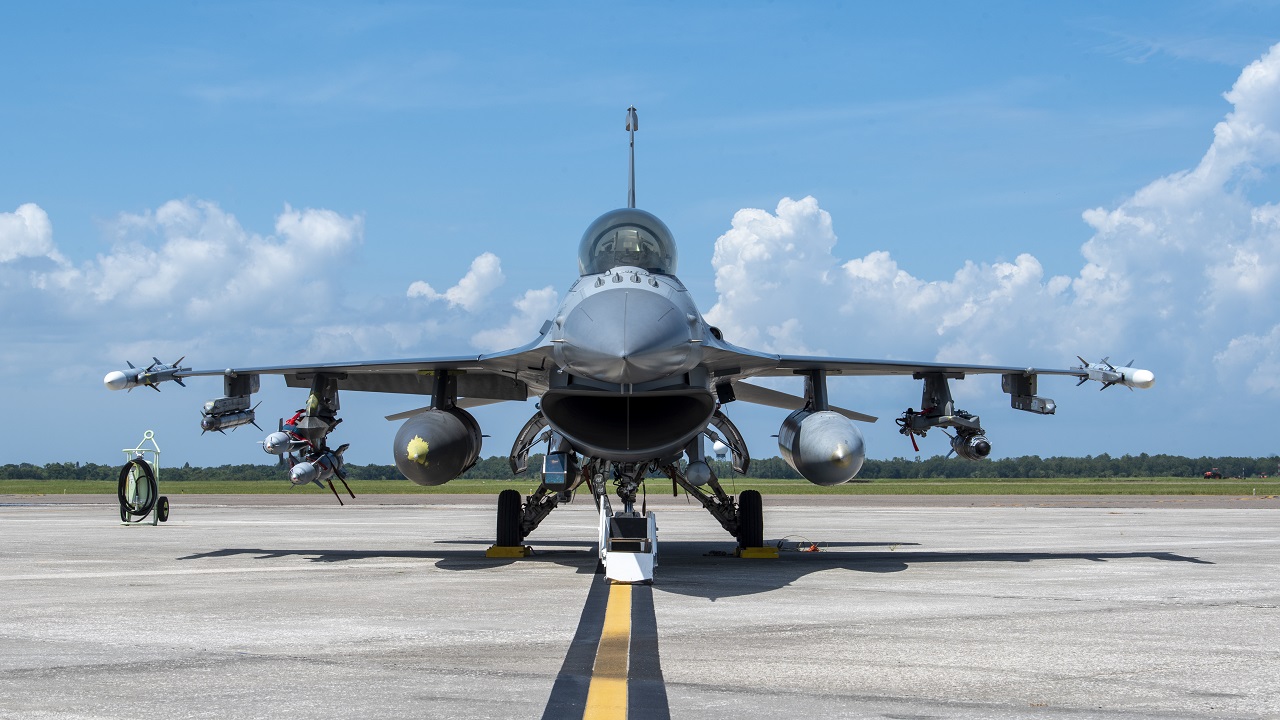
A U.S. Air Force F-16 Fighting Falcon aircraft sits parked on flight line at MacDill Air Force Base, Sept. 8, 2021. (U.S. Air Force photo by Airman 1st Class Lauren Cobin).
Forget an upgrade to the F-16s already in the inventory; this would be a new airframe based on the Block 70 that Lockheed has been selling overseas for years. Customers include Jordan, Bahrain, Slovakia, and Taiwan.
An insider with the plan told Aviation Week the aircraft is to be fitted with a drag chute, Sniper targeting pod, and an infrared search-and-track pod, along with conformal fuel tanks and 600-gallon external wing tanks.
The Block 70 comes standard with Northrop Grumman’s APG-83 active electronically scanned array radar and an airframe good for 12,000 hours.
According to Air & Space Forces Magazine, the American variant will also carry the AN/ALQ-257 Integrated Viper Electronic Warfare Suite from Northrop Grumman for threat detection, active jamming, and radar warning.
One source well-versed in the proposal was blunt, telling the magazine: “This would not be your grandfather’s F-16.” He said buying it would be more like deciding to get an F-15EX.
But swish fighter jets aren’t conjured out of thin air; you have to build them swiftly and efficiently. That is where Lockheed Martin’s tried-and-tested facilities come into play.
After shifting F-16 production from Texas to South Carolina in 2019, the $123 billion company now operates a major plant turning out Blocks 70/72 for global purchasers. The U.S. Air Force would not have to invest in production lines from scratch.
Virginia-based Northrop Grumman would also offer the aircraft’s electronic warfare suite and radar technology.
GE Aerospace and Pratt & Whitney would both supply F-16 engines. In fact, Pratt licensed Hermeus this week to construct the F100-PW-226. This adds another American production source for an engine used by the F-16 and the F-15.
The Old Fleet
The Air Force already owns 826 F-16s, and 484 are active-duty. The average age of these jets is 34, and the freshest American examples have been flying since 2005. Years of combat operations have consumed airframe life that cannot be sustained indefinitely through further enhancements.
Retired Brig. Gen. Houston Cantwell put the shortage plainly in July: “Even though we’d rather have F-35s go off and do everything around the world, there simply aren’t enough of them.”
A study published by the Air Force in 2025 concluded that fighter production needs to expand to address this shortfall.
The Congressional Research Service reported that buying more aircraft could lift the fighter inventory from 1,098 in fiscal 2026 to 1,558 in fiscal 2035, reaching what the service considers an acceptable level of risk.
Back in 2021, erstwhile Air Force acquisition chief Will Roper referenced the new South Carolina line and its “wonderful upgraded capabilities,” which he suggested could be part of a “capacity solution.”
No Order Yet Confirmed
The Air Force is currently developing its fiscal 2028 budget and five-year spending plan, and the F-16G is being considered in light of this.
This fall, the service’s four-star generals will meet at their Corona conference and potentially consider these and other plans.
The Air Force has refused to discuss the plans directly. It said it was in the “initial phases” of considering options and had “neither defined the precise mission requirements nor the spectrum of options that could fill it.” Lockheed also declined to detail its pitch but said it was prepared to support the service.
An August business notice warned that “the current industrial base has demonstrated significant challenges, including production delays, quality control issues, and critical obsolescence.” The Air Force has also warned that peak demand is likely to reach more than “180 engines per year by FY 2034.”
About the Author: Georgia Gilholy
Georgia Gilholy is a journalist based in the United Kingdom who has been published in Newsweek, The Times of Israel, and the Spectator. Gilholy writes about international politics, culture, and education.