
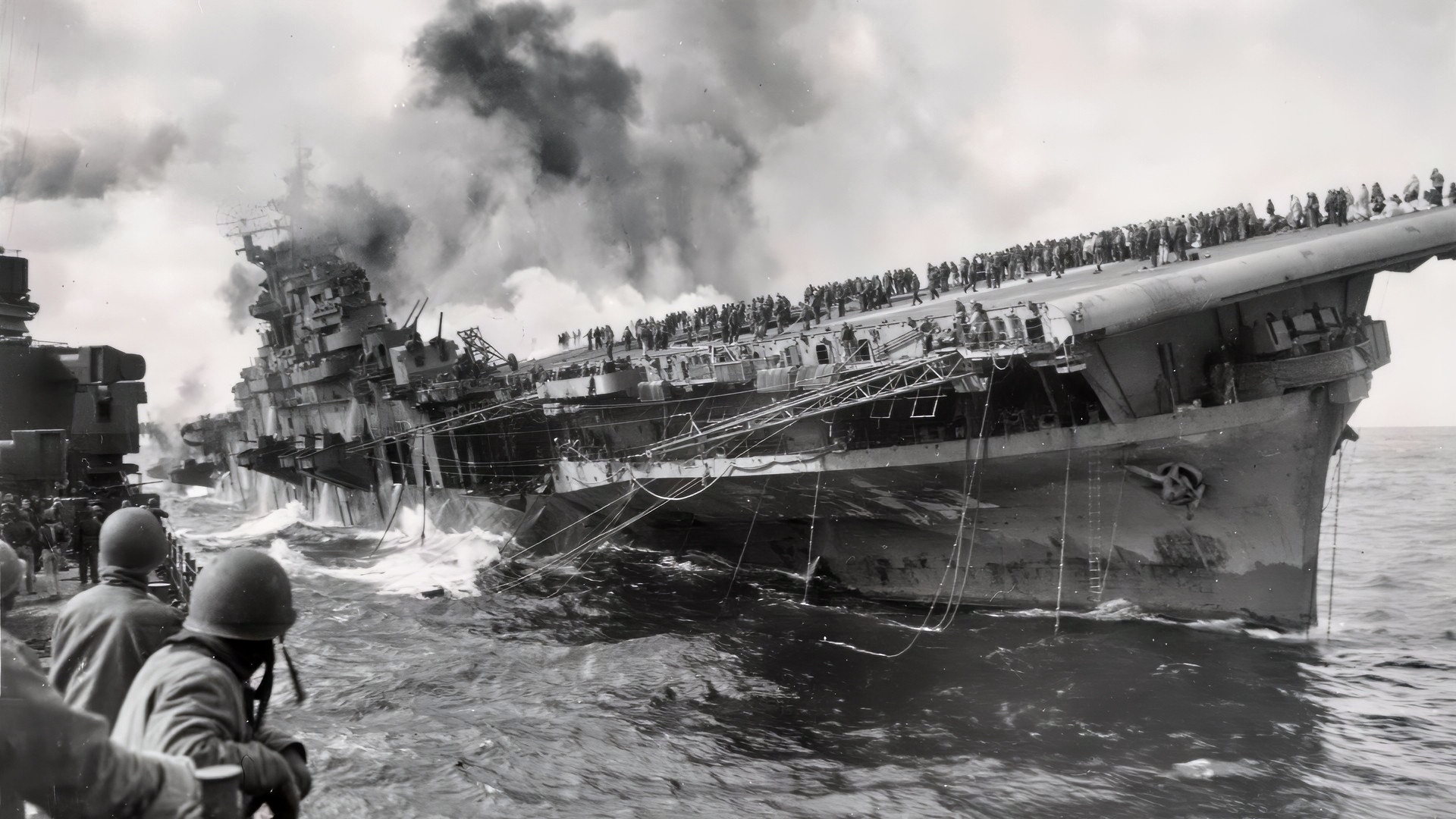
The story of the aircraft carrier USS Franklin (CV-13) is one of the most incredible survival stories in maritime history, military and civilian alike.
In the annals of United States Navy history, the Second World War was ultimately a triumphant endeavor, but it came at the cost of many tragic losses of men and materiel.
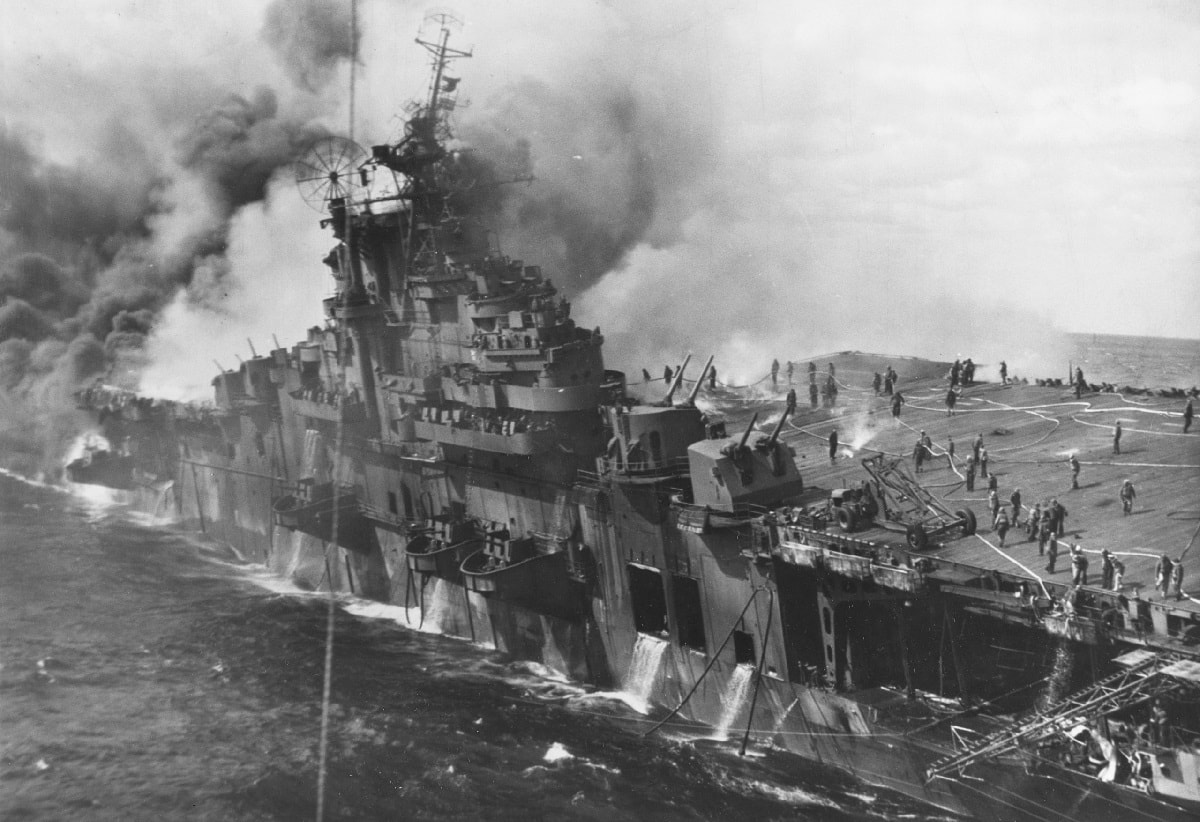
USS Franklin
However, the Franklin’s example shows that even in the midst of grievous tragedy and adversity, the human spirit can triumph against seemingly impossible odds.
Indeed, this particular “flattop” crew became the most decorated crew for a single action in U.S. Navy history: 392 decorations were awarded, including 2 Medals of Honor, 20 Navy Crosses, and 22 Silver Stars.
USS Franklin (CV-13) Initial History and Tech Specs
CV-13 was a member of the 24-ship-strong Essex-class of aircraft carriers, which were the backbone of the USN WWII fleet.
Named in honor of Benjamin Franklin and affectionately nicknamed “Big Ben” by Newport News Shipbuilding, she had her keel laid on the 1-year anniversary of the Pearl Harbor raid.
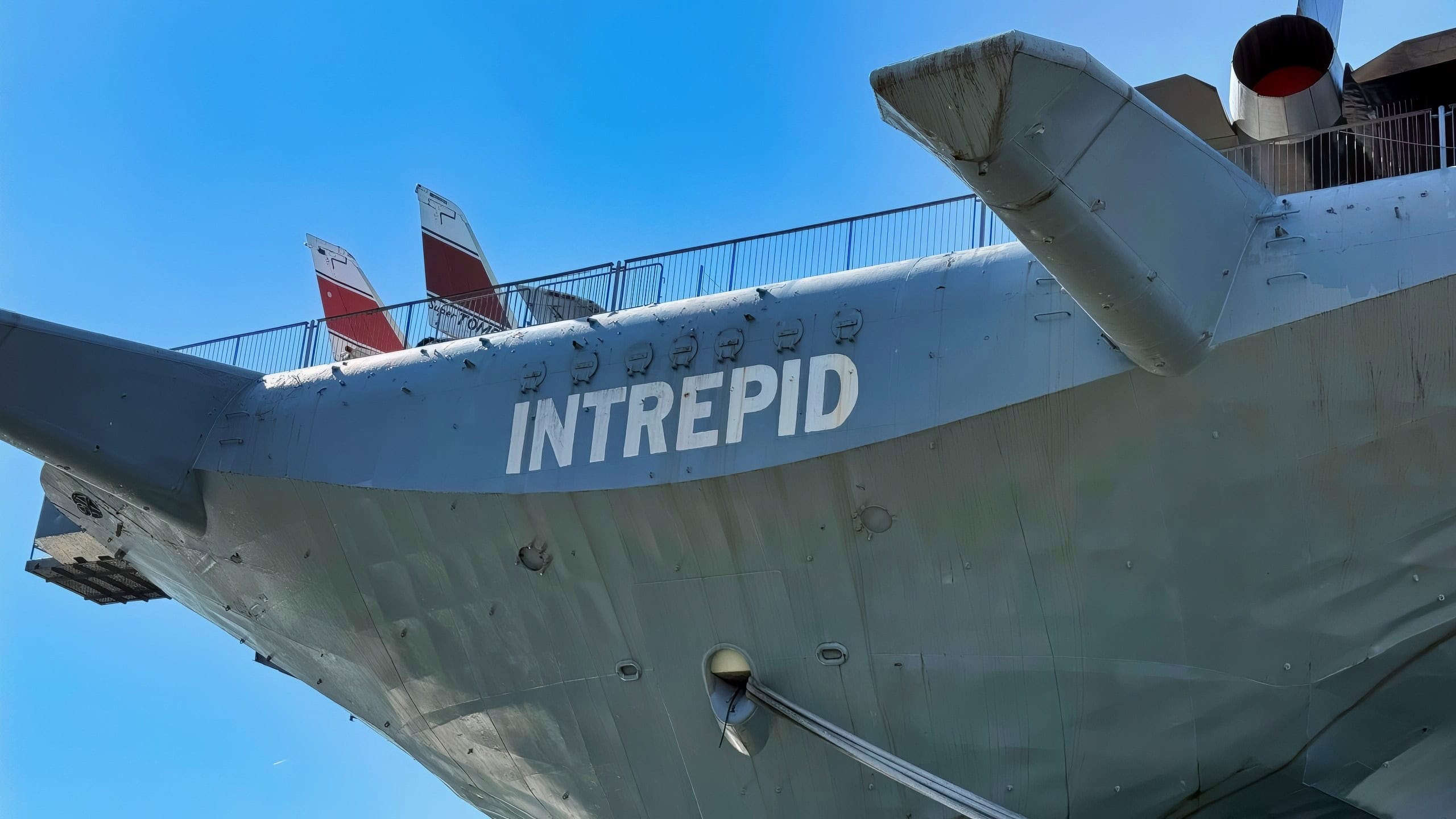
USS Intrepid of the Essex-Class Aircraft Carriers. Image Credit: 19FortyFive.com Original Photo.
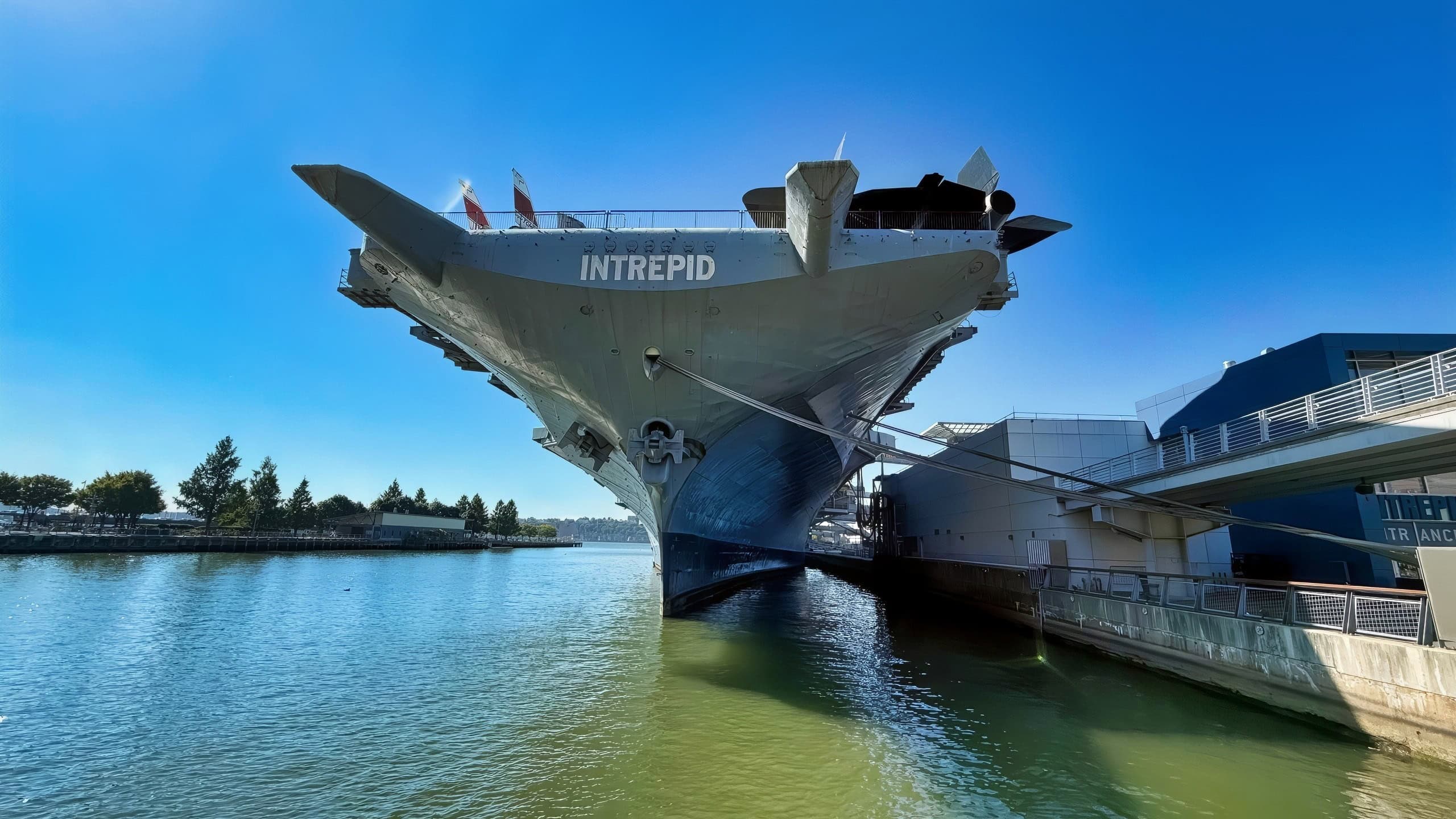
USS Intrepid Essex-Class Aircraft Carrier 19FortyFive.com Photo.
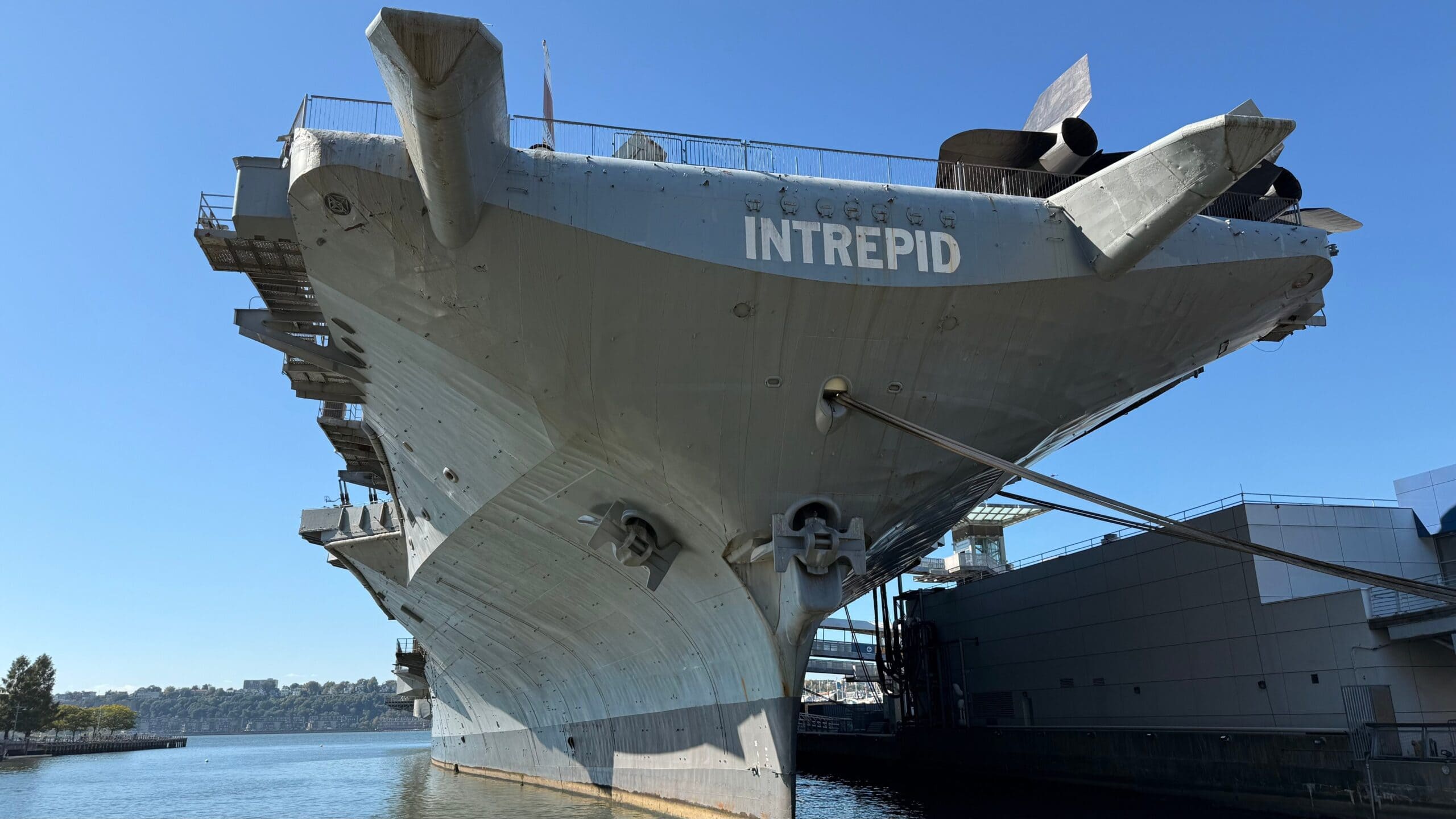
Exterior of Essex-Class USS Intrepid. Image Credit: 19FortyFive.com
She was launched on 14 October 1943 and commissioned on 31 January 1944.
The Essex-class warships sported a hull length of 888 feet, a beam width of 147.5 feet, a draft of 34 feet 2 inches, and a fully laden displacement of 36,960 tons.
The crew complement was 3,100 commissioned officers and enlisted seamen, and warbird carrying capacity was 36 fighter planes, 36 dive bombers, and 18 torpedo bombers.
For self-defense, the flattops wielded four twin and four single five-inch gun turrets along with sixty 20mm Oerlikon cannons and seventeen quad-barrel 40mm Bofors anti-aircraft (AA) guns. Max speed was 33 knots.
The most significant construction factor that ultimately boosted the survival chances of USS Franklin and her sister ships was armor protection, which was far greater than that of the preceding Yorktown-class carriers.
That armor protection incorporated extensive use of flat, straight metal pieces and special-treatment steel, a nickel-chrome alloy that provided the same protective qualities as Class B armor plate but was fully structural.
Big Ben and her brethren also benefited from improved ammunition-handling facilities and more effective damage-control equipment.
“Big Ben” was first “blooded” in combat on 30 June 1944, whereupon she sortied for carrier strikes on the Bonin Islands in support of the subsequent Mariana Islands assault.
Four days later—on America’s birthday no less—her warbirds plastered Iwo Jima, Chichi Jima, and Haha Jima, hitting ground targets, sinking a large cargo ship in the harbor and setting three smaller ships ablaze.
The Franklin’s Incredible Ordeal
The fateful day was 19 March 1945. “Big Ben” maneuvered to within 50 miles of the Japanese mainland, closer than any other U.S. carrier during the war, launching a fighter sweep against the main island of Honshū and later a strike against shipping in Kure Harbor.
Alas, a lone Imperial Japanese Navy (IJN) Yokosuka D4Y Susei (Comet; Allied codename “Judy”)v dive bomber evaded radar detection and struck the Franklin with two 550-lb. semi-armor-piercing bombs before the AA gunners could open fire:
–The first bomb penetrated the flight deck on the centerline and exploded in the forward hangar deck, blasting the forward elevator upward, starting raging fires, and knocking out the combat information center (CIC)
–The second bomb inflicted even more grievous damage, hitting the flight deck amongst the densely packed aircraft ready for launch, detonating above the hangar deck, and disabling the aft elevator
From there, twelve “Tiny Tim” rockets started cooking off and flying in all directions.
So then, how did the ship manage to survive?
Besides the aforementioned superior construction factors, it was the incredibly brave actions of her crew.
To highlight just one example, let’s look at an excerpt from the Medal of Honor citation of Lieutenant (j.g.) Donald Gary:
“Staunchly determined, he struggled back to the messing compartment three times despite menacing flames, flooding water, and the ominous threat of sudden additional explosions, on each occasion calmly leading his men through the blanketing pall of smoke until the last one had been saved.
Selfless in his concern for his ship and his fellows, he constantly rallied others about him, repeatedly organized and led firefighting parties into the blazing inferno on the flight deck, and, when firerooms 1 and 2 were found to be inoperable, entered No. 3 fireroom and directed the raising of steam in one boiler in the face of extreme difficulty and hazard.
An inspiring and courageous leader, Lt. (j.g.) Gary rendered self-sacrificing service under the most perilous conditions and, through his heroic initiative, fortitude, and valor, was responsible for saving several hundred lives.
His conduct throughout reflects the highest credit upon himself and upon the U.S. Naval Service.”
10,000+ miles later, USS Franklin limped into Brooklyn Naval Yard under her own power on 28 April 1945. As noted by naval historian M. Glenn Ross: “There were 962 men on board, less than one-third of the 3100 that sailed to Japan six weeks earlier. As they sighted the Statue of Liberty, many unashamedly wept.”
No Essex-class vessel was ever lost in combat. But boy oh boy, did the USS Franklin come ever so perilously close.
Where Is She Now?
CV-13 was officially decommissioned, though USS Franklin lived on for nearly two decades in reserve status after WWII ended—along the way, she was reclassified as an attack carrier (CVA), then an antisubmarine carrier (CVS), and finally an aircraft transport (AVT)—she was never reactivated or modernized and therefore never put to good use during the Korean War or any of the other paradoxical “hot wars” of the Cold War.
She was stricken from the Naval Register on 1 October 1964 and sadly and unceremoniously scrapped on 27 July 1966.
As far as this writer can ascertain, not even a small part of “Big Ben” has been preserved for posterity. If any of you dear readers know otherwise, please let us know in the Comments section.
About the Author: Christian D. Orr
Christian D. Orr is a Senior Defense Editor. He is a former Air Force Security Forces officer, Federal law enforcement officer, and private military contractor (with assignments worked in Iraq, the United Arab Emirates, Kosovo, Japan, Germany, and the Pentagon). Chris holds a B.A. in International Relations from the University of Southern California (USC) and an M.A. in Intelligence Studies (with a concentration in Terrorism Studies) from American Military University (AMU). He is also the author of the book “Five Decades of a Fabulous Firearm: Celebrating the 50th Anniversary of the Beretta 92 Pistol Series,” the second edition of which was recently published.