
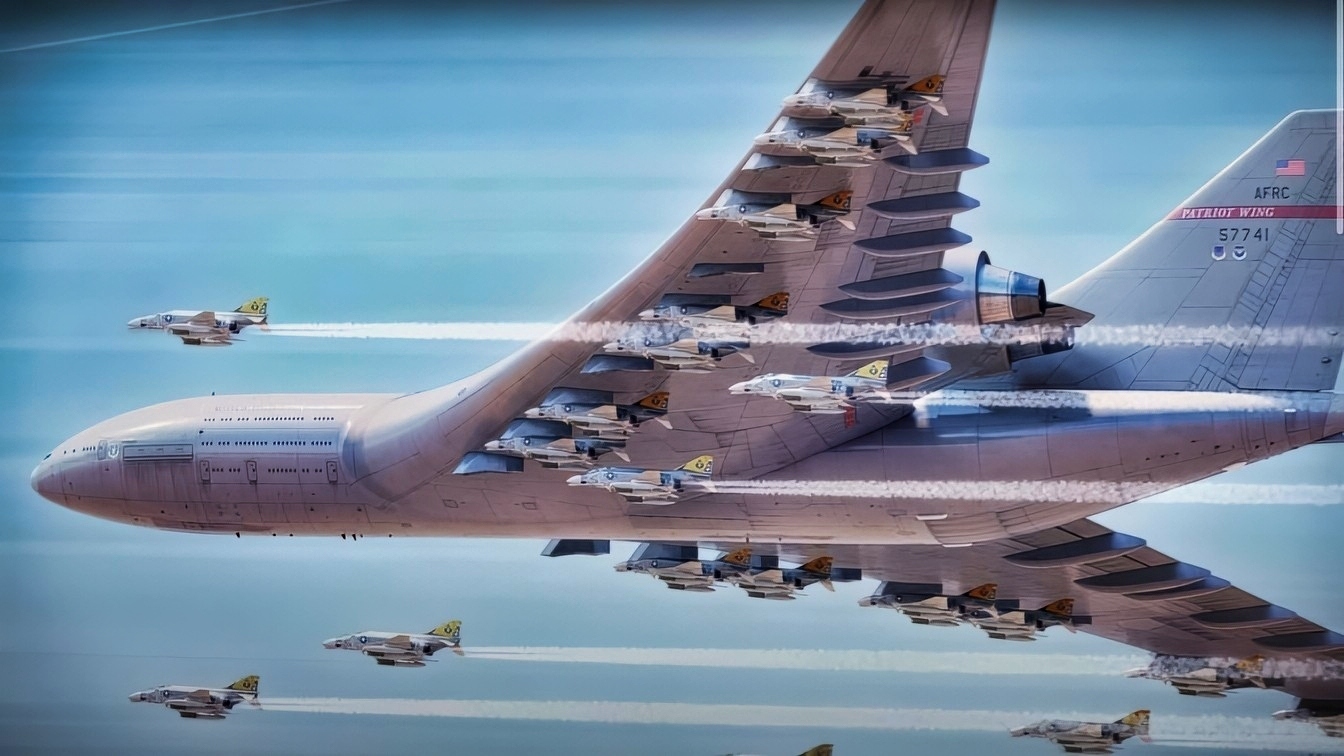
Summary and Key Points: Defense Expert Harrison Kass revisits the Lockheed CL-1201, a 1969 study by G.D. Brewer, S. Dalton, and P.J. Sibley of very large nuclear-powered aircraft. With a 1,120-foot wingspan, a 560-foot fuselage, a 125,000-square-foot wing, and a gross weight of 5,375 tons or 11.85 million pounds, 15 times a Boeing 747, it would have cruised at 500 knots for 41 days as a flying aircraft carrier or strategic transport, using a reactor, four turbofans, and 182 lift jets.
The Flying Aircraft Carrier Dream
In 1969, Lockheed engineers studied an aircraft that would have dwarfed virtually everything else in the air.
Known as the CL-1201, the proposed aircraft was absurdly large, with a 1,120-foot wingspan and a 560-foot length.
Its maximum gross weight would have been 5,375 tons (11.85 million pounds), roughly 15 times the gross weight of a Boeing 747.
But size wasn’t necessarily the CL-1201’s most unique feature; it proposed using a nuclear reactor that would have let the aircraft stay airborne for weeks.
One proposed CL-1201 configuration was essentially a flying aircraft carrier, transporting fighters across the globe.
Since the CL-1201 was conceived, nothing comparable has been built.
But the project reveals just how ambitious war planners were during the height of the Cold War.
Thinking Big
The concept emerged in the late 1960s, when nuclear propulsion and extreme aircraft endurance still held aerospace engineers’ attention.
Three Lockheed engineers, G.D. Brewer, S. Dalton, and P.J. Sibley, authored a 1969 study titled A Study of Very Large Nuclear-Powered Aircraft in a Potential Mission Application.
As the title suggests, the study explored the military applications of extremely large nuclear-powered aircraft.
The study outlined two principal mission concepts: massive strategic transports and an airborne aircraft carrier.
The transport version would have theoretically moved enormous quantities of troops and equipment over intercontinental distances.
The carrier version, meanwhile, suggested bringing fighter aircraft into position without relying on conventional ground bases or naval aircraft carriers.
But this study was an internal engineering study, not an approved acquisition program.
Measuring the CL-1201
With a wingspan of 340 meters—more than three football fields—the CL-1201 was indeed massive.
The fuselage was 170 meters long, and it stood about 46 meters high.
The wing area was approximately 11,630 square meters or 125,000 square feet.
The gross weight was approximately 5,375 metric tons.
For perspective, a Boeing 747’s wingspan measures up to 244 feet, depending on the variant; an Airbus A380’s wingspan is about 262 feet.
The CL-1201 would have had a wingspan more than four times larger than the A380. The design featured an enormous, broadly crescent-shaped wing.
NASA reviewed the concept in a 1971 technical memorandum, X-2386, noting that the proposed payload could represent about 40 percent of the aircraft’s gross weight, while conventional structural materials accounted for about 25 to 30 percent of gross weight.
NASA also noted that the CL-1201’s proposed structural proportions were not inherently impossible.
So while the aircraft was extreme, it wasn’t pure fantasy; it accounted for real-world engineering limitations.
Nuclear Propulsion
Conventional aircraft carry fuel and burn that fuel to generate thrust.
The CL-1201 proposed something entirely different: replacing much of that fuel-burning requirement with nuclear heat.
The proposed reactor would have heated a working fluid, which would transfer energy through heat exchangers to the propulsion engines—the proposal called for four large turbofan engines at the rear of the aircraft.
During cruise, the nuclear power would provide the heat necessary for propulsion, while some reactor concepts allowed the engines to operate on conventional fuel when necessary.
The proposed cruising speed was about 500 knots, with an estimated endurance of 41 days (though surviving sources do not indicate a clear endurance figure).
Regardless, nuclear propulsion would have dramatically reduced the need to carry conventional fuel for long-duration cruise portions of flight.
But getting a 5,000-ton aircraft off the ground required enormous thrust.
And nuclear cruise engines alone weren’t intended to provide the necessary takeoff performance. Lockheed therefore proposed supplementary chemically fueled lift engines.
Some accounts even described as many as approximately 182 lift jets for the carrier configuration, which would provide additional thrust during takeoff and landing.
Once airborne, however, the CL-1201 would transition to nuclear-powered cruise.
The complexity here is fascinating.
Four principal cruise engines plus another 180 auxiliary engines.
The operational complexity would have been enormous—as would the scale and complexity of ground handling, maintenance, and takeoff operations.
Indeed, the CL-1201 is one of the more ambitious aerospace programs ever proposed. But the program remains only a preliminary study—and understandably so.
The costs would have been enormous, the engineering complexity unprecedented, and the military advantages over existing alternatives were questionable.
And the CL-1201 would have risked nuclear contamination in a crash every time it flew.
About the Author: Harrison Kass
Harrison Kass is a writer and attorney focused on national security, technology, and political culture. His work has appeared in Tablet, City Journal, The Hill, The Spectator, and The Cipher Brief. He holds a JD from the University of Oregon and a master’s in Global & Joint Program Studies from NYU—more at harrisonkass.com.