
President Donald Trump has said he is open to opening a new dialogue with North Korean leader Kim Jong Un before the end of 2026. “I get along with him well,” Trump said in a social media post. “And you know what? The fact that I get along with him, that’s a very good thing, not a bad thing.” However, hawks in both major political parties have condemned the president’s comments.
On the delicate and difficult issue of relations with the so-called Democratic People’s Republic of Korea (DPRK), Trump’s current instincts are correct. A summit meeting would be a useful initial step toward ending the dangerous policy rigidity that has plagued Washington’s stance toward North Korea for decades. The president would also offer to reduce the scope of future joint U.S.-South Korea military exercises. Pyongyang officials consider those annual war games inherently provocative.
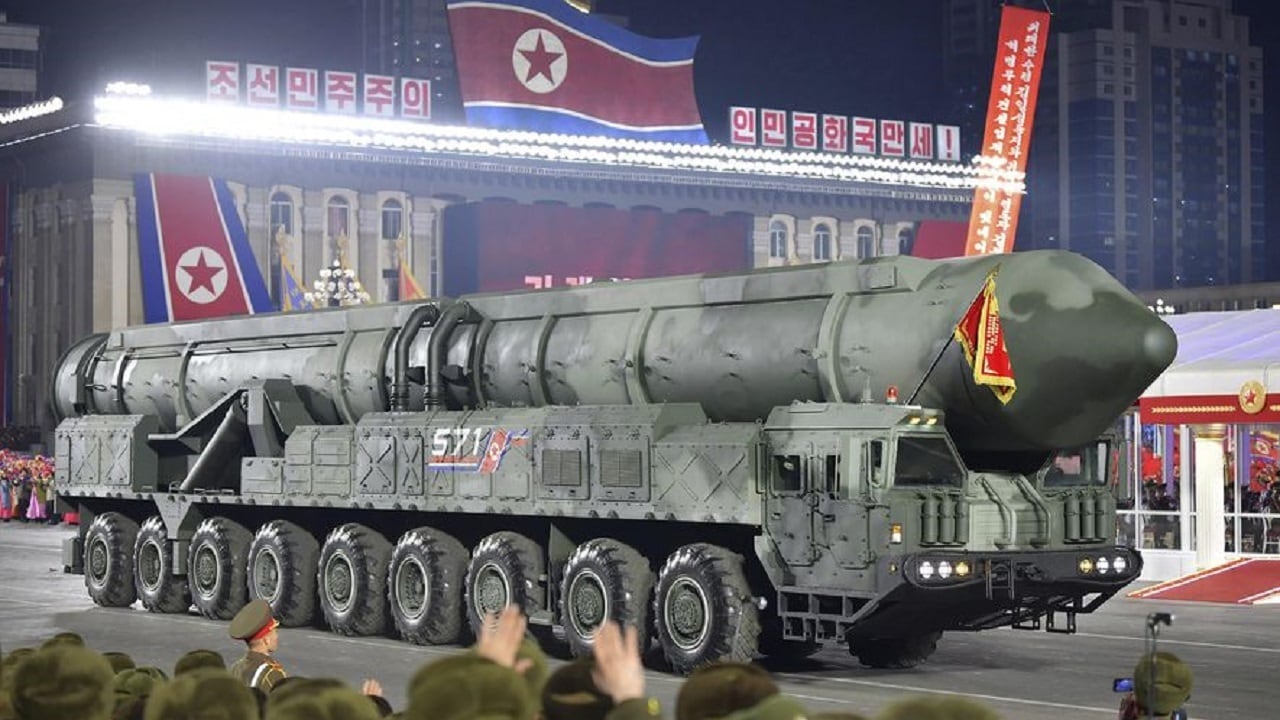
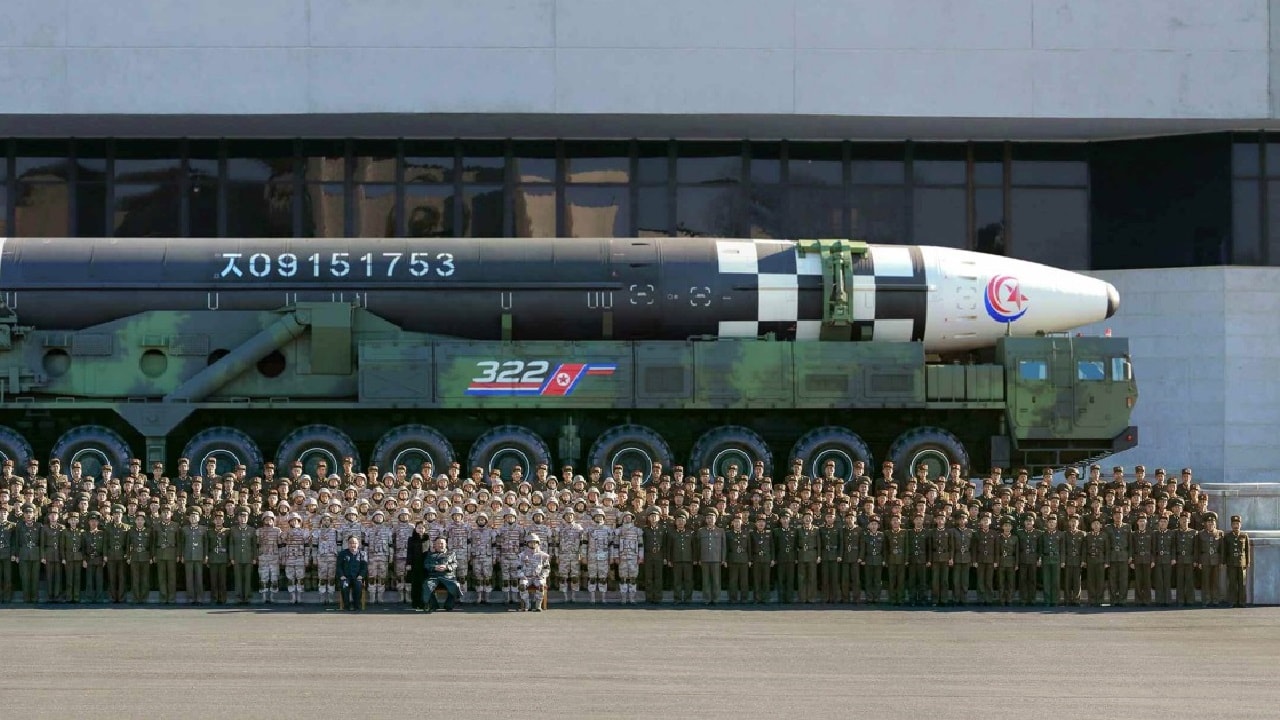
Image Credit: KCNA/North Korean Government.

North Korea’s New ICBM
To achieve a meaningful, constructive breakthrough in bilateral relations, however, Trump must go on the political offensive against a host of detractors. His modest, reasonable outreach to North Korea already is drawing fire akin to the attacks that ultimately doomed the president’s similar initiatives in 2018 and 2019.
Two Camps of Opposition
Two sets of staunch opponents oppose any hint of rapprochement between Washington and Pyongyang.
One group is sincerely but stridently ideological. That faction understandably regards the DPRK as an odious, utterly repressive regime as well as a security threat to North Korea’s neighbors in East Asia and potentially to the United States itself. Vehemently anti-communist conservative Republicans are the most visible and outspoken opponents of any concessions to the DPRK, but members of the human rights lobby in both political parties also are prominent.
The other main source of opposition to Trump’s hints of possible détente with Pyongyang is Democrats in Congress and the broader U.S. political community who exhibit partisan and opportunistic motives for opposing any outreach to Pyongyang.
Even Democrats who normally favor a more cautious, prudent global foreign policy for the United States seem to adopt a surprisingly hostile posture toward Trump’s proposals regarding North Korea. They showed such obstructionist behavior in response to the White House’s initiatives in 2018-2019, and they are doing the same today.
The Chorus of Critics
Sarah Ewall-Wice, a Daily Beast reporter, expressed especially shrill criticism of Trump’s latest bid for détente with North Korea. She accused him of “fawning” over “a brutal dictator” while stabbing longtime U.S. ally South Korea “in the back.” Congressional hawks in both parties tried to match her intemperance, and they often succeeded. “Trump aligning with North Korea’s dictator and announcing the scale-down of military exercises with South Korea was swiftly met with bipartisan criticism,” Ewall-Wice noted.
She quickly added, though, that “it remains to be seen whether any Republicans in Congress will have the backbone to demand further answers” from the administration regarding the proposed meeting.
Sen. Thom Tillis (R-NC) won her praise for denouncing the president’s outreach to Pyongyang—especially Trump’s willingness to scale back scheduled U.S. war games with Seoul’s forces. “South Korea has been a solid military ally for over 70 years that possesses exquisite military capabilities,” Tillis wrote in a social media post. In addition to constituting a public slap against Washington’s loyal ally, Tillis contended, “reducing joint exercises with South Korea does nothing more than free up thousands of North Korea’s troops to support Putin’s systematic kidnapping, torture, rape, and murder of innocent Ukrainian citizens.”
Indeed, from the standpoint of pro-war enthusiasts like Ewall-Wice, Tillis probably deserved bonus credit for hawkish impulses, since he managed to rage against Putin, Trump, and Kim Jong Un in the same post.
The Partisan Playbook, Then and Now
Sen. Jack Reed’s hostility to Trump’s willingness to meet with Kim reflects the intensely partisan opposition to any signs of U.S.-DPRK détente. “Kim Jong Un is not, I think, terribly impressed with Donald Trump,” the Rhode Island Democrat stated sarcastically. “And withdrawing [U.S.] forces from Korea, canceling exercises,” Reed added, “plays into his game.” In an earlier Truth Social post, Trump confirmed that he told Secretary of Defense Pete Hegseth to “substantially reduce” planned joint military exercises alongside South Korean forces.
Reed scorned Trump’s comments, implying that they constituted outright appeasement from a weak and discredited U.S. leader.
Reed’s unhelpful role mirrored the stance leading Democrats took toward Trump’s dialogue with Pyongyang during his first term. They denounced the president for being willing even to talk to Kim, arguing that the United States gave the dictator a huge boost in prestige simply by meeting him face-to-face and treating him as an equal. “In his haste to reach an agreement, President Trump elevated North Korea to the level of the United States while preserving the regime’s status quo,” intoned then-House minority leader Nancy Pelosi.
Why Reed’s Position Matters
That destructive partisan mentality fueling resistance to any softening of U.S. animosity toward the DPRK unfortunately seems as strong today as it was then. Reed’s hostility to détente is especially troubling. As the ranking Democratic member on the powerful Senate Armed Services Committee, he has considerable influence.
If the Democrats win control of the Senate in November’s midterm congressional elections (which most current polling data suggests is a very real possibility), his importance will be even greater.
At that point, he would become chairman of the Armed Services Committee and be poised to torpedo any conciliatory measures President Trump might propose regarding North Korea that required congressional approval.
Reed would have a de facto veto over White House efforts to establish a more workable, less confrontational policy toward Pyongyang.
Where Ideology and Partisanship Meet
The ideological source of opposition to détente with the DPRK dovetails with the partisan component.
The Wall Street Journal’s editorial board fully shared Reed’s opposition to Trump’s conciliatory gestures toward Pyongyang. “President Trump is nothing if not impulsive, and his latest brainstorm is to rekindle his courtship of North Korean dictator Kim Jong Un,” they concluded.
The editors were especially annoyed that Trump had cited his “very good relationship” with Kim and contended that large U.S. military exercises with South Korea would “send a signal that is totally inappropriate and hostile, to a Country that, as long as Donald J. Trump has been President, has been unthreatening and respectful.”
The Journal editorial expressed alarm at the president’s entire approach regarding North Korea—especially the scaling back of Washington’s military cooperation with Seoul. “This will reinforce the growing belief in Asia and Europe that the U.S. is becoming an unreliable ally,” the editors warned.
“It may also increase the calls in the South for Seoul to develop its own nuclear deterrent.”
Too Little, Too Late—Not Appeasement
Despite the often-shrill criticism, Trump’s latest initiative is merely a cautious, overdue effort to jump-start meaningful diplomacy with Pyongyang. The real danger is not that the approach constitutes appeasement, but that such a modest, conciliatory effort will come too late.
Pyongyang’s growing nuclear weapons capability should be sufficient reason by itself for the United States to seek détente with the DPRK. Experts at the U.S. Arms Control Association estimate that North Korea has assembled approximately 50 warheads.
The DPRK also is building an increasingly capable ballistic missile system to deliver such weapons. Kim’s government has tested several long-range missiles, and there are credible indications that such missiles already may have sufficient range to reach the continental United States.
Yet the United States still has no formal relations whatsoever with an important, volatile regional power that could do serious damage to America in an armed clash. That must change, and promptly. Washington needs to initiate a wide-ranging, pragmatic dialogue with Pyongyang.
The petty, sometimes partisan, domestic opposition even to Trump’s very modest suggestion about holding a new summit meeting with Kim Jong Un highlights the intellectual bankruptcy of Trump’s opponents on the issue of U.S. policy toward North Korea.
About the Author: Ted Galen Carpenter
Ted Galen Carpenter is a senior fellow at the Randolph Bourne Institute and a contributing editor at The National Security Journal and The American Conservative. He has authored 13 books and more than 1,500 articles on national security, international affairs, and civil liberties. His latest book is Unreliable Watchdog: The News Media and U.S. Foreign Policy (2022).