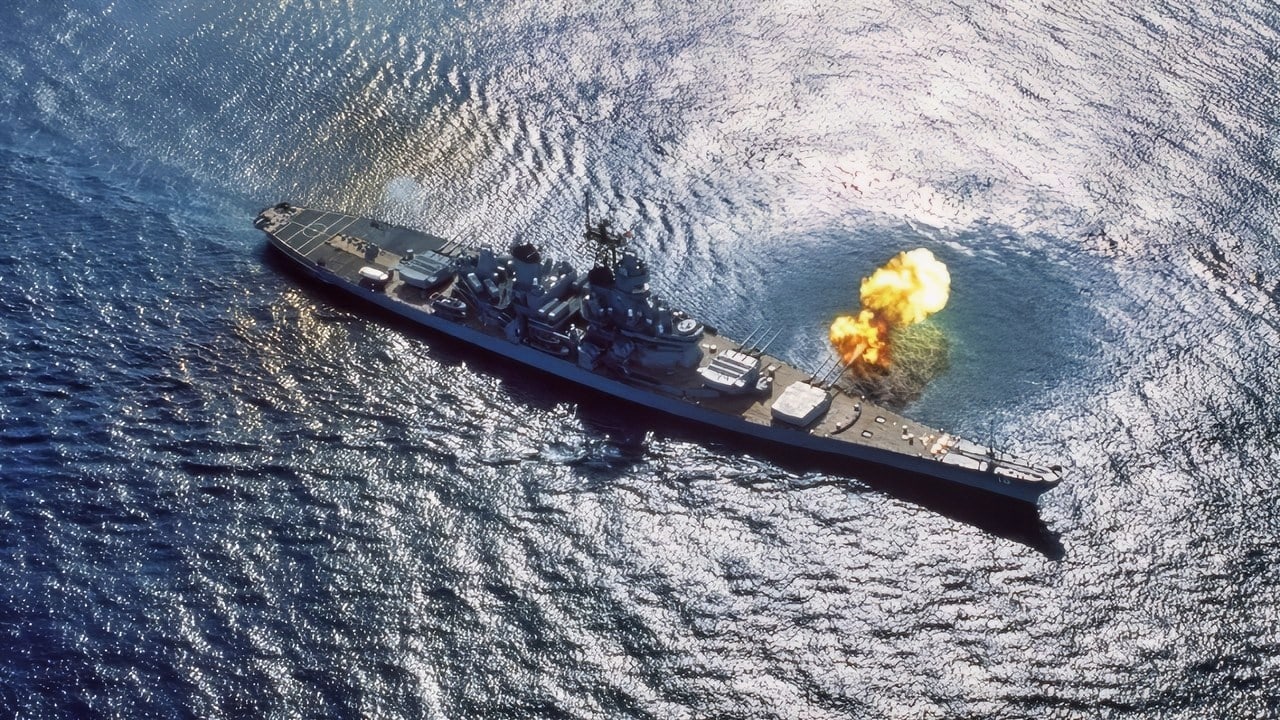
Will A “Trump-class” Battleship Be Worth $23 Billion? – In 2025, President Donald J. Trump proposed a new class of surface combatant ship, designated BBG-1 or BBG(X), as the centerpiece of his modernized Golden Fleet initiative. Then US Navy Secretary John Phelan stated that the future USS Defiant “…will be the largest, deadliest and most versatile and best-looking warship anywhere on the world’s oceans.” This is known, of course, as the Trump-class battleships.
With a projected cost of $23 billion for the first of these ships, the question begs to be asked: “Is it worth the money?”
Because the projected cost and specifications of Navy ships can change until construction blueprints are finalized, here are the pros and cons of what is being called the “Trump Class.”
Not As Big As A Battleship, But Bigger Than a Cruiser
One of the many controversies surrounding BBG-1 is how to classify it. Is it a Battleship, a cruiser, or something else?
Traditionally, a “Battleship” is a heavily armored capital ship with large-caliber guns, capable of serving as the centerpiece of a task force or line of battle in a naval engagement.
Cruisers were defined as fast, long-range ships with less armor and smaller guns, able to fight other cruisers and destroyers. In modern times, a cruiser could also serve as a flagship for the Admiral commanding an embarked Carrier Strike Group.
This new class defies both those traditional definitions in some way.
At 30-35,000 tons and without armor, Defiant is much lighter than a battleship but still heavier than a cruiser.
Still, it carries lots of missiles, packing a battleship-like punch.
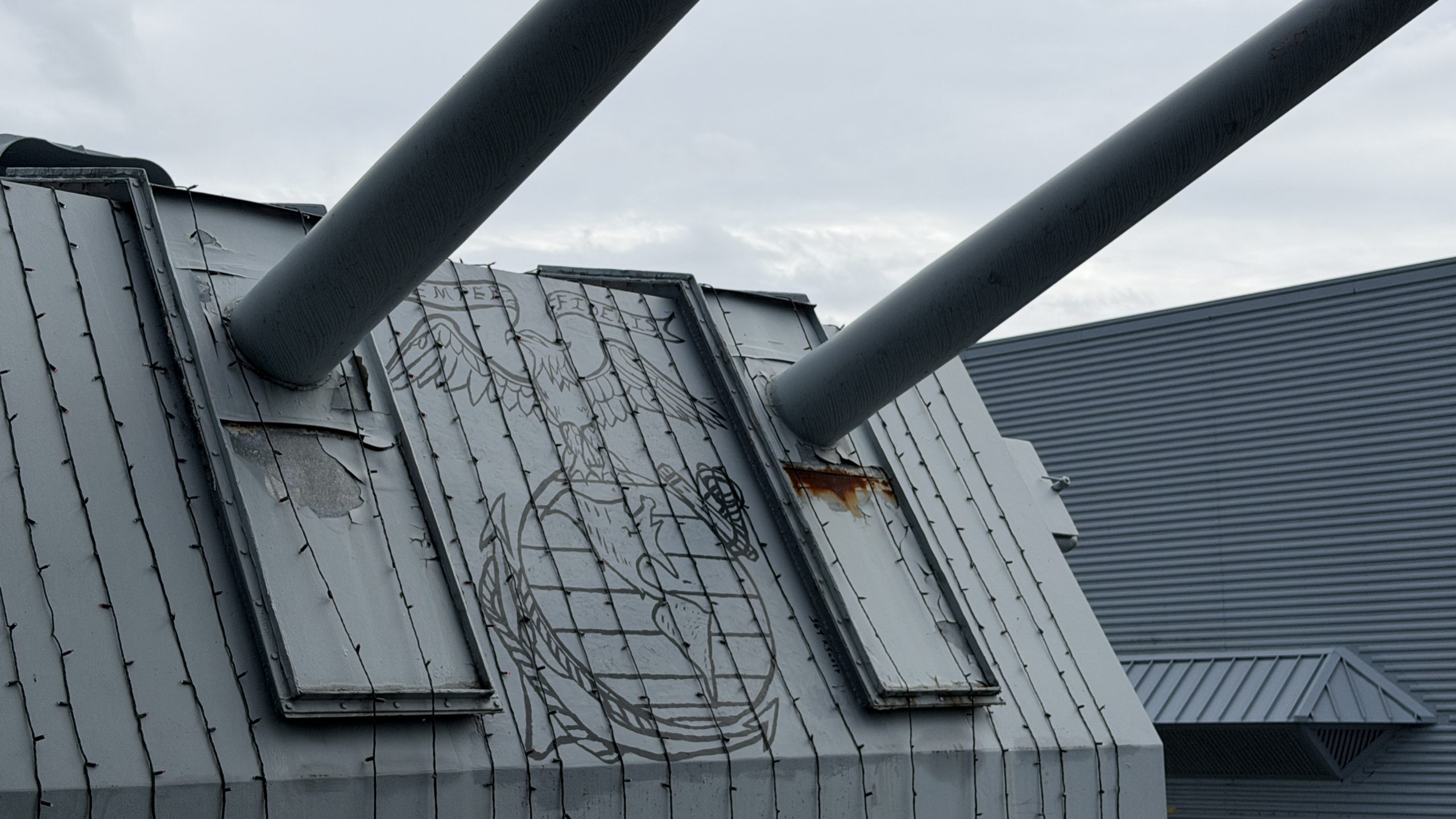
USS Wisconsin Iowa-Class Battleship Tour. Photo by 19FortyFive Reporter Christian D. Orr.
With a nuclear reactor, it has the speed and range of a heavy cruiser and can serve as a flagship for a larger fleet.
By traditional definitions, the new Defiant most closely resembles a battlecruiser: less armor and smaller guns than a battleship, but with long range, speed, and bigger guns than a standard cruiser.
Battlecruisers fight as the middleweights in naval battles.
USS Defiant Would Be A Big Ship Armed To The Teeth
The hull would be about 840-880 feet long, with a 105–115-foot beam, and would probably use the A1B nuclear reactors from the Ford-class aircraft carriers.
This would give the Defiant near-unlimited endurance and plenty of electrical power to support future systems and upgrades.
As armament, the Defiant would have 128-200 Mk 41 Vertical Launch System tubes capable of launching Tomahawks and Standard Missiles for anti-air, anti-surface, and anti-submarine warfare. These larger-diameter tubes could also fire the future Conventional Prompt Strike missile and the sea-launched nuclear cruise missile (SLCM-N).
On deck would be two 5-inch Mk 45 rapid-fire naval guns, 30 mm cannons, and the Rolling Airframe Missile for point defense against missiles and aircraft. Later additions could include high-powered lasers and rail guns.
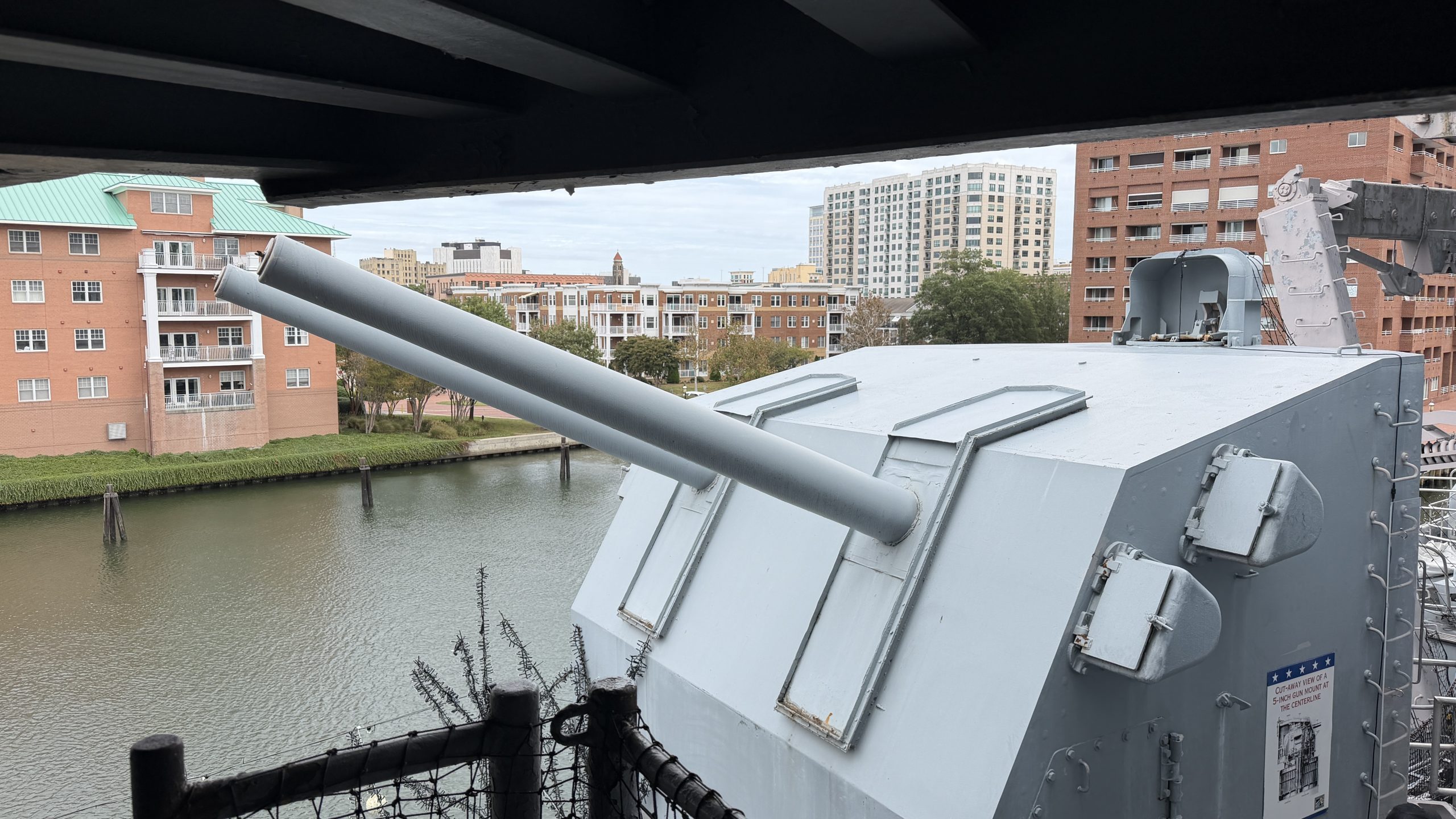
USS Wisconsin Iowa-Class Battleship Tour. Photo by 19FortyFive Reporter Christian D. Orr.
The Defiant’s two large hangars would accept drones, V-22 Ospreys, or helicopters for uses like Anti-submarine warfare or vertical replenishment at sea.
Her sensors would include variants of the advanced Aegis combat system built around the AN/SPY-6 radar for air and missile defense. This would make Defiant the primary air-defense ship for one or more carriers in a task force.
The first Defiant is projected to cost $23 billion, with future ships at $18 billion a copy.
This lower cost reflects spreading the R&D and tooling costs over a production run of 10-25 ships.
If that order is cut to just five, the per-copy cost will balloon dramatically.
The USS Defiant Would Be Able To Stay With The Carriers For As Long As Needed
On the pro Side of the argument, the Defiant-class would be a capable, formidable surface combatant, able to go on 8-month deployments with nuclear aircraft carriers and match them knot for knot and mile for mile with its own nuclear propulsion.
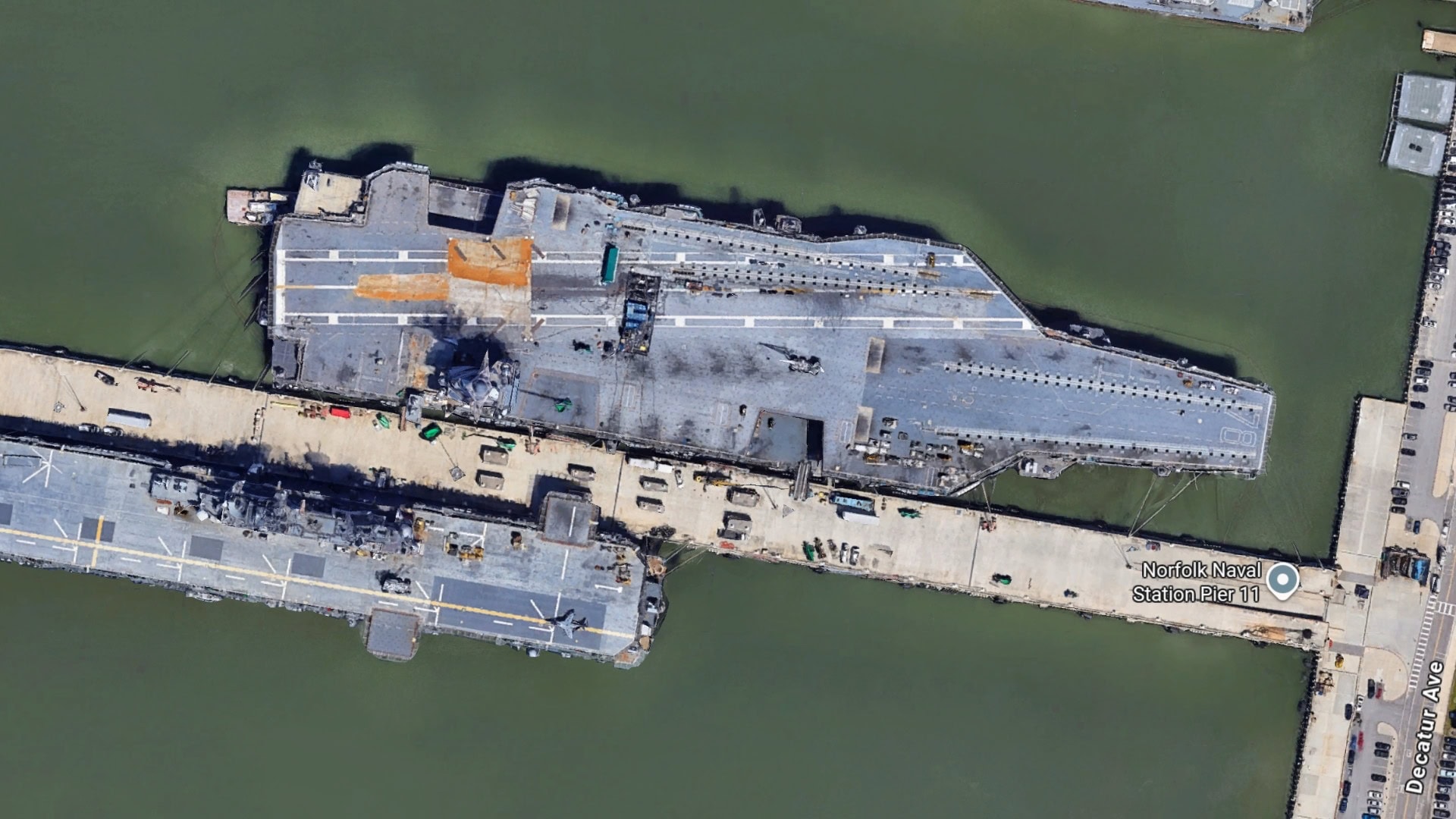
USS Gerald R. Ford Google Maps Photo Screenshot.
Carrying some 140-200 missiles of various types, it has a large magazine that lets it engage cruise missiles, aircraft, and other ships at long range. The ship’s size would also make long voyages easier for the crew. If bulked out to 40,000 tons and nearly 900 feet long, it could carry more food and supplies for its crew, requiring fewer replenishments at sea than the much smaller Burke-class DDGs in service now.
Deviant’s size and excess electrical capacity would also make it much easier to expand and upgrade her weapons and sensors later. A persistent complaint about the Burke-class destroyers is that they lack the internal volume and energy output for more upgrades.
The USS Defiant Will Cost More Than A Ford-class Carrier
On the Con side of the ledger is the per-unit cost.
At $23 billion, a Defiant will cost more than the new Ford-class aircraft carrier ($13 billion for USS Gerald R. Ford and more for each one after, according to most estimates, but nowhere near the $23 billion, the top-line number cited most times for the first Trump-class). It lacks the size and complexity of the Ford; it will probably shave considerable time off the 5-12 years it takes to build a carrier right now.
By contrast, the latest Burke-class DDG to put to sea, the USS Ted Stevens (DDG-128), cost $2.5 billion to build. The Navy could build 9 Burke-class DDGs for the cost of just one Defiant-class ship.
Of course, this cost is offset by the fuel and maintenance costs of 9 destroyers versus one battlecruiser with a nuclear reactor.
Cost Versus Distributed Lethality
Finally, we come to an argument over Cost versus Distributed Lethality.
Do you spend a lot of money on single ships that can only be in one place at one time? Or do you spend less on less capable ships that can be in more places at once?
The US Navy operates in two basic modes. Single ships like the Burke-class patrol the world’s oceans like sentinels, ensuring freedom of navigation and trade, while Carrier Strike Groups exist to punch anybody in the mouth trying to prevent it.
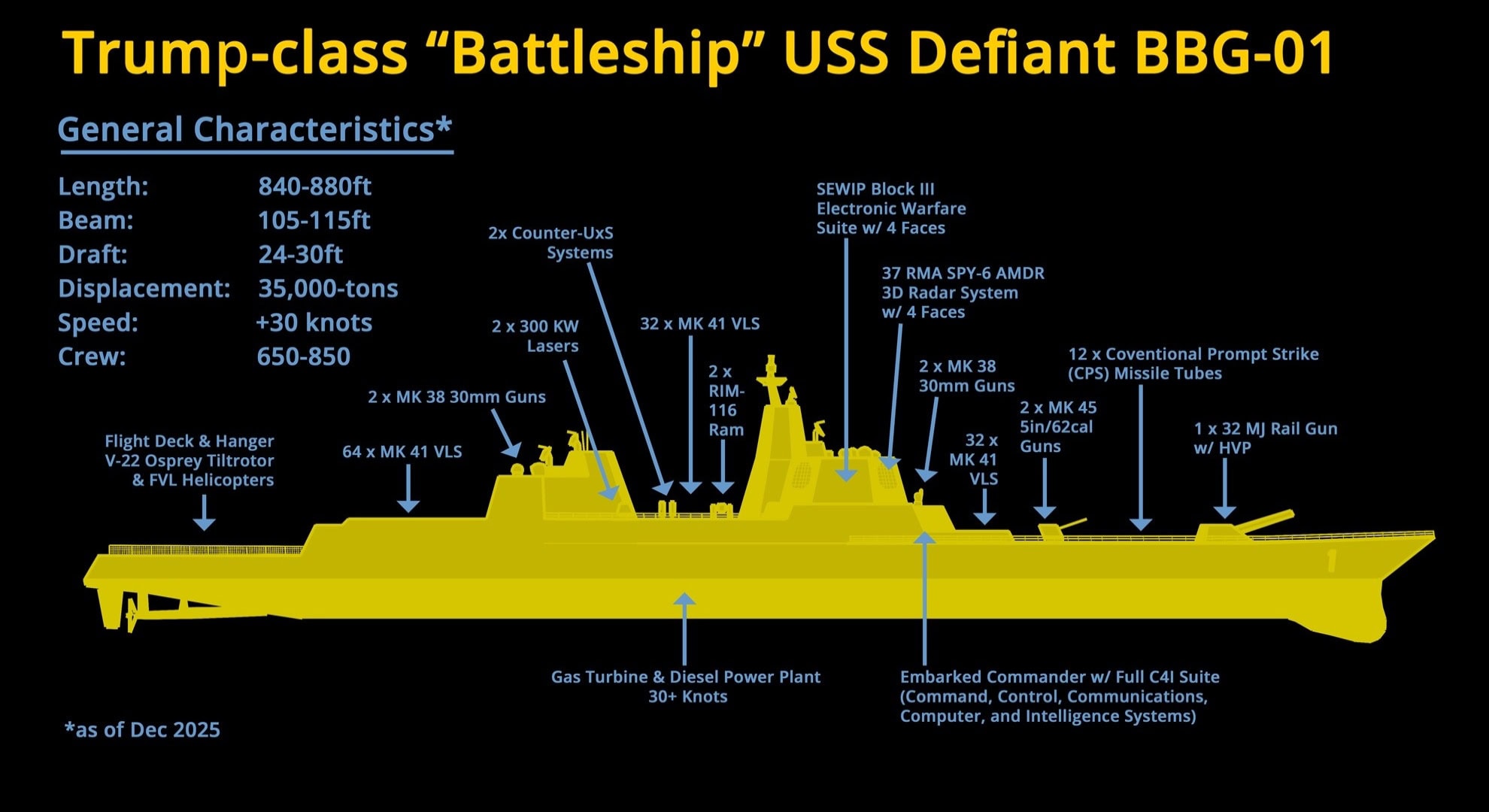
Trump-Class Battleship Creative Commons Photo
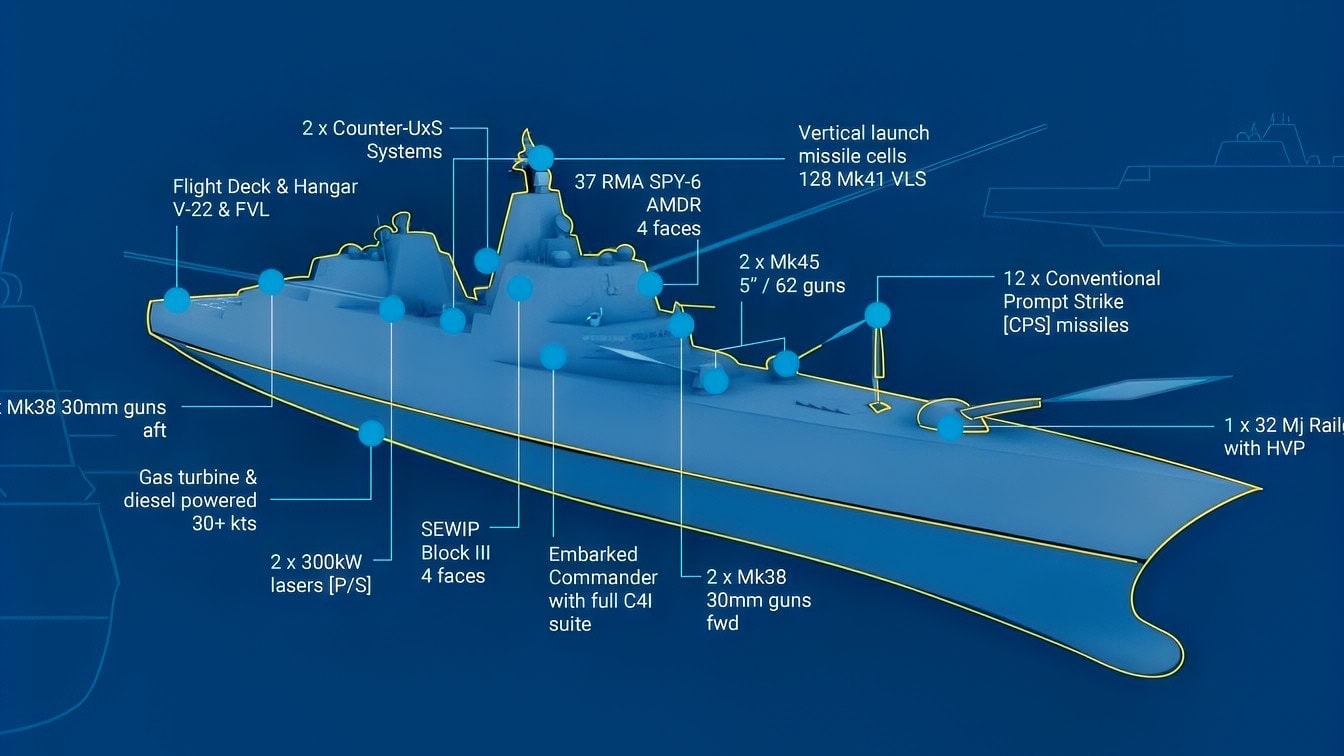
Trump-Class Battleship Creative Commons Image
Every design choice for naval warships is a tradeoff. Want more weapons? Then you must shed armor weight or lose speed. Want more armor and weapons? Then you must build a bigger ship to distribute that weight and bigger engines to move it.
The Defiant also has trade-offs in cost and capabilities versus having fewer ships patrol the world’s oceans.
Of the Navy’s two primary roles, the Defiant seems better suited on paper to travel with Carrier Strike Groups, both protecting them and increasing their punch against land and surface targets. Its worth should be judged by how well it performs in that role.
About the Author: Sean Spoonts
Sean Spoonts is the former Editor-In-Chief of SOFREP.com. He is a military analyst, writer, and commentator whose work has appeared in Newsweek, CNS News, Ukrinform, and various military/veteran media networks and professional publications, including the Military Intelligence Professional Bulletin. He is a U.S. Navy veteran, having served as an Aviation Anti-Submarine Warfare Operator and Search and Rescue Helicopter Aircrewman.