Summary and Key Points: At its peak, 286 Harriers flew in 8 squadrons, and when the UK retired its 72 Harriers, the Marines spent $181 million on airframes and engines. The last AV-8B flight came on June 3, 2026. Eleven F-35B and F-35C squadrons are flying, with a goal of 18.
The Harrier Was a True US Military Legend
In the late 1960s and early 70s, as the Hawker Siddeley GR.1 Harrier entered service with the UK’s Royal Air Force, the US Marine Corps took an immediate interest.
In the Harrier, the Marines saw an aircraft that could fill their primary mission requirement for a fixed-wing aircraft: close air support for Marines ashore.
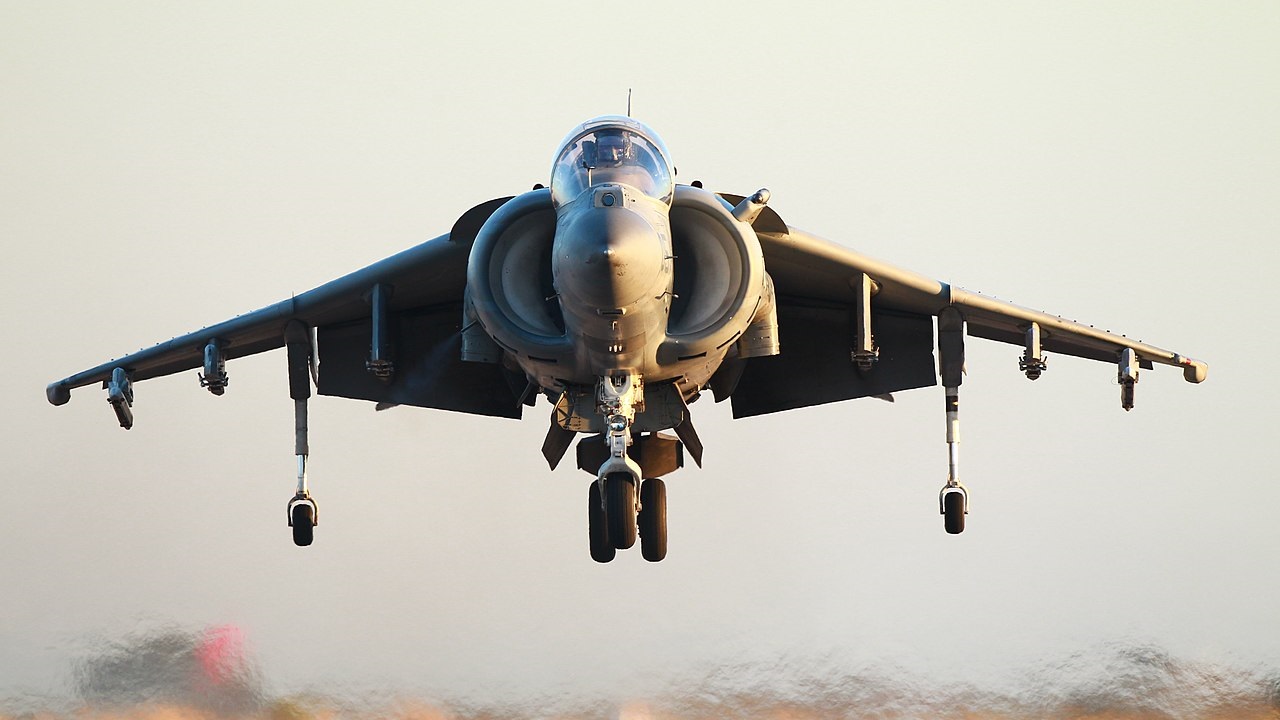
An AV-8B Harrier hovers over the flight line during the Marine Corps Community Services (MCCS) sponsored annual Air Show on Marine Corps Air Station (MCAS) Miramar, San Diego, Calif., Oct. 13, 2012. The MCAS Miramar Air Show showcases not only the aerial prowess of the Armed Forces but their appreciation of the community’s support and dedication to the troops. (U.S. Marine Corps photo by Cpl. Jamean Berry/Released)
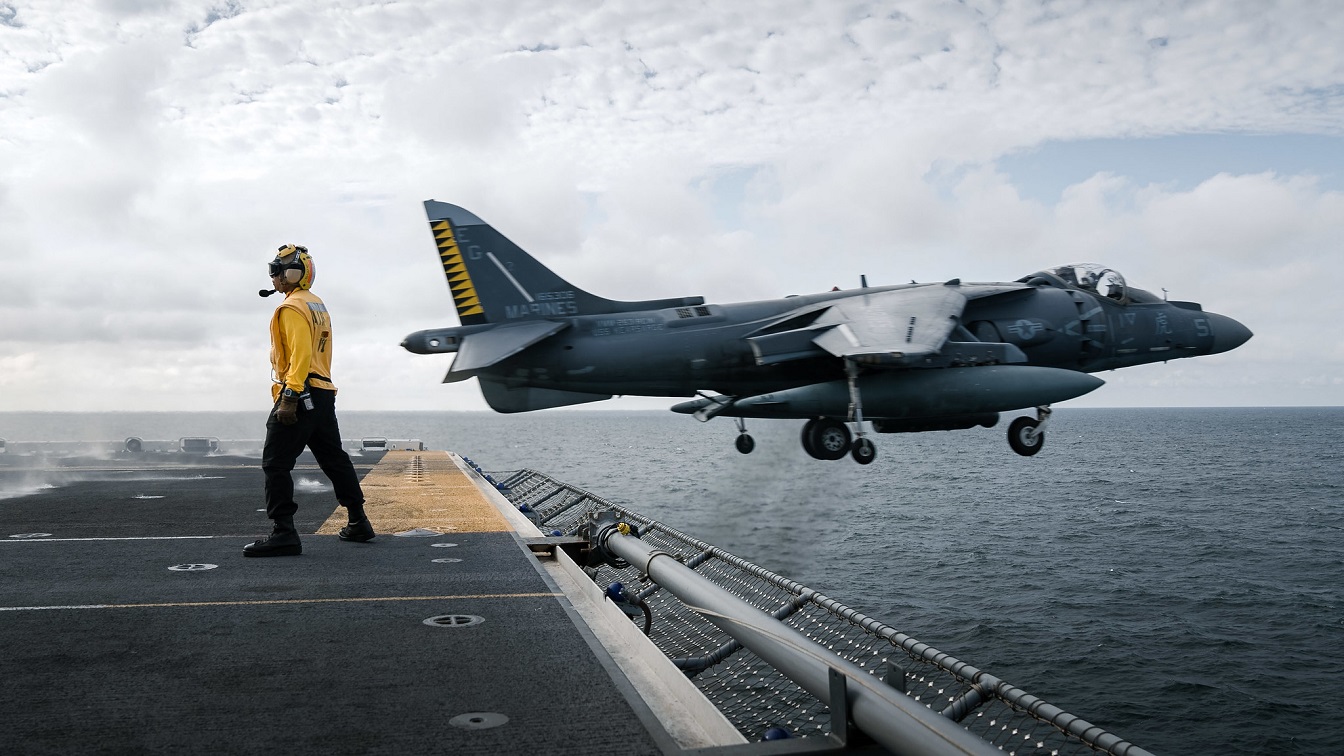
BALTIC SEA (Aug. 24, 2022) A U.S. Marine Corps AV-8B Harrier attached to the 22nd Marine Expeditionary Unit (MEU) flies past U.S. Navy Aviation Boatswain’s Mate (Handler) 1st Class Tu N. Chau during flight operations aboard the Wasp-class amphibious assault ship USS Kearsarge (LHD 3), Aug. 24, 2022. The Kearsarge Amphibious Ready Group and embarked 22nd MEU, under the command and control of Task Force 61/2, is on a scheduled deployment in the U.S. Naval Forces Europe area of operations, employed by U.S. 6th Fleet to defend U.S., allied and partner interests.
At the time, Marine squadrons flying the F-4 Phantom II and A-4 Skyhawks flew off Navy aircraft carriers far from the landing beaches.
This meant longer transit times going back and forth and less loiter time over the target.
If Marines could obtain the Harrier and fly it off amphibious assault ships and amphibious transport docks, they would be less than 100 miles from the landing beaches, and a jet capable of vertical take-off and landing could be quickly rearmed and refueled on deck and launched again on another close air support mission for Marines on the ground.
The Navy Was Happy To Approve Of The Marines Adopting The AV-8B Harrier.
The Navy would not mind Marines operating their own aircraft off the “Gator Navy” ships the Marines used for amphibious landings.
They were loath to bring their expensive aircraft carriers too close to the beach and within range of land-based aircraft.
Their WWII experience had taught hard lessons. Contrary to the myth that the Navy abandoned the Marines at Guadalcanal, that 7-month campaign cost the Navy 2 fleet carriers, 6-8 cruisers, 15-17 destroyers, a like number of submarines, and more than 600 aircraft.
More than 5,000 Sailors had been killed versus 1,353 Marines. All of that to protect the Marines fighting the Japanese on that island.
In that long, slogging fight across the Pacific, the Navy endured wave after wave of land-based aircraft and kamikazes attacking its carriers as it defended the fleet and supported the beach landings.
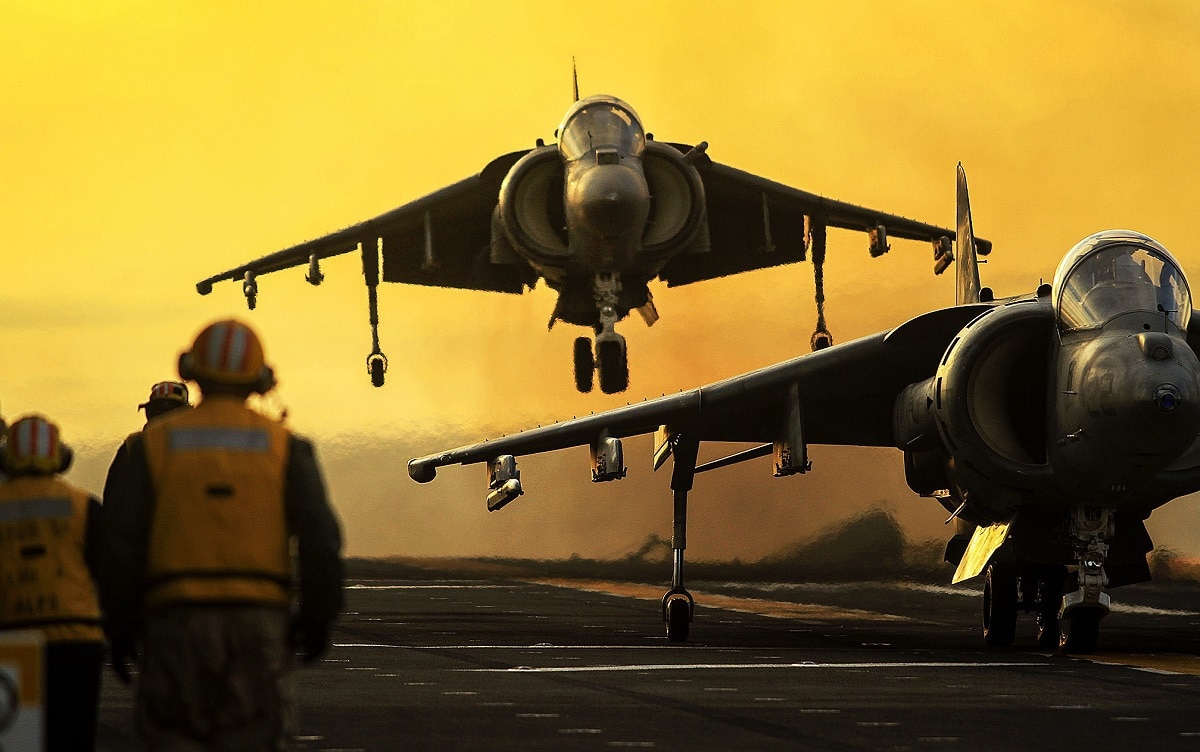
An AV-8B Harrier from Marine Attack Squadron (VMA) 214 performs a vertical take off from the flight deck of the amphibious assault ship USS Boxer (LHD 4). Boxer is underway conducting training off the coast of Southern California.
If Navy aircraft carriers no longer had to carry Marine squadrons dedicated to close air support missions, that meant more room for Navy bombers and fighters for other missions like inland strikes and engaging enemy fleets.
For The Marines, The AV-8B Would Need Significant Design Modifications
The Navy liked the plan for the Marines to fly Harriers.
The Marines got a supplemental funding request approved and had their first squadron of Harriers in the air by 1971.
The AV-8A version had its problems, though; it carried half the bomb weight of a Skyhawk, and the range was more limited.
To carry more bombs, it would need bigger wings and engines. Visibility out of the cockpit also needed improvement.
35 Years Of Combat Missions For The AV-8B Harrier
Within years of the first Marine Harriers taking to the air, the US and the UK formed a joint venture to improve the Harrier design. McDonnell Douglas created a larger composite wing, a raised cockpit, and Rolls-Royce provided a more powerful Pegasus engine.
The new AV-8B Harrier made its first flight in 1981 and entered Marine Corps service in 1985.
At its peak, 286 Harriers flew for the Marines in 8 squadrons.
The Harrier flew thousands of combat sorties over 35 years in Kuwait, Iraq, Afghanistan, the Balkans, and Libya. As recently as 2024, the Harrier AV-8B was shooting down Houthi drones in the Red Sea.
The Harrier became so integral to Marine Corps’ expeditionary doctrine that when the UK retired its 72 Harriers, the Marines spent $181 million to obtain a stockpile of airframes and engines to keep their own AV-8Bs flying.
The AV-8B Saw Its Last Sundown In June 2026
Earlier this year, on June 3rd, the AV-8B Harrier made its last flight for the Marine Corps with the “Bulldogs” of Marine Attack Squadron 223 (VMA-223), capping the Marine Corps’ truly extraordinary 55-year relationship (including the earlier AV-8A) with this multi-mission attack aircraft.
The Marines did not lose sight of the AV-8B’s utility when it came time to replace it.
The F-35B Lightning II was developed specifically for the Marine Corps to replace its Harriers, based on lessons learned over more than half a century of experience.
Currently, the Marines have 11 full squadrons of both F-35Bs and F-35Cs operating from aircraft carriers and amphibious landing ships, with an ultimate transition goal of 18 squadrons, which is double the number of Harrier squadrons they had in service.
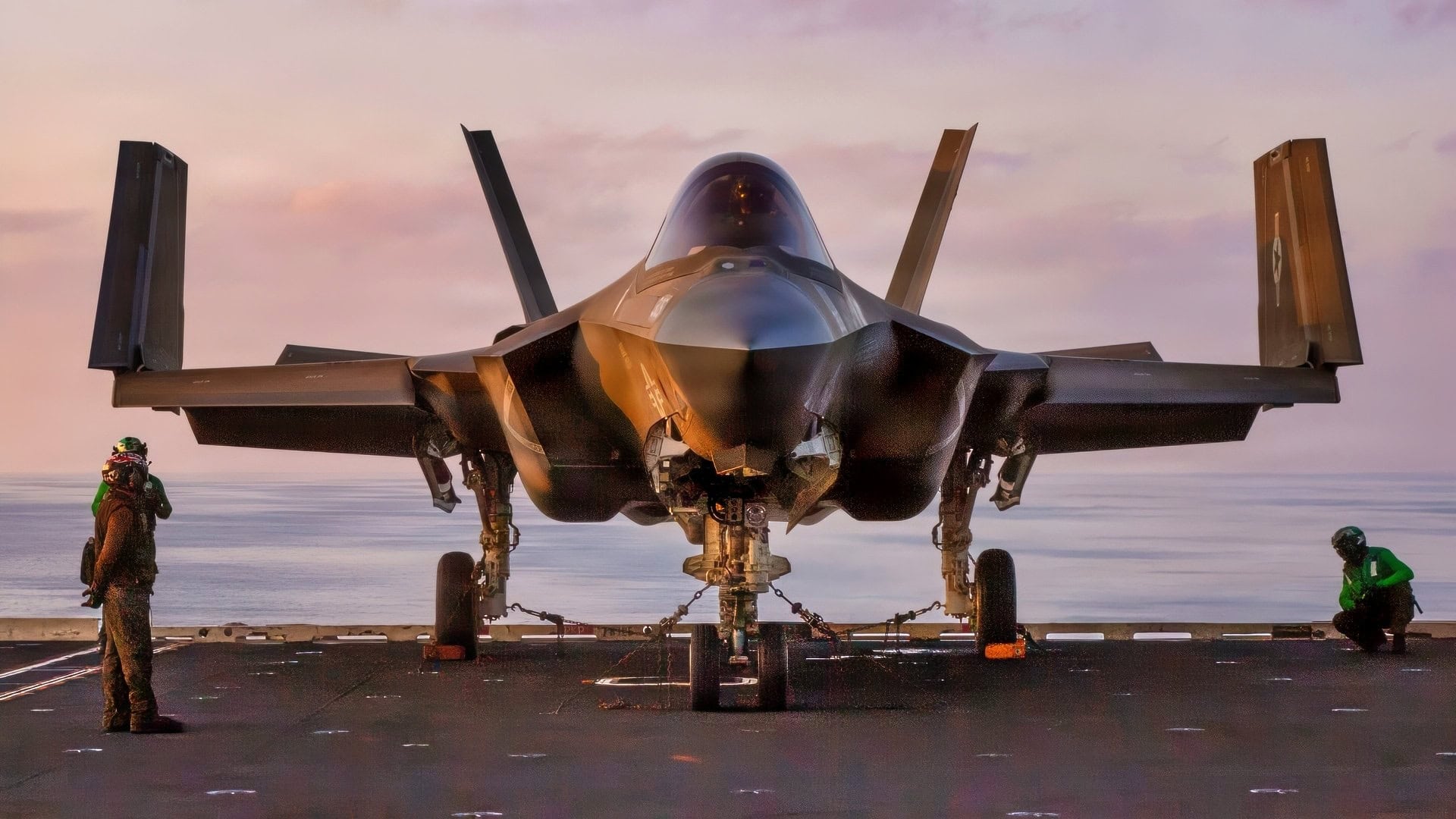
An F-35C Lightning II, attached to Marine Fighter Attack Squadron (VMFA) 314, is chained down on the flight deck of Nimitz-class aircraft carrier USS Abraham Lincoln (CVN 72) in support of Operation Epic Fury, Mar. 3, 2026. (U.S. Navy photo)
Specifications:
Missions: Close air support/Medium-range intercept/ Attack
Contractor: McDonnell Douglas Aircraft (Airframe), Rolls-Royce (Engine)
Deployed: First Flight: 25 May 1968; Operational: July 1971.
Propulsion:
TAV-8B/AV-8B Day Attack (DA): One Rolls-Royce Pegasus F402-RR-406 turbofan engine. 20,280 pounds of thrust(approximate)
AV-8B Night Attack (NA)/AV-8B Radar: One Rolls-Royce Pegasus F402-RR-408A turbofan engine, 22,200 pounds of thrust (approximate)
Length: 46 ft. 4 in. (14.12 m)
Height: 11 ft. 8 in. (3.55 m)
Wingspan: 30 ft. 4 in. (9.25 m)
Armament: 1 General Dynamics GAU-12 Equalizer 25 mm 5-barreled rotary cannon mounted under the fuselage in the left pod, with 300 rounds of ammunition in the right pod.
Air-to-Air Missiles:
AIM-120 AMRAAM(Radar-equipped AV-8B Plus Variant
AIM-9 Sidewinder
Air-to-Surface / Anti-Armor Missiles:
AMG-65 Maverick
AGM-122 Sidearm
Bombs & Munitions:
Joint Direct Attack Munitions (JDAM):
GBU-38, GBU-32, and GBU-54
Paveway series:
Laser-guided bombs (LGBs, such as GBU-12 and GBU-16)
Mark 80 series:
general-purpose bombs (Mk-81, Mk-82, Mk-83)
CBU-100 / Mk Rockeye II
Mark 77 fire (incendiary) bombs
B61 nuclear bomb
Rockets:
LAU-5003 / LAU-61 / LAU-68
Rocket pods carrying CRV7,
Hydra 70,
APKWS 70 mm,
Zuni 5-inch rockets
Other Equipment:
4 external drop tanks (300, 330, or 370 US gallons)
Intrepid Tiger II electronic jammer or targeting pods (LITENING)
About the Author: Sean Spoonts
Sean Spoonts is the former Editor-In-Chief of SOFREP.com. He is a military analyst, writer, and commentator whose work has appeared in Newsweek, CNS News, Ukrinform, and various military/veteran media networks and professional publications, including the Military Intelligence Professional Bulletin. He is a U.S. Navy veteran, having served as an Aviation Anti-Submarine Warfare Operator and Search and Rescue Helicopter Aircrewman.