
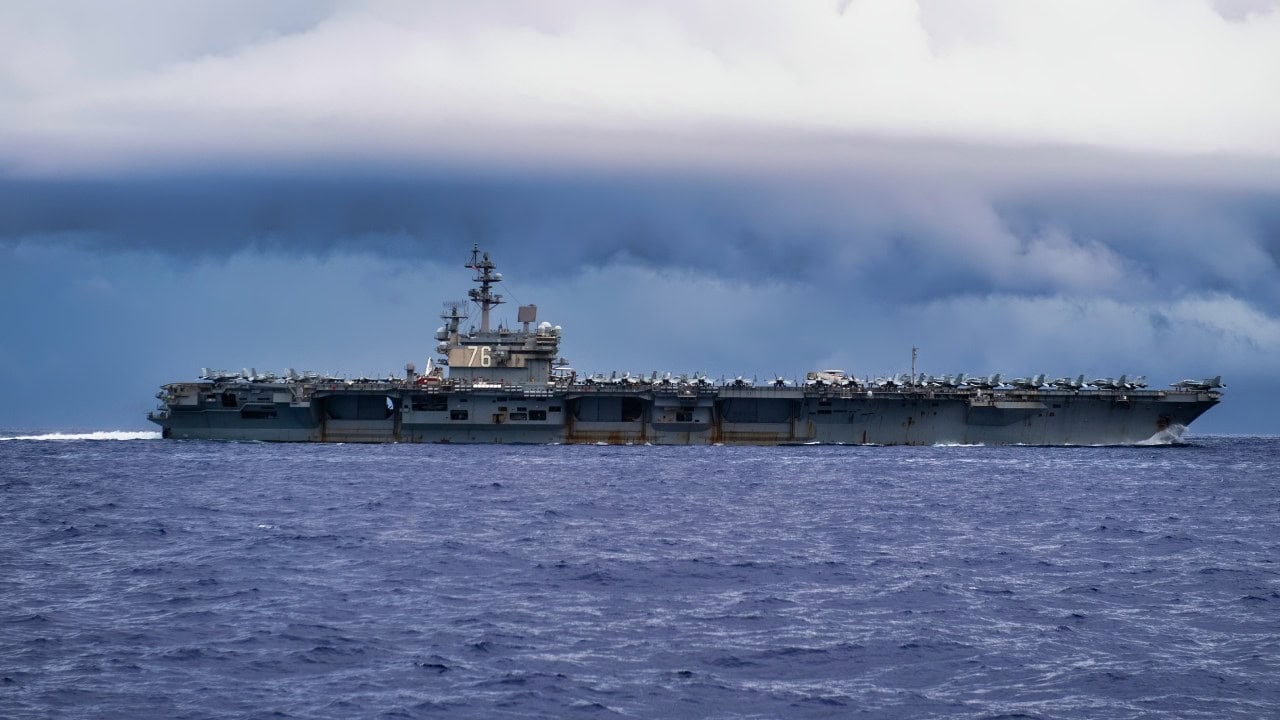
Key Points and Summary – Washington surged naval power across the Western Pacific this week, sailing two aircraft carriers and an amphibious assault ship as China expands its own blue-water reach.
-Navy photos show USS Abraham Lincoln operating in 7th Fleet waters, while USS George Washington continued Philippine Sea operations after Guam.
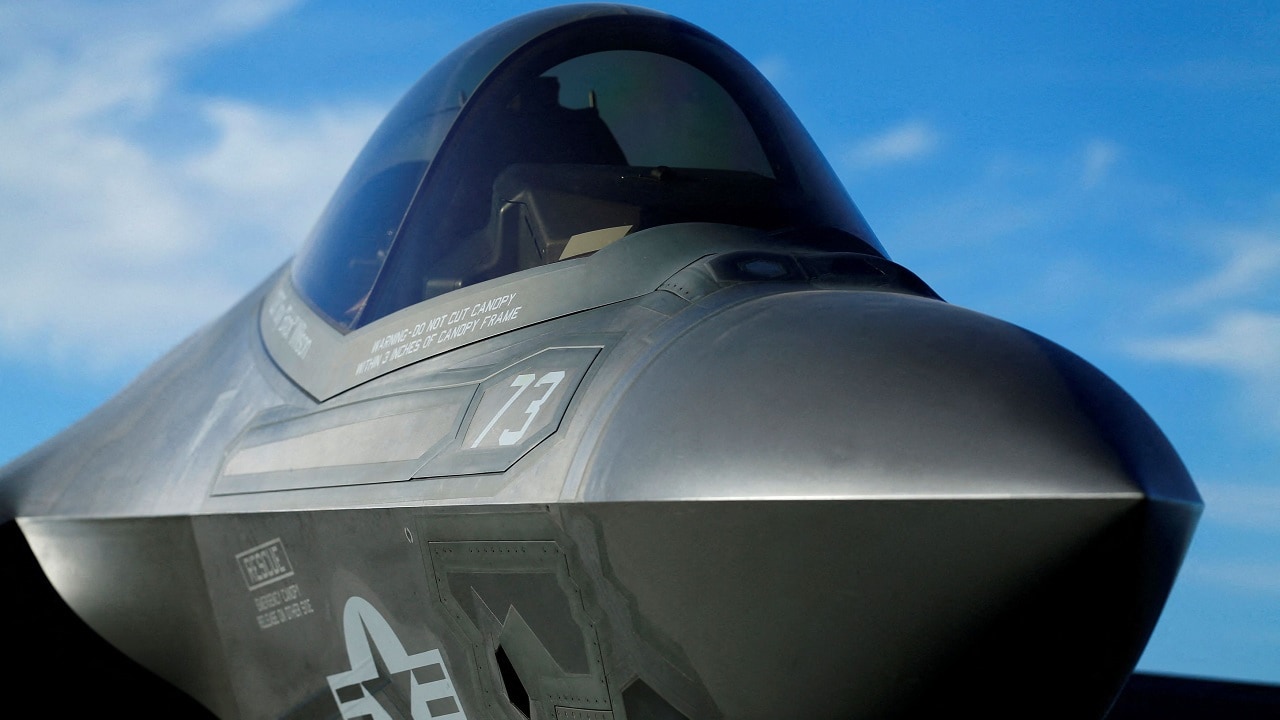
A Lockheed Martin Corp’s F-35C Joint Strike Fighter is shown on the deck of the USS Nimitz aircraft carrier after making the plane’s first ever carrier landing using its tailhook system, off the coast of California, November 3, 2014. REUTERS/Mike Blake (UNITED STATES – Tags: TRANSPORT MILITARY)/File Photo
-The deployment spotlights sea-based F-35 capability: Lincoln’s carrier air wing can field F-35Cs, and USS Tripoli brings F-35Bs, arriving in Da Nang with USS Robert Smalls during the 30th anniversary of U.S.-Vietnam ties.
-Officials framed the moves as routine, allied-focused deterrence amid Beijing’s carrier modernization and pointed to Fujian’s sea trials as signal.
Two U.S. Navy U.S. Aircraft Carriers and an F-35 Amphib Ship Surge Across the Western Pacific
The United States has moved two aircraft carriers and an amphibious assault ship across the Western Pacific this week, marking one of the most visible demonstrations of American naval power in the region as China continues to expand its maritime presence.
Notably, the aircraft carriers deployed to the area are equipped to deploy F-35 stealth fighters.
The move comes as Beijing pushes to modernize its armed forces and projects naval strength through its own carrier deployments, and as its newly assembled warship groups sail through contested waters.
Photographs released by the U.S. Navy this week show the aircraft carrier USS Abraham Lincoln underway in the 7th Fleet’s area of operations, conducting what the service described as routine activities to preserve a “free and open Indo-Pacific.”
“USS Abraham Lincoln (CVN 72), flagship of the Abraham Lincoln Carrier Strike Group, is underway conducting routine operations in the U.S. 7th Fleet area of operations, demonstrating the U.S. Navy’s long-term commitment to a free and open Indo-Pacific,” the full Navy caption reads.
The Chinese Foreign Ministry has not publicly commented on the decision. Still, the deployment will not go unnoticed, given that it marks the latest development in a steady back-and-forth display of capabilities among the U.S., its allies, and Beijing in the Western Pacific’s strategic waterways.
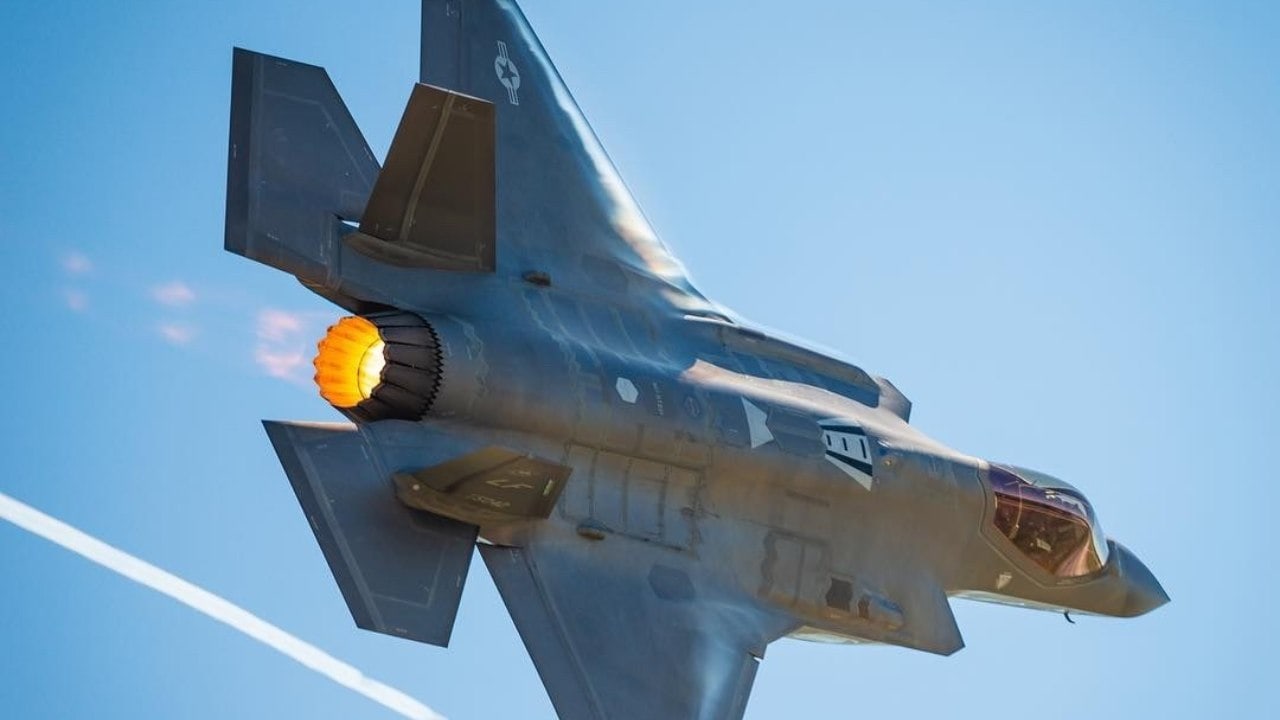
Capt. Andrew “Dojo” Olson, F-35 Demonstration Team commander and pilot performs a dedication pass in an F-35A Lightning II during the 2019 Wings Over Wayne Airshow April 27, 2019, at Seymour Johnson Air Force Base, North Carolina. The WOW Airshow marks the third public performance of the F-35 Demo Team’s new aerial demonstration during 2019 airshow season.
The F-35s aboard American carriers remain central to U.S. naval presence in the region. The jet family – which includes the F-35A for land-based operations, the F-35B for short takeoffs and vertical landings, and the F-35C for carrier operations – grants U.S. naval forces a broad reach across the region, even if the fighter jets are unlikely to be used at this stage.
The 7th Fleet, which is responsible for the Western Pacific and Indian Ocean, remains the United States’ most significant forward-deployed naval formation. With between 50 and 70 vessels in total, 150 aircraft, and more than 27,000 personnel operating at any given time, the fleet serves at the core of America’s efforts in the Indo-Pacific region. The Abraham Lincoln, carrying F-35C jets, departed San Diego in late November to begin its Pacific deployment.
A second carrier, the USS George Washington, is also active in the area. The ship continued operations in the Philippine Sea earlier this week following a port visit to Guam, the westernmost U.S. territory. Capt. Tim Waits, commanding officer of the George Washington, praised his crew in a press release issued this week, noting that the carrier’s mission is “to preserve the peace, respond in crisis, and win decisively in war.”
“Our presence in the Indo-Pacific and integration with our allies and partners gives us a strategic advantage that enables mission success,” he added.
While the carriers themselves are the most prominent symbols of American presence in the region, the deployment of additional assets allows the fleet to maintain coverage across the region. The amphibious assault ship USS Tripoli – which operates F-35B jets – entered Da Nang, Vietnam, this week alongside the cruiser USS Robert Smalls.
Their arrival marked the 30th anniversary of U.S.-Vietnam relations, too. The visit also occurred only months after the Tripoli arrived in Sasebo, Japan, as part of a scheduled rotation of U.S. forces.
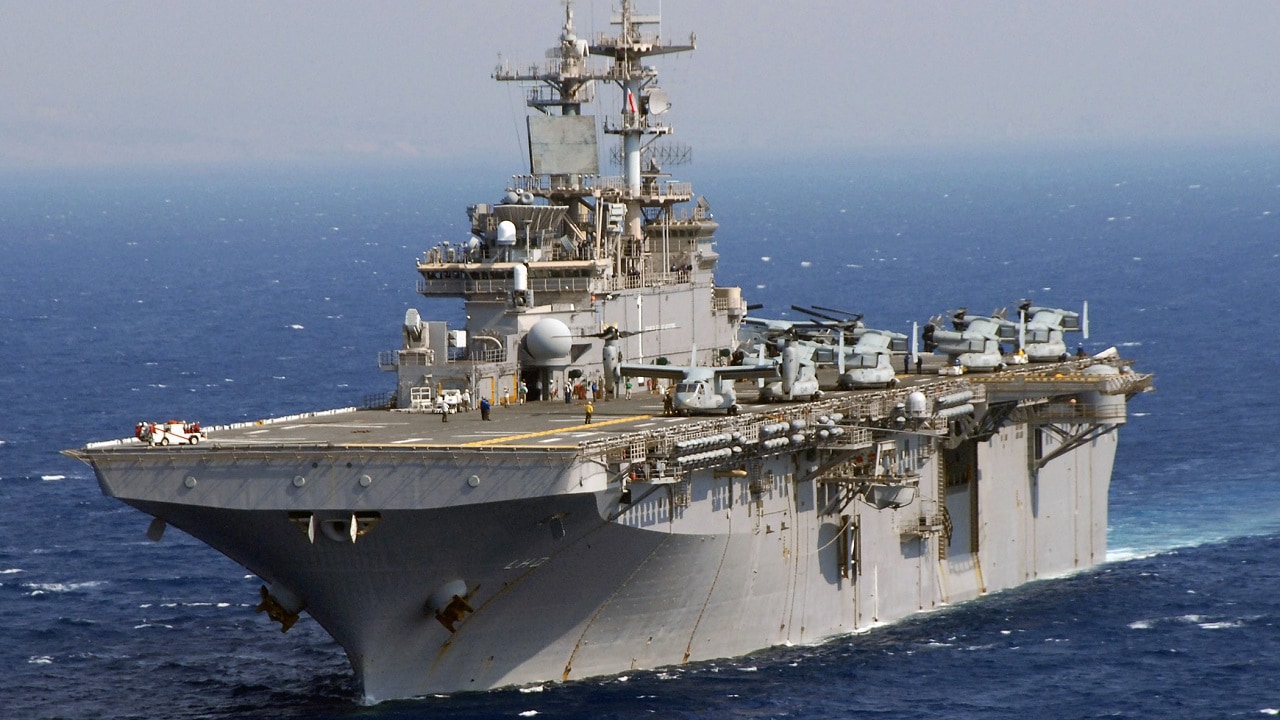
(Oct. 4, 2007) – U.S. Marine Corps MV-22 Ospreys, assigned to Marine Medium Tiltrotor Squadron (VMM) 263, Marine Aircraft Group 29, prepare for flight on the deck of the multipurpose amphibious assault ship USS Wasp (LHD 1). Wasp is on surge deployment to the Middle East carrying the Osprey to its first combat deployment. U.S. Navy photo by Mass Communication Specialist 2nd Class Zachary L. Borden (RELEASED)
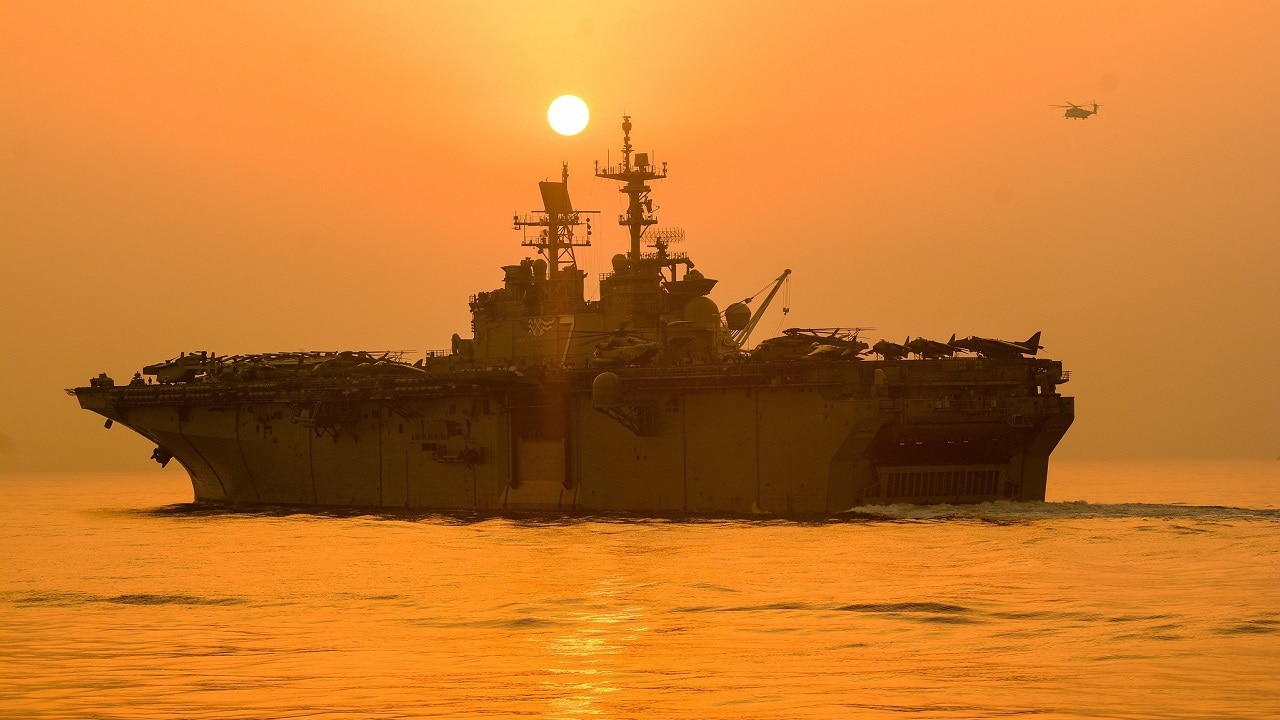
(Aug. 4, 2021) The Wasp-class amphibious assault ship USS Iwo Jima (LHD 7) transits the Strait of Hormuz, Aug. 4, 2021. Iwo Jima is deployed to the U.S. 5th Fleet area of operations to ensure maritime stability and security in the Central Region, connecting the Mediterranean and the Pacific through the western Indian Ocean and three strategic choke points. (U.S. Navy photo by Seaman Logan Kaczmarek)
Speaking about the visit by Tripoli, U.S. Ambassador to Vietnam Marc E. Knapper described the event as “heartening” proof that the U.S. and Vietnam remain as close as ever.
“The visit by USS Tripoli and USS Robert Smalls, coming as we close out celebrations to mark 30 years of bilateral relations, is proof that the U.S.-Vietnam partnership has never been better,” Knapper said. “It is so heartening to see the warm welcome U.S. service members have received here in Da Nang, a city that holds a special place in the history of our bilateral relations and recently faced challenges following multiple typhoons.”
What Happens Next?
U.S. presence in the region is likely to remain elevated as Beijing continues expanding its carrier operations and long-range naval deployments. China’s third aircraft carrier, Fujian, began sea trials earlier this year – a milestone U.S. officials say reflects Beijing’s ambition to field a fully modern blue-water fleet capable of operating far from its shores.
The Pentagon’s 2024 China Military Power Report similarly warns that China is accelerating efforts to project power deeper into the Pacific, including through increasingly complex joint naval drills.
About the Author:
Jack Buckby is a British author, counter-extremism researcher, and journalist based in New York who writes frequently for 19FortyFive. Reporting on the U.K., Europe, and the U.S., he works to analyze and understand left-wing and right-wing radicalization, and reports on Western governments’ approaches to the pressing issues of today. His books and research papers explore these themes and propose pragmatic solutions to our increasingly polarized society. His latest book is The Truth Teller: RFK Jr. and the Case for a Post-Partisan Presidency.