
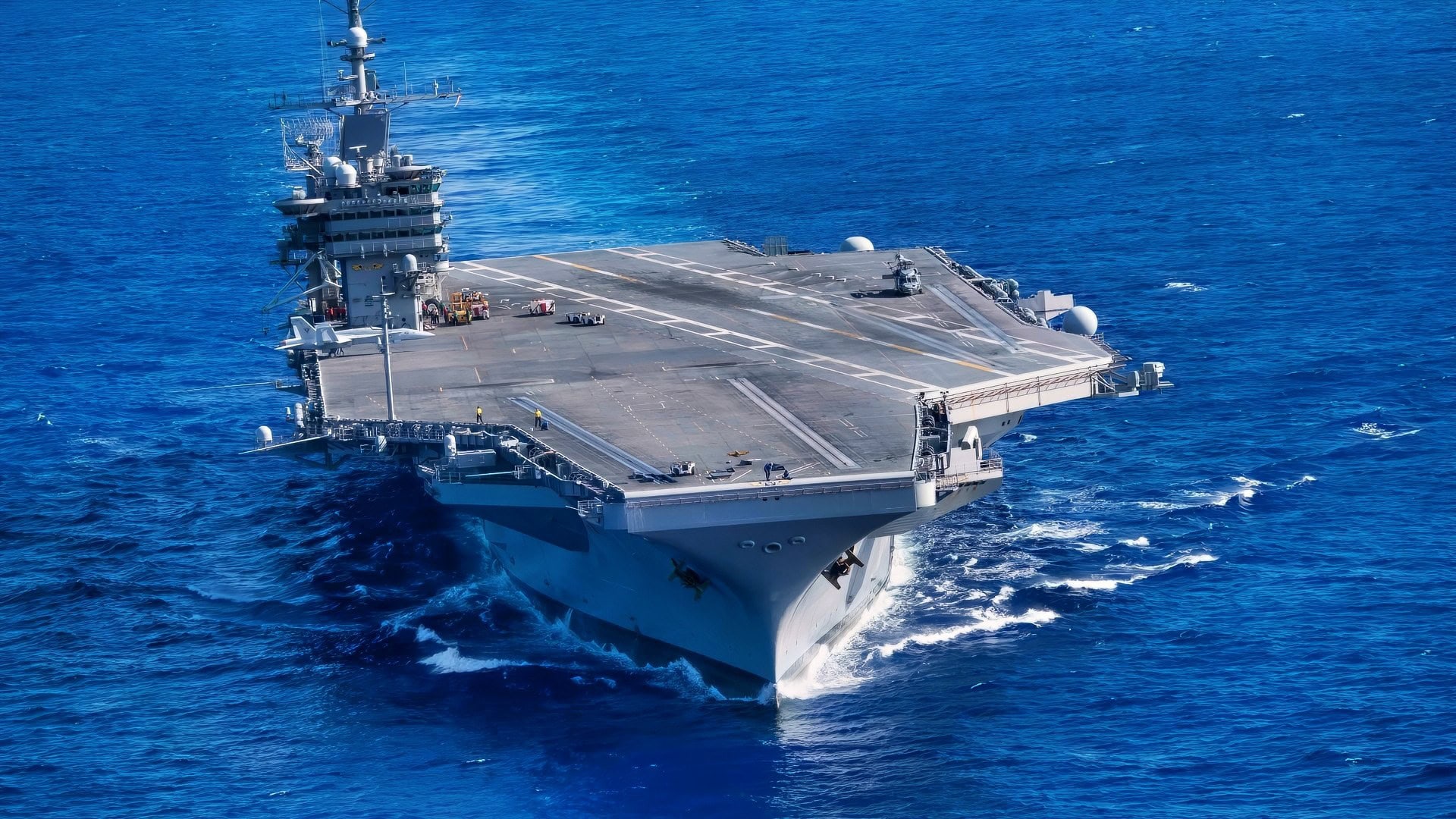
USS John F. Kennedy’s Final Ride: A 1,000-Foot Carrier Heads To The Scrapyard
For decades, the aircraft carrier USS John F. Kennedy (CV-67) was a visible symbol of American maritime power – and while for many years it served as an operational flattop, it later became a news story as the Navy grappled with the difficulty of retiring a ship of this size.
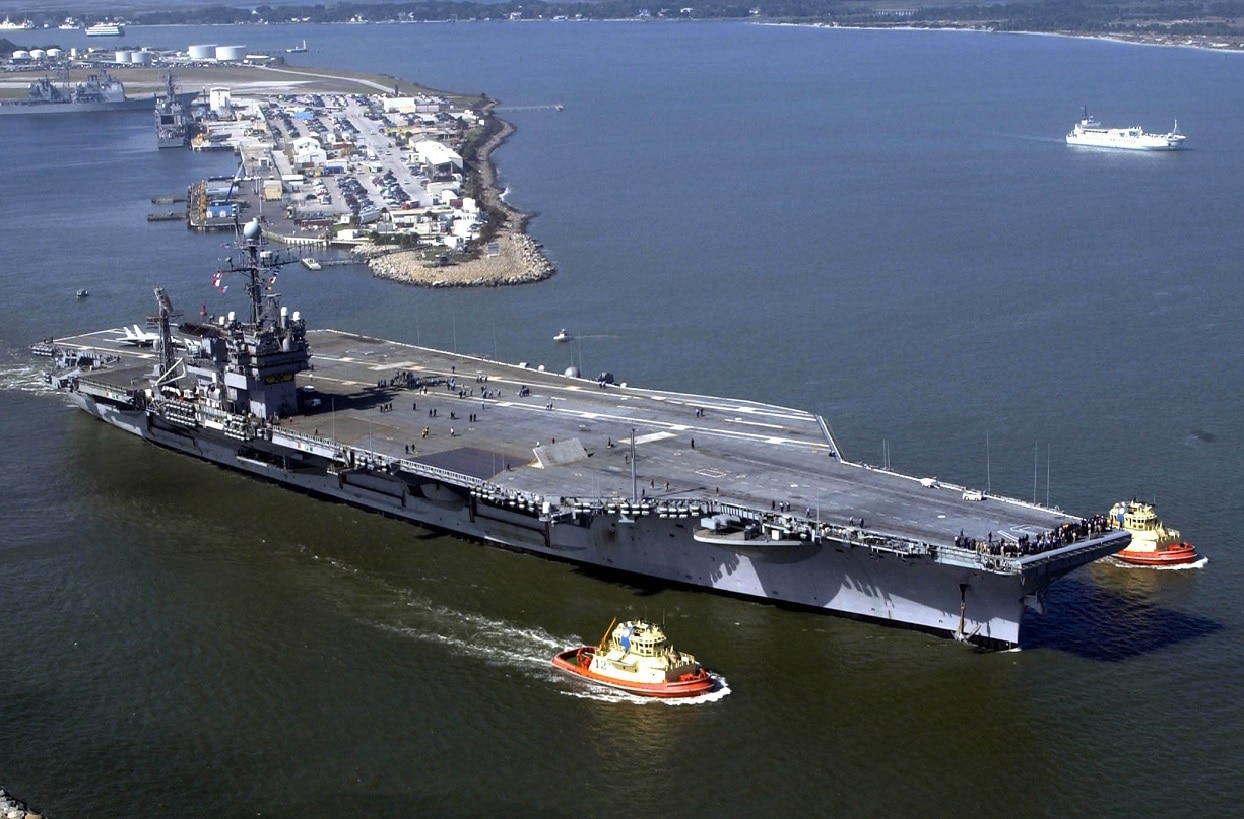
Mayport, Fla. (Nov. 11, 2003) — USS John F. Kennedy (CV 67) departs Naval Station Mayport under her own power following a ten month Extended Service Repair Availability (ESRA). During a short at sea period the ship will test numerous systems installed or upgraded while in port. The $300 million maintenance period included renovation of berthing compartments, and new navigational radar system. U.S. Navy photo by Photographer’s Mate 1st Class Greg Curry. (RELEASED)
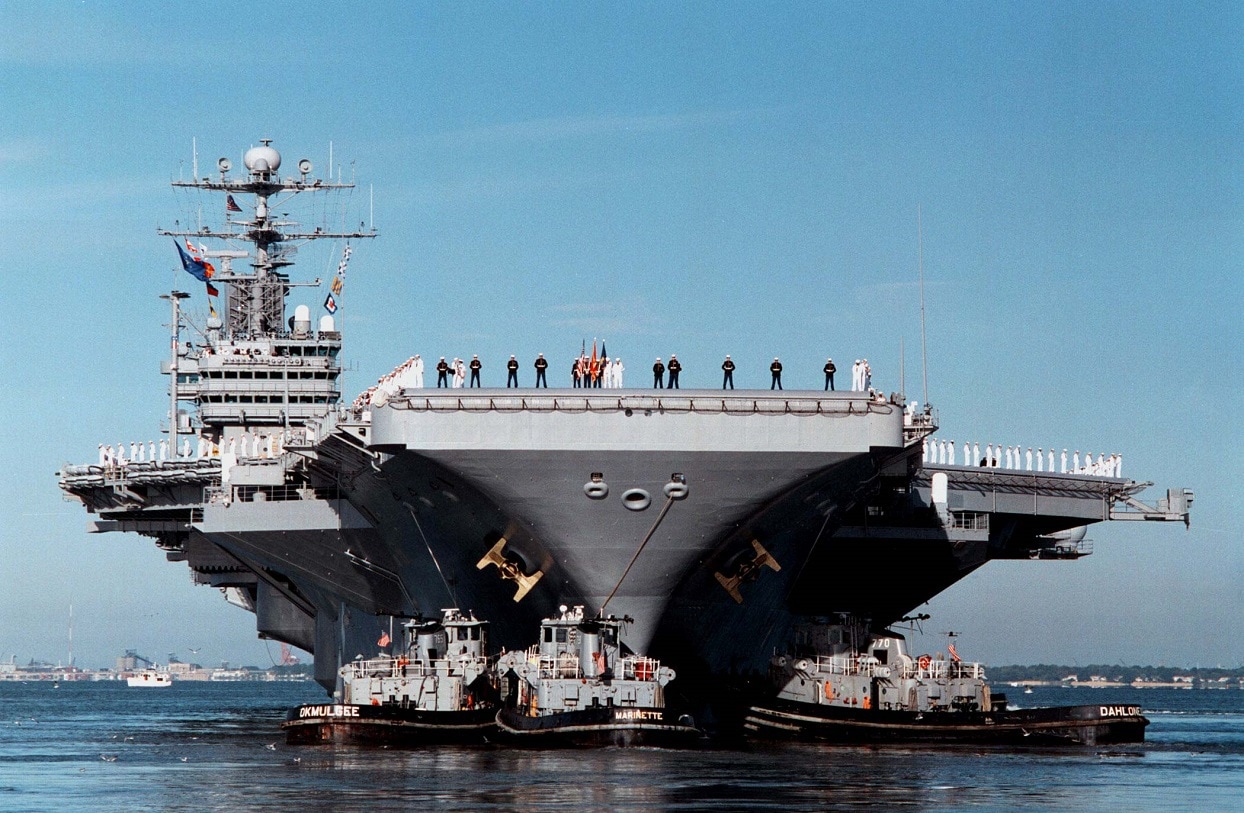
Sailors and Marines man the rail as three harbor tugs push the aircraft carrier USS George Washington (CVN 73) away from Pier 11 at Norfolk Naval Base on Oct. 3, 1997, for a scheduled six-month deployment. The George Washington will relieve the USS John F. Kennedy (CV 67) to conduct operations in the Mediterranean Sea. DoD photo by Petty Officer 2nd Class Christopher Vickers, U.S. Navy.
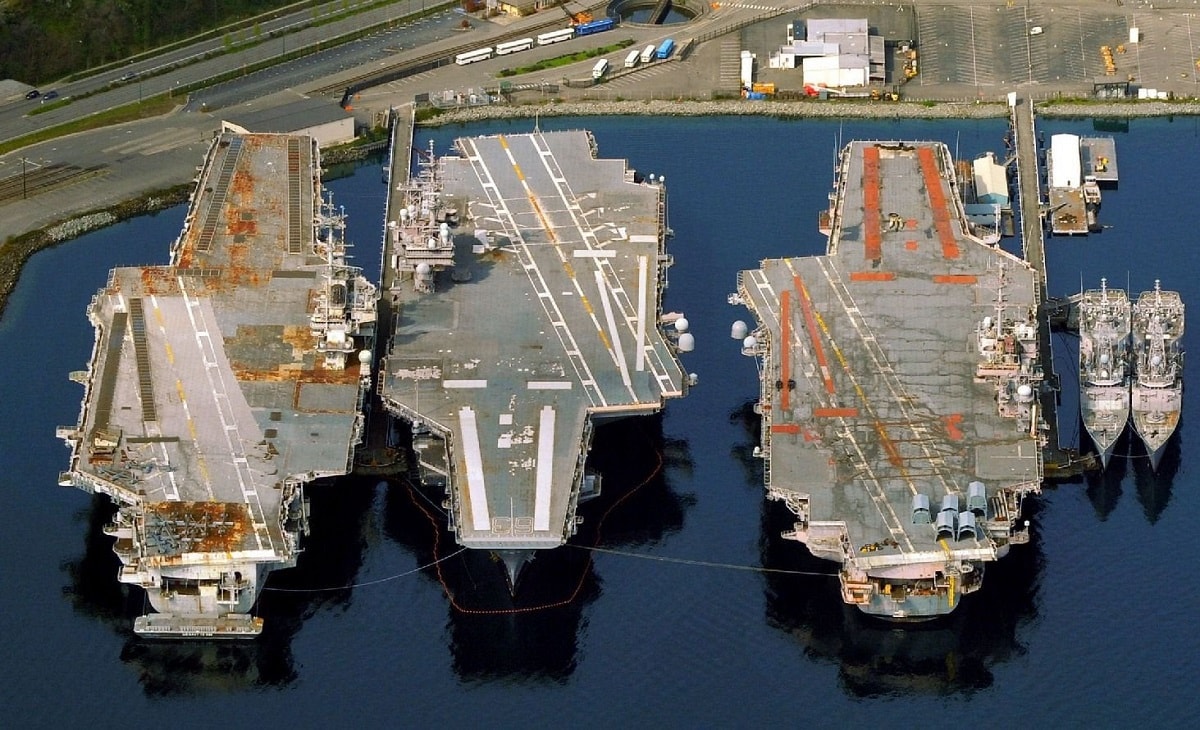
Image of several old carriers headed to scrap yard.
On January 16, 2025, the decommissioned carrier departed the U.S. Navy’s Inactive Ships Maintenance Facility in Philadelphia to be towed to Brownsville, Texas, where it will be dismantled. “The ex-John F. Kennedy (CV 67) began its final journey this morning as it departed from the U.S. Navy’s Inactive Ships Maintenance Facility in Philadelphia, PA for transit to Brownsville, Texas where it will be dismantled,” a statement from January 16, 2025 reads.
The move marked the beginning of the end of the Navy’s last conventionally powered aircraft carrier – a distinction that makes CV-67 particularly notable because every U.S. carrier class that followed it – beginning with nuclear-powered supercarriers – made the shift to reactors rather than relying on fossil-fuel propulsion.
After its departure, the carrier entered the Brownsville ship channel on February 2, 2025, completing its final transit and arriving at the dismantlement site operated by International Shipbreaking Ltd.
How a 1,000-foot Supercarrier Gets Scrapped
The Navy’s official position on the dismantlement and retirement of the CV-67 is this: the vessel was removed from service years ago and was ultimately slated for dismantlement once museum-ship proposals failed to produce a viable plan.
Specifically, that means no city or nonprofit was able to secure the funding, docking location, and long-term maintenance plan required to keep the aircraft carrier as a public museum, leaving dismantlement as the only remaining option.
For the ship to be dismantled, it must enter into a long and regulated industrial process that involves cutting the ship down, recycling what materials can be recycled, and disposing of hazardous materials under U.S. environmental and workplace rules. All of that must take place at a site capable of handling a vessel of this size.
The Brownsville destination was not incidental: the same contractors and port infrastructure here have been used for other retired carriers, including the former USS Kitty Hawk (CV-63), which arrived in Brownsville for scrapping in 2022. That limitation matters because the Navy does not fully control where a carrier can be dismantled: only a small number of U.S. shipyards have the permits, skilled workforce, and heavy-industrial access required to break up a carrier-sized hull – and even fewer are capable of doing it at scale or at relatively short notice.
A detail of this most recent case that keeps drawing attention is the price, but this is nothing new. The Navy sold both Kitty Hawk and John F. Kennedy to the shipbreaker for one cent each, proving that a retired supercarrier – despite its huge value both in terms of its parts and its history – is actually a costly liability more than it is an asset.

At Sea (Aug. 9, 2004) -USS Kitty Hawk (CV 63) plows through the waters of the Pacific Ocean as it makes its approach to the oiler USNS Yukon (T-AO 202) before commencing a replenishment-at-sea (RAS) evolution. A RAS is the on- and off-loading of fuel and stores while ships are under way. Currently underway in the 7th Fleet area of responsibility (AOR), Kitty Hawk demonstrates power projection and sea control as the world’s only permanently forward-deployed aircraft carrier, operating from Yokosuka, Japan.
U.S. Navy photo by Photographer’s Mate 3rd Class Jason T. Poplin
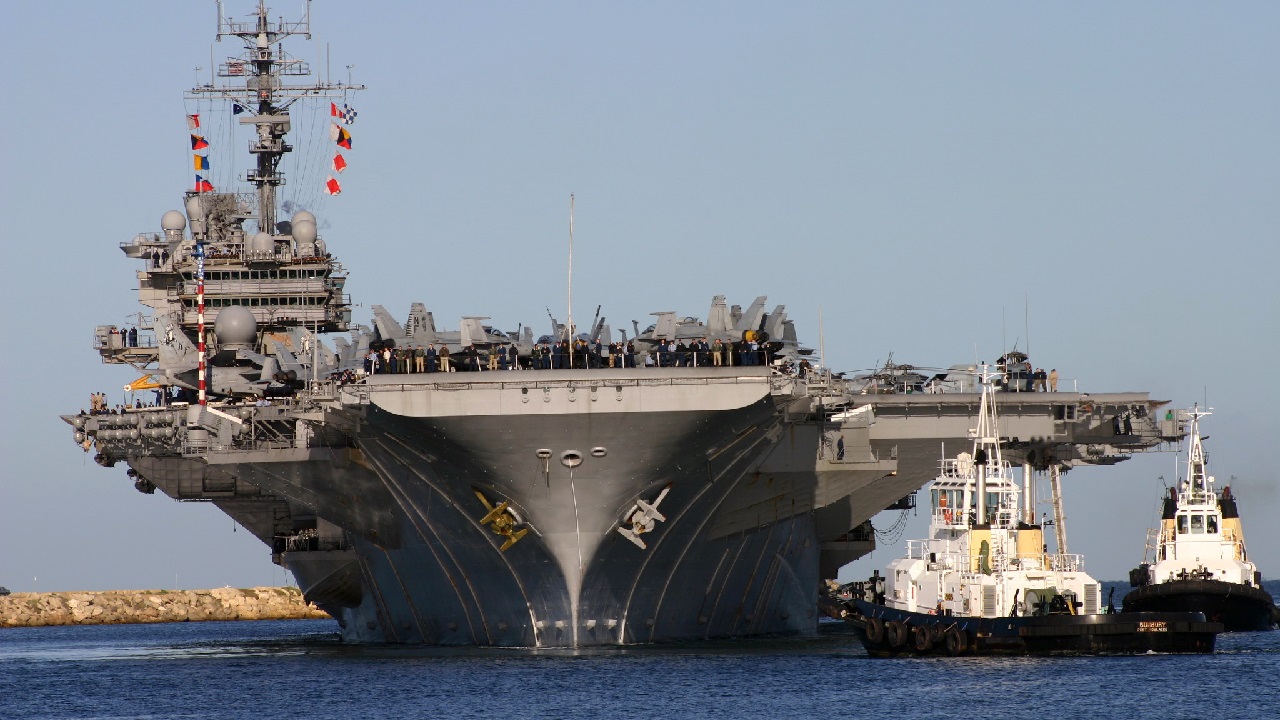
Fremantle Harbour, Australia (Apr. 22, 2004) – Tug boats escort USS Kitty Hawk (CV 63) and embarked Carrier Air Wing Five (CVW-5) into Fremantle Harbour, Australia where the crew will enjoy a five day port call. This was Kitty Hawk’s fifth visit to Fremantle and the ninth for CVW-5. Kitty Hawk is one two remaining conventionally powered aircraft carriers in the U.S. Navy, and is currently homeported in Yokosuka, Japan.
To shipbreakers, it’s an asset that can be purchased cheap and broken down using their specialist tools, knowledge, and workforce – but the Navy and everyone else, it’s a burden that requires expensive upkeep, towing, and a place to dock.
Local coverage of the February 2025 arrival showed just how much goes into this final phase, with crowds gathering to watch the carrier’s final entry into the ship channel where it would begin the process of being dismantled.
Thankfully for shipbuilders, the CV-67 is not nuclear-powered, meaning the Navy and the contractor can avoid the extra layer of complexity associated with dismantling ships with reactor plants. However, those problems can no longer be avoided – because the Kennedy is the last of its kind.
New Challenges Ahead
With the CV-67 dismantlement underway, the next major story will be what happens when the Navy begins retiring its nuclear supercarriers in large numbers.
The Government Accountability Office has already warned that dismantling and disposing of the ex-USS Enterprise (CVN-65) – America’s first nuclear-powered aircraft carrier – could cost more than $1 billion, and that typical budgeting and reporting practices do not provide enough detail for robust oversight of a project of this size.
In other words: if scrapping a conventional carrier is difficult, scrapping nuclear carriers introduces higher costs, regulatory authority questions, and extensive planning requirements that can ultimately turn into years-long budget fights.
Those future costs are unavoidable and coming at the same time the Navy is trying to keep its carrier force at a politically and operationally acceptable level.
The service has repeatedly stressed the importance of maintaining an 11-carrier force – but the disposal and replacement timelines do not always cleanly align with requirements, and that number can only be maintained if new carriers also become operational on time.
Whether the Navy can navigate this coming problem without sacrificing readiness will depend on decisions being made now – long before the next carrier even reaches the end of its service life.
About the Author:
Jack Buckby is a British researcher and analyst specialising in defence and national security, based in New York. His work focuses on military capability, procurement, and strategic competition, producing and editing analysis for policy and defence audiences. He brings extensive editorial experience, with a career output spanning over 1,000 articles at 19FortyFive and National Security Journal, and has previously authored books and papers on extremism and deradicalisation.