
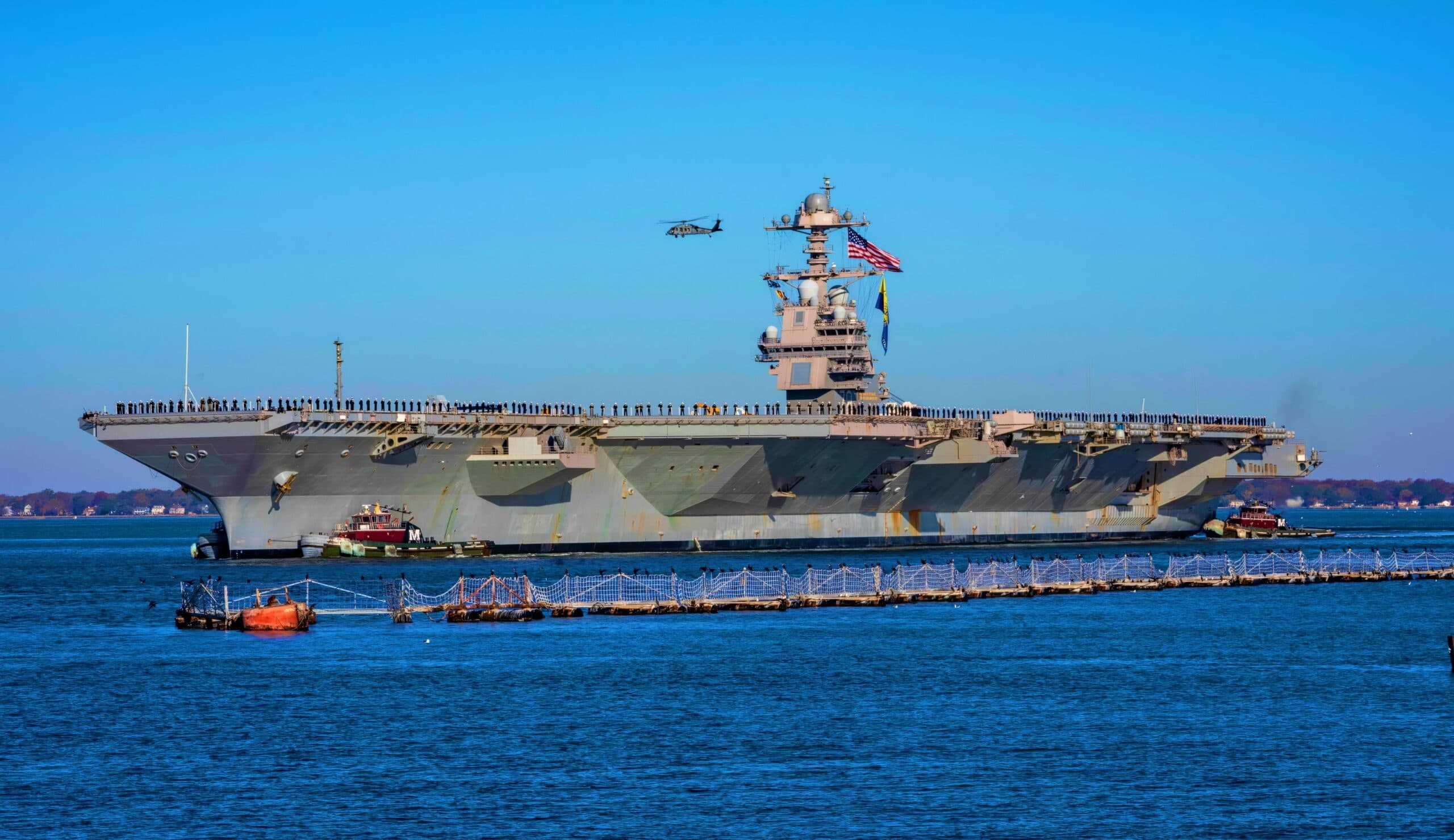
U.S. Navy Aircraft Carrier USS Gerald R. Ford Has Been at Sea Since June 24, 2025—and the Navy Is Worried
After the Iranian regime responded to protests by murdering thousands of people—some estimates run as high as 12–20,000 dead, U.S. President Trump has told the Iranian people that help is on the way.
The clerical regime responded on Wednesday, warning Trump against interfering with the country and saying “this time” the bullet “won’t miss” as it showed a picture of the president emerging from an assassination attempt at a Butler, Pennsylvania, campaign rally in July 2024.
There are currently no aircraft carriers in the U.S. Central Command (CENTCOM) region, and the Navy’s top admiral said he wants to avoid extending the deployment of the USS Gerald R. Ford Carrier Strike Group (CSG). The CSG could be sent for any potential operation against the Iranian regime.
The Ford carrier strike group has been operating in the Caribbean, including during the Operation Absolute Resolve mission to capture Venezuelan dictator Nicolás Maduro.
The CSG has been at sea since leaving its homeport of Norfolk on June 24, 2025. When the Navy plans force employment timelines, it prioritizes both current force demands and the ability to meet future contingencies. It routinely deploys forces around the globe, sometimes to respond to crises such as the current situation in Iran.
The Ford and its carrier strike group typically follow a six-to-seven-month deployment, with up to six months in a shipyard. Delaying that maintenance by continually extending the carrier’s deployment often leads to costs spiraling.
Chief Of Naval Operations Seeks Alternative to the Ford
Chief of Naval Operations (CNO) Admiral Daryl Caudle addressed the situation at the Surface Navy Association’s annual symposium.
“I think the Ford, from its capability perspective, would be an invaluable option for any military thing the president wants to do,” Caudle said. “But if it requires an extension, it’s going to get some push back from the CNO. And I will see if there is something else I can do.”
Caudle told TWZ: “I am a big non-fan of extensions, and because they do have a significant impact. Number one, I’m a sailors-first CNO. People want to have some type of certainty that they’re going to do a seven-month deployment.”
“When it goes past that, that disrupts lives,” Caudle added. “It disrupts things like funerals that were planned, marriages that were planned, okay, babies that were planned, you know, so the human element of extension, I’m not a big fan of obviously.”
Currently, there are six Navy warships in the CENTCOM area of operations, including three Arleigh Burke-class destroyers—the USS McFaul (DDG-74), USS Mitscher (DDG-57), and USS Roosevelt (DDG-80)—and three Littoral Combat Ships, the USS Tulsa (LCS-16), USS Santa Barbara (LCS-32), and USS Canberra (LCS-30).
Having an aircraft carrier isn’t necessary for offensive operations, but adding the air element makes such operations much more powerful than an amphibious assault ship alone.
Long Sea Deployments Hurt Readiness, Maintenance, And Morale
Long naval deployments can lead to severe strain on sailor morale and well-being, increased material readiness issues, and significant disruption to meticulously planned ship maintenance schedules and workforce. This creates a detrimental cycle of crisis and remediation that affects overall fleet readiness.
Extended time away from family increases stress, affecting mental health and potentially leading to lower retention rates. Pushing ships harder than normal also stresses the maintenance workforce and disrupts the balance of available personnel.
Effects on Ships And Readiness
Long, extended deployments often accelerate wear and tear on operating systems and equipment. Ships operating past their planned cycles deteriorate faster and experience unexpected breakdowns.
Maintenance backlogs are frequently encountered. Extended deployments mean critical components begin to need repairs, increasing the maintenance workload and delaying return-to-service dates.
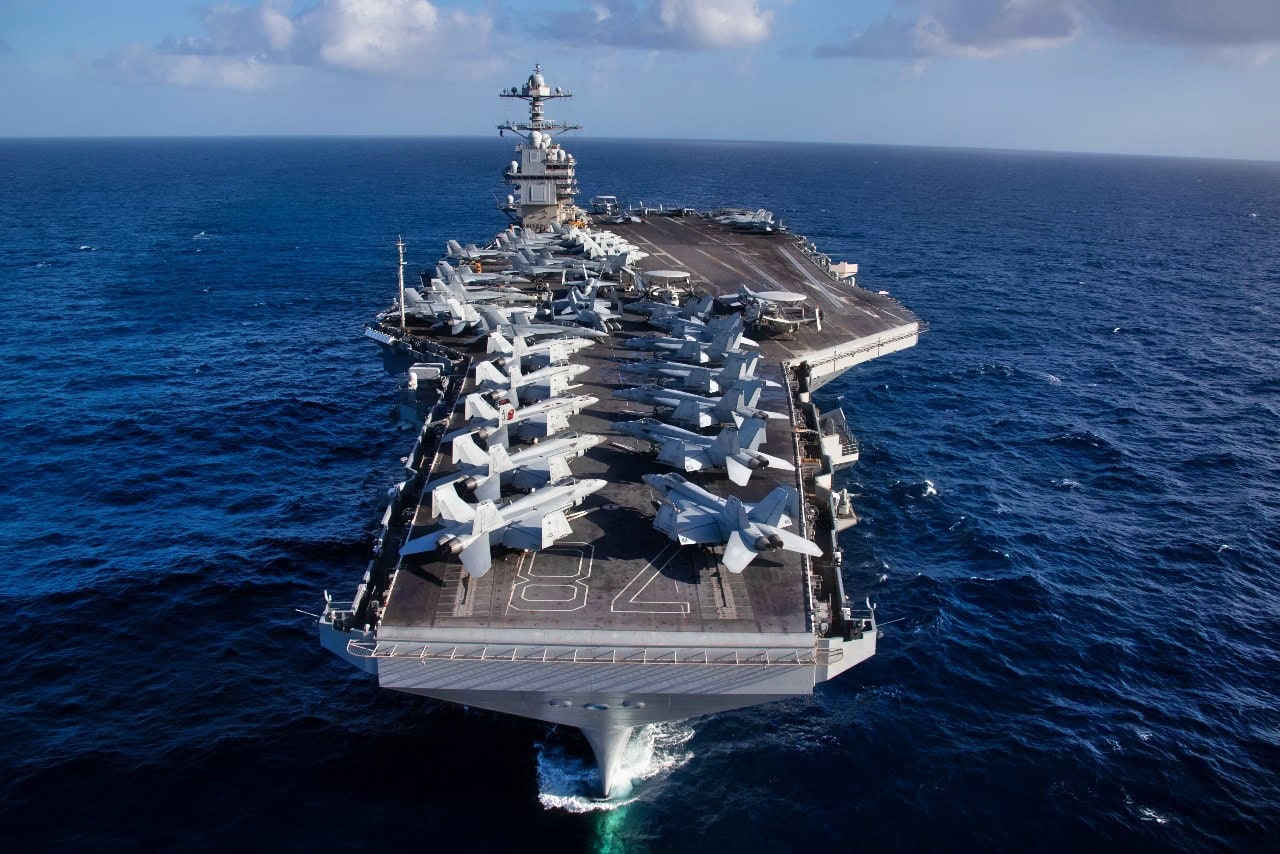
The world’s largest aircraft carrier USS Gerald R. Ford (CVN 78), steams in the Mediterranean Sea, Dec. 24, 2023. The Gerald R. Ford Carrier Strike Group is currently operating in the Mediterranean Sea. The U.S. maintains forward-deployed, ready, and postured forces to deter aggression and support security and stability around the world. (U.S. Navy photo by Mass Communication Specialist 2nd Class Jacob Mattingly)
When extended deployments throw off planned maintenance periods it affects the readiness of the entire fleet, not just the deployed ship. In the case of the Ford CSG, all of the ships will suffer from the lack of maintenance downtime. According to RAND, “Similar solutions with similar problems arise for nearly all elements of readiness, creating a spiral that becomes increasingly difficult to reverse. The impacts can rapidly cascade into persistent problems for force development, threatening the Navy’s ability to meet projected wartime surge needs.”
While necessary for global commitments, these disruptions challenge the Navy’s ability to sustain a forward presence and meet wartime surge requirements.
Navy Redirecting the USS Abraham Lincoln To The Gulf
The Pentagon has redirected the USS Abraham Lincoln Carrier Strike Group from the South China Sea to the Middle East. It is expected to take a week for the CSG to get there.
The USS Abraham Lincoln (CVN-72), the fifth Nimitz-class nuclear-powered supercarrier, last week conducted live-fire exercises and a replenishment-at-sea as part of ongoing routine operations since its deployment began in November.
About the Author: Steve Balestrieri
Steve Balestrieri is a National Security Columnist. He served as a US Army Special Forces NCO and Warrant Officer. In addition to writing on defense, he covers the NFL for PatsFans.com and is a member of the Pro Football Writers of America (PFWA). His work was regularly featured in many military publications