
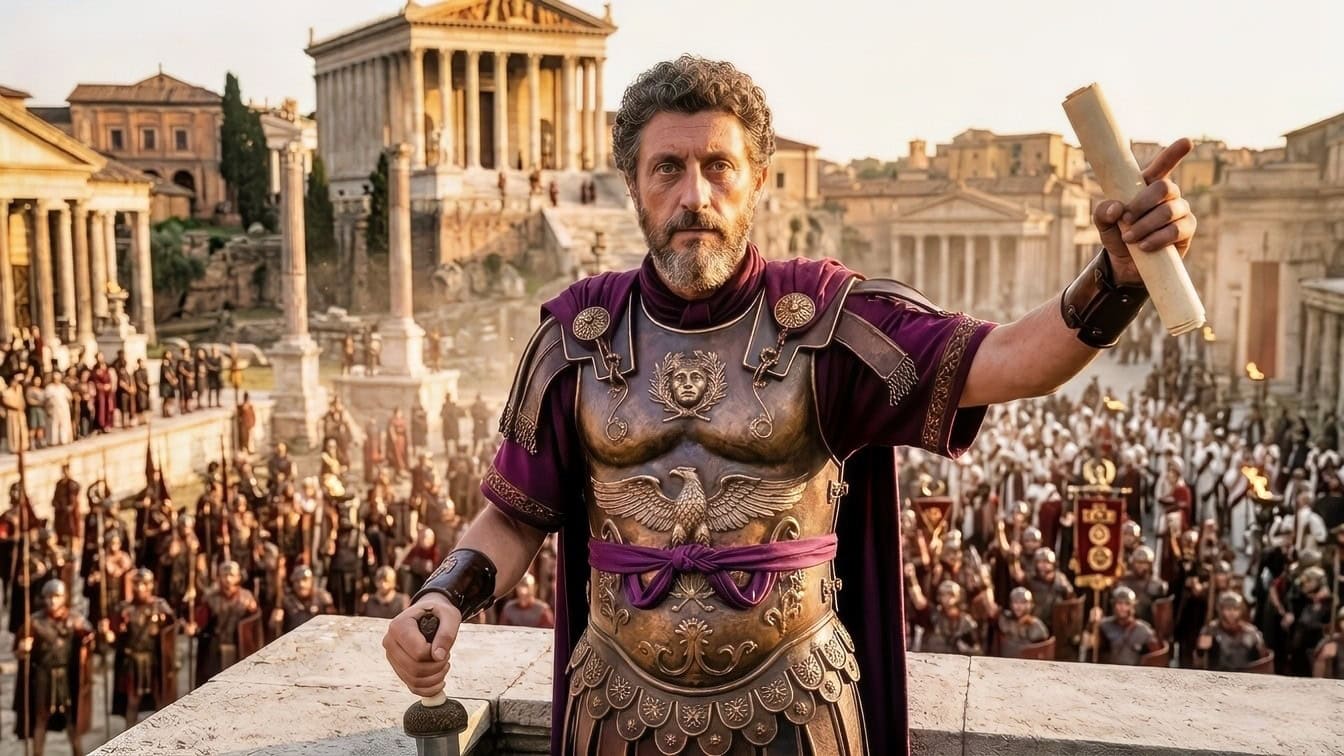
“If you are distressed by anything external, the pain is not due to the thing itself, but to your estimate of it; and this you have the power to revoke at any moment.” – Marcus Aurelius
General Marcus Aurelius: One of the Best Emperors of Rome?
Marcus Aurelius Antoninus was the Roman Marcus Aureliusemperor from 161 to 180 A.D., and a leading Stoic philosopher.
According to a History Channel biography of the late emperor, he was born to a powerful family.
“Growing up, Marcus Aurelius was a dedicated student, learning Latin and Greek. But his greatest intellectual interest was Stoicism, a philosophy that emphasized fate, reason, and self-restraint,” the biography said. “Discourses, written by a former slave and Stoic philosopher, Epictetus, had a great deal of influence over Marcus Aurelius.”
As a teenager, Marcus Aurelius moved into politics, first as the leader of the senate, serving as counsel to Antoninus, his adoptive father and predecessor as emperor. He first ruled alongside his brother, Lucius Aurelius Verus Augustus, until Verus died in 169, leaving Marcus Aurelius to rule alone for the next 11 years.
“While once again battling the German tribes, Marcus Aurelius made his son Commodus his co-ruler in 177. Together, they fought the northern enemies of the empire. Marcus Aurelius even hoped to extend the empire’s borders through this conflict,” the History Channel biography said.
However, Marcus Aurelius died three years later, in 180, and Commodus became his successor.
Where He Ranks
When historians and Roman Empire enthusiasts publish rankings of the Roman emperors, Marcus Aurelius tends to place highly. One History Channel ranking places Marcus Aurelius eighth, behind only Julius Caesar, Caesar Augustus, Tiberius, Vespasian, Trajan, Hadrian, and Antoninus Pius.
This ranking, by the University of Pennsylvania, ranks Marcus Aurelius very highly among emperors, noting that Marcus Aurelius was “marked out to be emperor during the reign of Hadrian, and rose to power without a trail of murder behind him.” He is given a final grade of “A,” described as “a philosopher-king that Plato would have loved, but perhaps overrated?”
Marcus Aurelius has also been described as one of the “five good emperors,” along with his predecessors Nerva (96-98), Trajan (98-117), Hadrian (117-138), and Antoninus Pius (138-161).
In the 2000 movie “Gladiator,” which is not known for adhering closely to historical accuracy, Richard Harris played Marcus Aurelius, while Joaquin Phoenix played his son and successor, Commodus.
Marcus Aurelius was not, as in the movie, murdered by his son, while the film’s hero, Maximus, was not a real person.
Meditations
The emperor, per the History Channel biography, “is not best remembered for the wars he waged, but for his contemplative nature and his rule driven by reason.”
“Meditations” was a collection of Marcus Aurelius’ notes, written over the course of his time as emperor. Written in the form of a private diary, it is not considered likely that he ever intended for these writings to be published.
The Daily Stoic describes “Meditations” as “perhaps the only document of its kind ever made,” because it represents “the private thoughts of the world’s most powerful man giving advice to himself on how to make good on the responsibilities and obligations of his positions.”
As characterized by the Daily Stoic, Meditations consists of the emperor stopping nightly for spiritual exercises, described as “reminders designed to make him humble, patient, empathetic, generous, and strong in the face of whatever he was dealing with.”
The Stoic analysis sees the major themes of “Meditations” as “change, death, and the shortness of life; the role and importance of the rational mind and will; dealing with others and accepting their shortcomings; avoiding the chase for pleasure and fame; and living according to nature and fully accepting its course.”
The Daily Stoic noted that “Meditations” remains popular among political leaders to this day, with adherents including former President Bill Clinton, former Defense Secretary and General James Mattis, and Chinese leader Wen Jiabao.
“There is left to each of us, no matter how far defeat pierces, the unassailable wintry kingdom of Marcus Aurelius. . . . It is not outside, but within, and when all is lost, it stands fast,” author William Alexander Percy said of the volume, according to The Daily Stoic.
“Meditations” is available in various forms, including as a book and on many different websites.
The Quote
One well-known, and much-debated, quote from “Meditations” is the following:
“If you are distressed by anything external, the pain is not due to the thing itself, but to your estimate of it; and this you have the power to revoke at any moment.”
Per an analysis by Wildmind Meditation, this philosophy has its roots in Buddhism and Stoicism. This quotation, in particular, relates the pain to the response to it.
“We create distress in response to external events because of the way we interpret them. We don’t just witness events; we automatically create stories about them, based on our habitual tendencies. We assign meaning to them,” the Wildmind analysis says.
A discussion on the Stoicism subreddit in 2023 examined this quotation and asked whether it should apply to physical as well as emotional pain.
“I understand this and how it can help with negative thoughts or insults, but when it comes to real physical injuries, I’m stumped, and I feel that this wouldn’t apply because you can’t control how your neurons react,” one participant in the forum asked. “So am I wrong and taking this quote too literally, or does it not apply when it’s physical pain because you can’t control them?”
About the Author: Stephen Silver
Stephen Silver is an award-winning journalist, essayist, and film critic, and contributor to the Philadelphia Inquirer, the Jewish Telegraphic Agency, Broad Street Review, and Splice Today. The co-founder of the Philadelphia Film Critics Circle, Stephen lives in suburban Philadelphia with his wife and two sons. For over a decade, Stephen has authored thousands of articles that focus on politics, national security, technology, and the economy. Follow him on X (formerly Twitter) at @StephenSilver, and subscribe to his Substack newsletter.