
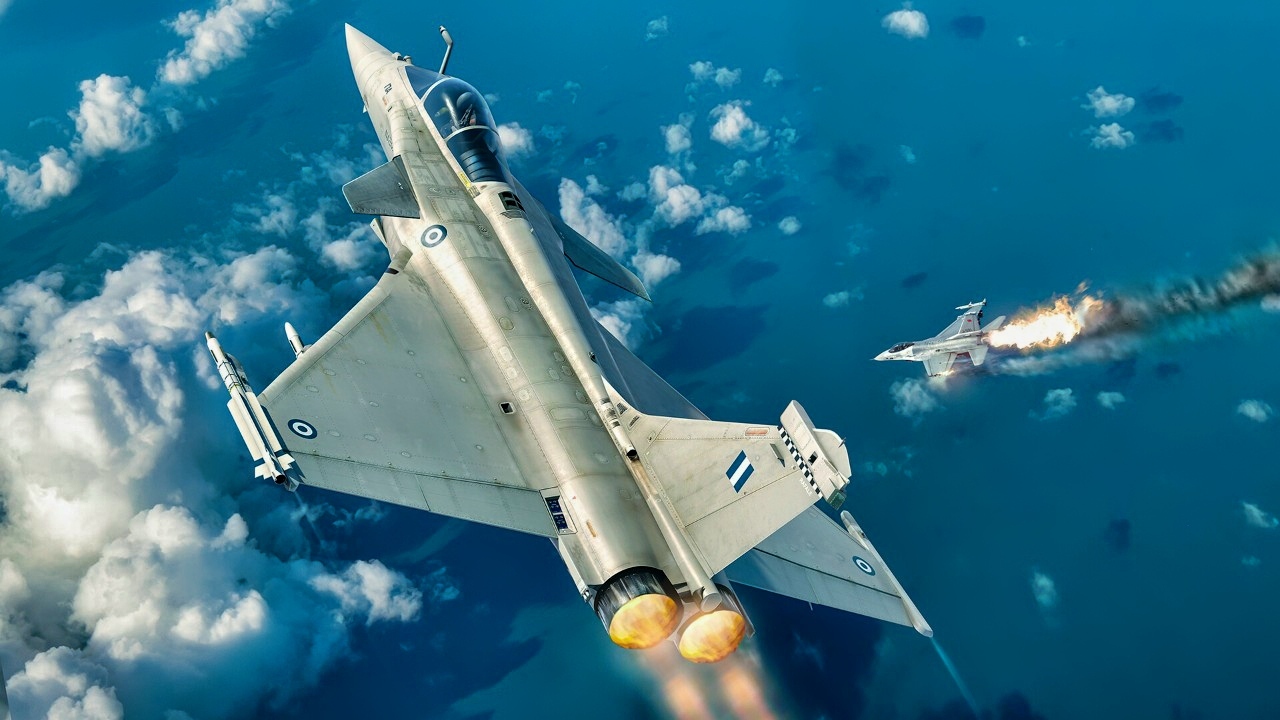
Dassault Aviation is arguably the most famous and successful name in French military aviation history (in fairness, it’s also made its fair share of civilian aircraft too, though it’s not as famous as Airbus in that arena), and the Rafale (“gust of wind”) fighter series is its latest & greatest product line. Like the Eurofighter Typhoon (itself also a product of France, albeit in a multinational intracontinental consortium with the United Kingdom, Italy, and Germany), it is a 4.5 Generation jet fighter, without true stealth capability. So then, how does the Rafale remain relevant in this day & age of 5th-generation stealth fighters, and how did it come into existence in the first place?
Roots of the Dassault Rafale
Back in the 1970s, the French Navy (Marine nationale) and the French Air Force (Armée de l’air) alike were in need of a new multirole fighter capable of handling the stresses of many different missions, including carrier-based operations.
Given Dassault’s proven track record of building warbirds (such as the Mirage series), the firm was a natural choice to do its country’s bidding (contracting pun intended).
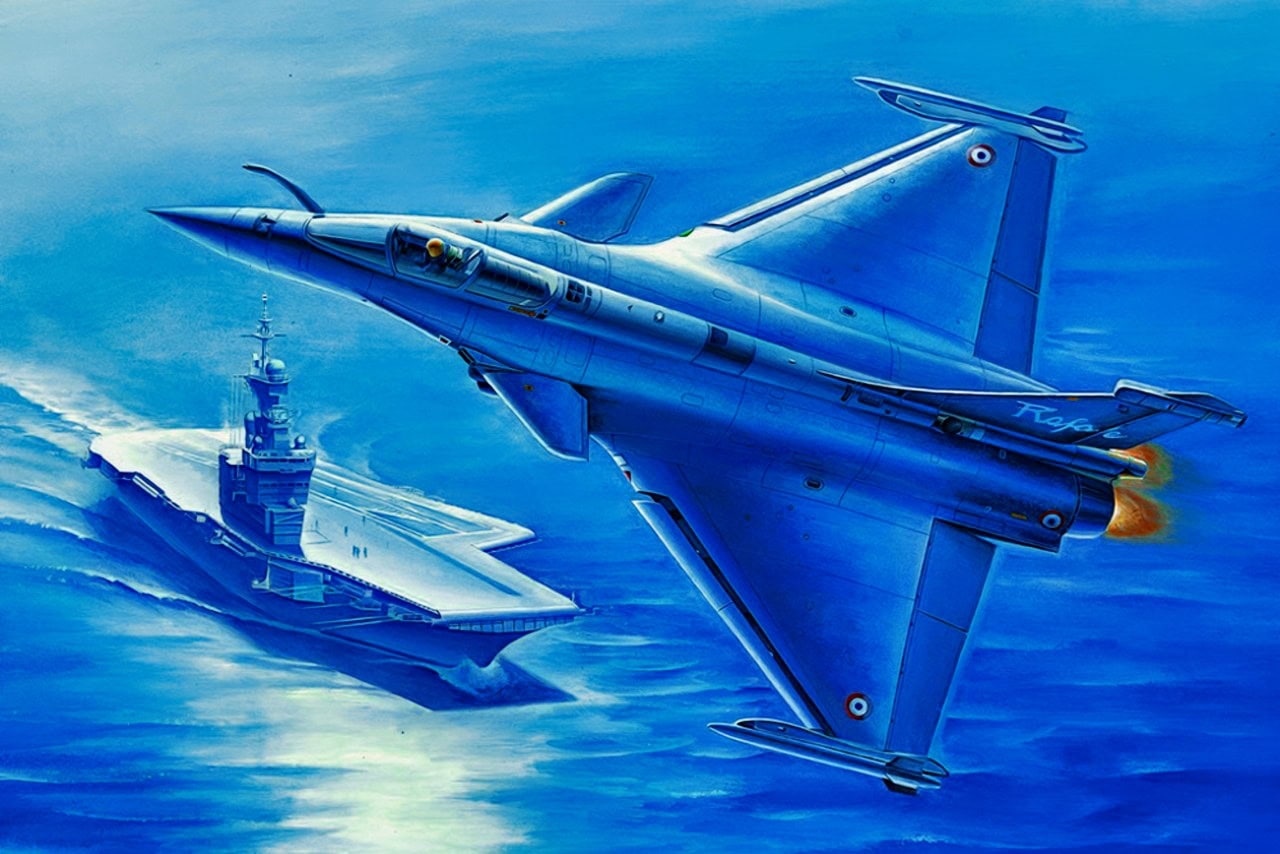
Dassault Rafale Fighter. Image Credit: Creative Commons.

Dassault Rafale Fighter. Image Credit: Creative Commons.
Fast-forward to 1983—at a time when just plain 4th Generation (as opposed to 4.5 Generation) fighters like the F-14 Tomcat, F-15 Eagle, and MiG-29 “Fulcrum” ruled the roost (and Gen 3 warbirds like the Phantom were still also very much in the picture)—the French government had officially given the program the green light, naming the initiative the “Future European Fighter Aircraft” (FEFA).
FEFA would bring together the aerospace engineering talents of France, Italy, Spain, West Germany (remember, this was in the midst of the Cold War, i.e., prior to the fall of the Berlin Wall and subsequent German reunification), and Great Britain design teams, which all held slightly different requirements for the aircraft. As already noted, the French needed a lightweight aircraft that could serve both Air Force and Navy roles, whilst the Brits also mandated that the jet serve as a long-range interceptor.
In 1985, Dassault decided to break away from FEFA, hastening that program’s collapse (though, as already indicated, France would still go on to collaborate with the UK, Germany, and Italy to produce the Eurofighter). Instead, the time-honored aerospace firm “flew solo” (metaphorically speaking) to concentrate on developing the Rafale instead.
Accordingly, the Rafale A made its maiden flight on July 4, 1986. However, the warbird still had to undergo an extensive testing regime, thus delaying its entry into official operational service with the French Navy and Air Force until 2004 and 2006, respectively (long after the Cold War had finally ended).
Retaining Dassault Rafale Relevance: Current and Future Upgrades
The F4 and F5 Standards of the Rafale (not to be semantically confused with the American-made 3rd Generation F-4 Phantom II and F-5 Tiger II fighter jets) are somewhat along the lines of the “Super Typhoon,” not to mention the “Super” F-22 and the “Ferrari” F-35 in terms of technological capabilities, and definitely. The F4 standard is the most current, operational upgrade, whilst the F5 standard is the wave of the future.
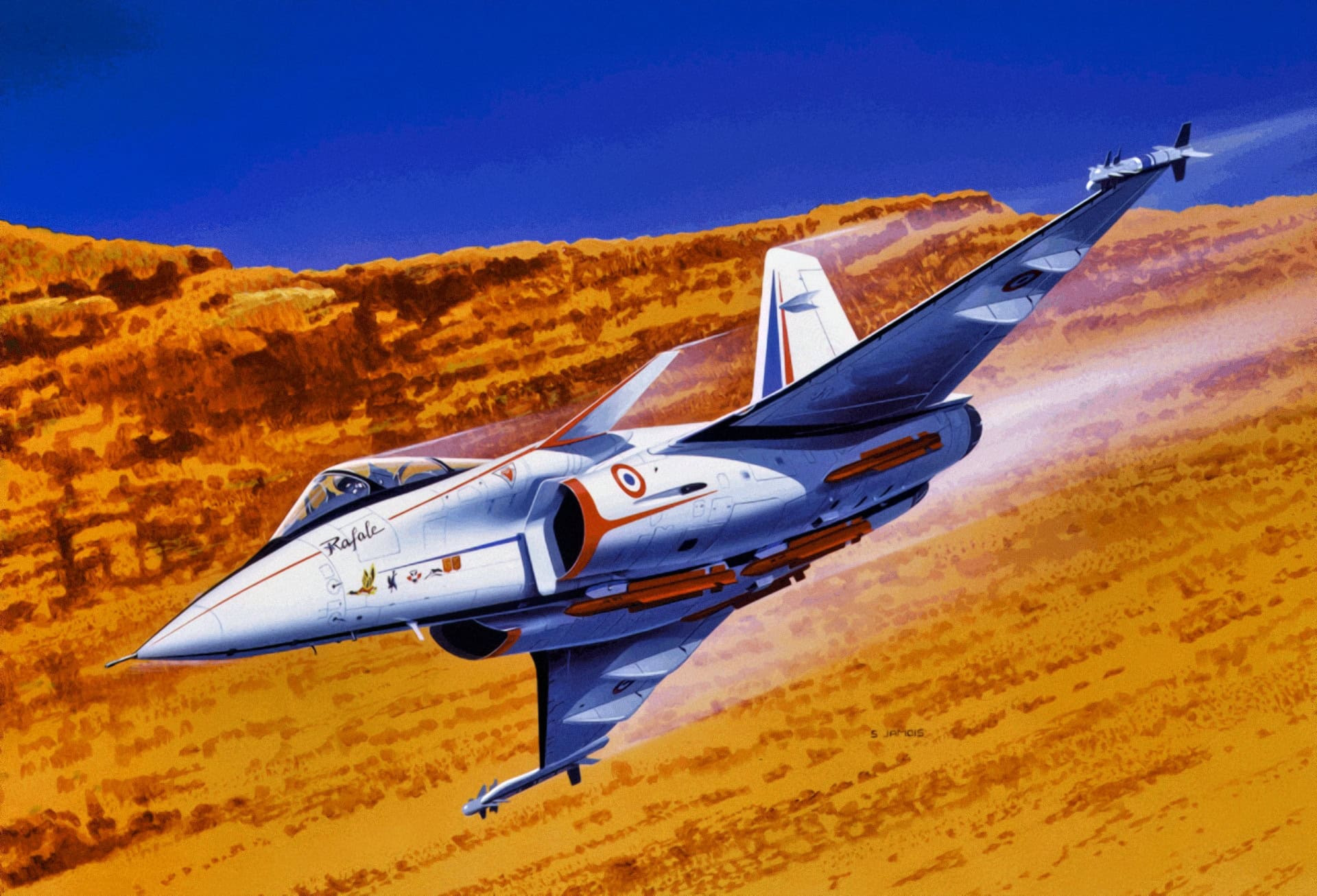
Dassault Rafale Artist Image. Image Credit: Creative Commons.
To elaborate further:
-F4: Attaining full operational status back in 2024, the F4 significantly enhances the Rafale’s connectivity and targeting precision.
Major additions include the Thales RBE2 XG [AESA] radar and improved helmet-mounted displays, designed to increase pilot situational awareness and streamline target acquisition.
There are also improved data fusion capabilities, enabling more seamless interoperability with French and allied forces (e.g., NATO). Armament packages are also upgraded through the integration of the 1000 kg AASM-guided bomb, designed for precision strikes on high-value targets (HVTs).
Put together, these capabilities allow the Rafale F4 to excel in multi-role missions, from air-to-air engagements to precision ground strikes, with the versatility required for both naval and air force deployment.
NOTE: “AASM” stands for “Armement Air-Sol Modulaire (Modular Air-to-Ground Armament); also known as the “Hammer” (yet another acronym, believe it or not, i.e., “Highly Agile Modular Munition Extended Range”), the weapon has been in service since 2007 and is built by Safran Electronics & Defense (headquartered in Boulogne-Billancourt, France).
What’s more, there’s also the subvariant F4.1 model, which will provide a range of upgrades and additional capabilities, including the integration of the new helmet sight, improved fire control for use with the so-called “no-escape” Meteor missile, expanded passive threat detections, and boosted datalink exchange. This is slated for deliveries beginning in 2027.
-F5: This version is scheduled for introduction post-2033 and will redefine the Rafale’s combat role with a focus on collaborative drone operations.
It will involve the addition of an Unmanned Combat Aerial Vehicle (UCAV), likely based on the stealth nEUROn demonstrator program…This ‘loyal wingman’ UCAV will act as an advanced sensor and combat adjunct, capable of performing reconnaissance and penetrating heavily defended areas ahead of the manned aircraft.
It will also support electronic warfare, allowing the Rafale to avoid direct engagement with high-threat air defenses, thereby enhancing survivability and strike precision under intense operational conditions (despite the lack of stealth).
This innovation aligns with the French Military Programming Law’s mandate to build network-centric air combat capabilities as a prelude to the Future Combat Air System (FCAS).
The F5 standard also aims to accommodate the ASN4G [Air-Sol Nucléaire de 4ème Génération] hypersonic missile, the next-generation nuclear deterrent to replace the current ASMPA [Air-Sol Moyenne Portée Amélioré], which underscores France’s commitment to maintaining a credible, advanced nuclear deterrent that can respond flexibly to evolving threats.
Speaking of 2033, Gen 6 fighters like the F-47 Next Generation Air Dominance (NGAD) will presumably be operational by then, but Dassault execs and engineers appear undeterred by this prospect.
Dassault Rafale Fighter. Image Credit: Creative Commons.
Reaping the Rewards of Relevancy
The F4 upgrades, in particular, have indeed resulted in a foreign military sales (FMS) windfall for Dassault Aviation (and, by logical extension, the French government’s tax coffers).
As noted by Richard Thomas in a January 16, 2025, article for Airforce Technology titled “Dassault outlines Rafale deliveries as France eyes upgrades,” the aerospace firm delivered 21 Rafale airframes in 2024, compared to 13 aircraft in 2023; breaking that down further, 14 specimens were for domestic use in 2024, whilst seven were earmarked for export.
Contrast this with 11 Rafales delivered to the French armed forces in 2023, and a measly deux (two) provided to foreign buyers. In other words, Dassault saw a whopping 350 percent increase in FMS transactions from one year to the next.
The laundry list of FMS customers of the Rafale includes Croatia, Egypt, Greece, India, Indonesia, Qatar, and the United Arab Emirates (UAE).
About the Author: Christian D. Orr
Christian D. Orr is a Senior Defense Editor. He is a former Air Force Security Forces officer, Federal law enforcement officer, and private military contractor (with assignments worked in Iraq, the United Arab Emirates, Kosovo, Japan, Germany, and the Pentagon). Chris holds a B.A. in International Relations from the University of Southern California (USC) and an M.A. in Intelligence Studies (with a concentration in Terrorism Studies) from American Military University (AMU). He is also the author of the book “Five Decades of a Fabulous Firearm: Celebrating the 50th Anniversary of the Beretta 92 Pistol Series,” the second edition of which was recently published.