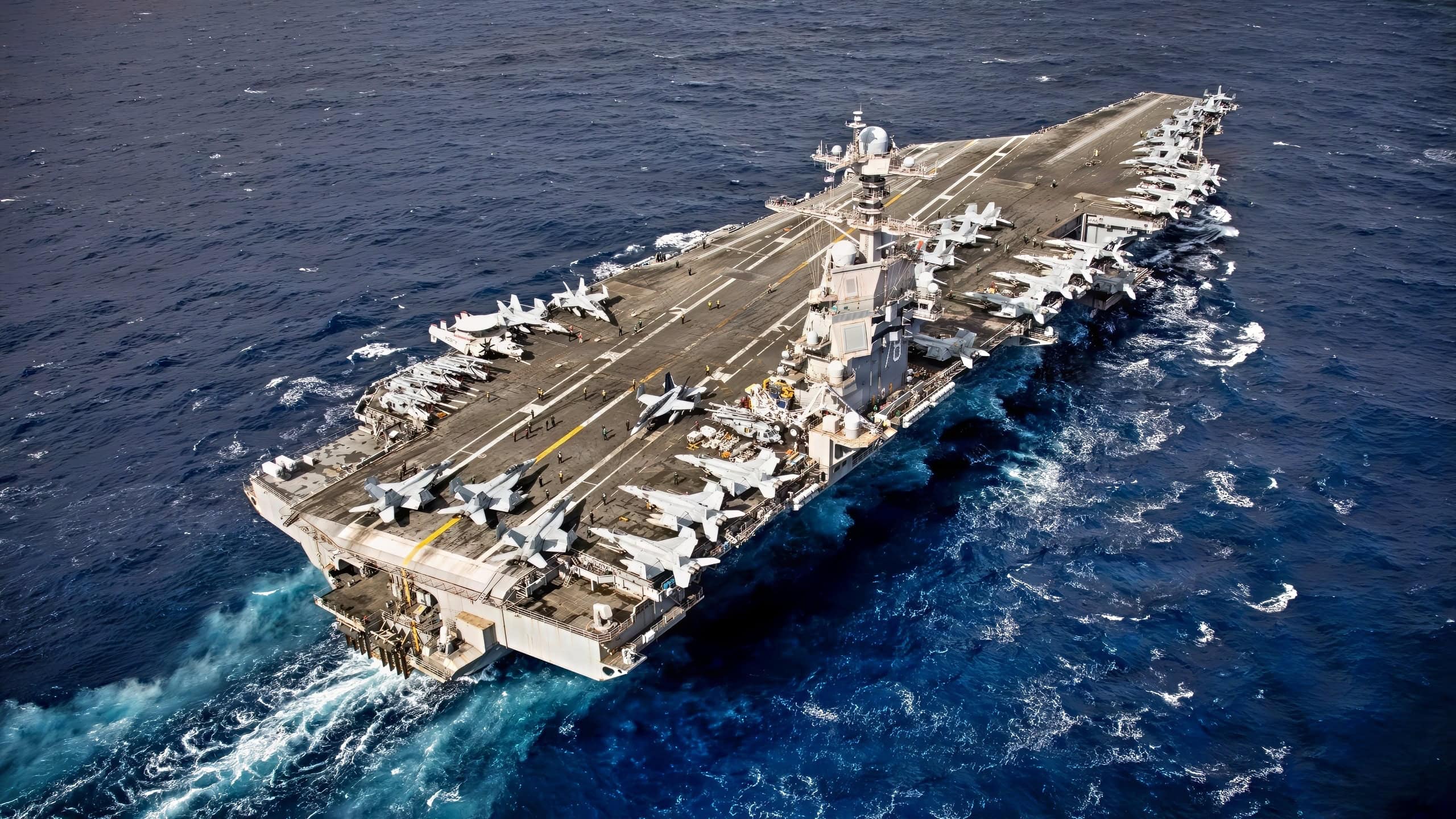
America’s newest, most advanced aircraft carrier, the USS Gerald R. Ford, has just completed the longest carrier deployment in the modern era…and keeps going. It was also one of the most controversial. Plagued by sewage problems and damaged by an alleged laundry fire that rendered parts of the crew quarters unlivable, the massive carrier has been at sea for nearly 300 days. Ford has now surpassed the post-Vietnam record previously set by the USS Abraham Lincoln in 2020 to become the longest carrier deployment since 1973.
The deployment of the great ship could stretch to around 11 months total.
The previous Vietnam-era record for the USS Midway was around 333 days. Given the ongoing crisis in the Middle East, along with the reluctance of the Pentagon to bring the troubled carrier (and its exhausted crew) home after that much time at sea, it only indicates that the Ford will likely surpass the Midway’s Vietnam War record.
A Globe-Spanning Mission Across Multiple War Zones
Essentially, the Ford has circled the globe, visiting the planet’s conflict zones since June 2025. Its initial deployment from Norfolk saw it head to the European theater, where it conducted NATO defense exercises in the North Sea (and was shadowed by an advanced Russian submarine armed with hypersonic missiles).
The Ford went to the Mediterranean Sea and conducted deterrence patrols. From there, she was sent to backstop the Trump administration’s successful raid on Caracas, Venezuela, that resulted in the arrest of Venezuelan dictator Nicolas Maduro.
After that, most believed the Trump administration would have brought the ship home. Instead, she was deployed to the Middle East to assist in the Iran War.
Mechanical Failures and Operational Strain
Despite its globe-trotting and record-setting, though, the carrier did not perform as well as one would expect a brand new carrier–the first of her class–that cost $13 billion to perform. As noted above, she struggled through chronic sewage and toilet system failures. The carrier experienced a devastating laundry-room fire that injured sailors and displaced hundreds of personnel from their living quarters. Then, maintenance delays and repairs in Croatia and Greece complicated the ship’s ability to operate at combat readiness.
This deployment exposed reliability and sustainment issues on the Navy’s most advanced carrier that should never have occurred, given the vessel’s cost and newness.
The Human Cost: Crew Exhaustion and Burnout
What’s more, the human cost is the real concern. After all, no ship can operate at full potential if its crew is exhausted and broken from being over-deployed. A crew of 4,000-5,000 sailors, deployed on a broken ship for nearly 11 months at sea, is not combat-ready.
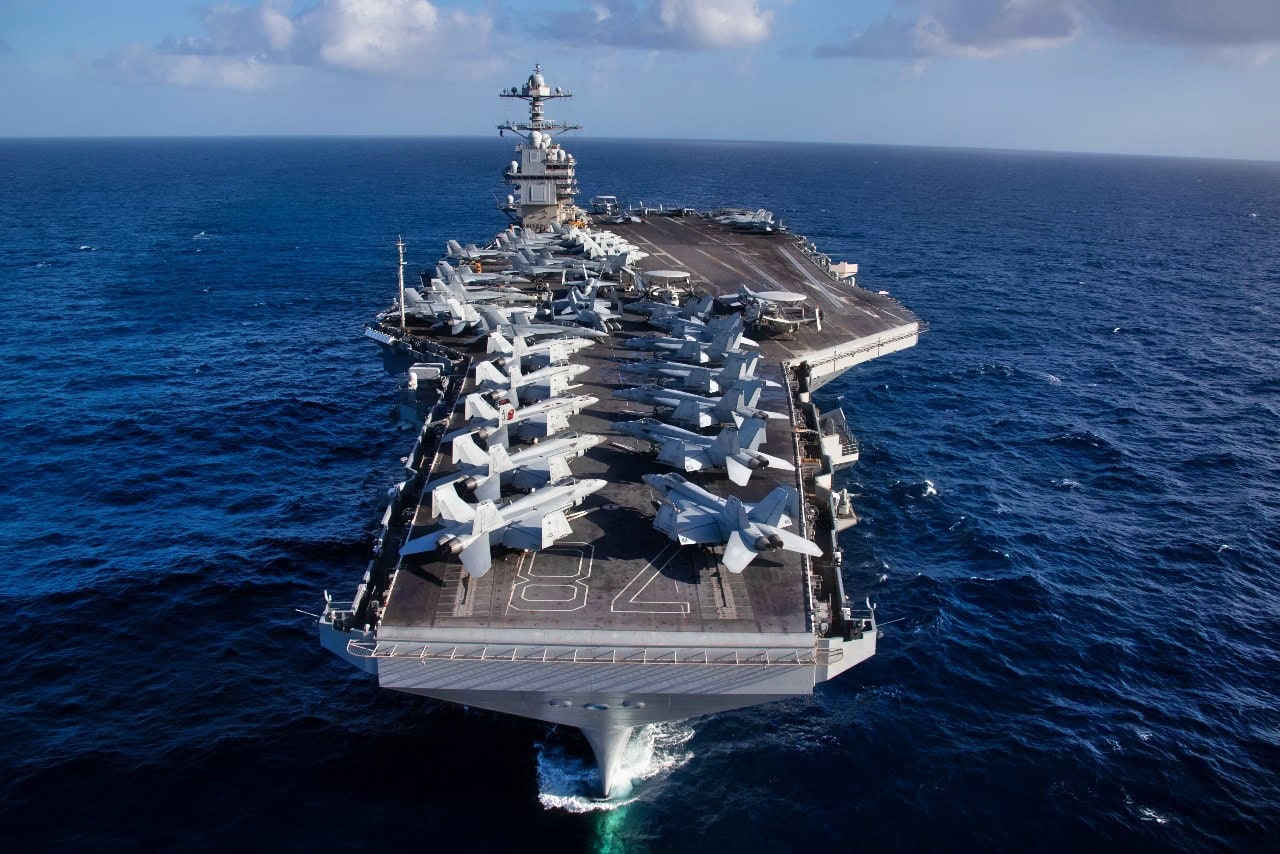
The world’s largest aircraft carrier USS Gerald R. Ford (CVN 78), steams in the Mediterranean Sea, Dec. 24, 2023. The Gerald R. Ford Carrier Strike Group is currently operating in the Mediterranean Sea. The U.S. maintains forward-deployed, ready, and postured forces to deter aggression and support security and stability around the world. (U.S. Navy photo by Mass Communication Specialist 2nd Class Jacob Mattingly)
Plus, that crew has had limited downtime and repeated mission extensions, which have added to the exhaustion of those on board. These events have all led to various concerns over mental health strain, family separation stress, and fatigue from what are high-tempo combat operations.
Multiple American lawmakers have even flagged this as a significant point of concern.
So, the Navy is experiencing both a force management problem and an individual ship problem. The nightmare deployment of the Ford has shown the world how strained the US Navy’s primary surface warfare asset, the aircraft carrier, has been, stretched to its breaking point. America’s rivals, notably China, are taking copious notes about that strain.
USS Gerald R. Ford and A Navy Stretched Too Thin
By having a single carrier doing multi-theater crisis response, the world sees that the Navy lacks sufficient carriers to handle the variety of strategic crises currently afflicting the world. Whether those in Washington want to admit it or not, just because the Navy technically has 11 aircraft carriers in its fleet, maybe four are ready for deployment–barely–at any one time. And the cost of maintaining these juggernauts and keeping them crewed is onerous, especially given the current budgetary environment the United States finds itself mired in.
One might think a reduction in US military commitments abroad would do the trick. It certainly would. But, not even the Trump administration has managed to extricate itself from the commitments imposed upon it by previous administrations and Congresses.
So, that carrier shortage becomes even more pronounced.

Aircraft Carrier USS Gerald R. Ford Diagram. Image Credit: Creative Commons.
Deferred Maintenance, Recruitment Risks, and a Breaking Force
These long-term deployments mean that maintenance on the carriers, even a new one like the Ford, is deferred. That only compounds whatever mechanical issues arise during the normal course of the ship’s functioning.
Then there are crew burnout issues that negatively impact combat readiness. What’s more, these repeated, long-term deployments under the strain the Ford has experienced lead to personnel retention risks.
There has already been a recruitment crisis in the US military. The Trump administration had started to address this problem.
Yet many sailors from the Ford have been quoted on background in multiple press accounts, saying they are not interested in reenlisting in the Navy after their experiences over the last year. Many had missed family events, births of children, deaths of loved ones, because their deployments were (unexpectedly) extended, mostly due to the force planning crisis in the US Navy’s fleet.
No Relief in Sight
Even with all the damage incurred and the psychological strain inflicted upon the Ford’s beleaguered crew, there is no indication that the Trump administration intends to relieve the carrier anytime soon.
Yes, the Trump administration is sending George H.W. Bush to the Middle East. Yet no one knows whether she will replace the Ford or the Abraham Lincoln (which has been on station longer), or simply augment the two carriers while the Mideast crisis among the United States, Israel, and Iran continues.
It is very unlikely that the Ford is totally combat-ready, given the crew exhaustion alone. Add in the aforementioned damage from the sewage failure and the supposed laundry fire, and the ship is in bad condition.
What this indicates is that the United States Navy is running its most important assets–carriers–harder, longer, and across more theaters than at any time since the Cold War.
Unlike the Cold War, however, the Navy is struggling to sustain them, and it is impacting both readiness and the force posture itself–all as an even larger war looms closer.
About the Author: Brandon J. Weichert
Brandon J. Weichert is the Senior National Security Editor at 19FortyFive.com. Recently, Weichert became the editor of the “NatSec Guy” section at Emerald.TV. He was previously the senior national security editor at The National Interest. Weichert is the host of The National Security Hour on iHeartRadio, where he discusses national security policy every Wednesday at 8pm Eastern. He hosts a companion show on Rumble entitled “National Security Talk.” Weichert consults regularly with various government institutions and private organizations on geopolitical issues. His writings have appeared in numerous publications, among them Popular Mechanics, National Review, MSN, and The American Spectator. And his books include Winning Space: How America Remains a Superpower, Biohacked: China’s Race to Control Life, and The Shadow War: Iran’s Quest for Supremacy. Weichert’s newest book, A Disaster of Our Own Making: How the West Lost Ukraine, is available for purchase wherever books are sold. He can be followed via Twitter/X @WeTheBrandon.